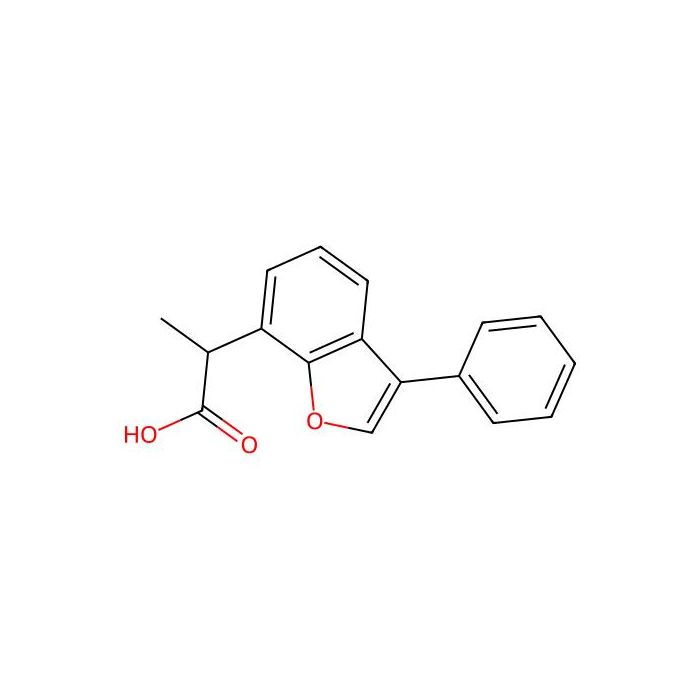
Furaprofen (R803) is an effective HCV replication inhibitor. Furaprofen (R803) is substantially more potent against genotype 1a and 1b replicons ( EC 50 , ~30 nM) than against the genotype 2a replicon (EC 50 , ~1,000 nM).
In Vitro
Furaprofen (R803) is potent and highly specific for HCV replication. The antiviral activity of Furaprofen has been determined by a reporter replicon assay with multiple repeats to be 29.88±8.05 nM, an ~3-fold improvement over the activity of the parent compound, R706. The potency of Furaprofen against the replicon is also confirmed by both Western blotting and TaqMan RT-PCR to be about 37 nM and 54.67±4.11 nM, respectively. To assess the general effect of Furaprofen on cell proliferation, a panel of primary cells and transformed human cell lines are treated with increasing doses of Furaprofen for 48 h, and the effect on cell proliferation is measured by an MTS-based cell viability assay. The the concentration that caused a 50% reduction in cell numbers in the absence of virus infection (CC 50 ) of Furaprofen is found to range from 2 μM to ≥10 μM, depending on the cell type and proliferation status. MCE has not independently confirmed the accuracy of these methods. They are for reference only.
Furaprofen (R803) is an effective HCV replication inhibitor. Furaprofen (R803) is substantially more potent against genotype 1a and 1b replicons ( EC 50 , ~30 nM) than against the genotype 2a replicon (EC 50 , ~1,000 nM).
Condizioni di conservazione di stoccaggio
Store at -20°C
Spedito in
Ice chest + Ice pads
Questo prodotto richiede spedizione a catena fredda. I servizi di terra e altri servizi economici non sono disponibili.
This compound belongs to the class of organic compounds known as phenylbenzofurans. These are organic aromatic compounds that contain a phenyl group attached to a benzofuran moiety. Benzofuran is a bicyclic compound containing a benzene fused to a furan.
External Descriptors
Not available
1. Djoumbou Feunang Y, Eisner R, Knox C, Chepelev L, Hastings J, Owen G, Fahy E, Steinbeck C, Subramanian S, Bolton E, Greiner R, and Wishart DS. ClassyFire: Automated Chemical Classification With A Comprehensive, Computable Taxonomy. Journal of Cheminformatics, 2016, 8:61.
Certificati (CoA, COO, BSE/TSE e tabella di analisi)
C of A & Other Certificates(BSE/TSE, COO):
Analytical Chart:
Proprietà chimiche e fisiche
Solubilità
DMSO : 250 mg/mL (938.83 mM; Need ultrasonic)
Peso molecolare
266.29
XLogP3
4.000
Hydrogen Bond Donor Count
1
Hydrogen Bond Acceptor Count
3
Rotatable Bond Count
3
Exact Mass
266.094 Da
Monoisotopic Mass
266.094 Da
Topological Polar Surface Area
50.400 Ų
Heavy Atom Count
20
Formal Charge
0
Complexity
348.000
Isotope Atom Count
0
Defined Atom Stereocenter Count
0
Undefined Atom Stereocenter Count
1
Defined Bond Stereocenter Count
0
Undefined Bond Stereocenter Count
0
The total count of all stereochemical bonds
0
Covalently-Bonded Unit Count
1
Calcolatori di soluzioni
Molarity Calculator
Determine the necessary mass, volume, or concentration for preparing a solution.
Dilution Calculator
Determine the dilution needed to prepare a stock solution.
Reconstitution Calculator
Recensioni
Recensioni dei clienti
Application Protocols
No tested application protocols are provided for this item. The following generic procedures are commonly used for small‑molecule library members; adapt and validate for your system.
Preparation of DMSO stock: Weigh compound quickly at room temperature, minimize exposure to ambient humidity. Dissolve to 10–50 mM in anhydrous DMSO, vortex/sonicate. Filter through 0.22 µm PTFE if needed. Aliquot into amber vials, flush headspace with inert gas if stability is unknown, and store at −20°C.
Aqueous assay dilution: Add the required volume of stock to pre‑equilibrated buffer under vigorous mixing to reach 0.1–1% final DMSO. Inspect for cloudiness/precipitation; if observed, increase mixing time, slightly raise temperature, or reduce final concentration.
LC–MS reference solution: Prepare 0.1–1.0 mg/mL in MeCN or MeOH with 0.1% formic acid (if positive‑mode MS) or 5 mM ammonium acetate (for neutral/negative mode). Store at 4°C short‑term; remake weekly.
Stability check: Incubate working solutions at assay temperature and sample at 0, 2, 6, 24 h by LC–MS to confirm absence of degradation or adsorption losses.
All protocols must be verified against the compound’s SDS/CoA and your institutional EHS guidelines.
Biological Roles
Item‑specific biological function, targets, or pathway roles are not provided for this product. No clinical or therapeutic claims are made or implied; this compound is supplied strictly for research use only.
General guidance for small‑molecule library members
Hypothesis testing: Use in biochemical or cellular systems to probe pathways, phenotypes, or target hypotheses. Any observed bioactivity should be treated as preliminary until confirmed with orthogonal assays and counter‑screens.
Polypharmacology awareness: Many small molecules interact with multiple targets at micromolar concentrations. Deconvolute activity using concentration–response curves, selectivity panels, and chemical analogs where available.
ADME profiling (research context): If biological experiments are planned, consider basic in vitro assessments (solubility, chemical stability in buffer and microsomes, plasma protein binding, PAMPA/Caco‑2 permeability) to contextualize assay outcomes.
Aggregation/artifacts: Screen for colloidal aggregation (e.g., detergent sensitivity, dynamic light scattering) and redox/fluorescence interference to reduce false positives in HTS.
Reporting and reproducibility
Record exact lot, stock solvent, concentration, and storage history. Provide full analytical characterization in supporting information when publishing results derived from this compound.
Buffer Applications
This product is not a buffering agent, and no item‑specific pKa or buffer capacity data are provided. However, many small molecules are handled in buffered assay media. Practical points:
Stock preparation: Dissolve the compound in DMSO (commonly 10–50 mM), then dilute into the working buffer immediately before use. Maintain final DMSO at 0.1–1% v/v to limit assay perturbation.
Common assay buffers: PBS, HEPES, or Tris‑buffered saline are typical; choose based on assay biology and temperature stability (HEPES is preferable for CO2‑independent systems).
Precipitation control: When diluting hydrophobic compounds into aqueous buffer, add the compound to vigorously mixed buffer, optionally containing 0.01–0.05% nonionic surfactant if assay‑compatible, to avoid local supersaturation.
Adsorption mitigation: Use low‑bind tubes/plates; include carrier protein (e.g., 0.1% BSA) if compatible, to reduce losses for sticky compounds.
pH sensitivity: If the compound ionizes, assay pH can affect apparent potency/solubility. Perform pH robustness checks over ±0.5 units around your target pH.
For precise buffer recipes, ionic strengths, and pH control, consult standard biochemical references. Always verify that the compound remains in solution and chemically stable over assay time.
Green Alternatives
This product is a target compound (not a process solvent). “Green alternatives” therefore focus on greener handling, dissolution, purification, and waste practices rather than substituting the compound itself.
Greener solvent choices (general guidance)
Dissolution for stocks: Prefer water or aqueous buffer when feasible. If organic is required, consider MeOH or EtOH over DMF/NMP. 2‑MeTHF or ethyl acetate can replace chlorinated solvents in some workflows.
Chromatography: For normal‑phase, heptane/ethyl acetate is a lower‑toxicity alternative to hexane/DCM. For reverse‑phase, water/MeOH can often replace water/MeCN if resolution permits.
Workup/extractions: Ethyl acetate or MTBE may replace DCM/CHCl3; ensure partitioning remains acceptable.
Process considerations
Minimize DMSO usage by preparing the highest concentration compatible with your assay to reduce solvent volume in waste streams.
Use microscale scouting to avoid unnecessary reagent/solvent consumption.
Adopt closed‑cap LC vials and amberware to reduce evaporative losses and photodegradation, enhancing material longevity and reducing re‑prep.
Trade‑offs
MeOH/EtOH are greener but may alter assay sensitivity or elution order versus MeCN; validate before full deployment.
Ethyl acetate and 2‑MeTHF have different evaporation rates and polarity indices than DCM; method adjustments may be required.
Document any method changes and verify that analytical performance (resolution, signal‑to‑noise, recovery) remains acceptable.
Pharmaceutical Uses
Item‑specific pharmacopeial status, excipient roles, or formulation uses are not provided. This material is supplied for research use only and is not intended for human or veterinary applications.
Reference standard: May be used to develop and validate analytical methods (e.g., HPLC/UPLC, LC–MS) in a preclinical research setting.
Preformulation screening: If investigating as a research tool compound, assess solubility across pH, pKa (if known), solid‑state form (XRPD/DSC/TGA), and stability (hydrolysis/oxidation/photolysis) to inform vehicle selection.
Vehicles for in vivo research (non‑clinical): Where institutionally approved, typical vehicles include PEG400/saline, Captisol solutions, or aqueous buffers with controlled percentages of DMSO/EtOH/solubilizers. Ensure IACUC and EHS approvals and compound‑specific stability before use.
Salt/ prodrug strategy: If the compound contains ionizable groups, salt screening can enhance solubility for research formulations; verify stoichiometry and stability.
Regulatory note
No compendial monograph or GMP status is claimed. Do not use in diagnostic or therapeutic contexts. For any regulated application, source GMP‑compliant material and full regulatory documentation.
Physical Properties
Item‑specific physical constants
Melting point (MP): Not specified for this item; refer to CoA/Spec Sheet.
Boiling point (BP): Not specified for this item; refer to CoA/Spec Sheet.
Density: Not specified for this item; refer to CoA/Spec Sheet.
Solubility (water/organic): Not specified for this item; refer to CoA/Spec Sheet.
LogP/logD, pKa, refractive index: Not specified for this item; refer to CoA/Spec Sheet.
Practical guidance (general/literature-informed, not item‑specific)
Solubility scouting: For small molecules of unknown polarity, screen a tiered panel—DMSO, DMF, MeCN, MeOH/EtOH, acetone, ethyl acetate, toluene, and PBS (with 0.5–1% DMSO if needed). Begin at 1–10 mg/mL.
Aqueous handling: If the compound is weakly acidic or basic, modest pH adjustment (±1 pH unit from neutrality) can drastically change solubility; perform small‑scale tests and avoid extreme pH unless stability is known.
Thermal behavior: If no MP is provided, use a micro‑MP apparatus or DSC to profile thermal events before scale‑up operations or formulation work.
Volatility and hygroscopicity: Absent data, assume low volatility but unknown hygroscopicity. Store tightly sealed under dry atmosphere and minimize open‑air exposure.
Spectral characterization: LC–MS, NMR, and, where relevant, IR/UV–Vis can be used to establish a baseline fingerprint for later stability or compatibility studies.
Always defer to the item’s SDS and lot CoA for definitive specifications and handling limits.
Quality and Grades
Item‑specific quality details
Grade/Purity: Not specified for this item; refer to CoA/Spec Sheet.
Appearance: Not specified for this item; refer to CoA/Spec Sheet.
Research Use: For research use only (per Product Data). Not for human or veterinary use.
How to interpret and verify quality (general guidance)
Certificate of Analysis (CoA): Review assay/purity methodology (e.g., HPLC/UPLC area%, LC–MS, GC) and thresholds; confirm lot number alignment with your documentation.
Identity confirmation: A combined approach (1H/13C NMR, HRMS/LC–MS) provides robust identity confirmation, especially important for screening compounds and reference standards.
Residual solvents and water: If Karl Fischer moisture or residual solvent limits are critical for your application (e.g., solid‑state screening, catalysis), request those data for the specific lot.
Stabilizers and form: If stabilizers, salts, or solvates are present, they should be declared on the CoA; these can meaningfully affect mass balance, solubility, and reactivity. For this item, no stabilizer or salt information is provided—verify on receipt.
UV profile (for analytical applications): If planning HPLC/UPLC detection by UV, obtain a UV spectrum or PDA scan to select optimal wavelengths and assess background absorbance; do not assume low-UV behavior without data.
Quality control on receipt
Perform a small verification check (e.g., LC–MS purity, melting point/thermal profile) before committing to critical experiments or large‑scale screenings.
Reaction and Applications
Item‑specific application notes are not provided. Given its classification within a small‑molecule/compound library, typical research uses include:
Screening and SAR: Use as a discrete chemical entity in biochemical or cell‑based assays to explore structure–activity relationships, potency ranking, or chemical genetics hypotheses.
Method development: Serve as a test article for developing analytical methods (HPLC/UPLC, LC–MS, stability‑indicating assays), including sample prep and extraction workflows.
Reference standard: Calibrate mass spectrometric response, retention time windows, or validate recovery in spiking experiments.
Materials and catalysis probes: In certain cases, small molecules are used to probe adsorption/partitioning in materials or to evaluate catalyst compatibility; verify chemical compatibility beforehand.
Practical tips (general)
Stock handling: Prepare concentrated DMSO stocks (e.g., 10–50 mM) in small aliquots to minimize freeze–thaw. Record exact mass, diluent, and final molarity.
Stability checks: Run a short isothermal stability study (e.g., 24–72 h at room temperature and 4°C in your chosen solvent) by LC–MS to detect degradation pathways.
Adsorption losses: Low‑solubility or moderately lipophilic compounds can adsorb to plastics; use low‑bind PP/HDPE or glass vials and add 0.01–0.1% surfactant (where assay‑compatible).
Photostability: If chromophores are suspected, protect from light (amber glass, foil) during assays and storage.
Always corroborate any literature‑derived use with the CoA/SDS for the specific lot.
Reaction Conditions
No item‑specific reaction conditions are provided, and the compound is offered as a finished small molecule rather than a reagent or catalyst. If chemical modification is contemplated, first confirm the structure and functional groups from the CoA/SDS, then consult the literature for conditions tailored to that scaffold and handle type.
General guidelines for condition scouting (when structure is known)
Solvent: Start with polar aprotic media (DMSO, DMF, MeCN) for coupling reactions; use anhydrous conditions where moisture‑sensitive steps are involved.
Temperature: Begin at ambient temperature; escalate in 10–20°C increments while monitoring by TLC or LC–MS. For sensitive scaffolds, consider microflow or microwave screening to minimize decomposition.
Catalysts/bases: Choose bases and catalysts matched to the functional handles (e.g., amide couplings with carbodiimides or HATU; cross‑couplings with Pd catalysts and appropriate ligands). Verify compatibility with any heteroaromatic motifs.
Atmosphere: Use inert gas (N2/Ar) if redox‑sensitive functional groups or metal catalysis are involved.
Workup: Quench cautiously and employ extraction systems compatible with the polarity of starting materials and products; consider solid‑phase scavengers to streamline purification.
These are general recommendations; adapt only after confirming the exact chemical structure.
Safety and Handling
GHS and hazard information (item‑specific)
Signal word: Not specified for this item; refer to SDS.
Hazard statements (H‑codes): Not specified for this item; refer to SDS.
GHS classification/pictograms: Not specified for this item; refer to SDS.
General laboratory precautions (not item‑specific)
PPE: Safety glasses, lab coat, and suitable chemically resistant gloves. Use in a fume hood to avoid inhalation of dusts/aerosols.
Avoid: Incompatible reagents are unknown; prudently avoid strong oxidizers/reductants, strong acids/bases, and reactive acylating/alkylating agents until compatibility is known.
First aid (overview): If inhaled—move to fresh air; if on skin—wash with soap and water; if in eyes—rinse cautiously with water for several minutes; if ingested—rinse mouth, seek medical advice. Provide the SDS to healthcare personnel.
Spill response: Contain solids with inert absorbent, avoid generating dust, and collect for disposal. Decontaminate surfaces with appropriate solvent, then detergent and water.
Fire safety: For organic solids, use CO2, dry chemical, or foam. Combustion may generate COx and other irritants—firefighters should wear SCBA.
Stability and storage
Storage (item‑specific): Store at −20°C (per Product Data). Keep tightly closed in the original container.
Shipping (item‑specific): Shipped cold (ice chest + ice pads) to preserve material integrity.
Always consult the product’s SDS for authoritative safety information and local regulatory requirements.
Solvent Selection
Item‑specific solvent preferences are not provided for this compound. The following general workflow is recommended for small molecules in screening libraries when solubility and stability are initially unknown.
Stock solutions for screening
DMSO first: Prepare a 10–50 mM DMSO stock if the compound dissolves readily at room temperature. Warm gently (≤40°C) and vortex/sonicate as needed. Filter (0.22 µm PTFE) if particles persist.
Alternative polar aprotic solvents: DMF or NMP can be used if DMSO stocks are unstable or if viscosity is a concern; verify assay compatibility.
Solubility scouting panel
Polar protic: MeOH, EtOH, i‑PrOH.
Polar aprotic: MeCN, acetone, ethyl acetate.
Nonpolar: toluene, MTBE, cyclohexane (for chromatographic method development rather than stocks).
Aqueous: PBS or assay buffer with 0.5–1% co‑solvent (DMSO/MeCN) to minimize precipitation during dilutions.
Selection considerations (general)
Assay compatibility: Minimize final DMSO to 0.1–1% v/v unless your assay tolerates higher levels; verify with controls.
Stability: Check for hydrolysis, oxidation, or photolysis in candidate solvents via short LC–MS time‑course. Amber vials and inert headspace help if sensitivity to light/air is suspected.
Purification and analytics: Reverse‑phase (water/MeCN/MeOH) is typical for LC. For normal‑phase chromatography, heptane/EtOAc or DCM/MeOH systems are common starting points.
Document solvent choice, concentration, and any observed precipitation to facilitate reproducibility.
Storage and Reconstitution
Storage conditions (item‑specific)
Store at −20°C (per Product Data). Maintain in the original, tightly sealed container. Protect from moisture and, if chromophoric, from light (amber vial or foil wrap).
Shipping: Provided in an ice chest with ice pads to preserve integrity during transit.
General best practices
Headspace and atmosphere: For materials of unknown air/moisture sensitivity, purge vial headspace with dry nitrogen or argon after each use. Include desiccant in secondary containment.
Aliquoting: Upon first opening, divide into small, single‑use aliquots to minimize freeze–thaw cycles and air exposure. Record mass, date, and storage location.
Primary solvent: DMSO is the preferred first‑line solvent for small molecules; warm gently (≤40°C) and sonicate to assist dissolution. If insoluble, trial DMF, MeCN, MeOH, or EtOH.
Aqueous use: Dilute DMSO stock into buffer immediately prior to use, maintaining low final organic content (0.1–1%). Verify that no precipitation occurs over the assay duration.
Filtration: If particulate matter is observed, pass solutions through 0.22 µm PTFE/NYL filters as compatible with solvent system.
Stability monitoring
Establish a baseline LC–MS/HPLC profile on receipt, and recheck periodically to ensure material integrity over storage.
Always defer to the CoA/SDS for lot‑specific stability, solubility, and reconstitution details.
Structure and Identity
Overview: This listing is for a small‑molecule compound supplied as part of a screening/compound library offering.
Item‑specific identifiers (from Product Data)
SKU: F646308
Product name: Furaprofen
CAS: 67700-30-5
PubChem CID: 37801
InChIKey: 255445 (as provided)
SMILES: Not specified for this item; refer to CoA/Spec Sheet.
Molecular formula: Not specified for this item; refer to CoA/Spec Sheet.
Molecular weight: Not specified for this item; refer to CoA/Spec Sheet.
Structural features
Functional groups, ring systems, and stereochemistry: Not specified for this item; refer to CoA/Spec Sheet. Without a provided structure, functional-group annotation and stereochemical description cannot be asserted.
Notes for users
Identity confirmation: For compounds sourced for screening, it is best practice to confirm identity and purity on receipt (e.g., LC–MS for exact mass and retention, 1H/13C NMR for structure, and, if relevant, chiral HPLC for enantiopurity).
Reference look‑ups: If additional structural metadata is needed, consult the SDS/Spec Sheet associated with this SKU, or look up the CAS (67700-30-5) and CID (37801) in authoritative databases, then reconcile with the CoA for this specific lot before reporting structural details in publications or registrations.
Synthetic Utility
Item‑specific functional groups and reactivity are not disclosed in the Product Data. Accordingly, no specific synthetic transformations can be recommended for this exact compound without first confirming structure from the CoA/SDS.
General considerations if derivatization is desired (research context)
Functional handle assessment: Use 1H/13C NMR, IR, and LC–MS to identify potential handles (e.g., alcohols, amines, carboxylic acids, halides, heteroarenes). Each suggests distinct diversification vectors (ester/amide formation, N‑acylation, cross‑coupling, late‑stage C–H functionalization, etc.).
Protecting‑group strategy: If multiple reactive sites are present, plan orthogonal protection to enable selective transformations. Validate stability of any sensitive motifs to acid/base, heat, and oxidants.
Parallel synthesis: For SAR building, employ split‑pool or plate‑based coupling (amide/urethane/Suzuki variants) once the core scaffold and handles are known.
Purification and analytics: Anticipate the need for reverse‑phase purification of polar/ionizable derivatives; establish MS‑triggered fraction collection and PDA monitoring.
Caution
Do not assume reactivity or compatibility with standard conditions until the exact structure is confirmed. Small differences in substitution or stereochemistry can lead to markedly different outcomes.
Target Specificity
Item‑specific biological target(s), binding constants, or selectivity profiles are not provided for this product. No claims are made regarding activity against any enzyme, receptor, ion channel, or other biomolecular target.
If target exploration is intended (research use only)
Primary assays: Employ orthogonal readouts to confirm activity (e.g., biochemical vs cell‑based) and build concentration–response relationships.
Selectivity panels: Use counter‑screens against related targets and common assay‑interference panels (redox, fluorescence quenchers, aggregators) to identify artifacts.
Mechanism of action: Consider kinetic analyses, competition experiments, or target engagement methods (CETSA, DARTS, SPR, ITC) when feasible.
Document all findings with explicit reference to this SKU/lot and the exact solvent/stock conditions used.
Domande frequenti
What is the purity of this product?
This product is supplied at ≥99% purity (chemical assay). Lot-specific values are stated on the Certificate of Analysis.
How should this product be stored?
Store at ?20 °C. Freezer storage is required to maintain the specified shelf life.
How is this product shipped?
This product ships in an insulated container with ice pads. Unpack on arrival and transfer it to the storage condition stated above.
What are the CAS number, molecular formula and molecular weight?
The CAS Number is 67700-30-5, the molecular formula is C17H14O3, and the molecular weight is 266.29 g/mol. InChIKey ODZUWQAFWMLWCF-UHFFFAOYSA-N.
What documentation is provided?
Available product documentation, including Certificates of Analysis (COA), Safety Data Sheets (SDS), and specification sheets, is shown in the product document area. Document availability and access follow the current site policy.
Utilizziamo i cookie per garantire il corretto funzionamento del sito web e, ove consentito, per migliorare la tua esperienza. Puoi gestire le tue preferenze in qualsiasi momento nelle Impostazioni. Per saperne di più, consulta la nostra Cookie Policy.
Desidera che le inviamo un messaggio quando avremo sconti disponibili?
Ricordamelo più tardi
Grazie! Controlli la sua casella di posta per confermare.
Products are supplied to verified businesses, institutions, and qualified professionals for research and development use only. Not for use in humans, animals, diagnosis, or therapy.