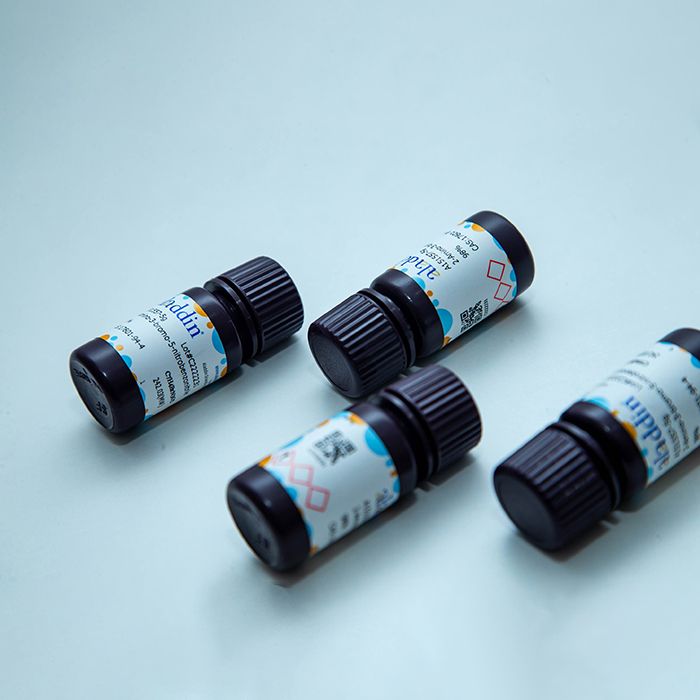
G3-C12 TFA - ≥99% , CAS No.G659199

CAS: G659199 Cat. No.: G659199 Formula: C74H115N23O23S2.C2HF3O2 Peso molecolare: 1873
Disponibile su ordine
QUALITÀ & PUREZZA ≥99%
Storage
Desiccated,Store at -80°C
Shipped In
Dry ice packs + Cold packs
★
Dimensione
Germania (EU)
USA*
Prezzo
Qtà
1mg
G659199-1mg
Su ordinazione · 8–12 settimane
156,97€
5mg
G659199-5mg
Su ordinazione · 8–12 settimane
382,59€
10mg
G659199-10mg
Su ordinazione · 8–12 settimane
573,49€
Enter a quantity for the sizes you want to add.
🧪
Perché questa qualità

≥99% per flussi di lavoro cromatografici e analitici sensibili che richiedono un'interferenza minima della linea di base.

🌡

Stoccaggio e spedizione

Desiccated,Store at -80°C Spedizione Dry ice packs + Cold packs. Consultare il COA specifico del lotto per le specifiche esatte.

📋

Documenti di qualità

SDS, COA, scheda tecnica e scheda delle specifiche disponibili per il download. COA specifico del lotto accessibile tramite ricerca per numero di lotto.

📚

Prova documentale

Citato in 0 pubblicazioni peer-reviewed su cromatografia, sintesi organica e reazioni di accoppiamento incrociato.

Panoramica

G3-C12 (TFA) is a galectin-3 binding peptide, with K d of 88 nM, and shows anticancer activity.

Appearance:Solid

IC50& Target:Kd: 88 nM (Galectin-3) .

In Vitro:G3-C12 (TFA) is a galectin-3 binding peptide, with high affinity (K d ) of 88 nM, but shows no affinity for other galectin family members or to other lectins. G3-C12 (TFA) bearing opolymers N-(2-hydroxypropyl)methacrylamide (HPMA) potently and selectively

Biological Activity:G3-C12 (TFA) is a galectin-3 binding peptide, with K d of 88 nM, and shows anticancer activity.

Specifiche

Specifiche e purezza
≥99%
Condizioni di conservazione di stoccaggio
Desiccated,Store at -80°C
Spedito in
Dry ice packs + Cold packs
Questo prodotto richiede spedizione a catena fredda. I servizi di terra e altri servizi economici non sono disponibili.
Purezza
≥99%
Nomi e identificatori
Peso molecolare
1873

Documentazione

📋 Scheda di dati di sicurezza (SDS)

Documento completo su pericoli, manipolazione, stoccaggio e conformità normativa.

<<<<<<< HEAD Scarica SDS → ======= Scarica SDS → >>>>>>> release248-p3

✅ Certificato di analisi (COA)

Dati di qualità specifici del lotto. Inserisci il numero di lotto per recuperare il COA esatto.

Cerca COA →

📊 Scheda tecnica

Riepilogo di riferimento rapido delle specifiche e applicazioni del prodotto.

Visualizza scheda tecnica →

🔬 Scheda delle specifiche

Attributi di qualità completi e criteri di accettazione per questa qualità.

Visualizza scheda delle specifiche →

Dati avanzati

Certificati (CoA, COO, BSE/TSE e tabella di analisi)
C of A & Other Certificates(BSE/TSE, COO):
Analytical Chart:
Proprietà chimiche e fisiche
SolubilitàH2O : ≥ 50 mg/mL (26.70 mM)
Calcolatori di soluzioni
Recensioni

Recensioni dei clienti

Application Protocols

No tested application protocols are provided for SKU G659199 in the Product Data.

General, non-validated guidance for amphiphile preparation (informational only):

  • Micelle preparation: Dissolve to 10–50 mM in DMSO. Under vigorous stirring, add the stock dropwise into water or buffer to the desired final concentration. Optionally sonicate (bath, 5–10 min). Equilibrate 30–60 min before measurements.
  • Size characterization: Measure DLS at 25 °C; perform triplicates; report intensity- and number-weighted distributions; confirm with TEM/AFM where appropriate.
  • Adsorption on surfaces: Prepare 0.1–1.0 mM solutions in buffer; rinse substrates thoroughly; monitor adsorption via QCM-D, ellipsometry, or contact angle. Optimize ionic strength to tune layer formation.

These are general starting points only and are not validated for this specific item. Adjust parameters based on your system and verify with small-scale trials.

Biological Roles

Item-specific biological roles: Not specified for this item; no endogenous role is provided in the Product Data.

General/literature context (not item-specific):

  • Peptide amphiphiles containing glycine repeats and an alkyl tail are synthetic constructs without direct endogenous counterparts. They are frequently used as model systems to study self-assembly, membrane interactions, and peptide–lipid interfaces in vitro.
  • Interactions with biomolecules: At concentrations above the critical micelle concentration (CMC), amphiphiles can bind and sequester hydrophobic dyes or interact with lipid bilayers. The extent of interaction depends strongly on sequence, charge state, and tail length.
  • Enzymatic stability: Short glycine-rich sequences may be susceptible to nonspecific proteolysis in biological matrices; incorporation of non-natural residues or end-capping is often used in research to modulate stability. Whether SKU G659199 contains such modifications is Not specified for this item; refer to CoA/Spec Sheet.
  • Spectroscopic detection in bioassays: Lacking aromatic residues, glycine-rich amphiphiles have weak absorbance at 280 nm; assays often rely on 214–220 nm peptide-bond absorbance or external labels.

Important: All uses are for research only. No claims are made about biological activity, safety, or suitability for clinical/diagnostic applications. Validate concentration ranges and potential cytotoxicity in your specific in vitro model before use.

Buffer Applications

Item-specific buffer recipes or validated systems: Not specified for this item.

General guidance for working with amphiphilic peptide salts in buffers (not item-specific):

  • Preparing aqueous stocks: Dissolve the material first in a small volume of DMSO or acidified water (e.g., 0.1% acetic or formic acid), then titrate into your target buffer under vigorous mixing to prevent localized supersaturation. Gentle bath sonication helps.
  • pH control: Ionization affects assembly. Slightly acidic buffers can stabilize TFA-associated forms; neutral to slightly basic pH may alter aggregation and CMC. Always report pH, ionic strength, and temperature.
  • Common buffers: Phosphate (PBS, pH 7.2–7.4), HEPES (pH ~7.4), acetate (pH 4–5.5) are frequently used. High ionic strength can screen charges, shifting CMC and morphology.
  • Filtration/sterilization: 0.22 µm filtration can remove particulates; if strong self-assembly occurs, filtration may adsorb material—assess recovery by UV at 214 nm or gravimetry.
  • Compatibility notes: Avoid high concentrations of anionic surfactants (e.g., SDS) that may form mixed micelles and confound interpretation. Divalent cations can influence assembly of charged amphiphiles; document Mg2+/Ca2+ content.

These are general best practices. For SKU G659199, verify actual solubility, charge state, and counterion stoichiometry on the CoA before formulating buffers.

Green Alternatives

Green chemistry considerations for amphiphilic peptide salts (general guidance; not item-specific):

  • Counterion choice: Trifluoroacetate (TFA) is persistent and corrosive; when feasible for your chemistry, consider exchanging TFA for acetate, chloride, or bicarbonate via ion-exchange or repeated lyophilization with volatile acids/bases. This may decrease environmental impact and improve biocompatibility in some assays.
  • Solvent selection: Favor water and aqueous buffers where possible. When organic co-solvents are necessary, consider ethanol or isopropanol before DMF/DMF; use DMSO judiciously and recycle via fractional distillation if your facility allows.
  • Purification: Replace TFA-containing HPLC mobile phases with formic acid or acetic acid for LC–MS-compatibility and improved waste profile, when resolution permits.
  • Process scale: For method development, miniaturize (microscale assembly screens) to reduce solvent and material use.

Illustrative comparison (general):

  • TFA salt vs. acetate salt: TFA offers robust ion-pairing and volatility in prep-HPLC but contributes to corrosive waste; acetate reduces fluorinated waste but may modestly alter solubility/assembly; verify performance tradeoffs experimentally.
  • DMSO vs. ethanol/water: DMSO dissolves stubborn aggregates but is harder to remove and can complicate toxicity profiles; EtOH/water blends are greener but may not fully solubilize hydrophobic segments.

For SKU G659199 specifically, no alternative counterion or green-grade specifications are provided; consult the CoA if a non-TFA form or special grade is available.

Pharmaceutical Uses

This product is supplied for research use only; no clinical or therapeutic claims are made.

General formulation-related context for peptide amphiphiles (not item-specific):

  • Excipient research: Amphiphilic peptides are explored in preformulation studies as solubilizers or stabilizers for hydrophobic actives in vitro. Their ability to form micelles/assemblies can improve apparent solubility in screening assays.
  • Delivery science studies: Used to probe structure–property relationships governing cargo encapsulation, release kinetics, and interaction with model membranes and liposomes. Any insights are strictly preclinical and methodological.
  • Salt form considerations: TFA counterions are common from synthesis, but acetate or HCl salts are sometimes preferred in formulation research due to improved biocompatibility profiles. Counterion for this specific item is indicated as “TFA” by name; quantitative stoichiometry is Not specified for this item; refer to CoA/Spec Sheet.
  • Analytics in formulation: Characterize by DLS (size/PDI), zeta potential, and stability over time/temperature. Monitor concentration via 214–220 nm UV or NMR with internal standards.

If your work requires compliance with pharmacopeial monographs or excipient compendial status, note that no pharmacopeial grade or listing is provided for SKU G659199. Confirm suitability with your QA and regulatory teams before use in any regulated context.

Physical Properties

Item-specific properties: Not specified for this item; refer to CoA/Spec Sheet for appearance, exact molecular weight, elemental analysis, water content, and related specifications.

General/literature context for peptide–amphiphile salts of the G3–C12 type (informational only):

  • Physical state: Typically a white to off-white solid or foam; hygroscopic tendencies can vary depending on counterion content and residual solvent.
  • Solubility profile: Frequently soluble in polar aprotic solvents (e.g., DMSO) and water to varying degrees; may exhibit critical micelle concentration (CMC) behavior in aqueous media, with apparent solubility increasing above CMC; miscible with MeOH/EtOH; limited solubility in nonpolar alkanes.
  • Aggregation: Amphiphiles often self-assemble (micelles, vesicles, nanofibers) depending on concentration, ionic strength, and pH; apparent solution properties (viscosity, light scattering) can change sharply near CMC.
  • pKa/logP: Not meaningful as single values due to amphiphilic and ionizable nature; effective hydrophobicity depends on ionization state and assembly.
  • Melting behavior: Often shows broad softening or phase transitions rather than a sharp melting point due to microphase-separated domains and counterion effects.
  • UV characteristics: Lacks strong chromophores; detection commonly by low-wavelength UV (e.g., 214–220 nm) for peptide bonds or by evaporative light scattering/charged aerosol detection. Specific extinction coefficients are system-dependent.

Important: Do not treat the above as specifications for Aladdin SKU G659199. For experimental planning, verify actual properties on the product CoA and SDS.

Quality and Grades

Grade/purity for this item: Not specified for this item; refer to CoA/Spec Sheet.

How grades typically apply to peptide–amphiphile materials (general guidance):

  • Research grade: Suitable for exploratory R&D, screening, and method development. Characterization often includes HPLC purity (UV at 214/220 nm) and mass confirmation (ESI/HRMS). Residual TFA and solvent content may be reported.
  • Peptide-specific metrics: HPLC area % is commonly used; however, amphiphilic self-assembly can affect chromatographic behavior. Orthogonal methods (MALDI/ESI-MS, NMR in appropriate solvents, and elemental analysis) are recommended.
  • Counterion accounting: For TFA salts, reported molecular weight may include specific equivalents of TFA; verify stoichiometry on the CoA to avoid dosing errors.
  • Water/residual solvent: Hygroscopic materials can retain water; Karl Fischer moisture and residual solvent by GC are often provided in detailed specs. For this item, values are Not specified for this item; refer to CoA/Spec Sheet.
  • Batch-to-batch consistency: Amphiphiles are sensitive to minor synthetic and workup variations that alter aggregation behavior. For reproducibility, maintain consistent lot numbers across a study when feasible.

Recommendation: Confirm exact assay, counterion stoichiometry, and analytical data on the item’s CoA before preparing concentration-dependent experiments (e.g., CMC, self-assembly, or biological assays).

Reaction and Applications

Manufacturer Applications: Not provided in Product Data for this item.

General research uses for G3–C12-type amphiphiles (not item-specific; literature context):

  • Self-assembly studies: Model systems for micelles, vesicles, nanofibers, and hydrogel formation driven by hydrophobic collapse of the C12 tail and hydrogen bonding along peptide backbones.
  • Surface modification: Amphiphilic adsorption on interfaces (e.g., solid–liquid, air–water) to tune wettability, protein adsorption, or to create peptide-presenting monolayers.
  • Delivery and encapsulation research: Exploration as carriers for hydrophobic dyes or small molecules in purely in vitro, non-clinical contexts; evaluation of CMC, loading capacity, and release profiles.
  • Analytical standards/tracers: Calibration of amphiphile-sensitive methods (DLS, tensiometry, cryo-TEM) and as controls in peptide–lipid interaction studies.

Practical tips (general):

  • Concentration matters: Characterize CMC via tensiometry or fluorescence probes (e.g., pyrene I1/I3) before interpreting biological or materials data.
  • Salt and pH effects: Ionic strength and counterions alter assembly; document buffer composition meticulously.
  • Sample preparation: Use serial dilution from a DMSO or acidified aqueous stock; equilibrate samples prior to measurement to reach steady-state morphology.
  • Filtration: 0.22–0.45 µm filtration can remove dust-induced nucleation sites that confound DLS.

Note: The above are general application themes for amphiphiles; confirm that SKU G659199’s identity and purity meet your study’s requirements before use.

Reaction Conditions

No item-specific reaction conditions are provided for SKU G659199.

General handling and assembly conditions for peptide–amphiphile research (not item-specific):

  • Stock preparation: Dissolve in anhydrous DMSO (10–100 mM as allowed), then dilute into aqueous buffer under vortexing. Typical working concentrations for self-assembly studies range from low µM to low mM, depending on CMC.
  • Temperature: Assembly is often temperature dependent. Record and control temperature (e.g., 20–37 °C) during DLS, spectroscopy, and microscopy.
  • Ionic strength: 0–150 mM NaCl can significantly modulate assembly and size distributions. Titrate salt to map phase behavior.
  • pH: Explore pH 4–8 to survey ionization effects. Avoid extremes that promote hydrolysis of peptide bonds.
  • Analytics: Allow equilibration (e.g., 30–120 min) prior to measurement. Use fluorescence probe partitioning (pyrene), surface tension, or isothermal titration calorimetry to quantify CMC.
  • Yields/conversions: Not applicable—this reagent is generally used as-is rather than transformed chemically.

Important: These are literature-style conditions to guide experimental planning. They are not specifications for SKU G659199. Confirm identity, counterion content, and solubility on the CoA/SDS before executing experiments.

Safety and Handling

Authoritative safety information: Hazard classification, signal word, pictograms, and H-statements are Not specified for this item; refer to the SDS for SKU G659199 for definitive guidance.

General laboratory precautions for peptide/amphiphile TFA salts (informational):

  • Personal protective equipment: Lab coat, safety glasses, and appropriate chemically resistant gloves. Avoid inhalation of dust/aerosols; handle powders in a fume hood or ventilated enclosure.
  • Trifluoroacetate salts: TFA residues/counterions can be corrosive/irritant in concentrated forms. Prevent skin/eye contact and avoid ingestion. Neutralize/contain spills with inert absorbent; dispose according to local regulations.
  • Hygroscopicity: Store tightly sealed under desiccation to prevent moisture uptake and clumping; minimize container open time.
  • Dust control: Amphiphilic powders can become statically charged; use antistatic precautions and avoid generating dust.
  • First aid (general): If inhaled, move to fresh air; if on skin, wash with soap/water; if in eyes, rinse cautiously with water for several minutes and seek medical attention as needed. If ingested, rinse mouth and seek medical attention. Always follow site-specific EHS protocols.
  • Incompatibilities (general): Strong oxidizers and strong bases/acids can degrade peptide backbones; avoid prolonged exposure to high pH (>10) or strong nucleophiles; TFA salts may release TFA under strong base.

Always defer to the product-specific SDS for final hazard statements, storage incompatibilities, and emergency measures.

Solvent Selection

This product is expected to behave as an amphiphilic organic salt (general context). Optimal solvent choice should balance dissolution of the hydrophobic C12 segment (if present) and ionizable peptide portion.

General solvent strategy (not item-specific):

  • Primary stock preparation: Start with anhydrous DMSO to prepare a concentrated stock (e.g., 10–100 mM as solubility permits). DMSO often overcomes aggregation and enables accurate dosing.
  • Aqueous working solutions: Dilute DMSO stocks into buffered saline or water while vortexing to minimize local supersaturation; consider gentle sonication. Maintain final DMSO ≤1–2% v/v for cell-free assays; for cellular work, follow your protocol and approvals.
  • Alcohols: MeOH or EtOH can assist dissolution but may alter self-assembly and bioassay outcomes. Validate if using.
  • pH considerations: Ionization state controls solubility and aggregation. Slightly acidic media may stabilize TFA salts; basic media can deprotonate amines and disrupt TFA association.
  • Nonpolar solvents: Hexanes/heptane are generally poor for peptide-containing amphiphiles; isopropanol or acetonitrile/water mixtures may be better for HPLC and recrystallization trials.

Comparison (general):

  • DMSO: Highest solvating power; may require dilution steps to avoid precipitation.
  • Water/buffer: Physiologically relevant; behavior is concentration- and salt-dependent due to CMC phenomena.
  • Acetonitrile/water (0.05–0.1% TFA or formic acid): Often suitable for analytical HPLC; note that added TFA can complicate MS detection—use formic acid for LC–MS.
Storage and Reconstitution

Storage conditions (from Product Data):

  • Store desiccated at −80 °C.
  • Shipped on dry ice packs + cold packs to maintain low temperature during transit.

General best practices for this class of materials (not item-specific):

  • Upon receipt: Keep sealed at −80 °C. Allow the container to equilibrate to room temperature in a desiccator before opening to prevent moisture condensation.
  • Aliquoting: For hygroscopic or aggregation-prone solids, prepare single-use aliquots in an inert atmosphere glovebox or a dry cabinet if available. Clearly label concentration and counterion form if you prepare solutions.
  • Reconstitution: Start with dry, anhydrous solvent (e.g., DMSO) to make a concentrated stock. Mix thoroughly (vortex, brief sonication). For aqueous use, dilute the stock into buffer under stirring. If direct aqueous dissolution is attempted, consider mildly acidic water (e.g., 0.1% acetic acid) to aid solubilization of TFA salts.
  • Filtration and sterility: If sterility is required, filter through a 0.22 µm PTFE or PVDF membrane. Check for loss due to adsorption by measuring pre/post concentrations.
  • Stability: Minimize freeze–thaw cycles; store solutions at −20 to −80 °C in aliquots as appropriate. Monitor for changes in clarity, particle size (DLS), or HPLC profile over time.

Research use only: Follow your institution’s SDS and CoA for definitive handling and stability information for SKU G659199.

Structure and Identity

Brief overview: G3-C12 TFA is listed as a small-molecule/compound library entry. Based on common shorthand in peptide–amphiphile chemistry, the designation “G3-C12 TFA” is often used in research literature to describe a glycine trimer (G3) coupled to a dodecyl (C12) alkyl chain, isolated as a trifluoroacetate (TFA) salt. However, the exact structural identity of this catalog item has not been specified here.

Item-specific identifiers (from Product Data):

  • CAS: Not specified for this item; refer to CoA/Spec Sheet.
  • Molecular Formula: Not specified for this item; refer to CoA/Spec Sheet.
  • Molecular Weight: Not specified for this item; refer to CoA/Spec Sheet.
  • InChIKey: Not specified for this item; refer to CoA/Spec Sheet.
  • SMILES: Not specified for this item; refer to CoA/Spec Sheet.

Structural features (general/literature context, not item-specific):

  • “G3” typically denotes a tripeptide of glycine (Gly-Gly-Gly), featuring backbone amide linkages and terminal amino/carboxyl functionality.
  • “C12” typically denotes a lauryl (dodecyl) lipophilic tail that imparts amphiphilicity and can drive self-assembly (e.g., micelles, fibers) in water.
  • “TFA” typically indicates the trifluoroacetate counterion, commonly associated with protonated amine-bearing peptides after TFA-assisted cleavage or ion exchange.

2D description (general, if the above convention applies): A short peptide segment (three glycine residues) linearly connected, with an N- or C-terminal conjugation to a saturated 12-carbon chain; peptide backbone amide carbonyls alternating with NH groups; no stereocenters in glycine residues; a counterion (trifluoroacetate) balancing cationic charge if present. Exact regiochemistry and termini for this specific item are Not specified for this item; refer to CoA/Spec Sheet.

Synthetic Utility

Item-specific functional groups and protecting groups are Not specified for this item; refer to CoA/Spec Sheet.

General synthetic perspective on G3–C12-type amphiphiles (not item-specific):

  • Modular design: A short peptide segment linked to a hydrophobic alkyl tail provides a platform for constructing self-assembled nanostructures. Retrosynthetically, these arise from coupling a lipid tail (e.g., lauric acid derivatives) to a peptide fragment prepared by SPPS or solution-phase coupling.
  • Handle placement: Depending on orientation (tail at N- or C-terminus), the free terminus (amine or carboxyl) can be used for further conjugation to dyes, haptens, or polymers (e.g., NHS esters, isothiocyanates, carbodiimide couplings). The precise availability of such handles for SKU G659199 is Not specified for this item.
  • Counterion exchange: TFA salts can be converted to alternative salts (acetate, HCl) by dissolution in aqueous alcohols and iterative lyophilization or ion-exchange resins, facilitating downstream reactions sensitive to TFA.
  • Assembly-guided synthesis: Post-assembly modifications (e.g., metal-ion templating, click reactions of appended azides/alkynes) can be exploited in water, provided reactive moieties are present.

Caveat: Without confirmed structure, treat SKU G659199 as a finished research reagent rather than a generic building block. Verify termini, side chains (if any), and purity profile before planning derivatizations.

Target Specificity

Not applicable. This product is not an antibody or affinity reagent, and no target, epitope, clone, or species reactivity information is provided in the Product Data.

Domande frequenti

What is the purity of this product?
This product is supplied at ≥99% purity (chemical assay). Lot-specific values are stated on the Certificate of Analysis.
How should this product be stored?
Store at ?80 °C, desiccated. Keep the container tightly closed with desiccant — the material is moisture-sensitive.
How is this product shipped?
This product ships frozen with dry ice and cold packs. Unpack on arrival and transfer it to the storage condition stated above; handle dry ice with insulated gloves in a ventilated area.
What are the CAS number, molecular formula and molecular weight?
The CAS Number is G659199, the molecular formula is C74H115N23O23S2.C2HF3O2, and the molecular weight is 1873 g/mol.
What documentation is provided?
Available product documentation, including Certificates of Analysis (COA), Safety Data Sheets (SDS), and specification sheets, is shown in the product document area. Document availability and access follow the current site policy.

Desidera che le inviamo un messaggio quando avremo sconti disponibili?

Ricordamelo più tardi

Grazie! Controlli la sua casella di posta per confermare.

Ops! Le notifiche sono disabilitate.