QUALITÀ & PUREZZAExactAb™?ExactAb™ — Aladdin's antibody line emphasizing precision and validated quality. Use for reliable, specificity-validated antibody applications.Validated?Validated grade — performance confirmed in defined applications before release. Use when you want documented assurance the reagent works as stated.See COA
Mouse anti Human GBP5 Antibody, Monoclonal (OTI5C9), could be used for WB, IF/ICC, Flow Cytometry and so on.
Specifiche
Product Name
GBP5 Mouse mAb - Anticorpo primario, specific to GBP5, Rabbit IgG
Sinonimi
GBP-5|GBP 5 antibody|GBP TA antigen antibody|GBP-5 antibody|GBP-TA antigen antibody|GBP5 antibody|GTP binding protein 5 antibody|GTP-binding protein 5 antibody|Guanine nucleotide binding protein 5 antibody|Guanine nucleotide-binding protein 5 antibody|Guanylate binding protein 5 antibody|Guanylate-binding protein 5 antibody|UNQ2427/PRO4987 antibody|GBP-TA antigen|GTP-binding protein 5|Guanine nucleotide-binding protein 5
Specifiche e purezza
ExactAb™, Validated, See COA
Specie ospite
Mouse
Specificità
GBP5
Immunogeno
Recombinant protein of human GBP5 (AA 1-586)
Controllo positivo
WB: Jurkat, HeLa, A549, and MCF7 cell lysates. IF/ICC: COS7 cells transiently transfected with pCMV6-ENTRY GBP5. Flow Cytometry: HEK293T cells transfected with pCMV6-ENTRY GBP5.
Coniugazione
Unconjugated
Grado
ExactAb™, Validated
Isotipo
Rabbit IgG
SDS-PAGE
150 kDa
Metodo di purificazione
Protein G purified
Concentrazione
See COA
Product Line
Prodotti biologici
Stoccaggio e spedizione
Forma
Liquid
Condizioni di conservazione di stoccaggio
Store at -20°C,Avoid repeated freezing and thawing
Spedito in
Ice chest + Ice pads
Stabilità e conservazione
Store at 4°C short term (1-2 weeks). Store at -20°C long term (24 months). Upon receipt, it is recommended to aliquot. Avoid freeze/thaw cycle.
Immagini
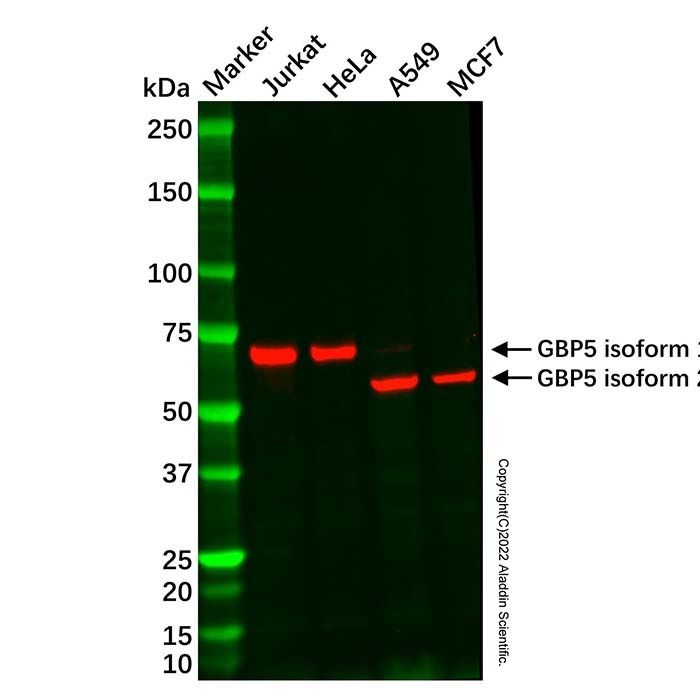
GBP5 Mouse mAb (Ab104958) - Western Blot All lanes: GBP5 Mouse mAb (Ab104958) at 1/1000 dilution Samples: Lysates at 20 µg per lane Secondary: Goat Anti-Mouse IgG H&L (HRP) (Ab179001) at 1/20000 dilution
Predicted band size: 66 kDa Observed band size: 67, 58 kDa Exposure time: 110.0 s
GBP5 Mouse mAb (Ab104958) - Flow Cytometry HEK293T cells transfected with either overexpress plasmid (Red) or empty vector control plasmid (Blue) were immunostained by GBP5 Mouse mAb (Ab104958) and then analyzed by flow cytometry.
GBP5 Mouse mAb (Ab104958) - IF/ICC GBP5 Mouse mAb (Ab104958) immunofluorescent staining of COS7 cells transiently transfected by pCMV6-ENTRY GBP5.
Applicazione
Applicazione
Dilution info
WB
1/500-1/2000
Flow Cytometry
1/100
IF/ICC
1/100
Dati avanzati
Obiettivi associati (umani)
GBP5TbioGuanylate-binding protein 5 (0 Activities)
Determine the necessary mass, volume, or concentration for preparing a solution.
Dilution Calculator
Determine the dilution needed to prepare a stock solution.
Reconstitution Calculator
Recensioni
Recensioni dei clienti
Application Protocols
Item-specific: Manufacturer-tested applications, recommended dilutions, incubation times, detection systems, and positive control materials are not specified for this item; refer to CoA/Spec Sheet or request validation data.
General workflow guidance (not product-validated; for user optimization):
Western blotting: Use lysates from interferon-stimulated cells as a positive control. Perform serial titration of the primary antibody to identify the signal-to-noise optimum. Employ appropriate blocking (e.g., 5% BSA or milk) and HRP- or fluorescence-based detection.
Immunofluorescence/ICC: Fixation (paraformaldehyde) and mild permeabilization (e.g., 0.1% Triton X-100 or 0.05% saponin) are common; validate that conditions preserve GBP5 epitopes. Include nuclear or organelle markers to contextualize localization.
IHC: Optimize antigen retrieval (citrate pH 6.0 or Tris-EDTA pH 9.0) based on tissue type; include known positive tissues or treated controls.
IP/Co-IP: Use mild lysis buffers (e.g., NP-40 or digitonin-based) to preserve protein–protein interactions if downstream interactome analysis is intended.
These guidelines are general and not specific validations for this product. Establish working conditions empirically in your laboratory.
Biological Roles
Target overview (literature/general knowledge):
GBP5 (guanylate-binding protein 5) is an interferon-inducible large GTPase within the dynamin superfamily and a member of the human GBP cluster on chromosome 1. It binds and hydrolyzes GTP and can oligomerize, often associating with membranes via C-terminal prenylation motifs (e.g., CaaX box in some GBPs; specific post-translational features for GBP5 are described in literature).
Cellular functions: GBP5 participates in cell-autonomous immunity against intracellular pathogens and modulates inflammasome activity. It has been reported to positively regulate NLRP3 inflammasome assembly under certain contexts, facilitating caspase-1 activation and downstream cytokine maturation; in other settings, GBPs restrict microbial replication by disrupting pathogen-containing vacuoles.
Regulation: Transcription is strongly upregulated by type I and type II interferons (IFN-α/β/γ) and by pattern-recognition receptor signaling (e.g., via STAT/IRF pathways). Protein abundance and localization can be stimulus- and cell-type dependent.
Localization: Predominantly cytosolic with inducible targeting to membranes or pathogen-containing compartments; literature reports punctate or perinuclear patterns upon stimulation.
Interactions: GBPs can interact with other immune GTPases and inflammasome components; GBP5 has been implicated in scaffolding functions that promote supramolecular complex assembly in response to danger signals.
Relevance for assay design (general):
Because GBP5 is inducible, include stimulated controls (e.g., IFN-γ-treated cells) to establish dynamic range in detection assays. Knockdown/knockout lines provide valuable negative controls.
Buffer Applications
While buffering systems are not intrinsic properties of the antibody itself, appropriate buffers are essential for optimal performance.
Item-specific: Buffer composition for this product is not specified; refer to the CoA/Spec Sheet.
General guidance (literature/practice):
Storage/dilution buffers: PBS (10–20 mM phosphate, 150 mM NaCl, pH 7.2–7.6) or TBS (20–50 mM Tris, 150 mM NaCl, pH 7.4–8.0) are commonly used.
Blocking buffers: 3–5% BSA, 5% nonfat dry milk, or species-matched normal serum can reduce nonspecific binding; choice depends on assay (WB/IHC/IF) and detection chemistry.
Detergents: Tween-20 (0.05–0.1%) in wash buffers reduces background in WB/ELISA; for IF/IHC, permeabilization may use Triton X-100 or saponin as compatible with epitope exposure.
Preservatives: Sodium azide (0.02–0.05%) or ProClin can suppress microbial growth in stored working stocks; avoid azide with HRP-based detection.
pH considerations: Maintain near-neutral pH to preserve antibody conformation; avoid repeated exposure to pH extremes used for antigen retrieval—rinse thoroughly before incubation steps.
Preparation notes:
Filter-sterilize buffers (0.22 µm) to prevent contamination for long incubations.
Prepare fresh working dilutions and discard after use to avoid microbial growth and activity loss.
Green Alternatives
Green chemistry considerations are less about “solvent replacement” and more about minimizing waste and preservatives for antibody products.
Practical sustainability steps (general):
Concentration and aliquoting: Aliquot once to avoid multiple freeze–thaw cycles, reducing waste from activity loss.
Buffer design: Use PBS without azide if downstream oxidative enzymes (e.g., HRP) are required; consider ProClin-free, low-toxicity preservatives when biosafety permits. Preservatives for this item are not specified.
Packaging: Choose volumes aligned with experimental throughput to minimize leftover reagent. Recycle secondary packaging where possible.
Pros (azide): Broad antimicrobial activity; extended shelf life at 2–8°C.
Cons (azide): Toxic, hazardous for drains and certain assays (e.g., HRP). Preservative-free buffers are safer downstream but require stricter aseptic handling and colder storage.
These are general recommendations. The specific formulation and preservative system for this item are not specified; refer to the CoA/Spec Sheet.
Pharmaceutical Uses
This product is a research-grade monoclonal antibody and is not intended for diagnostic or therapeutic use.
Item-specific: No pharmacopeial status, excipient role, or GMP manufacturing details are provided for this item; refer to CoA/Spec Sheet if available.
General note (for context only, not specific to this product): Antibodies can serve as critical reagents in bioanalytical release testing and process development assays in biopharmaceutical manufacturing; however, such applications require assay-specific qualification and supply chain controls beyond the scope of this research-use product.
Physical Properties
Item-specific (from Product Data):
Appearance: Not specified for this item; refer to CoA/Spec Sheet.
Concentration, buffer composition, preservative, and isotype: Not specified for this item; refer to CoA/Spec Sheet.
Molecular weight (exact for this preparation): Not specified for this item; refer to CoA/Spec Sheet.
General/literature values for antibodies (non-specific to this item):
Typical IgG molecular mass: ~150 kDa (literature), composed of ~25 kDa light chains and ~50 kDa heavy chains.
Isoelectric point (pI): commonly ~6–9 depending on isotype and glycosylation (literature).
Solubility: Highly soluble in aqueous buffers such as PBS or TBS; sensitive to extreme pH and high ionic detergents (literature).
Stability: Enhanced by protein stabilizers (e.g., BSA, trehalose) and cryoprotectants (e.g., 10–50% glycerol) during frozen storage (literature). These details are not specified for this item.
Notes for use:
Avoid surface adsorption by using low-protein-binding plastics and including carrier protein if compatible with the intended assay (general guidance).
Minimize foaming and vigorous vortexing to protect conformational integrity (general guidance).
Quality and Grades
Item-specific (from Product Data):
Grade/Purity: ExactAb™, Validated.
Interpretation (general explanation):
ExactAb™: Denotes a vendor-specific quality designation used by Aladdin Scientific to indicate a rigorously characterized monoclonal reagent. While the precise qualification criteria are proprietary, this typically implies controlled immunogen definition, lot-to-lot consistency, and documentation of key attributes (e.g., specificity assessments). Item-specific acceptance criteria, if any, are not specified for this product listing; refer to the CoA/Spec Sheet.
Validated: Indicates that the antibody has undergone internal verification for identity and basic performance. Exact validated applications, host reactivity spectrum, and assay conditions are not specified for this item; consult the CoA/Spec Sheet or request validation data.
What this means for your workflow:
Expect improved reproducibility across lots compared to non-validated polyclonal preparations.
Still perform in-house titration and control experiments in your assay context (WB, IF, IHC, IP, ELISA, flow), since validated use-cases and recommended dilutions are not specified for this item.
If your application is sensitive to isotype or carrier protein (e.g., live-cell staining, Fc-mediated effects), request isotype and buffer details prior to use.
Reaction and Applications
For monoclonal antibodies, chemical reaction conditions are not the primary focus. Instead, performance is defined by immunoassay applications. No manufacturer-tested applications are provided for this item.
General research applications for anti-GBP5 antibodies (literature/general knowledge; not item-specific claims):
Western blotting (WB): Detection of GBP5 in cell/tissue lysates; often requires interferon stimulation to induce robust expression in some cell types.
Immunofluorescence (IF) / Immunocytochemistry (ICC): Visualization of subcellular localization; GBP5 may display cytosolic and membrane-associated patterns.
Immunohistochemistry (IHC): Assessment of GBP5 expression in fixed tissues; fixation and antigen retrieval conditions must be optimized for epitope exposure.
Immunoprecipitation (IP)/Co-IP: Enrichment of GBP5 and interacting partners for downstream MS or WB.
ELISA/Targeted capture: If epitope accessibility allows, sandwich or indirect formats can quantify GBP5 in lysates.
Practical considerations (general):
Include appropriate positive controls (e.g., IFN-γ/β-stimulated cell lysates known to express GBP5) and negative controls (isotype control, knockout/siRNA samples where feasible).
Titrate antibody concentration and optimize blocking/detergents to reduce background. Specific dilutions and application validations for this item are not specified; conduct pilot optimization.
Reaction Conditions
Not applicable to chemical synthesis. Antibody performance depends on immunoassay conditions rather than chemical reaction parameters. See Application Protocols for assay-related guidance; note that specific, tested applications and dilutions for this item are not provided and should be determined empirically.
Safety and Handling
Item-specific (from Product Data):
GHS classification, signal word, H-statements, pictograms: Not specified for this item; consult the SDS.
Research use only; not for human or veterinary use.
Storage: Store at -20°C; avoid repeated freezing and thawing. Shipped in an ice chest with ice pads.
General safety guidance for antibody reagents (literature/general knowledge):
PPE: Wear lab coat, nitrile gloves, and safety glasses when handling.
Handling: Keep on ice during use to limit proteolysis/denaturation. Do not mouth pipette. Avoid microbial contamination; use sterile technique if sterility is required.
Incompatibilities: Avoid strong oxidizers and extreme pH; most antibodies denature below pH ~3 or above pH ~10. Avoid repeated freeze–thaw cycles which can cause aggregation and loss of activity.
Potential preservatives: Some antibody formulations contain sodium azide or ProClin as preservatives. Presence/amount are not specified for this item; check the SDS/label before disposing or performing azide-incompatible assays (e.g., HRP activity can be inhibited by azide).
First-aid overview (general):
Skin/eye contact: Rinse with water for several minutes; remove contaminated clothing. Seek medical attention if irritation persists.
Inhalation/ingestion: Move to fresh air; rinse mouth; seek medical attention according to institutional policy.
Always refer to the product label and SDS for authoritative safety information.
Solvent Selection
This section is not typically applicable to antibody reagents, which are aqueous biological macromolecules rather than small-molecule solutes.
Practical guidance (general):
Use physiologically compatible aqueous buffers such as PBS (pH ~7.2–7.6) or TBS (pH ~7.4–8.0). Avoid organic solvents (acetonitrile, methanol, DMSO) which can denature antibodies.
For long-term storage, many labs use PBS or TBS with added stabilizers (e.g., 10–50% glycerol) and carrier protein (e.g., 0.1–1% BSA) when compatible with downstream assays. Specific buffer and additives for this item are not specified; refer to CoA/Spec Sheet.
For antigen retrieval or IHC workflows, solvent choice relates to tissue processing rather than antibody solubility; consult your assay protocol.
Storage and Reconstitution
Item-specific (from Product Data):
Storage: Store at -20°C. Avoid repeated freezing and thawing.
Shipping: Shipped in an ice chest with ice pads.
Reconstitution status, buffer composition, preservative, and recommended aliquot size: Not specified for this item; refer to CoA/Spec Sheet.
General guidance (not item-specific):
Upon receipt, inspect for any signs of temperature excursion. If liquid, mix gently by inversion; if lyophilized, briefly centrifuge before opening to collect contents, then reconstitute with sterile buffer (e.g., PBS) to a convenient stock concentration. The appropriate reconstitution volume for this item is not specified.
Aliquot immediately into single-use volumes to prevent freeze–thaw cycles. Store working aliquots at -20°C or below; for long-term storage, many labs prefer -80°C, and may include 10–50% glycerol as a cryoprotectant when compatible with downstream assays.
Avoid repeated freeze–thaw; thaw on ice and keep samples cold during setup. Do not vortex vigorously.
For preservative-containing formulations (e.g., sodium azide), follow institutional disposal guidelines and avoid HRP-based assays if azide is present. Presence/amount of preservatives for this item are not specified.
Always prioritize the specific instructions on the product label and CoA/Spec Sheet for this SKU.
Structure and Identity
Brief overview: GBP5 Mouse mAb is a mouse monoclonal antibody directed against guanylate-binding protein 5 (GBP5), supplied for research use.
CAS, CID, InChIKey, SMILES: Not applicable for antibodies; not specified for this item.
Molecular formula / molecular weight (exact): Not specified for this item; refer to CoA/Spec Sheet.
General structure (literature/general knowledge):
Typical monoclonal IgG is a glycoprotein composed of two heavy chains (~50 kDa each) and two light chains (~25 kDa each) linked by disulfide bonds, forming a Y-shaped molecule with two identical antigen-binding fragments (Fabs) and one Fc region.
The antigen-binding site recognizes an epitope on human/mammalian GBP5 protein (specific epitope for this clone not specified for this item).
Expected immunoglobulin domain architecture: variable domains (VH/VL) for specificity; constant domains (CH1–CH3, CL) for stability and effector functions (isotype-dependent; isotype not specified for this item).
Target overview (literature):
GBP5 (guanylate-binding protein 5) is a large interferon-inducible dynamin-like GTPase of the GBP family, localized to cytosol/membrane compartments; involved in host-defense signaling and inflammasome modulation.
Synthetic Utility
Not applicable. As a biological macromolecule used for immunodetection, this antibody is not employed as a synthetic building block or catalyst. For practical use, see the sections on Biological Roles, Application Protocols, and Storage & Reconstitution.
Target Specificity
Item-specific (from Product Data):
Antibody name: GBP5 Mouse mAb (monoclonal antibody)
Host: Mouse
Antigen target: GBP5 (guanylate-binding protein 5)
Clone ID, isotype, epitope mapping, species reactivity: Not specified for this item; refer to CoA/Spec Sheet.
General notes (literature/general knowledge):
GBP5 is an interferon-inducible large GTPase; epitope accessibility may vary with fixation and stimulation status. When epitope masking is suspected, adjust antigen retrieval (IHC) or permeabilization (IF) accordingly.
To confirm specificity in your system, include controls such as isotype-matched negative antibody, peptide/antigen competition (if immunogen is known and available), and genetic controls (GBP5 knockdown/knockout).
Domande frequenti
What does ExactAb? mean?
ExactAb? indicates the product has been validated for use in rigorous antibody validation workflows. Validation may include positive/negative control samples, signal-to-noise testing, and protocol-specific QC. Lot-specific test data is published on the Certificate of Analysis where available.
What does Validated mean?
Validated indicates the product has been validated for use in rigorous antibody validation workflows. Validation may include positive/negative control samples, signal-to-noise testing, and protocol-specific QC. Lot-specific test data is published on the Certificate of Analysis where available.
How should this product be stored?
Store at ?20 °C. Avoid repeated freeze–thaw cycles. Aliquot into single-use volumes before freezing.
How is this product shipped?
This product ships in an insulated container with ice pads. Unpack on arrival and transfer it to the storage condition stated above.
What documentation is provided?
Available product documentation, including Certificates of Analysis (COA), Safety Data Sheets (SDS), and specification sheets, is shown in the product document area. Document availability and access follow the current site policy.
Which species reactivity has this antibody been validated against?
Validated reactivity is listed on the PDP and on each lot's datasheet. We validate against the most commonly tested species for the target (GBP5 Mouse mAb); cross-reactivity in untested species may exist but is not guaranteed. Contact technical support for specific species inquiries.
Hai bisogno di aiuto per scegliere la qualità?
La nostra guida alla selezione delle qualità copre purezza, stato dello stabilizzatore e idoneità all'applicazione per tutte le varianti del nostro catalogo.
Utilizziamo i cookie per garantire il corretto funzionamento del sito web e, ove consentito, per migliorare la tua esperienza. Puoi gestire le tue preferenze in qualsiasi momento nelle Impostazioni. Per saperne di più, consulta la nostra Cookie Policy.
Desidera che le inviamo un messaggio quando avremo sconti disponibili?
Ricordamelo più tardi
Grazie! Controlli la sua casella di posta per confermare.
Products are supplied to verified businesses, institutions, and qualified professionals for research and development use only. Not for use in humans, animals, diagnosis, or therapy.