≥99% for sensitive chromatographic and analytical workflows requiring minimal baseline interference.
🌡
Storage & shipping
Store at -20°C Ships Ice chest + Ice pads Check lot-specific COA for exact specifications.
📋
Quality documents
SDS, COA, datasheet, and spec sheet available for download. Lot-specific COA accessible via lot number lookup.
📚
Literature proof
Cited in 0 peer-reviewed publications across chromatography, organic synthesis, and cross-coupling reactions.
Panoramica
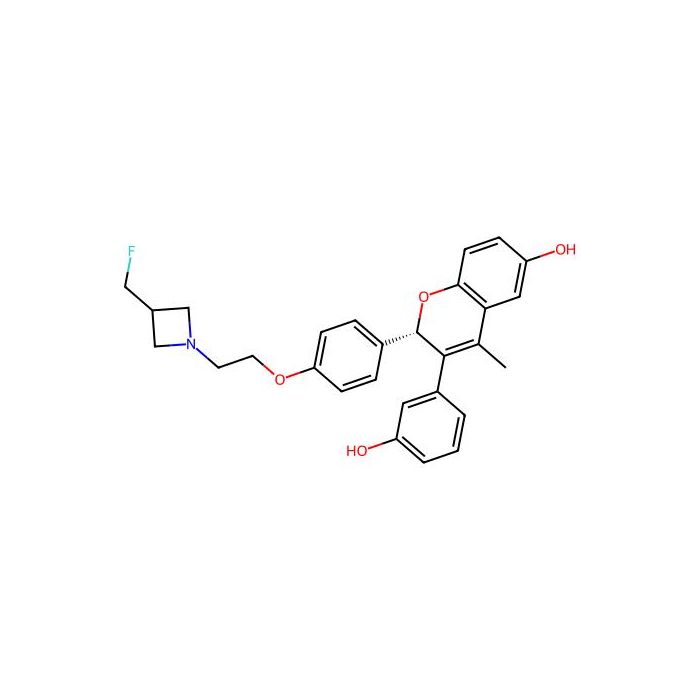
GDC-0927 (SRN-927) is a potent, non-steroidal, orally bioavailable, selective estrogen receptor antagonist
In Vivo
GDC-0927 is a novel, potent, non-steroidal, orally bioavailable, selective ER antagonist/ER degrader (SERD) that induces tumor regression in estrogen receptor (ER)+breast cancer (BC) patient-derived xenograft models . MCE has not independently confirmed the accuracy of these methods. They are for reference only.
This compound belongs to the class of organic compounds known as 6-hydroxyflavonoids. These are flavonoids that bear one hydroxyl group at the C-6 position of the flavonoid skeleton.
External Descriptors
Not available
1. Djoumbou Feunang Y, Eisner R, Knox C, Chepelev L, Hastings J, Owen G, Fahy E, Steinbeck C, Subramanian S, Bolton E, Greiner R, and Wishart DS. ClassyFire: Automated Chemical Classification With A Comprehensive, Computable Taxonomy. Journal of Cheminformatics, 2016, 8:61.
Certificati (CoA, COO, BSE/TSE e tabella di analisi)
C of A & Other Certificates(BSE/TSE, COO):
Analytical Chart:
Proprietà chimiche e fisiche
Solubilità
DMSO : 83.33 mg/mL (180.56 mM; Need ultrasonic)
Peso molecolare
461.500 g/mol
XLogP3
4.700
Hydrogen Bond Donor Count
2
Hydrogen Bond Acceptor Count
6
Rotatable Bond Count
7
Exact Mass
461.2 Da
Monoisotopic Mass
461.2 Da
Topological Polar Surface Area
62.200 Ų
Heavy Atom Count
34
Formal Charge
0
Complexity
703.000
Isotope Atom Count
0
Defined Atom Stereocenter Count
1
Undefined Atom Stereocenter Count
0
Defined Bond Stereocenter Count
0
Undefined Bond Stereocenter Count
0
The total count of all stereochemical bonds
0
Covalently-Bonded Unit Count
1
Calcolatori di soluzioni
Molarity Calculator
Determine the necessary mass, volume, or concentration for preparing a solution.
Dilution Calculator
Determine the dilution needed to prepare a stock solution.
Reconstitution Calculator
Recensioni
Recensioni dei clienti
Application Protocols
No tested application protocols are provided for this SKU. The following general workflow is commonly used for small-molecule research compounds in biochemical or cell-based assays.
General small-molecule handling protocol (research use only)
Prepare a stock solution in dry DMSO at a convenient concentration (e.g., 10–50 mM). Record exact concentration from mass and volume.
Store aliquots at −20 °C, protected from light and moisture. Avoid repeated freeze–thaw; use single-use aliquots when possible.
For assays, dilute stock into pre-warmed buffer or medium to the desired final concentration while controlling final DMSO%.
Include a vehicle control (matching DMSO%) and, when available, a positive control compound of known activity.
Incubate for the validated time period for your assay and proceed with the chosen readout (e.g., luminescence, fluorescence, Western blot, LC–MS quantitation).
Documentation
Record compound lot, solvent lot, dilution scheme, plate map, and environmental conditions to ensure reproducibility.
Note: For any application-specific parameters (WB, IF, IHC, FC, enzymology), consult your internal SOPs; none are specified for this item.
Biological Roles
Item-specific biological target and mode-of-action data are not provided in this listing. The notes below outline general considerations for small-molecule research tools in cell and molecular biology.
Small molecules can serve as chemical probes to modulate protein function, enabling hypothesis testing about pathway roles (e.g., transcriptional regulation, signal transduction, protein stability) under controlled conditions.
When deploying a probe, pair it with orthogonal readouts (e.g., target engagement by CETSA/thermal shift, downstream reporter assays, and proteomics) to establish on-target effects.
Include structurally unrelated comparators with similar nominal activity to control for scaffold-specific artifacts.
Consider permeability and efflux: confirm intracellular exposure using surrogate markers (e.g., LC–MS quantitation) when effects are modest or delayed.
Assess time-dependence (acute vs chronic dosing), reversibility (washout experiments), and protein resynthesis effects for targets with slow turnover.
Evaluate assay interference risks (fluorescence quenching, redox cycling, aggregation) using dedicated counter-screens, especially in high-throughput contexts.
Important: No pharmacological or clinical claims are made for this product. All uses are strictly for research/laboratory investigations. Users should consult primary literature to understand any putative targets reported for similarly named compounds and validate in their own systems.
Buffer Applications
This product is not a buffer reagent. However, when used in biochemical or cell-based assays, appropriate buffer systems are essential for reproducible results.
General recommendations (not item-specific)
Prepare a concentrated DMSO stock and dilute into assay buffer such that final DMSO ≤0.1–0.5% v/v (or per your assay’s validated tolerance).
Common buffers: PBS (pH 7.2–7.4), HBSS, or HEPES-buffered saline. For enzyme assays, use target-appropriate buffers (e.g., Tris, HEPES, MOPS) with defined pH and ionic strength.
Additives: 0.01–0.1% BSA or 0.01–0.05% Tween-20 can mitigate nonspecific binding and adsorption to plastic; verify no effect on readout.
Avoid precipitation upon dilution by pre-mixing compound stock with a small volume of buffer containing carrier protein before final dilution.
For pH-sensitive analyses, maintain CO2-independent buffers (e.g., HEPES) for long bench-top incubations outside incubators.
Documentation
Record buffer composition, pH (±0.05), temperature, and DMSO percentage for each run to support reproducibility and data comparability.
Green Alternatives
Green chemistry considerations are limited for a finished bioactive compound, as it is not primarily used as a solvent or reagent. Nevertheless, you can reduce environmental impact in handling and assays.
Prefer DMSO over halogenated or high-toxicity organic solvents for stock solutions, and keep final assay solvent content minimal.
Employ miniaturized assay formats (e.g., 384- or 1536-well plates) to reduce solvent and compound consumption.
Use aqueous buffers and cyclodextrin carriers where compatible to minimize organic co-solvents.
Consolidate shipments and maintain cold-chain efficiency to reduce packaging waste and dry ice/ice pack usage.
Comparison (general; not item-specific)
Halogenated solvents (e.g., dichloromethane) vs DMSO: DMSO offers lower environmental and health hazard profiles in typical assay concentrations; avoid chlorinated solvents for dissolution when possible.
Ethanol vs DMF: Ethanol is generally greener but may be less effective for very hydrophobic compounds; validate on a small scale.
End-of-life
Segregate waste streams to enable optimal treatment: non-halogenated organic vs aqueous with DMSO.
Explore solvent recycling programs for large screening campaigns.
These measures address process sustainability without altering the compound’s chemical identity.
Pharmaceutical Uses
No therapeutic or clinical claims are made for this catalog item. The compound is offered strictly for research use.
Non-clinical, formulation-adjacent uses (general; not item-specific)
May be qualified as a research reference standard for analytical method development (e.g., LC–MS/MS) in discovery settings after appropriate in-house characterization.
Can support pre-formulation research such as solubility screening (shake-flask, kinetic solubility), pKa determination, and excipient compatibility on a research scale.
Useful in stability-indicating method development by subjecting solutions to heat, light, oxidative, and pH stress to map likely degradation pathways (for research only).
Regulatory note
No pharmacopeial monograph or compendial status is provided for this item. Any use in regulated workflows requires independent qualification and documentation of purity, identity, and stability.
Handling for formulation experiments
Use high-quality solvents (e.g., anhydrous DMSO) and low-bind consumables. Track lot numbers, storage time, and freeze–thaw cycles to interpret assay variance.
Physical Properties
Only limited item-specific physical data are provided with this listing. Do not assume values not stated here.
Item-specific specs
Appearance: Not specified for this item; refer to CoA/Spec Sheet.
Molecular Weight: Not specified for this item; refer to CoA/Spec Sheet.
Solubility (item-specific): Not specified for this item; refer to CoA/Spec Sheet.
Melting point / Boiling point / Density / Refractive index / pKa / logP: Not specified for this item; refer to CoA/Spec Sheet.
General/literature guidance for screening compounds (not item-specific)
Many drug-like small molecules are provided as off-white solids or films and are commonly prepared as DMSO stock solutions (e.g., 10–50 mM) for biological assays.
Typical working diluent systems include DMSO→aqueous buffer (final DMSO often ≤0.1–0.5% v/v in assays) to balance solubility with biological compatibility.
For sparingly soluble compounds, co-solvents such as DMF, ethanol, or minimal Tween-80 may be used in research settings; always verify compatibility with your assay.
Practical notes
If the compound is supplied neat, assess solubility empirically by incremental addition of dry DMSO with mild warming (≤40 °C) and sonication.
Record solution concentration by mass and volumetric addition, and verify with UV-Vis (if chromophore present) or quantitative NMR when required.
Quality and Grades
Item-specific quality
Grade/Purity: Not specified for this item; refer to CoA/Spec Sheet.
What grade typically implies (general guidance for screening library compounds)
Screening/HTS-grade materials are commonly qualified by HPLC or UPLC purity (e.g., area % at multiple wavelengths) and LC–MS identity. Some programs also verify NMR and HRMS.
If your application requires low background in optical assays, request or verify UV absorbance profile and any residual solvent data.
Documentation and release testing
For this SKU, rely on the Certificate of Analysis (CoA) or specification sheet for the exact acceptance criteria: assay/purity method, residual solvent limits, and identification tests.
If the compound is used as a reference standard in analytical methods, consider in-house qualification: verify purity by orthogonal techniques and establish a reference value with uncertainty.
Stabilizers and formulation
Any stabilizer, salt form, or solvate content will affect handling and assay setup. None are specified here; confirm on receipt.
Change control
For regulated workflows, archive the lot-specific CoA, and document any retesting (e.g., re-purification, dryness checks) performed in your lab.
Reaction and Applications
This product is supplied as a bioactive small-molecule research compound rather than a synthetic reagent. As such, classical synthetic reaction use (e.g., as a catalyst, reagent, or monomer) is not typically applicable.
Practical research applications (general, non-clinical)
Use as a reference compound in target-engagement assays, binding studies, or phenotypic screens where its activity profile is relevant to your research questions.
Generate dose–response curves across cellular or biochemical assay panels; maintain consistent DMSO % and pre-incubation times to enable cross-study comparison.
Apply in mechanistic studies (e.g., washout kinetics, time-dependent effects) with appropriate negative controls and, when available, structurally distinct comparators.
Assay design notes
Ensure the dynamic range of the readout (e.g., reporter gene, phosphorylation state, thermal shift) is compatible with anticipated potency; avoid saturation.
For cell-based work, pre-validate cytotoxicity windows (e.g., CellTiter-Glo, resazurin) to separate on-target effects from general toxicity.
Analytical applications
Employ as a system suitability spike for method development in LC–MS bioanalysis or as a retention-time marker in discovery workflows, after in-house qualification.
Reminder: No item-specific activity, potency, or selectivity data are provided with this listing; consult primary literature and validate in your system.
Reaction Conditions
Classical synthetic reaction conditions are not applicable to this catalog item because it is supplied as a finished bioactive compound rather than a reagent.
If performing ancillary studies (general guidance)
For solution stability assessments, test aliquots in DMSO, acetonitrile, and relevant aqueous buffers across temperatures (4 °C, ambient, 37 °C) and pH values to map degradation profiles.
For conjugation or assay-tagging (structure-dependent), choose mild conditions that preserve the parent scaffold; avoid strong acids/bases or high temperatures until stability is known.
For analytical method development, typical LC conditions include C18 reversed phase, water/ACN or water/MeOH with 0.1% formic acid; adjust gradients to achieve baseline resolution from impurities.
Note: No item-specific reaction parameters, catalysts, or yields are provided.
Safety and Handling
Hazard classification
Signal Word / H-Statements / GHS Classification / Pictograms: Not specified for this item; refer to the product SDS for authoritative safety information.
General laboratory precautions (for small-molecule research compounds)
Handle in a chemical fume hood with appropriate PPE: lab coat, safety glasses, and nitrile gloves. Avoid inhalation of dust and contact with skin/eyes.
Prevent contamination of stocks and minimize exposure by using dedicated, labeled DMSO stock vials with septum caps when possible.
Incompatibilities and stability
Avoid contact with strong oxidizers or strong acids/bases unless stability is known. Protect from light and moisture until stability is established.
If supplied in solution, review the CoA/SDS for any stabilizers or special precautions.
First-aid overview (general; defer to SDS)
Skin/eye contact: Rinse with water for ≥15 minutes; remove contaminated clothing; seek medical evaluation.
Inhalation: Move to fresh air; seek medical attention if symptoms persist.
Ingestion: Rinse mouth; do not induce vomiting; seek medical attention.
Waste disposal
Dispose of unused material, solutions, and contaminated consumables as organic chemical waste per institutional and local regulations.
Note: Always consult the SDS for this specific SKU before use.
Solvent Selection
Compound-specific solubility is not provided. The following are general best practices for dissolving drug-like small molecules for research assays.
Primary stock solvent: DMSO is typically preferred for hydrophobic discovery compounds due to broad solvency and assay compatibility at low final %.
Secondary options: DMF or ethanol can assist dissolution for certain scaffolds; evaluate assay tolerance and evaporation risk.
Aqueous workup: Prepare a concentrated DMSO stock (e.g., 10–50 mM), then dilute into assay buffer to a final DMSO ≤0.1–0.5% v/v, unless your system tolerates more.
Buffers: Use PBS, HBSS, or HEPES-buffered saline with carrier protein (e.g., 0.1% BSA) when nonspecific binding is a concern.
Quick comparison (general; not item-specific)
DMSO: highest solvency, low volatility; can affect cell membranes at >0.5–1%.
Ethanol: volatile, antimicrobial; often tolerated up to ~0.1–0.5% in cells, but may perturb lipid signaling.
Aqueous with cyclodextrin: can enhance apparent solubility; verify no interference with readout.
Tips
Warm (≤40 °C) and sonicate to aid dissolution; avoid prolonged heating.
Filter sterile stocks (0.22 µm PTFE) if using in cell-based assays and if the compound is stable to filtration.
Document solvent lot and water content if reproducibility is critical.
Storage and Reconstitution
Item-specific conditions
Storage Conditions (as provided): Store at −20 °C.
Upon receipt, place the material at −20 °C or colder. If hygroscopic or light-sensitive, keep in a desiccated, light-protected container.
If supplied as a solid: Allow to equilibrate to room temperature in a sealed container before opening to prevent moisture condensation.
Reconstitution: Prepare a concentrated DMSO stock (e.g., 10–50 mM) using anhydrous solvent. Mix by gentle vortexing and brief sonication; avoid prolonged heating.
Aliquot stocks into single-use vials to minimize freeze–thaw. Label with concentration, solvent, date, and lot number.
Working solutions in aqueous buffers are generally less stable; prepare fresh just before use and keep on ice during setup when compatible.
Stability monitoring
Track appearance (color, precipitate), HPLC purity, and LC–MS over time for critical studies. Discard if significant degradation or precipitation is observed.
Note: For definitive stability and reconstitution parameters, consult the lot-specific CoA/Spec Sheet and SDS.
Structure and Identity
Brief overview for a bioactive small-molecule research compound supplied as part of a screening collection.
Product Name: GDC-0927 (catalog reference name)
CAS: 1642297-01-5
PubChem CID: 87055263
InChIKey: 181294 (as provided)
SMILES: Not specified for this item; refer to CoA/Spec Sheet.
Molecular Formula: Not specified for this item; refer to CoA/Spec Sheet.
Molecular Weight: Not specified for this item; refer to CoA/Spec Sheet.
Structural description
Item-specific structural features (ring systems, heteroatoms, stereocenters, functional groups): Not specified for this item; refer to CoA/Spec Sheet.
2D structure summary in words: Not available because atom connectivity (SMILES/InChI) is not provided in this listing.
Identity assurance
Use the CAS and CID above to cross-reference external databases for orthogonal identity checks (literature values only; not a substitute for CoA).
For experimental work, confirm identity/purity by HPLC/UPLC-UV, HRMS, and, where feasible, 1H/13C NMR prior to critical assays.
Synthetic Utility
This product is supplied as a finished bioactive small molecule, not a building block or reagent. It is therefore not typically used as a substrate or intermediate in routine organic synthesis.
General considerations if derivatization is desired (research-only)
Without a disclosed structure (functional groups not specified for this item), no specific transformation guidance can be provided. Obtain the structure from the CoA/Spec Sheet or literature before planning any modifications.
If used to generate probe derivatives (e.g., biotinylated or fluorescent conjugates), design linkers to avoid perturbing putative pharmacophores; confirm activity is retained using matched assays.
For SAR exploration, employ late-stage functionalization strategies (e.g., C–H activation, mild coupling conditions) once reactive handles are identified from the structure.
Analytical support
Validate any derivatives by LC–MS, HRMS, and NMR; establish purity thresholds fit for purpose (e.g., ≥95% by HPLC for biological testing, as general practice; not item-specific).
Target Specificity
Item-specific target, selectivity, and binding data are not provided for this SKU.
Target/Pathway: Not specified for this item; refer to CoA/Spec Sheet.
Species reactivity or cell-line context: Not specified for this item; refer to CoA/Spec Sheet.
Assay-confirmed potency/selectivity values (Ki, IC50, EC50, Kd): Not specified for this item; refer to CoA/Spec Sheet.
Users should establish target engagement and selectivity in their own systems with appropriate controls and orthogonal assays. Only product data can define target specificity in this section; consult the supplied documents upon receipt.
We use cookies to ensure the website functions properly and, where permitted, to improve your experience. You can manage your preferences at any time in Settings. Learn more in our Cookie Policy.
Shall we send you a message when we have discounts available?
Remind me later
Thank you! Please check your email inbox to confirm.
Products are supplied to verified businesses, institutions, and qualified professionals for research and development use only. Not for use in humans, animals, diagnosis, or therapy.