This compound belongs to the class of organic compounds known as acyclic monoterpenoids. These are monoterpenes that do not contain a cycle.
External Descriptors
Not available
1. Djoumbou Feunang Y, Eisner R, Knox C, Chepelev L, Hastings J, Owen G, Fahy E, Steinbeck C, Subramanian S, Bolton E, Greiner R, and Wishart DS. ClassyFire: Automated Chemical Classification With A Comprehensive, Computable Taxonomy. Journal of Cheminformatics, 2016, 8:61.
Determine the necessary mass, volume, or concentration for preparing a solution.
Dilution Calculator
Determine the dilution needed to prepare a stock solution.
Reconstitution Calculator
Recensioni
Recensioni dei clienti
Application Protocols
No assay protocols are validated for this catalog item. As a small-molecule reagent, usage conditions are reaction-specific. See the Reaction & Applications and Reaction Conditions tabs for literature-based guidance, and consult primary literature for substrate-specific optimization.
Biological Roles
This product is intended for research use in chemical synthesis and is not a biochemical reagent per se. However, the geranyl moiety is central in isoprenoid biochemistry (literature/general):
Prenyl units: The “geranyl” fragment (C10) arises from head-to-tail condensation of two isoprene units. In biology, geranyl diphosphate (GPP) is a key intermediate toward monoterpenes, carotenoids, and sterols.
Protein modification: Prenylation typically involves farnesyl/geranylgeranyl groups; the geranyl group is less common but conceptually related as an isoprenoid hydrophobe.
Membrane interactions: Hydrophobic C10 chains enhance membrane association and modulate protein–lipid interactions when installed synthetically on probes (chemical biology applications, literature).
Note: Geranyl chloride itself is a synthetic electrophile; it is not used directly in biological systems. Any use in bio-conjugation workflows should include verification of compatibility, quenching of excess electrophile, and rigorous purification to remove residual allylic chloride, which can be nonselectively reactive. No medical or clinical claims are made.
Buffer Applications
Not typically applicable. Geranyl chloride is a hydrophobic organic reagent and is not used to formulate aqueous buffers. For workups involving this reagent:
Use biphasic systems (e.g., aqueous buffer/organic solvent) to quench and extract; select buffers that maintain nucleophile/leave-group stability (pH 7–9 for basic nucleophiles) while minimizing emulsions (add brine).
Remove residual reagent by thorough extraction and silica/neutral alumina cleanup; verify by GC or NMR (general practice).
Green Alternatives
Greener choices focus on solvent selection and alternative leaving groups that reduce hazard while preserving reactivity (literature/general guidance).
Solvent greening:
Replace DCM/DMF with 2-MeTHF, CPME, or MeCN (if compatible). 2-MeTHF offers biorenewable sourcing, higher boiling point, and reduced peroxide concerns vs Et2O.
Use toluene or anisole instead of chlorinated solvents for Lewis acid-mediated alkylations when feasible.
Alternative electrophiles (trade-offs):
Geranyl acetate/tosylate/carbonate:
Pros: often less irritant/odorous; better for Pd-catalyzed Tsuji–Trost reactions (allylic acetates/carbonates are superior substrates).
Cons: May require preactivation step and different catalysts/bases; acetate slower in SN2 with hard nucleophiles compared to chloride.
Process considerations:
Employ catalytic Cu(I) for SN2′ selectivity at ambient temperature, reducing energy input.
Telescoping: in situ generation from geraniol using thionyl chloride or greener chlorinating agents can reduce solvent use, but must be weighed against handling of reagents/byproducts (SO2, HCl) and safety.
Small comparison (literature-based, qualitative):
Geranyl chloride vs geranyl acetate
Reactivity in SN2′: chloride ≥ acetate
Suitability for Pd-allylic substitution: acetate/carbonate > chloride
Hazard profile: acetate often preferred from an EHS standpoint; confirm SDS.
Pharmaceutical Uses
No direct excipient or pharmacopeial role is indicated for this item. It is supplied for research use only.
General formulation/manufacturing context (literature/general):
Synthetic intermediate: Geranyl chloride can be used to introduce a geranyl group into small molecules, lipids, or polymers during process R&D.
Quaternary ammonium surfactants: Quaternization with tertiary amines affords geranyl ammonium salts that may serve as phase-transfer catalysts or surfactants in nonclinical applications.
Note: No therapeutic or clinical claims are made. For any cGMP or regulatory use, confirm compliance specifications via CoA/Spec Sheet and applicable pharmacopeias.
Physical Properties
Item-specific specifications (exact numerical specs for this catalog item): Not specified for this item; refer to CoA/Spec Sheet.
Literature/general properties for geranyl chloride (for reference only; not product specifications):
Physical state/appearance: colorless to pale yellow liquid; terpenoid odor (literature)
Boiling point: ~194–200 °C at 101 kPa (literature)
Melting point: < −60 °C (literature)
Density: ~0.90–0.92 g/mL at 20–25 °C (literature)
Refractive index: nD20 ~1.462–1.468 (literature)
Solubility: low solubility in water; miscible with many organic solvents (e.g., ethers, alcohols, aromatics, chlorinated solvents) (literature)
Vapor pressure: low at ambient temperature (literature)
LogP: expected high (nonpolar terpenoid chloride; literature qualitative)
Notes for practitioners (general guidance):
The allylic chloride can slowly hydrolyze or isomerize under moist/basic or acidic conditions; handle under dry conditions to preserve assay (literature).
Viscosity remains low; easy to dispense with glass or PTFE syringes. Avoid prolonged contact with elastomers that may swell in nonpolar terpenoids (literature).
Quality and Grades
Grade/Purity (item-specific): Not specified for this item; refer to CoA/Spec Sheet.
Appearance (item-specific): Not specified for this item; refer to CoA/Spec Sheet.
How to interpret grade for allylic halides (general guidance):
High-purity allylic chlorides are important for reproducible SN1/SN2′ chemistry and to minimize side products from peroxides or isomerization impurities (literature). While ethers form peroxides readily, terpenoid chlorides can form trace oxidation/isomerization products over time; routine GC assay is commonly used to qualify material (general practice).
Low UV-absorbing solvent content and tight water limits are desirable when using the reagent in moisture-sensitive or catalytic reactions. If you require specific limits (e.g., residual solvents, isomer ratio geranyl:neryl, GC purity), request the current CoA.
Stabilizers/inhibitors:
None specified for this item; refer to CoA/Spec Sheet. If present in other lots, neutral/basic inhibitors may affect acid-catalyzed reactions—remove by washing over silica or by distillation (general note).
Reaction and Applications
Geranyl chloride is a versatile allylic electrophile for constructing terpenoid and prenylated motifs.
Key application families (literature/general):
Allylic substitution (SN2/SN2′ vs SN1):
Hard nucleophiles (e.g., alkoxides, thiolates, cyanide, azide) give geranyl- and/or neryl-substituted products. Cu(I) salts can favor SN2′ at the 3-position (allylic transposition).
Silver(I) or Lewis acids promote ionization to the geranyl cation; useful for installing weak nucleophiles but increases rearrangement risk.
Organometallic generation:
Formation of geranylmagnesium chloride from Mg in Et2O/THF, enabling nucleophilic addition to carbonyls or cross-coupling after transmetalation (e.g., to Cu, Zn) (literature).
Friedel–Crafts alkylation/prenylation:
Under AlCl3, BF3·Et2O, or other Lewis acids, arene prenylation affords geranyl/neryl arenes; regioselectivity guided by arene activation (literature).
Azide displacement and subsequent transformations:
NaN3 substitution in polar aprotic solvents gives geranyl azide; Staudinger/aza-Wittig or CuAAC after oxidation to the corresponding alkyne equivalent via rearrangements is feasible (route-dependent) (literature).
Quaternization:
Alkylation of tertiary amines to give geranyl ammonium salts (phase-transfer agents, ionic liquids precursors) (literature).
Practical tips:
Dry conditions suppress hydrolysis and isomerization; add nucleophile base slowly at ≤25 °C.
Monitor geranyl:neryl isomer ratios by GC or 1H NMR (allylic/olefinic diagnostics); silica can promote isomerization—use neutral alumina if necessary.
For Pd-catalyzed allylic substitution (Tsuji–Trost), convert to geranyl carbonate/acetate for higher activity; direct use of chloride is possible with more forcing conditions and appropriate ligands (literature).
Reaction Conditions
General, literature-based guidance for common transformations with geranyl chloride (not product specifications):
Formation of geranylmagnesium chloride:
Solvent: anhydrous Et2O or THF; inert atmosphere (N2/Ar).
Conditions: Mg turnings with catalytic I2 or 1,2-dibromoethane initiator, 0–25 °C; 1–3 h until consumption by GC.
Azide substitution (to geranyl azide):
Solvent: DMF or MeCN; NaN3 (1.2–2.0 equiv).
Temperature: 25–60 °C; 2–12 h; monitor for SN2′ content by NMR.
Workup: aqueous quench, extract with ether/EtOAc; handle azides with standard precautions.
Thioether formation (with thiolates):
Base: NaH/KOtBu or NaSPh; solvent THF/DMF/toluene.
Temperature: 0–25 °C; catalytic CuI may enhance SN2′.
Friedel–Crafts alkylation:
Catalyst: AlCl3, BF3·Et2O, or FeCl3 (0.1–1.0 equiv depending on substrate).
Solvent: DCM, DCE, or toluene; 0–25 °C.
Notes: Control over polyalkylation via stoichiometry, low temperature, and deactivation strategies.
Amination/quaternization:
Tertiary amines: neat or in MeCN/toluene; 25–80 °C; often forms quaternary ammonium salts readily.
Always verify exact conditions with small-scale trials and literature precedents for your substrate class; monitor for isomerization (geranyl↔neryl) and optimize temperature/base accordingly.
Safety and Handling
Item-specific hazard statements/classification: Not specified for this item; refer to CoA/Spec Sheet and the product SDS for definitive GHS information.
General safety information for allylic chlorides/terpenoid chlorides (literature/general; not product-specific):
Likely hazards: flammable liquid and vapor; irritant to skin, eyes, and respiratory tract; harmful to aquatic life. Avoid inhalation and skin contact.
Recommended PPE: lab coat, safety glasses or chemical splash goggles, and appropriate chemical-resistant gloves (nitrile or fluoroelastomer). Use in a fume hood.
Storage incompatibilities: avoid strong bases (elimination/isomerization), strong acids (carbocationic side reactions), strong oxidizers, and moisture (hydrolysis). Keep away from sources of ignition.
Handling tips:
Work under dry, inert atmosphere for moisture-sensitive transformations.
Use amber glass where possible to minimize light-induced isomerization.
Ground/bond containers during transfer of flammable liquids.
First aid overview (general):
Inhalation: move to fresh air; seek medical attention if symptoms persist.
Skin/eye contact: rinse with plenty of water for at least 15 minutes; remove contaminated clothing; obtain medical attention.
Ingestion: rinse mouth; do not induce vomiting; seek medical attention.
Always consult the SDS for authoritative hazard, exposure limits, and spill/fire-fighting measures for this product.
Solvent Selection
Geranyl chloride is a nonpolar-to-weakly polar, hydrophobic liquid. Solvent choice strongly influences whether substitution proceeds via SN1, SN2, or SN2′ pathways (literature/general guidance).
Polarity/miscibility (literature):
Water: poorly soluble.
Miscible with many organics: hexanes, toluene, diethyl ether, MTBE/CPME, THF, dichloromethane, acetonitrile, and alcohols.
Dielectric considerations:
Polar, ionizing solvents (e.g., acetonitrile, HFIP, formamide mixtures) can promote carbocationic pathways (SN1) with rearrangement/isomerization risk.
Less polar, coordinating ethers (THF, 2-MeTHF) or hydrocarbons (toluene, heptane) favor SN2/SN2′ with hard nucleophiles.
Typical selections by transformation:
Formation of Grignard (geranylmagnesium chloride): anhydrous Et2O or THF under inert gas.
Nucleophilic substitution with N-, O-, S-nucleophiles: THF, acetone, or toluene with added base; for azidation, DMF/MeCN often used (literature).
Friedel–Crafts alkylation: chlorinated or aromatic solvents (DCM, DCE, toluene) with Lewis acid catalysts.
Comparison (general):
THF/2-MeTHF: good for organometallic formation and SN2′; 2-MeTHF offers greener profile.
Acetonitrile: enhances ionization but may increase isomerization; monitor closely.
Toluene/hexanes: best for hydrophobic substrates and minimized side ionization; may require phase-transfer/catalyst for less reactive nucleophiles.
Storage and Reconstitution
Storage conditions (item-specific): Room temperature (per Product Data). Shipped under normal conditions.
Container/atmosphere (general best practice for allylic chlorides):
Store tightly closed in amber glass under dry inert gas to minimize hydrolysis and E/Z isomerization (literature guidance).
Keep away from acids/bases and light/heat sources.
Stability considerations (general):
Prolonged exposure to moisture or acids/bases can lead to hydrolysis (regeneration of geraniol or oligomers) and allylic rearrangement. Check purity by GC/NMR before critical use.
Reconstitution: Not applicable; supplied as a neat liquid. If dilution is required, use dry, oxygen-free solvent (e.g., THF, toluene, hexanes, MeCN) appropriate to the intended reaction.
Freeze–thaw: Not required. Avoid cold storage below typical lab freezers if unnecessary; viscosity increases but does not aid stability substantially. Focus on dryness and light exclusion instead.
Always refer to the product’s CoA/Spec Sheet and SDS for definitive handling and storage guidance.
Structure and Identity
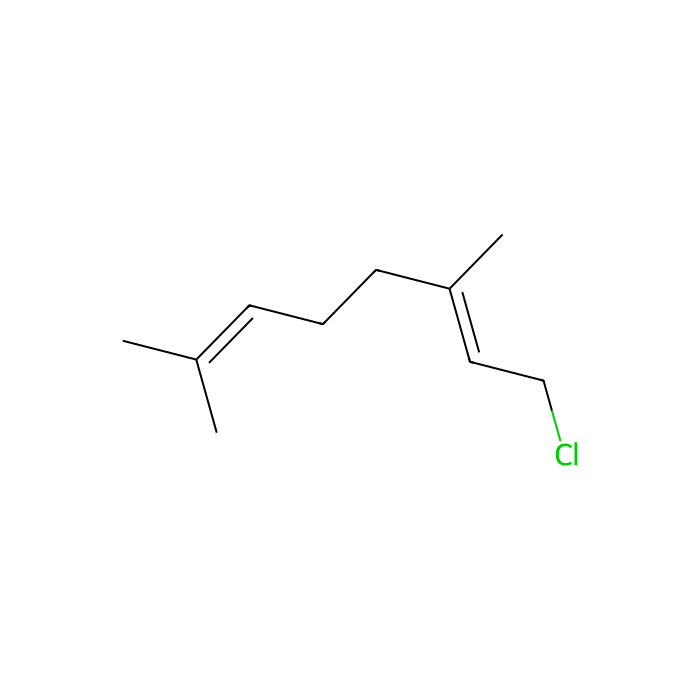
Geranyl chloride is an allylic, terpenoid-derived electrophile corresponding to the 3,7-dimethyl-2,6-octadien-1-yl chloride skeleton (the chloride replaces the primary alcohol of geraniol).
Item-specific identifiers from Product Data:
SKU: G118377
CAS: 5389-87-7
InChIKey: Not specified for this item; refer to CoA/Spec Sheet. (value provided appears incomplete in source)
SMILES: Not specified for this item; refer to CoA/Spec Sheet.
Functional groups: primary allylic chloride; two isolated E-alkenes (2,6-diene); two isopropenyl-like methyl substituents at C-3 and C-7 (terpenoid motif)
Structural features (2D description): a linear C8 backbone bearing double bonds at C2–C3 and C6–C7; methyl groups at C3 and C7; a primary CH2–Cl at C1. The allylic chloride is conjugated to the C2–C3 double bond, enabling SN1/SN2′ reactivity.
Stereochemistry: commonly supplied as the E-isomer at the 2- and 6-alkene positions (geranyl configuration) in contrast to the neryl (Z) isomer (literature). Commercial materials may contain minor neryl/isomerization content depending on synthesis and storage (literature).
Synthetic Utility
Reactivity stems from its primary allylic chloride and conjugated diene system (literature/general):
Allylic electrophile behavior:
Under SN2 conditions, substitution occurs at C1 (primary carbon). Under SN2′ conditions, nucleophilic attack at the γ-position (C3) provides rearranged products with geranyl/neryl interconversion.
Carbocation formation (SN1) generates a resonance-stabilized allylic cation; capture by weak nucleophiles (e.g., arenes, water, alcohols) occurs under Lewis/Brønsted acid catalysis.
Organometallic entry:
Preparation of geranylmagnesium chloride enables addition to carbonyls, opening epoxides, or subsequent cross-couplings after transmetalation (e.g., Negishi/Kumada variants; literature).
Named/related transformations:
Friedel–Crafts prenylation of aromatics.
Tsuji–Trost-type allylic substitution more commonly uses acetates/carbonates; chloride can be used with more active catalysts/ligands.
Copper-catalyzed allylic substitution (S_N2′-selective) with soft nucleophiles.
Phase-transfer catalysis for alkylation of anions (e.g., enolates, malonates) to install prenyl fragments.
Retrosynthetic value:
Direct handle to introduce geranyl units onto N, O, S, and C nucleophiles; flexible access to both geranyl and neryl architectures via isomerization control.
Target Specificity
Not applicable. This product is a small-molecule reagent, not a biological targeting reagent or antibody. No antigen/epitope, clone, isotype, or species reactivity applies.
Utilizziamo i cookie per garantire il corretto funzionamento del sito web e, ove consentito, per migliorare la tua esperienza. Puoi gestire le tue preferenze in qualsiasi momento nelle Impostazioni. Per saperne di più, consulta la nostra Cookie Policy.
Shall we send you a message when we have discounts available?
Remind me later
Thank you! Please check your email inbox to confirm.
Products are supplied to verified businesses, institutions, and qualified professionals for research and development use only. Not for use in humans, animals, diagnosis, or therapy.

 K2222453