QUALITÀ & PUREZZAMoligand™?Moligand™ — Aladdin's line of ligands and bioactive small molecules. Use for receptor, pathway, and binding studies needing defined small-molecule tools.≥98%
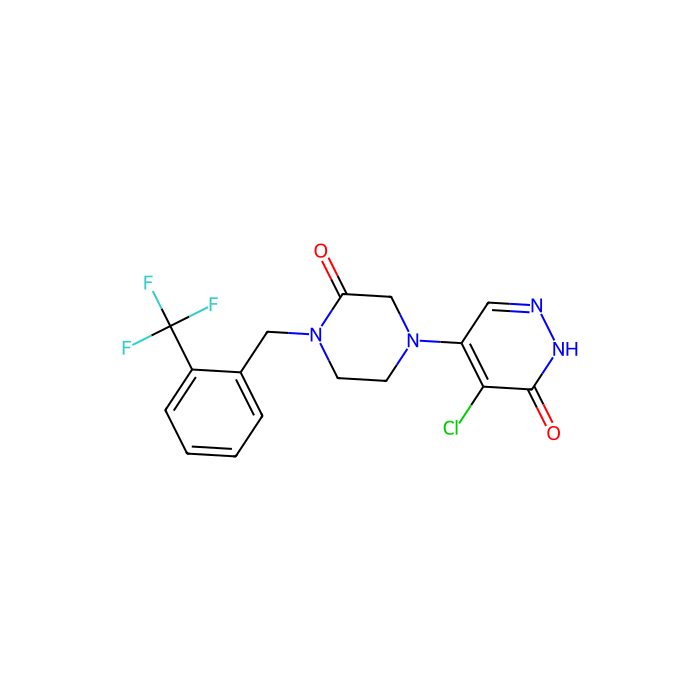
GFB-8438 GFB-8438 is a novel, potent, and subtype selective TRP channel subfamily C (TRPC) inhibitor that is equipotent against TRPC4 and TRPC5 with IC50 of 0.18 μM and 0.29 μM, and shows excellent selectivity against TRPC6, other TRP family members , NaV 1.5, as well as limited activity against the hERG channel .
GFB-8438 is a novel, potent, and subtype selective TRP channel subfamily C (TRPC) inhibitor that is equipotent against TRPC4 and TRPC5 with IC50 of 0.18 μM and 0.29 μM, and shows excellent selectivity against TRPC6, other TRP family members , NaV 1.5, as well as limited activity against the hERG channel.
Condizioni di conservazione di stoccaggio
Store at -20°C
Spedito in
Ice chest + Ice pads
Questo prodotto richiede spedizione a catena fredda. I servizi di terra e altri servizi economici non sono disponibili.
This compound belongs to the class of organic compounds known as n-arylpiperazines. These are organic compounds containing a piperazine ring where the nitrogen ring atom carries an aryl group.
External Descriptors
Not available
1. Djoumbou Feunang Y, Eisner R, Knox C, Chepelev L, Hastings J, Owen G, Fahy E, Steinbeck C, Subramanian S, Bolton E, Greiner R, and Wishart DS. ClassyFire: Automated Chemical Classification With A Comprehensive, Computable Taxonomy. Journal of Cheminformatics, 2016, 8:61.
Determine the necessary mass, volume, or concentration for preparing a solution.
Dilution Calculator
Determine the dilution needed to prepare a stock solution.
Reconstitution Calculator
Recensioni
Recensioni dei clienti
Application Protocols
No vendor-tested applications or protocols are provided in the Product Data for this item.
General assay setup guidance (for small-molecule ligands):
Stock solutions: Prepare 10–50 mM stocks in anhydrous DMSO. Vortex and, if necessary, sonicate briefly to ensure complete dissolution. Filter-sterilize (0.2 µm PTFE) if required by your assay.
Plate formatting: For 96/384-well plates, pre-dilute stocks to intermediate concentrations to improve pipetting accuracy at low final volumes.
Controls: Include vehicle-only controls at matched DMSO %, positive controls (if available), and unrelated negative controls to assess assay specificity.
Curve fitting: Generate 8–12 point concentration–response curves (typically 1:3 or 1:2 serial dilutions) with at least triplicate technical replicates for robust parameter estimation.
Adsorption mitigation: Use low-binding plastics; consider 0.1% BSA in buffers if hydrophobic adsorption is suspected.
Data integrity: Record lot number, preparation date, and storage history for each stock used.
Any application-specific dilutions, positive controls, or detection settings: Not specified for this item; refer to CoA/Spec Sheet or develop per your institutional SOPs.
Biological Roles
Item-specific biological targets or mechanisms are not provided in the Product Data for GFB-8438. The following guidance addresses general roles of small-molecule ligands in research workflows without making target-specific claims.
Chemical probes and ligands are used to modulate protein function (enzymes, receptors, ion channels, transporters) to interrogate signaling pathways and cellular phenotypes.
In discovery biology, paired active/inactive analogs and concentration–response experiments help establish causality between compound exposure and observed phenotypes.
Time-dependent studies (acute vs. chronic dosing) and washout experiments can differentiate reversible from irreversible effects and on-target from adaptive responses.
Orthogonal readouts (biochemical activity, target engagement via CETSA/DSF, localization by imaging, and transcript/proteomic signatures) strengthen mechanism hypotheses.
For absorption and distribution considerations in cells, solvent content, serum protein binding, and efflux transporter interactions can influence effective intracellular concentrations; design controls accordingly.
Recommendations:
Before large-scale deployment, run a physicochemical and liability screen (solubility at assay pH, apparent permeability in cell lines if relevant, redox activity, PAINS substructure checks) using your internal protocols.
If the compound will serve as a reference tool, document the exact lot, formulation, and handling practices (vehicle, concentration, exposure time), as these can substantially affect biological outcomes.
Note: For any specific target annotations (Ki, IC50, selectivity), consult the CoA/Spec Sheet or primary literature tied to the CAS/CID, ensuring alignment with this exact SKU/lot.
Buffer Applications
This product is not a buffer reagent. However, buffers are central to preparing working solutions for biological assays using small-molecule ligands.
Practical buffer guidance (general):
Common assay buffers: PBS (pH 7.2–7.4), HEPES-buffered saline (pH 7.2–7.6), or Tris-buffered saline (TBS; pH 7.4–8.0). Choose based on assay compatibility (e.g., Tris can interfere with some enzyme assays and metal-binding proteins).
DMSO carryover: Maintain final DMSO at ≤0.1–0.5% v/v where possible to limit solvent effects. Pre-mix ligand stock (in DMSO) with a small aliquot of buffer before final dilution to avoid local supersaturation and precipitation.
Surfactants: If precipitation occurs, 0.01–0.05% non-ionic surfactant (e.g., Pluronic F-127 or Tween-20) may improve solubility; confirm no interference with readout.
Protein supplements: 0.1–0.5% BSA can reduce nonspecific adsorption to plastics/glass and stabilize hydrophobic ligands; verify assay tolerance.
Tips for reproducibility:
Use identical buffer composition across vehicle and compound-treated wells.
Equilibrate buffers and stocks to the same temperature prior to dosing.
Document pH after final mixing; some ligands show pH-dependent stability or activity.
Item-specific buffer compatibility: Not specified for this item; refer to CoA/Spec Sheet for any stated incompatibilities.
Green Alternatives
As a screening ligand, the main “green chemistry” considerations relate to solvent use, mass efficiency, and assay design rather than substituting the compound itself.
Greener solvent practices (general):
Prefer DMSO for stock solutions over more hazardous dipolar aprotics (e.g., DMF, NMP) when solubility allows.
Minimize solvent volumes and final assay % v/v; design assays to function at ≤0.1% DMSO when feasible to reduce solvent load and potential biological perturbation.
Use aqueous buffers as the bulk phase and adopt miniaturized formats (e.g., 384/1536-well plates) to reduce per-experiment solvent consumption.
Comparison (literature/practice):
DMSO vs DMF:
DMSO: Broad solvency, relatively favorable EHS profile; common in HTS; miscible with water.
DMF: Strong solvency but reproductive toxicity concerns; avoid unless necessary for dissolution.
Ethanol/isopropanol: Renewable feedstocks possible; volatile and flammable; maintain adequate ventilation and limit to low final %.
Operational tips:
Implement solvent recycling for plate washing where infrastructure exists.
Use amber vials and low-permeability plate seals to reduce evaporation and waste.
Right-size batch preparations (only what is needed for a campaign) to minimize expired/unused material.
Note: No greener “substitute compound” can be proposed without a defined target profile; consult your sustainability office for program-level guidance.
Pharmaceutical Uses
No pharmacopeial grade or excipient designation is provided for this product. GFB-8438 (Moligand™ grade) is intended for research use only and not for human or veterinary use.
Context in pharmaceutical R&D (general, non-clinical):
Employed as a discovery tool compound or reference ligand in target validation, hit-to-lead benchmarking, and early ADME/Tox assays.
Can support SAR exploration by providing a comparator in biochemical or cellular assays and aiding in defining desired target modulation profiles.
Utilized in formulation screening at micro-scale (e.g., DMSO or aqueous cosolvent systems) to study solubility limits and stability under assay-relevant conditions.
Considerations for preclinical workflows:
Record exact lot and purity from the CoA for data integrity; any change in lot should trigger a brief re-qualification (identity/purity/solubility).
For in vivo enabling studies (if contemplated in your program), a different grade and expanded QC package are typically required; this listing does not supply that. Coordinate with your institutional sourcing and QA teams.
Regulatory note:
This material is not produced to GMP and has no assigned pharmacopeial monograph. It must not be used for manufacturing, clinical studies, or as an API/excipient.
Physical Properties
Item-specific physicochemical data have not been provided for this listing.
Appearance: Not specified for this item; refer to CoA/Spec Sheet.
Molecular weight: Not specified for this item; refer to CoA/Spec Sheet.
Molecular formula: Not specified for this item; refer to CoA/Spec Sheet.
Melting point (MP): Not specified for this item; refer to CoA/Spec Sheet.
Boiling point (BP): Not applicable/unknown for a library solid; refer to CoA/Spec Sheet.
Density: Not specified for this item; refer to CoA/Spec Sheet.
LogP, pKa, refractive index: Not specified for this item; refer to CoA/Spec Sheet.
Solubility profile: Not specified for this item; refer to CoA/Spec Sheet.
General guidance for small-molecule library compounds (literature/practice):
Stock solutions are commonly prepared in anhydrous DMSO (e.g., 10–50 mM), then diluted into aqueous buffers to ≤0.1–0.5% v/v DMSO for biochemical or cell-based assays to minimize solvent effects.
Many heteroatom-containing drug-like ligands exhibit improved solubility with co-solvents such as DMF, ethanol, or with aqueous buffers containing 0.01–0.1% non-ionic surfactant (e.g., Pluronic F-127) — confirm compatibility with your assay.
If hygroscopic or polyfunctional, drying under vacuum over P2O5 or silica in a desiccator prior to weighing can improve accuracy; confirm with the CoA before applying heat or vacuum.
Quality and Grades
Grade/Purity: Moligand™ (item-specific). Moligand™ denotes a screening-grade, bioactive small-molecule ligand suitable for discovery biology, primary/secondary assays, and chemical biology tool development. It emphasizes identity confirmation and suitability for high-throughput use rather than chromatographic or spectroscopic solvent grades.
What Moligand™ typically implies (general guidance):
Identity verification by modern spectroscopic/spectrometric techniques (e.g., NMR/MS/HRMS) appropriate for a screening ligand. Actual test suite and acceptance criteria are lot-specific—see CoA/Spec Sheet.
Purity sufficient for biological screening. Trace impurity limits (e.g., metal content, residual solvents) are not specified here and should be confirmed on the CoA if these are critical to your assay.
Format commonly compatible with microplate operations (e.g., pre-weighed or massed solids suitable for DMSO dissolution).
Item-specific notes:
Purity, water content, residual solvent profile, and counterion/salt form: Not specified for this item; refer to CoA/Spec Sheet.
Stabilizers/inhibitors: Not specified for this item; refer to CoA/Spec Sheet.
Intended use: For research use only (item-specific). Not for diagnostic or therapeutic applications.
Recommendations for QC on receipt:
Record lot number and reconcile CAS/CID with your ELN.
If using in SAR, run an orthogonal identity check (e.g., LC–MS, exact mass) and a quick purity assessment (LC–UV) to confirm suitability for your workflows.
Reaction and Applications
This product is supplied as a bioactive small-molecule research ligand for screening and probe development, rather than as a synthetic reagent. Consequently, classical synthetic reaction families (e.g., cross-couplings, Grignard, reductions) are not the primary use case.
Research applications (general, non-target-specific):
Primary/secondary screening in biochemical and cell-based assays to evaluate pathway modulation.
Tool-compound studies to benchmark phenotypic responses and support target validation when used alongside orthogonal chemotypes.
Mechanistic studies (e.g., time-course, dose–response, washout, chemical rescue) to characterize on-target vs. off-target effects.
Practical guidance:
Prepare concentrated DMSO stocks (e.g., 10–50 mM), verify solubility visually and by analytical LC.
Establish assay windows with a small solvent-tolerance study (0.03–1.0% DMSO) to balance solubility and biological tolerance.
Include vehicle and unrelated-ligand controls; use matched inactive analogs where possible to deconvolute assay artifacts.
If light or oxidation sensitivity is suspected (check CoA/SDS), conduct handling in amberware under inert gas when feasible and minimize freeze–thaw cycles.
If you intend to derivatize or immobilize the molecule for chemoproteomics or target-pull-down studies, consult the detailed structure on the CoA to identify vector positions and functional handles; none are provided in this listing.
Reaction Conditions
Not typically applicable. GFB-8438 is provided for use as a bioactive research ligand in biological assays, not as a reagent or substrate for synthetic transformations.
If you plan to modify the molecule (general guidance):
Select conditions based on the confirmed functional groups in the authenticated structure (consult CoA/literature). Pilot reactions on ≤5–10 mg scale with analytical LC–MS monitoring are recommended.
Maintain inert atmosphere and anhydrous solvents if moisture-sensitive moieties are present; avoid strong acids/bases or high temperatures until stability is established.
For biological testing conditions (general):
Stock preparation: 10–50 mM in anhydrous DMSO; store aliquots at −20 °C to avoid repeated freeze–thaw cycles.
Working concentrations: Define empirically using concentration–response curves and appropriate vehicle controls; final DMSO typically ≤0.1–0.5% v/v.
Incubation times and temperatures: Tailor to assay type (e.g., 15–60 min preincubation for biochemical targets; 2–24 h for cell-based readouts), ensuring compound stability over the assay window.
Safety and Handling
Safety information specific to this item has not been provided in the Product Data.
GHS classification, signal word, hazard statements, pictograms: Not specified for this item; refer to the SDS.
General laboratory precautions (good practice):
Wear appropriate PPE: lab coat, safety glasses, and suitable chemically resistant gloves (e.g., nitrile). Handle in a well-ventilated fume hood when weighing solids or preparing stocks.
Avoid inhalation of dusts/aerosols and contact with skin/eyes. Prevent ingestion.
Wash thoroughly after handling; avoid contamination of common surfaces.
Storage incompatibilities: Until specific data are available, segregate from strong oxidizers, strong acids/bases, and reactive reducing agents. Store tightly capped under inert headspace if repeatedly accessed.
First aid (overview; defer to SDS for authoritative guidance):
Inhalation: Move to fresh air; seek medical attention if symptoms persist.
Skin/eye contact: Rinse with water for several minutes; remove contaminated clothing; seek medical attention as needed.
Ingestion: Rinse mouth; do not induce vomiting unless directed by medical personnel.
Spill and disposal: Absorb small spills with inert material; collect for chemical waste. Dispose of contents/container in accordance with institutional and governmental regulations.
Note: As a research-only small molecule, hazard characterization may be limited. Always consult the official SDS for your received lot before first use.
Solvent Selection
Given the typical use of screening ligands, dissolution into DMSO is generally recommended unless otherwise specified on the CoA.
Primary vehicle (practice):
DMSO (anhydrous) for concentrated stocks (e.g., 10–50 mM). Filter-sterilize if needed through PTFE/nylon (0.2 µm) after complete dissolution.
DMF, ethanol, or isopropanol can assist dissolution for certain scaffolds; confirm that final solvent concentration is tolerated by your biological system.
Aqueous dilution:
Dilute DMSO stocks into assay buffers to ≤0.1–0.5% v/v DMSO to reduce solvent artifacts. Pre-warm to room temperature for homogeneous mixing and minimize precipitation.
Buffer compatibility:
Common assay buffers include PBS, HBSS, HEPES-buffered saline, or Tris-based buffers. Avoid high ionic strength or divalent cation levels if precipitation is observed; pre-test solubility at working concentrations.
Quick comparison (general):
DMSO: Broad solvating power; widely accepted in biochemical/cell assays; may affect membrane integrity >0.5–1% v/v.
DMF: Strong solvent but more cytotoxic; use sparingly at very low final %.
Ethanol: Volatile; good for some hydrophobic compounds; may denature proteins above ~1–2% v/v.
Practical tips:
Sonication and brief gentle heating (≤40 °C) can aid dissolution; avoid prolonged heating or light exposure unless supported by CoA stability data.
Document final vehicle and concentration in reports for reproducibility.
Storage and Reconstitution
Storage Conditions (item-specific): Store at −20 °C.
Shipping (item-specific): Ice chest + Ice pads.
Research Use: For research use only.
Reconstitution and handling (general for small-molecule ligands):
Upon receipt, allow the sealed container to equilibrate to room temperature before opening to prevent moisture condensation.
If supplied as a solid: Quickly weigh the required amount, then immediately recap and return to −20 °C storage in a desiccated environment. Consider aliquoting under dry inert gas to minimize headspace humidity.
If supplied as a solution: Verify concentration and solvent on the label/CoA. Store as directed and avoid repeated freeze–thaw.
Stock preparation: Dissolve in anhydrous DMSO to 10–50 mM. Mix thoroughly until clear. Optional: pass through a 0.2 µm PTFE filter.
Aliquoting: Prepare single-use aliquots in amber vials or low-bind tubes to avoid multiple freeze–thaw cycles and light exposure. Label with lot, concentration, date.
Working solution stability: Assess stability in your chosen buffer and at assay temperature/time by LC–MS or LC–UV if the program is data-critical.
Item-specific stability, hygroscopicity, light sensitivity, and permissible freeze–thaw cycles: Not specified for this item; refer to CoA/Spec Sheet for lot-specific guidance.
Structure and Identity
Brief description: GFB-8438 is supplied as a Moligand-grade small-molecule research ligand from Aladdin’s small-molecule library. Item-specific structural identifiers in the supplied Product Data are incomplete.
SMILES: Not specified for this item; refer to CoA/Spec Sheet.
Molecular formula: Not specified for this item; refer to CoA/Spec Sheet.
Molecular weight: Not specified for this item; refer to CoA/Spec Sheet.
Structural features (general guidance):
This product is categorized under “small molecules and compound libraries.” In the absence of an item-specific structure, no definitive functional-group description can be provided here.
If you require stereochemistry, functional group inventory, or ring-system information, please request the current CoA/Spec Sheet tied to this exact lot.
Notes on identifiers:
CAS and PubChem CID typically uniquely define the structure in external databases. Cross-verify these identifiers in your ELN/LIMS before building assays to ensure target alignment.
Any structural depictions used in publications should be sourced from the official CoA/SDS to ensure correct registry alignment with GFB-8438 (SKU G412526).
Synthetic Utility
This product is supplied as a finished small-molecule research ligand rather than a building block. No functional-handle information or derivatization guidance is provided in the Product Data.
General considerations (if derivatization is contemplated):
Consult the CoA/SDS or primary literature tied to the CAS/CID to review functional groups and potential vector positions for tagging (e.g., biotinylation, photoaffinity labels, alkyne/azide handles for click chemistry).
Evaluate synthetic tractability, stability of the core scaffold to common protection/deprotection conditions, and tolerance to coupling methodologies prior to planning analog synthesis or immobilization strategies.
For chemoproteomics or pull-down applications, prioritize linkers that minimize perturbation of the putative pharmacophore; validate activity of conjugates versus the parent compound.
Item-specific reactivity, named-reaction compatibility, or protecting-group strategies: Not specified for this item; refer to CoA/Spec Sheet and relevant literature for this exact compound.
Target Specificity
Item-specific target, selectivity, and potency data are not provided in the Product Data for GFB-8438.
Target class, primary target(s), off-target profile, species selectivity, and mechanism of action: Not specified for this item; refer to CoA/Spec Sheet and primary literature aligned to the stated CAS/CID.
If you require a verified reference on target specificity for your studies, please request the latest lot-specific documentation or contact technical support with the SKU (G412526) for assistance.
Note: To avoid data integrity issues, ensure any external target annotations you use are explicitly matched to the same structural identity, salt form, and lot as supplied here.
Domande frequenti
What is the purity of this product?
This product is supplied at ≥98% purity (chemical assay). Lot-specific values are stated on the Certificate of Analysis.
What is Moligand??
Moligand? is one of Aladdin Scientific's premium product lines, formulated for high-purity applications across multiple workflows. Compared to standard grades in the same workflow, Moligand? products typically offer tighter specifications, more rigorous QC, and stronger lot-to-lot consistency.
How should this product be stored?
Store at ?20 °C. Freezer storage is required to maintain the specified shelf life.
How is this product shipped?
This product ships in an insulated container with ice pads. Unpack on arrival and transfer it to the storage condition stated above.
What are the CAS number, molecular formula and molecular weight?
The CAS Number is 2304549-73-1, the molecular formula is C16H14ClF3N4O2, and the molecular weight is 386.76 g/mol. InChIKey MITRKIWBJVJRAM-UHFFFAOYSA-N.
What documentation is provided?
Available product documentation, including Certificates of Analysis (COA), Safety Data Sheets (SDS), and specification sheets, is shown in the product document area. Document availability and access follow the current site policy.
Hai bisogno di aiuto per scegliere la qualità?
La nostra guida alla selezione delle qualità copre purezza, stato dello stabilizzatore e idoneità all'applicazione per tutte le varianti del nostro catalogo.
Utilizziamo i cookie per garantire il corretto funzionamento del sito web e, ove consentito, per migliorare la tua esperienza. Puoi gestire le tue preferenze in qualsiasi momento nelle Impostazioni. Per saperne di più, consulta la nostra Cookie Policy.
Desidera che le inviamo un messaggio quando avremo sconti disponibili?
Ricordamelo più tardi
Grazie! Controlli la sua casella di posta per confermare.
Products are supplied to verified businesses, institutions, and qualified professionals for research and development use only. Not for use in humans, animals, diagnosis, or therapy.

 G2221042