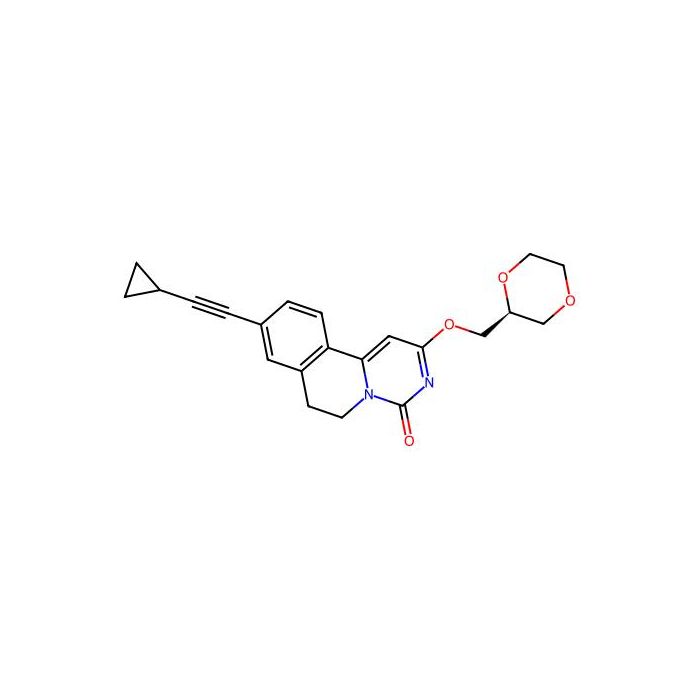
10mM in DMSO per flussi di lavoro cromatografici e analitici sensibili che richiedono un'interferenza minima della linea di base.
🌡
Stoccaggio e spedizione
Store at -80°C Spedizione Dry ice packs + Cold packs. Consultare il COA specifico del lotto per le specifiche esatte.
📋
Documenti di qualità
SDS, COA, scheda tecnica e scheda delle specifiche disponibili per il download. COA specifico del lotto accessibile tramite ricerca per numero di lotto.
📚
Prova documentale
Citato in 0 pubblicazioni peer-reviewed su cromatografia, sintesi organica e reazioni di accoppiamento incrociato.
Panoramica
GLPG1205 is potent, selective and orally active GPR84 (a G-protein-coupled receptor) antagonist with a favorable PK/PD profile. GLPG1205 has anti-inflammatory activity and is used for the treatment of pulmonary fibrosis.
In Vitro
GLPG1205 (0.5 μM) completely inhibits the ZQ16-induced [Ca 2+ ]i response in neutrophils. GLPG1205 (1 μM; for 5 min) completely blocks the ROS-response induced by the GPR84-agonist. GLPG1205 can potently antagonizes ZQ16-induced ROS with an IC 50 value of 15 nM in TNF-α primed neutrophils. MCE has not independently confirmed the accuracy of these methods. They are for reference only.
In Vivo
GLPG1250 (orally adminstation; 30mg/kg; twice daily) for 2 weeks, starts from 7 days post-challenge,greatly reduces the Ashcroft score, in idiopathic pulmonary fibrosis model. GLPG1250 (orally adminstation; 30mg/kg; once daily) starts from 18 weeks post irradition, significantly reduces college deposition in the mouse lung. Additionlly, GLPG1250 inhibits the increase in MnSOD in lung bronchial epithelial cells and parenchymal macrophages, in the irradiation model. GLPG1205 dose dependently decreases disease activity, histological activity, neutrophil influx and colonic MPO content,in a mouse IBD model. MCE has not independently confirmed the accuracy of these methods. They are for reference only.
Specifiche
Specifiche e purezza
10mM in DMSO
Meccanismi biochimici e fisiologici
GLPG1205 is potent, selective and orally active GPR84 (a G-protein-coupled receptor) antagonist with a favorable PK/PD profile. GLPG1205 has anti-inflammatory activity and is used for the treatment of pulmonary fibrosis.
Condizioni di conservazione di stoccaggio
Store at -80°C
Spedito in
Dry ice packs + Cold packs
Questo prodotto richiede spedizione a catena fredda. I servizi di terra e altri servizi economici non sono disponibili.
Certificati (CoA, COO, BSE/TSE e tabella di analisi)
C of A & Other Certificates(BSE/TSE, COO):
Analytical Chart:
Calcolatori di soluzioni
Molarity Calculator
Determine the necessary mass, volume, or concentration for preparing a solution.
Dilution Calculator
Determine the dilution needed to prepare a stock solution.
Reconstitution Calculator
Recensioni
Recensioni dei clienti
Application Protocols
Validated, item-specific protocols are not provided. The following general workflows reflect common practice for small-molecule tool compounds in discovery research.
DMSO master stock (example):
Allow vial to equilibrate to room temperature in a desiccator before opening.
Accurately weigh compound in a dry vial; add DMSO to achieve 10–50 mM. Vortex until fully dissolved; brief sonication if necessary.
Aliquot into low-bind microtubes to minimize freeze–thaw; label with concentration, lot, and date.
Serial dilutions:
Prepare intermediate DMSO dilutions to reduce precipitation on aqueous addition.
For 384-well cell assays, target final DMSO 0.1–0.5% with matched vehicle controls.
Assay interference checks:
For optical assays, record compound spectra to detect overlap with readout wavelengths.
Include detergent where appropriate to limit aggregation-based artifacts; confirm with detergent sensitivity tests.
Stability controls:
Analyze pre- and post-assay samples by LC–MS/HPLC to confirm integrity and concentration.
These are general recommendations; optimize for your assay format, cells, and detection technology.
Biological Roles
Item-specific biological target and mechanism are not provided in this listing. GLPG1205 should be treated as a research tool compound whose biological profile must be established or verified by the user for the intended system.
General context for small-molecule research tools (non–item-specific):
Pathway interrogation: Small molecules can modulate protein function to probe signaling cascades, metabolic routes, or transcriptional programs in cells and biochemical systems.
Selectivity considerations: Apparent potency can be confounded by off-target binding or assay interference; orthogonal assays (e.g., biophysics, chemoproteomics) are recommended to confirm on-target effects.
ADME traits (conceptual): Solubility, permeability, and stability influence observed activity. Validate compound stability in assay media and, for cellular work, consider efflux/uptake transporters.
Controls: Employ positive/negative controls and verify that phenotypes are reproduced across multiple concentrations and time points to deconvolute target-specific effects from cytotoxicity or solvent artifacts.
Note: For definitive biological role(s), consult primary literature associated with the CAS or CID provided, and corroborate with your in-house data.
Buffer Applications
GLPG1205 is not a buffering reagent. However, it is commonly used in buffered systems for biochemical and cellular assays. Practical considerations:
Vehicle control: Match the final DMSO (or other cosolvent) percentage in all test and control wells (e.g., 0.1–0.5% v/v) to isolate compound-specific effects.
Order of addition: Add GLPG1205 DMSO stock last, with rapid mixing, to minimize local supersaturation. For high-throughput formats, use acoustic or pin-tool dispensing for precision at low volumes.
Precipitation checks: After dilution into PBS/HEPES/Tris-based buffers, visually inspect clarity and, where critical, verify by light scattering or microfiltration (0.22 µm) before running assays.
pH stability: The pH stability profile is not specified for this item. Avoid extreme pH unless verified by stability testing (HPLC/LC–MS).
Protein binding: High serum or BSA content can sequester hydrophobic compounds; titrate protein levels and consider equilibrium dialysis if free concentration is critical.
Green Alternatives
While GLPG1205 itself is a fixed structure, greener choices can be made in its handling and assay workflows.
Solvent choices (general):
Prefer DMSO and ethanol over high-toxicity dipolar aprotics (DMF/NMP) whenever solubility allows.
For method development, consider bio-based solvents (e.g., Cyrene, 2-methyltetrahydrofuran) for non-biological steps; confirm compound stability/solubility first.
Formulation aids: Hydroxypropyl-β-cyclodextrin (HP-β-CD) or PEG-400/water systems can reduce reliance on harsh solvents during in vivo research formulations (research use only).
Process minimization: Design experiments to use minimal solvent volumes (high-concentration master stocks, miniaturized assays), and segregate solvent waste for appropriate disposal/recovery.
DMSO: good solvency, low volatility, widely accepted in bioassays; downside is persistence in the environment—minimize releases.
Ethanol: renewable, low toxicity; limited capacity for very lipophilic compounds.
DMF/NMP: strong solvency but reproductive toxicity concerns; reserve for last resort.
Packaging and shipping:
Product is shipped on dry ice + cold packs (from Product Data), which helps reduce degradation and waste from re-runs. Consolidate shipments and promptly transfer to specified storage to minimize cold-chain losses.
Pharmaceutical Uses
No excipient role, pharmacopeial status, or formulation specifications are provided for this item. GLPG1205 is offered strictly for research use only.
Research and development context (general, non–clinical):
Preformulation screening: Solubility, stability (thermal/light/oxidation), and polymorph assessment to inform assay conditions or exploratory formulation studies.
Enabling formulations (research only): DMSO/aqueous cosolvent systems, PEG-400 blends, cyclodextrin complexes, or lipid-based vehicles to achieve target concentrations in non-clinical models.
Analytics: Develop LC–UV/LC–MS methods for potency, purity, and degradation profiling. Forced-degradation studies can map stability-indicating conditions.
No medical or therapeutic claims are made or implied for this product.
Physical Properties
Item-specific physicochemical parameters are not provided in this listing. Where exact values matter to your workflow, please consult the CoA/Spec Sheet or measure under your lab conditions.
Appearance: Not specified for this item; refer to CoA/Spec Sheet.
Melting point (mp): Not specified for this item; refer to CoA/Spec Sheet.
Boiling point (bp): Not applicable/rarely reported for complex bioactive solids; Not specified for this item.
Density: Not specified for this item; refer to CoA/Spec Sheet.
Solubility: Not specified for this item; refer to CoA/Spec Sheet. Practical guidance: small, aromatic bioactives are commonly dissolved first in anhydrous DMSO to prepare concentrated stock solutions, then diluted into aqueous assay media with attention to final cosolvent percentage.
LogP/logD, pKa, refractive index: Not specified for this item; refer to CoA/Spec Sheet.
General notes for handling small-molecule tool compounds (non–item-specific):
Begin with a small-scale solubility screen (e.g., DMSO, DMF, ethanol) before making bulk stocks.
If aqueous use is required, consider co-solvent strategies (0.1–1% DMSO in buffers) or cyclodextrin-enabled solubilization. Filter sterilize (0.22 µm) as needed.
Record concentration by gravimetry and/or UV if an extinction coefficient is available (not provided here).
Quality and Grades
Item-specific grade or purity is not listed. For this catalog family (small molecules/compound libraries), quality control typically emphasizes identity and purity suitable for screening and target-validation workflows.
Grade/Purity (this item): Not specified for this item; refer to CoA/Spec Sheet.
Typical QC for small-molecule tools (general information):
Identity confirmation by LC–MS and/or 1H NMR; sometimes 13C NMR and HRMS.
Chromatographic purity typically assessed by HPLC/UPLC with UV/ELSD; impurities are reported as area % at a defined wavelength and method.
Water content (Karl Fischer) and residual solvent analysis may be provided for solid isolates; not specified here for this item.
Why this matters:
High chemical purity reduces off-target assay artifacts.
Low UV background is important for optical readouts; matched solvent blanks are recommended regardless of grade.
Documentation: Certificate of Analysis (CoA) and/or Specifications Sheet will provide definitive batch-level details (purity assay, analytical methods, acceptance criteria). Request these documents for regulated or tightly controlled workflows.
Stabilizers/antioxidants: Not specified for this item; refer to CoA/Spec Sheet if applicable.
Reaction and Applications
This product is supplied as a finished small-molecule tool compound and is not typically employed as a synthetic reagent. Accordingly, classical reaction roles (e.g., base, ligand, coupling partner) do not apply.
Research applications (general guidance for small-molecule probes):
Biochemical assays: Enzyme or receptor engagement studies, binding assays, and mechanistic evaluations. Prepare serial dilutions from a DMSO master stock; verify lack of assay interference (fluorescence/absorbance overlap) where applicable.
Cell-based assays: Pathway modulation and target validation. Maintain final DMSO at ≤0.2–0.5% to minimize solvent effects; include vehicle controls.
Target engagement/chemoproteomics (advanced): With appropriate analogs (not included), users may derivatize the core scaffold for pull-downs or photoaffinity studies. This specific item is the unmodified compound; derivatization details are not provided.
Stability checks: Assess compound integrity under assay conditions by LC–MS (pre/post incubation) to rule out degradation or adsorption.
If you intend to chemically modify GLPG1205 for SAR or probe development, obtain structural data from the CoA/literature and confirm synthetic feasibility and IP status prior to derivatization.
Reaction Conditions
Classical synthetic “reaction conditions” are not applicable—GLPG1205 is provided as a finished small-molecule tool compound rather than a reagent or coupling partner.
Assay preparation conditions (general guidance):
Stock preparation: Dissolve in anhydrous DMSO to 10–50 mM if solubility permits. Vortex and, if needed, sonicate briefly. Record concentration gravimetrically.
Dilution: Add to assay buffer/media to achieve target test concentrations while keeping final DMSO typically ≤0.2–0.5% for live cells (verify tolerance for your system). Mix thoroughly to avoid local precipitation.
Temperature/light: Prepare and handle at ambient temperature unless solubility dictates mild warming. Protect from prolonged light exposure as a precaution (item-specific photostability not provided).
Stability monitoring: Use LC–MS or HPLC to verify integrity after incubation under assay conditions (time-course samples).
All numeric, item-specific parameters (e.g., solubility limits, extinction coefficients) are not specified for this item; adjust empirically.
Safety and Handling
Hazard classification details are not provided in this listing. Always consult the SDS for authoritative safety information prior to use.
GHS classification / Pictograms / Signal word / H-statements: Not specified for this item; refer to SDS.
Primary use: For research use only (per Product Data). Not for human or animal diagnostic/therapeutic use.
General PPE: Laboratory coat, safety glasses, and appropriate chemically resistant gloves (e.g., nitrile). Work in a fume hood to avoid inhalation of dust or solvent vapors.
Handling advice:
Avoid generating dust/aerosols. Prevent contact with skin, eyes, and clothing.
Use dry tools and anhydrous solvents if preparing concentrated DMSO stocks; cap vials promptly to limit atmospheric moisture uptake.
Decontaminate benches and tools after use; segregate from food and incompatible materials.
Incompatibilities (general): Strong oxidizers and strong acids/bases may degrade many organic tool compounds. Avoid prolonged exposure to light, heat, and moisture.
First aid (overview; defer to SDS):
Inhalation: Move to fresh air; seek medical attention if symptoms occur.
Skin/eye contact: Rinse with water for several minutes; remove contaminated clothing; obtain medical advice if irritation persists.
Ingestion: Rinse mouth; do not induce vomiting; seek medical attention.
Waste: Collect organic solutions and contaminated disposables as hazardous chemical waste per institutional/EHS guidance.
Solvent Selection
Because detailed solubility data are not provided for this item, we recommend a short solubility screen using common laboratory solvents for bioactives.
Primary stock solvent (recommended workflow):
Start with anhydrous DMSO to prepare a concentrated stock (e.g., 10–50 mM) if solubility allows.
If DMSO is insufficient, test DMF or NMP, then consider ethanol/isopropanol. Avoid chlorinated solvents in biological assays.
Aqueous use:
Dilute DMSO stocks into buffer or media to a final DMSO of 0.1–0.5% for cells; up to ~1–2% may be acceptable in some biochemical assays (verify tolerance).
If precipitation occurs on dilution, increase mixing time, temperature (to ambient), or add non-ionic surfactants at very low levels where compatible.
Co-solvent strategies: Combine 5–20% PEG-400 or 2–10% ethanol with aqueous buffers for in vivo formulation development (research only); validate compatibility and osmolality.
Comparison (general):
DMSO: strongest solvating power for aromatic/heteroaromatic drugs; high bp; miscible with water.
DMF/NMP: potent solvents but higher EHS burdens—use only if required.
Ethanol/IPA: greener, volatile; limited capacity for highly lipophilic scaffolds.
Filtration: Use 0.22 µm PTFE or PES filters after dissolution to remove particulates prior to sensitive assays.
Storage and Reconstitution
Storage (as supplied): Store at −80°C (from Product Data). Keep container tightly closed in a dry, inert atmosphere. Avoid repeated warming cycles.
Shipping: Shipped on dry ice packs + cold packs (from Product Data). Upon receipt, inspect packaging integrity and promptly transfer to −80°C storage.
Reconstitution:
Bring the sealed vial to room temperature in a desiccator before opening to prevent moisture condensation.
Dissolve in anhydrous DMSO to prepare a concentrated stock (e.g., 10–50 mM) if solubility permits. Item-specific solubility not specified; determine empirically.
Optionally sterile-filter DMSO solutions (0.22 µm PTFE) for cell-based assays.
Aliquoting: Prepare single-use aliquots in low-bind tubes to avoid adsorption and minimize freeze–thaw.
Freeze–thaw guidance: Limit to a single freeze–thaw where possible. If multiple cycles are unavoidable, track cycle count and verify integrity by LC–MS/HPLC periodically.
Stability: No item-specific stability data (solution or solid) are provided; store frozen, dry, and protected from light as a precaution. For working solutions, keep on ice or at 2–8°C during use and discard after the session unless stability has been verified.
Documentation: Refer to CoA/Spec Sheet for any lot-specific notes on stability, solubility, or additional handling considerations.
Structure and Identity
Overview: GLPG1205 is supplied as a research-use small molecule (library/tool compound). Item-specific structural identifiers beyond CAS and PubChem CID are not provided in this listing.
Product name: GLPG1205
CAS: 1445847-37-9 (from Product Data)
PubChem CID: 71616860 (from Product Data)
InChIKey: Not specified for this item; refer to CoA/Spec Sheet.
SMILES: Not specified for this item; refer to CoA/Spec Sheet.
Molecular formula: Not specified for this item; refer to CoA/Spec Sheet.
Molecular weight: Not specified for this item; refer to CoA/Spec Sheet.
Structural features (general, non–item-specific guidance):
As a named small molecule tool compound, GLPG1205 is typically a heteroatom-containing, aromatic-rich organic scaffold designed for target engagement in biochemical/cellular assays. Exact ring systems, heterocycles, and functional groups for this catalog item are not disclosed here; consult the CoA/SDS for definitive identity data.
2D structure description (general):
Not specified for this item. When available, 2D line structures indicate the arrangement of aromatic cores, linker motifs, and hydrogen-bond donors/acceptors that drive potency and selectivity; please refer to supplier CoA or public databases (using the CAS/CID above) for the precise depiction.
Synthetic Utility
GLPG1205 is supplied as a final bioactive small molecule and is not primarily intended as a synthetic building block. Item-specific functional groups and handles for derivatization are not listed here.
General considerations if derivatization is desired (non–item-specific):
Probe development: With structural information (refer to CoA/literature), medicinal chemists may design analogs for SAR, photoaffinity, biotinylation, or click-compatible tags. Ensure that modifications preserve activity and do not disrupt key binding motifs.
Prodrugs and salts: Counter-ion selection or pro-moieties can tune solubility/permeability for research models; confirm chemical compatibility and stability.
IP and freedom-to-operate: Verify intellectual property constraints before synthesizing or using derivatives.
Because the precise functional group composition is not provided in this catalog entry, no specific named-reaction guidance is offered for this item.
Target Specificity
Target, selectivity profile, and potency values are not provided in this listing.
Item-specific data: Not specified for this item; refer to CoA/Spec Sheet and peer-reviewed literature indexed by CAS 1445847-37-9 or PubChem CID 71616860.
User guidance (general): Validate target engagement with at least two orthogonal methods (e.g., biochemical assay plus biophysical binding or cellular readout). Consider counterscreens to detect off-target activity and assay interference.
No claims about biological targets or specificity are made by this catalog entry.
Domande frequenti
How should this product be stored?
Store at ?80 °C. Ultra-low temperature storage is required to maintain the specified shelf life.
How is this product shipped?
This product ships frozen with dry ice and cold packs. Unpack on arrival and transfer it to the storage condition stated above; handle dry ice with insulated gloves in a ventilated area.
What are the CAS number, molecular formula and molecular weight?
The CAS Number is 1445847-37-9, the molecular formula is C22H22N2O4, and the molecular weight is 378.42 g/mol.
What documentation is provided?
Available product documentation, including Certificates of Analysis (COA), Safety Data Sheets (SDS), and specification sheets, is shown in the product document area. Document availability and access follow the current site policy.
Utilizziamo i cookie per garantire il corretto funzionamento del sito web e, ove consentito, per migliorare la tua esperienza. Puoi gestire le tue preferenze in qualsiasi momento nelle Impostazioni. Per saperne di più, consulta la nostra Cookie Policy.
Desidera che le inviamo un messaggio quando avremo sconti disponibili?
Ricordamelo più tardi
Grazie! Controlli la sua casella di posta per confermare.
Products are supplied to verified businesses, institutions, and qualified professionals for research and development use only. Not for use in humans, animals, diagnosis, or therapy.