≥60% for sensitive chromatographic and analytical workflows requiring minimal baseline interference.
🌡
Storage & shipping
Conservare a -20°C Ships Cassetta del ghiaccio + cuscini per il ghiaccio Check lot-specific COA for exact specifications.
📋
Quality documents
SDS, COA, datasheet, and spec sheet available for download. Lot-specific COA accessible via lot number lookup.
📚
Literature proof
Cited in 6 peer-reviewed publications across chromatography, organic synthesis, and cross-coupling reactions.
Panoramica
un derivato del carboidrato che aumenta la permeabilità della membrana nelle cellule di Glycine max Harosoy 63W. Il glicol chitosano aumenta la permeabilità di membrana e le perdite in cellule di Glycine max Harosoy 63w.
Determine the necessary mass, volume, or concentration for preparing a solution.
Dilution Calculator
Determine the dilution needed to prepare a stock solution.
Reconstitution Calculator
Recensioni
Recensioni dei clienti
Application Protocols
Item-specific (from Product Data)
Tested applications and recommended dilutions: Not specified for this item; refer to CoA/Spec Sheet.
General/literature protocols (examples; adjust to your lot’s MW/DS)
Preparation of sterile 1% w/v glycol chitosan solution
Add 1 g polymer to ~80 mL sterile water; stir at room temperature 1–2 h until dissolved; bring to 100 mL. Filter through 0.22 µm PES. Store aliquots at 4°C for short term or −20°C for long term.
EDC/NHS-mediated conjugation to a carboxylate ligand
Dissolve glycol chitosan at 2–5 mg/mL in 0.1 M MES, pH 6.0. Activate ligand (carboxylate) with equimolar EDC/NHS for 15–30 min; add to polymer; adjust pH to 7.2; react 2–6 h at RT. Dialyze (MWCO tuned to polymer MW) against water/PBS. Lyophilize if dry form is needed.
Formation of polyelectrolyte complexes (PECs) with DNA/RNA (screening-scale)
Prepare polymer and nucleic acid in the same low-salt buffer (e.g., 10 mM HEPES, pH 7.4). Mix at N/P ratios 5–20 by rapid pipetting; incubate 20–30 min before characterization (DLS, zeta potential). Optimize salt and N/P for stability.
Genipin-crosslinked hydrogel casting
Mix 1–3% w/v glycol chitosan with genipin (0.1–1 mM) in PBS, pH 7.4. Cast into molds; allow gelation at 25–37°C for 2–12 h. Rinse gels thoroughly to remove unreacted crosslinker.
Note: Parameters are starting points; tailor to the MW/DS of your specific lot and application.
Biological Roles
General/literature perspective (no clinical claims)
Origin: Chitosan is derived by deacetylation of chitin, a structural polysaccharide in arthropod exoskeletons and fungal cell walls. Glycol chitosan adds hydrophilic N-glycol substituents to improve solubility at physiological pH.
Biophysical properties: Cationic charge under mildly acidic to near-neutral pH supports electrostatic binding to negatively charged biomolecules (DNA/RNA, glycosaminoglycans) and surfaces (cell membranes, ECM components). Glycol groups modulate aggregation and can provide stealth-like hydration layers.
Biomolecular interactions: Forms polyelectrolyte complexes with anionic polymers (alginate, hyaluronan, DNA). Amine groups enable conjugation to peptides, proteins, and ligands for targeted delivery or imaging in research.
Enzymatic degradation: Susceptible to lysozyme and chitosanases; rate depends on degree of acetylation, substitution, and MW (literature). Degradation products (glucosamine derivatives) enter hexosamine pathways in biological systems.
Material functions: Used as a mucoadhesive, film-forming, and flocculating agent in laboratory studies; supports cell attachment when appropriately modified. Hydrogels and coatings from glycol chitosan are frequently explored for tissue engineering research.
Immunological profile: Generally recognized for low inherent immunogenicity in research settings; cationic nature can activate complement or cause membrane interactions depending on dose and MW (literature). Application-specific validation is recommended.
Note: All uses are for research and laboratory investigations only.
Buffer Applications
Applicability
Glycol chitosan is not a classical buffering agent. However, it is routinely dissolved and used in biological buffers; solution preparation and compatibility are central to performance.
Practical preparation (literature guidance)
Stock solutions: 1–10 mg/mL in water, PBS (pH 7.2–7.4), HEPES (pH 7.4), or MES (pH 6.0–6.5). Mix gently; allow time (30–120 min) for complete dissolution. Mild warming (room temperature to 37°C) can aid dissolution; avoid >50°C to limit depolymerization.
Sterilization: Filter sterilize through 0.22 µm PES or PVDF; pre-wet filter and, if needed, pre-filter through 0.45 µm to manage viscosity.
pH considerations: Apparent pKa of amines ~6–7; at pH above 7.5, reduced protonation may lower solubility for some DS/DDA profiles. Titrate pH only after polymer is fully dissolved.
Ionic strength: High salt (≥0.5 M) can screen charges and alter viscosity/complexation behavior. Optimize salt for desired polyelectrolyte interactions.
Additives: For conjugation, include buffering species with minimal nucleophilicity (e.g., MES, HEPES). Avoid Tris during NHS-ester reactions due to amine interference.
Compatibility notes
Enzymes/cells: Residual endotoxin/bioburden and small-molecule contaminants can affect bioassays; use endotoxin- and bioburden-controlled lots where required and confirm by CoA.
Storage of solutions: See Storage & Reconstitution for guidance on refrigerated/aliquoted storage.
Green Alternatives
Context
Glycol chitosan is itself a bio-based, renewable polymer derived from chitin (from crustacean shells or fungal sources). Green considerations focus on solvent choice, crosslinkers, and downstream processing.
Alternative materials and trade-offs (literature)
Native chitosan: Renewable, but requires acidic media for solubility; lower processing energy in water/acids but limited neutral pH compatibility.
Carboxymethyl chitosan: Water-soluble over broad pH; anionic character changes interaction profile compared to cationic glycol chitosan.
Hyaluronic acid or alginate: Naturally derived, aqueous-processable; anionic polymers form polyelectrolyte complexes with cationic species but lack amine-rich chemistry of chitosan.
Dextran or pullulan: Neutral polysaccharides; fewer cationic interactions, often excellent biocompatibility; different conjugation handles (mostly hydroxyls).
Process-level greener choices
Solvent system: favor water-only processes; avoid chlorinated solvents. Use ethanol for precipitation instead of acetone where feasible.
Crosslinkers: consider genipin (biogenic) over glutaraldehyde when mechanical properties allow. Enzymatic crosslinking (e.g., laccase/HRP) with phenol/tyramine-modified derivatives can reduce toxic residues.
Purification: dialysis or TFF minimizes solvent waste vs repeated precipitations.
Summary table (qualitative)
Glycol chitosan: cationic, water-soluble at neutral pH; renewable; excellent for aqueous green processing.
Alternatives alter charge and conjugation chemistry; select based on electrostatic requirements and target coupling strategies.
Pharmaceutical Uses
Scope and disclaimer
For research use only. The following are formulation-oriented roles described in the literature; they do not imply suitability for clinical use.
Formulation roles (literature)
Excipient/vehicle: water-soluble cationic polymer for viscosity modification and stabilization of colloidal dispersions at near-neutral pH.
Drug delivery research: component of nanoparticles, micelles (after hydrophobe grafting), or polyelectrolyte complexes for controlled release studies. Glycol substitution improves solubility and can reduce aggregation in physiological media compared to native chitosan.
Mucoadhesive coatings: enhances residence time on mucosal surfaces due to cationic interactions; used for in vitro/ex vivo model studies.
Hydrogel matrices: crosslinkable networks for depot studies; mechanical properties tunable via MW and crosslink density.
Targeting/conjugation: functional amines enable attachment of ligands (e.g., sugars, peptides) and imaging agents to create multifunctional carriers.
Regulatory/compendial considerations
Compendial status: Not specified for this item; refer to CoA/Spec Sheet. Chitosan derivatives may not have harmonized pharmacopeial monographs; application-specific qualification is required.
Quality attributes to control for translational studies: residual monomers/solvents, endotoxin, bioburden, heavy metals/ash, MW/DS/DDA, and stability under intended storage.
Processability: amenable to aqueous manufacturing, minimizing organic solvent use and facilitating greener processing.
Physical Properties
Item-specific (from Product Data)
Appearance: Not specified for this item; refer to CoA/Spec Sheet.
Molecular weight: Not specified for this item; refer to CoA/Spec Sheet.
General/literature values and behavior (non-spec)
Physical form: typically an off-white to light tan amorphous solid or fluffy powder (polymeric biopolymer; literature).
Solubility: readily soluble in water over a broad pH range (including neutral) due to N-glycol substitution; insoluble in most nonpolar organic solvents (literature). Soluble in physiological buffers (e.g., PBS) and dilute acids; formation of clear to slightly opalescent viscous solutions is common.
pKa: primary amines on chitosan backbone typically show apparent pKa ~6.2–6.8; glycol substitution slightly modulates basicity but maintains cationic character in mildly acidic to neutral media (literature, approximate).
Viscosity: strongly concentration- and MW-dependent; solutions can be highly viscous above a few wt% (literature). Report intrinsic viscosity or dynamic viscosity only from the specific CoA when needed for process design.
Density, MP/BP, refractive index, logP: Not applicable or not routinely defined for polydisperse polymers; Not specified for this item; refer to CoA/Spec Sheet.
Hygroscopicity: moderately hygroscopic; may absorb atmospheric moisture leading to caking and changes in apparent mass (literature).
Notes
For accurate MW (Mn/Mw), degree of substitution (DS), degree of deacetylation (DDA), and solution viscosity, consult the item’s CoA; values vary by lot.
Quality and Grades
Item-specific (from Product Data)
Grade/Purity: Not specified for this item; refer to CoA/Spec Sheet.
How to interpret quality for glycol chitosan (general guidance)
Key quality descriptors are polymer-specific and often more informative than a single “purity” number:
Molecular weight distribution (Mn, Mw, Đ): influences viscosity, diffusion, and formulation behavior.
Degree of substitution (DS) with glycol groups: controls aqueous solubility at neutral pH, charge density, and reactivity.
Degree of deacetylation (DDA): fraction of free amines available for conjugation.
Residual ash/metals, endotoxin/bioburden (for bioapplications), and residual solvents/monomers: critical for cell work; verify on CoA if needed.
UV/Vis background: relevant for spectroscopic or chromatographic assays (report only when on CoA).
Stabilizers: Typically none are added; the material’s stability depends on dryness and cold storage. If any stabilizer or preservative is present, it will be stated on the CoA—otherwise assume none.
Lot-to-lot consistency: For polymers, application performance can be sensitive to MW/DS; validate critical assays with each lot and consider reserving a single lot for long studies.
Suggested acceptance tests (user-side): moisture content (Karl Fischer), intrinsic viscosity, ninhydrin assay for amine content, 1H NMR for DS/DDA estimation, SEC-MALS for MW distribution.
Refer to the specific CoA/Specification Sheet for authoritative, item-specific values and test methods.
Reaction and Applications
Item-specific (from Product Data)
Manufacturer application notes: Not specified for this item.
Drug/gene delivery research: cationic nature facilitates electrostatic complexation with anionic cargos (nucleic acids) and coatings for nanoparticles or liposomes; glycol groups enhance colloidal stability and solubility at physiological pH.
Hydrogel formation: crosslinking via genipin, glutaraldehyde, diacrylates (after methacrylation), or enzymatic systems (e.g., HRP/H2O2 with phenol-modified derivatives) affords injectable or castable hydrogels.
Surface modification: adsorbs onto negatively charged substrates (glass, oxidized metals, polyanionic films); can be covalently grafted to carboxylated surfaces.
Imaging/theranostic research: attachment of fluorophores, MRI chelates (DOTA/DTPA), or radiolabel chelators to the amine sites for tracking in vitro/in vivo models (research use only).
Practical tips
Control DS and MW to tune solubility, charge density, and viscosity for the intended application.
For nucleophile-based couplings, maintain pH where amines are partially deprotonated (pH 7.5–8.5) to increase reaction rate while balancing solubility.
Precipitation/purification: ethanol or acetone precipitation, dialysis (MWCO selection based on MW), or tangential flow filtration are commonly used to remove small-molecule reagents.
Reaction Conditions
General conditions for common transformations (literature guidance)
EDC/NHS amide coupling
Solvent/buffer: 0.1 M MES, pH 5.5–6.0 for activation; adjust to pH 7.0–7.5 for coupling with glycol chitosan.
Temperature/time: 20–25°C, 1–12 h depending on DS target.
Tips: Avoid amine-containing buffers (Tris). Use molar excess of carboxylate reagent relative to estimated free amines.
Labeling with NHS-esters/isothiocyanates
Buffer: carbonate or HEPES, pH 8.0–8.5.
Conditions: 20–25°C, 1–4 h, protect from light for dyes.
Quench unreacted NHS-esters with ethanolamine.
Reductive amination with aldehydes
Buffer: acetate or phosphate, pH 6.0–7.0.
Reductant: NaBH3CN (organic-compatible) or picoline borane (water-compatible) at 1–10 mM.
Conditions: 20–25°C, 2–16 h; then dialyze to remove reductant and byproducts.
Genipin crosslinking
Medium: aqueous, pH 7.0–8.0.
Conditions: 25–37°C, 2–24 h; gelation time depends on amine concentration and temperature.
Methacrylation (for photo-crosslinking)
Reagent: methacrylic anhydride targeting amines under buffered aqueous conditions or prior hydroxyl activation.
Control DS by reagent stoichiometry; purify by dialysis.
Workup and purification
Precipitation into ethanol/acetone, dialysis (MWCO selected by MW), or TFF are standard. Lyophilize to obtain dry product.
Expected outcomes
Yields are reported as degrees of substitution rather than mass yields; typical DS ranges 1–20% for labeling and higher for crosslinkable derivatives (literature, application-dependent). Validate by NMR and amine assays.
Safety and Handling
Item-specific (from Product Data)
GHS Classification: Not specified for this item; refer to SDS.
Signal Word / H-Statements / Pictograms: Not specified for this item; refer to SDS.
Storage: Store at −20°C. Shipped on ice (ice chest + ice pads).
Research Use: For research use only.
General guidance (literature, not a substitute for SDS)
Expected hazards: Polysaccharide derivative with low acute toxicity profile; dust may cause mechanical irritation to eyes/respiratory tract. Avoid generating dust/aerosols. May form slippery gels on wet surfaces.
Peroxide formation: Not applicable (no ether solvent behavior); however, biopolymers can support microbial growth if hydrated—maintain sterility for biological work.
Incompatibilities: Strong oxidizers (can degrade polysaccharide), strong acids/bases at elevated temperature (hydrolysis/depolymerization), and reactive acylating/alkylating agents (uncontrolled derivatization). Avoid prolonged exposure to moisture and heat.
Personal protective equipment (PPE): lab coat, safety glasses, nitrile gloves; use dust mask/respirator if handling powders in quantities prone to aerosolization (per risk assessment).
First aid overview: Eye/skin contact—rinse with water. Inhalation—move to fresh air. Ingestion—rinse mouth. Seek medical attention according to institutional protocols.
Thermal decomposition: Charring and release of CO/CO2 and nitrogen-containing fragments at high temperatures.
Always consult the SDS for authoritative hazard and first-aid information and perform a task-specific risk assessment.
Solvent Selection
Applicability
Glycol chitosan is a hydrophilic, cationic polysaccharide derivative. Solvent considerations focus on preparing homogeneous, sterile solutions and compatible media for conjugation or formulation.
General/literature guidance
Primary solvent: water (DI or sterile) produces clear to slightly opalescent solutions. Unlike native chitosan, glycol chitosan is typically soluble at neutral pH due to glycol substitution.
Buffer compatibility: soluble in common biological buffers (PBS, HEPES, MES) over pH ~6–8; ionic strength can modulate viscosity and chain interactions.
Organic cosolvents: miscible with low percentages of ethanol, methanol, or DMSO; high organic content (>30–40%) can induce precipitation or coil contraction. Avoid strong dehydrating solvents (acetone, acetonitrile) which typically precipitate the polymer.
Salt effects: multivalent anions (e.g., sulfate, phosphate at high concentration) can promote complexation/gelation via ionic interactions.
Sterile filtration: feasible at ≤1–2% w/v using 0.22 µm PES filters; higher concentrations may require warming to room temperature and pre-filtration through 0.45 µm due to viscosity.
Quick comparison (literature, qualitative)
Native chitosan: often requires acidic media (pH <6) for solubility; glycol chitosan: soluble near neutral pH.
Hyaluronic acid: anionic, water-soluble; forms complexes oppositely to cationic glycol chitosan. Choice depends on desired electrostatics in formulations.
Dextran/PEG: neutral polymers; lack cationic binding present in glycol chitosan.
Storage and Reconstitution
Item-specific (from Product Data)
Storage conditions: Store at −20°C.
Shipping: Shipped in an ice chest with ice pads.
General guidance (literature)
Solid storage: Keep tightly sealed, dry, and protected from light. Allow container to equilibrate to room temperature before opening to prevent condensation. Reseal promptly with desiccant if available.
Shelf life: Polymer stability depends on moisture and temperature; monitor for changes in color/odor/solubility. For definitive shelf life, refer to CoA/Spec Sheet.
Reconstitution
Solvent: water or buffer (e.g., PBS, HEPES). Typical working concentrations: 0.1–20 mg/mL depending on application; solutions above ~2% w/v may be highly viscous.
Method: Sprinkle polymer slowly into vigorously stirred solvent to avoid clumping. Allow complete hydration (30–120 min). Gentle warming (RT–37°C) may help.
Sterilization: 0.22 µm filtration where viscosity permits. For higher concentrations, prepare under aseptic conditions.
Storage of solutions
Short term: 2–8°C for up to 1–2 weeks (monitor for microbial growth; consider 0.02% sodium azide for non-biological assays if compatible).
Long term: Aliquot and freeze at −20°C to avoid repeated freeze–thaw. Thaw gently at 2–8°C or RT; mix to re-homogenize. Avoid multiple freeze–thaw cycles that can alter MW.
Disposal: Aqueous polymer waste can typically be disposed of as nonhazardous chemical waste, absent hazardous additives; follow institutional and local regulations.
Structure and Identity
Item-specific (from Product Data)
Product: Glycol chitosan (SKU: G121028)
CAS: 123938-86-3
InChIKey: 28918 (as provided)
SMILES: Not specified for this item; refer to CoA/Spec Sheet.
Molecular formula: Not specified for this item; refer to CoA/Spec Sheet.
Molecular weight: Not specified for this item; refer to CoA/Spec Sheet.
General description (literature)
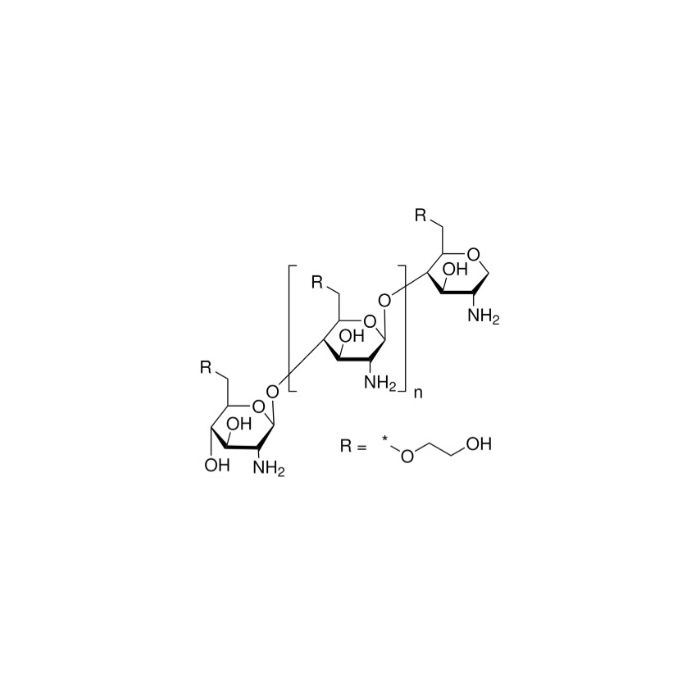
Glycol chitosan is a water-soluble chitosan derivative in which a fraction of the C2 primary amines (on β-(1→4)-linked D-glucosamine residues) are N-substituted with hydrophilic glycol-type moieties (commonly 2-hydroxyethyl units introduced via glycidol/ethylene oxide chemistry). Degree of substitution (DS) and molecular weight are distributional and supplier-specific.
Structural features: linear polysaccharide backbone of β-(1→4)-D-glucosamine and N-acetyl-D-glucosamine units (chitosan), bearing protonatable primary amines (–NH2/–NH3+), primary/secondary alcohols (C3, C6), and N-glycol substituents that enhance aqueous solubility at neutral pH.
2D depiction (in words): repeating pyranose rings (chair conformations) linked through C1–O–C4 glycosidic bonds; each ring carries C6 primary hydroxymethyl, C3 secondary OH, and at C2 an amine bearing a –CH2–CH2–OH (glycol) substituent on a fraction of units; residual N-acetyl groups may be present depending on deacetylation level.
Polymer identity: polydisperse, typically provided as a free base polymer; exact DS, acetylation, and MW should be obtained from the specific lot CoA.
Synthetic Utility
General synthetic value (literature)
Functional handles: primary amines (on deacetylated units) and multiple alcohols provide orthogonal reactivity. N-glycol substitution increases solubility, enabling reactions at neutral pH.
Conjugation chemistry:
Amide formation: EDC/NHS coupling to carboxylic acids; use MES or HEPES buffers (pH 5.5–7.0 for activation; pH 7.0–7.5 for coupling) to balance amine protonation and reactivity.
Isothiocyanates/NHS-esters: label with fluorophores or drugs under mildly basic conditions (pH 7.5–8.5).
Aldehyde coupling: Schiff base formation with aldehyde-bearing ligands followed by NaBH3CN or picoline borane reduction to stabilize linkages.
Click approaches: after introducing alkyne/azide groups onto amines or hydroxyls, perform CuAAC or SPAAC for modular assembly.
Crosslinking routes: genipin (amine–amine bridging), dialdehydes (imine/reduced imine networks), diacrylates (after methacrylation for photopolymerization), or enzyme-mediated phenol coupling after tyramine grafting.
Carrier/solid support: glycol chitosan films, beads, or nanoparticles can serve as heterogeneous supports for catalysts or reagents, leveraging easy phase separation.
Retrosynthetic considerations
Polymer-analogous transformations dominate; control DS and distribution using stoichiometry and reaction time. Purify by dialysis/TFF to remove small-molecule reagents while retaining polymer fraction defined by MWCO.
Characterization: 1H/13C NMR (DS/DDA), FTIR (amide/imine bands), TNBS/ninhydrin assays (free amines), SEC-MALS (MW/Đ), and elemental analysis to corroborate substitution levels.
Target Specificity
Not applicable
This product is a polymeric reagent/biomaterial, not an affinity reagent or antibody. No target/epitope specificity, clone, isotype, or species reactivity applies to this item.
For biochemical interactions (e.g., polyelectrolyte complexation), see Biological Roles and Reaction & Applications sections.
Utilizziamo i cookie per garantire il corretto funzionamento del sito web e, ove consentito, per migliorare la tua esperienza. Puoi gestire le tue preferenze in qualsiasi momento nelle Impostazioni. Per saperne di più, consulta la nostra Cookie Policy.
Desidera che le inviamo un messaggio quando avremo sconti disponibili?
Ricordamelo più tardi
Grazie! Controlli la sua casella di posta per confermare.
Products are supplied to verified businesses, institutions, and qualified professionals for research and development use only. Not for use in humans, animals, diagnosis, or therapy.

 D2409113