≥98% for sensitive chromatographic and analytical workflows requiring minimal baseline interference.
🌡
Storage & shipping
Conservare a -20°C, con carica di argon Ships Cassetta del ghiaccio + cuscini per il ghiaccio Check lot-specific COA for exact specifications.
📋
Quality documents
SDS, COA, datasheet, and spec sheet available for download. Lot-specific COA accessible via lot number lookup.
📚
Literature proof
Cited in 7 peer-reviewed publications across chromatography, organic synthesis, and cross-coupling reactions.
Panoramica
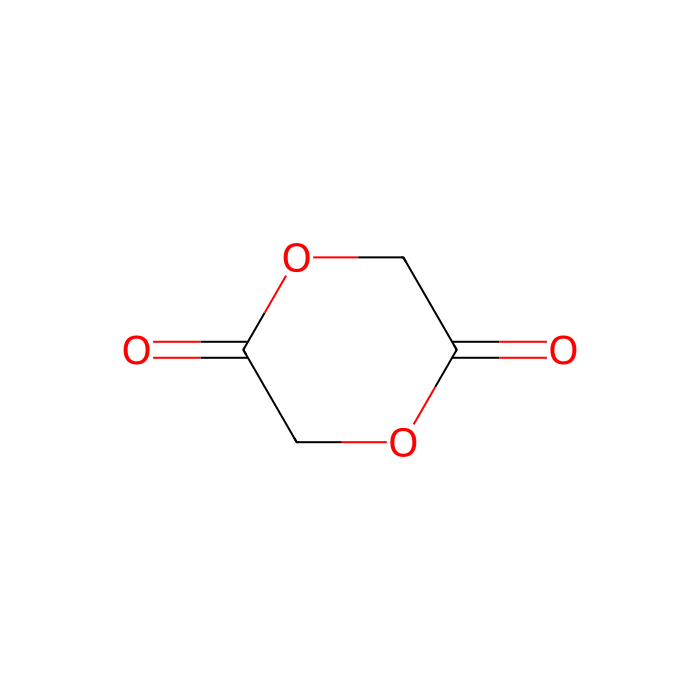
Il glicolide è un dimero ciclico di α-idrossiacido che può essere utilizzato nella formazione di poliestere alifatico. È sintetizzato dalla dimerizzazione dell'acido glicolico. Forma un polimero sintetico biodegradabile a bassa tossicità che può essere utilizzato in applicazioni mediche. Viene utilizzato principalmente per la formazione di un poli(glicolide) altamente cristallino mediante polimerizzazione ad apertura di anello.
Applicazioni: il glicolide può essere utilizzato come
La glicolide può essere utilizzata come monomero nella preparazione di poli(lattico-co-glicolide) (PGLA) mediante copolimerizzazione con il monomero lattide. Il PGLA viene ulteriormente utilizzato nelle seguenti applicazioni: Le microsfere porose di PGLA sono utilizzate nelle applicazioni di riparazione ossea. Le nanoparticelle di PGLA incapsulate possono essere utilizzate per la somministrazione di farmaci e l'ingegneria tissutale. Le micro/nanoparticelle polimeriche a base di PLGA hanno suscitato un notevole interesse per le loro caratteristiche interessanti, tra cui la biodegradabilità, la biocompatibilità, il rilascio prolungato di farmaci e la salvaguardia del farmaco dalla degradazione. Può anche essere utilizzato per sintetizzare copolimeri di poli(glicolide-caprolattone)(PGCL) applicabili come materiali di sutura bioassorbibili.
This compound belongs to the class of organic compounds known as 1,4-dioxanes. These are organic compounds containing 1,4-dioxane, an aliphatic six-member ring with two oxygen atoms in ring positions 1 and 4.
External Descriptors
Not available
1. Djoumbou Feunang Y, Eisner R, Knox C, Chepelev L, Hastings J, Owen G, Fahy E, Steinbeck C, Subramanian S, Bolton E, Greiner R, and Wishart DS. ClassyFire: Automated Chemical Classification With A Comprehensive, Computable Taxonomy. Journal of Cheminformatics, 2016, 8:61.
We use cookies to ensure the website functions properly and, where permitted, to improve your experience. You can manage your preferences at any time in Settings. Learn more in our Cookie Policy.
Shall we send you a message when we have discounts available?
Remind me later
Thank you! Please check your email inbox to confirm.
Products are supplied to verified businesses, institutions, and qualified professionals for research and development use only. Not for use in humans, animals, diagnosis, or therapy.

 I2214508