Determine the necessary mass, volume, or concentration for preparing a solution.
| Activity Type | Activity Value -log(M) | Mechanism of Action | Activity Reference | Publications (PubMed IDs) |
|---|

≥98% for sensitive chromatographic and analytical workflows requiring minimal baseline interference.
Store at -20°C Ships Ice chest + Ice pads Check lot-specific COA for exact specifications.
SDS, COA, datasheet, and spec sheet available for download. Lot-specific COA accessible via lot number lookup.
Cited in 0 peer-reviewed publications across chromatography, organic synthesis, and cross-coupling reactions.
Information
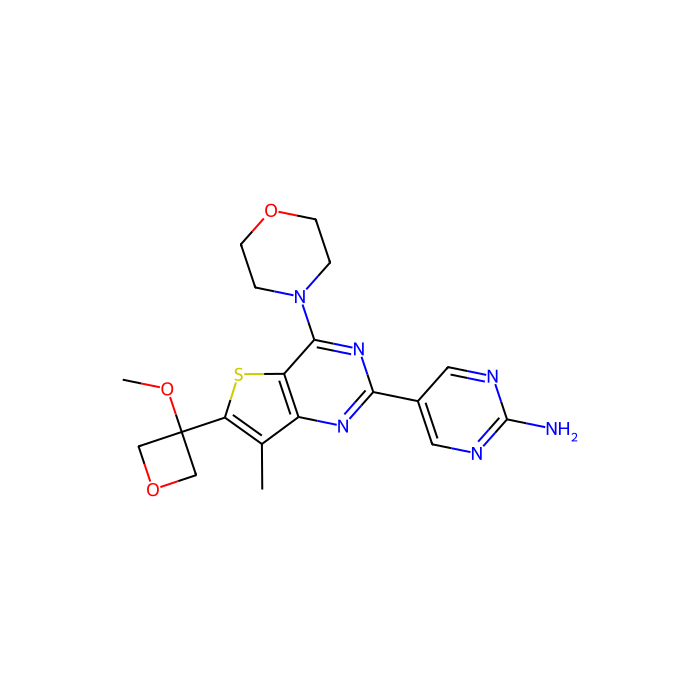
GNE-317 GNE-317 is a potent, brain-penetrant PI3K inhibitor.
Targets
PI3K
In vitro
GNE-317 is not a substrate of P-gp or BCRP transporter in transfected Madin-Darby canine kidney (MDCK) cells. Binding of GNE-317 to plasma proteins exhibits a free fraction of 14.9 % in mouse plasma, and binding to brain tissues is higher, with a free fraction of 5.4%. GNE-317 shows cytostasis but no cell death to U87 cells.
In vivo
GNE-317 (40 mg/kg, p.o.) markedly inhibits the PI3K pathway in mouse brain, causing 40% to 90% suppression of the pAkt and pS6 signals up to 6-hour postdose. GNE-317 (40 mg/kg, p.o.) is efficacious in the U87 and GS2 orthotopic models, achieving tumor growth inhibition of 90% and 50%, respectively. In the GBM10 tumor model, GNE-317 (30 mg/kg, p.o.; 40 mg/kg the first 2 weeks) extends the survival of mice from a median of 55.5 to 75 days.
| ALogP | 1.5 |
|---|---|
| hba_count | 7 |
| Conteggio HBD | 1 |
| Legame rotabile | 4 |
| Pubchem Sid | 488202151 |
|---|---|
| Pubchem Sid Url | https://pubchem.ncbi.nlm.nih.gov/substance/488202151 |
| Sorrisi canonici | CC1=C(SC2=C1N=C(N=C2N3CCOCC3)C4=CN=C(N=C4)N)C5(COC5)OC |
| IUPAC Name | 5-[6-(3-methoxyoxetan-3-yl)-7-methyl-4-morpholin-4-ylthieno[3,2-d]pyrimidin-2-yl]pyrimidin-2-amine |
| InChIKey | XOZLHJMDLKDZAL-UHFFFAOYSA-N |
| INCHI | 1S/C19H22N6O3S/c1-11-13-14(29-15(11)19(26-2)9-28-10-19)17(25-3-5-27-6-4-25)24-16(23-13)12-7-21-18(20)22-8-12/h7-8H,3-6,9-10H2,1-2H3,(H2,20,21,22) |
| Isomeri SMILES | CC1=C(SC2=C1N=C(N=C2N3CCOCC3)C4=CN=C(N=C4)N)C5(COC5)OC |
| Peso molecolare | 414.48 |
| Reaxy-Rn | 23003622 |
| Reaxys-RN_link_address | https://www.reaxys.com/reaxys/secured/hopinto.do?context=S&query=IDE.XRN=23003622&ln= |
Comprehensive hazard, handling, storage, and regulatory compliance document.
Download SDS →Lot-specific quality data. Enter your lot number to retrieve the exact COA.
Look up COA →Full quality attributes and acceptance criteria for this grade.
View spec sheet →Taxonomy Tree
| Kingdom | Organic compounds |
|---|---|
| Superclass | Organoheterocyclic compounds |
| Classe | Diazines |
| Subclass | Pyrimidines and pyrimidine derivatives |
| Intermediate Tree Nodes | Not available |
| Direct Parent | Bipyrimidines and oligopyrimidines |
| Alternative Parents | Thienopyrimidines Dialkylarylamines Aminopyrimidines and derivatives Morpholines Imidolactams Thiophenes Heteroaromatic compounds Oxetanes Oxacyclic compounds Dialkyl ethers Azacyclic compounds Primary amines Hydrocarbon derivatives |
| Molecular Framework | Aromatic heteropolycyclic compounds |
| Substituents | Bipyrimidine - Thienopyrimidine - Dialkylarylamine - Aminopyrimidine - Morpholine - Oxazinane - Imidolactam - Heteroaromatic compound - Thiophene - Oxetane - Dialkyl ether - Ether - Oxacycle - Azacycle - Organonitrogen compound - Hydrocarbon derivative - Organic nitrogen compound - Amine - Organooxygen compound - Organic oxygen compound - Primary amine - Aromatic heteropolycyclic compound |
| Descrizione | This compound belongs to the class of organic compounds known as bipyrimidines and oligopyrimidines. These are organic compounds containing two or more pyrimidine rings directly linked to each other. Pyrimidine is a 6-membered ring consisting of four carbon atoms and two nitrogen centers at the 1- and 3- ring positions. |
| External Descriptors | Not available |
| Activity Type | Activity Value -log(M) | Mechanism of Action | Activity Reference | Publications (PubMed IDs) |
|---|
| Activity Type | Activity Value -log(M) | Mechanism of Action | Activity Reference | Publications (PubMed IDs) |
|---|
| Activity Type | Relation | Activity value | Units | Action Type | Journal | PubMed Id | doi | Assay Aladdin ID |
|---|
| Activity Type | Relation | Activity value | Units | Action Type | Journal | PubMed Id | doi | Assay Aladdin ID |
|---|
| Activity Type | Relation | Activity value | Units | Action Type | Journal | PubMed Id | doi | Assay Aladdin ID |
|---|
| Activity Type | Relation | Activity value | Units | Action Type | Journal | PubMed Id | doi | Assay Aladdin ID |
|---|
| Activity Type | Relation | Activity value | Units | Action Type | Journal | PubMed Id | doi | Assay Aladdin ID |
|---|
| Activity Type | Relation | Activity value | Units | Action Type | Journal | PubMed Id | doi | Assay Aladdin ID |
|---|
| Activity Type | Relation | Activity value | Units | Action Type | Journal | PubMed Id | doi | Assay Aladdin ID |
|---|
| Activity Type | Relation | Activity value | Units | Action Type | Journal | PubMed Id | doi | Assay Aladdin ID |
|---|
Find and download the COA for your product by matching the lot number on the packaging.
| Lot Number | Certificate Type | Data | Oggetto |
|---|---|---|---|
 D2312925 D2312925 | Certificate of Analysis | Jan 21, 2026 | G413834 |
| D2312930 | Certificate of Analysis | Jan 21, 2026 | G413834 |
| D2312960 | Certificate of Analysis | Jan 21, 2026 | G413834 |
| D2312962 | Certificate of Analysis | Jan 21, 2026 | G413834 |
| D2312980 | Certificate of Analysis | Jan 21, 2026 | G413834 |
| D2313004 | Certificate of Analysis | Jan 21, 2026 | G413834 |
| D2313073 | Certificate of Analysis | Jan 21, 2026 | G413834 |
| D2313074 | Certificate of Analysis | Jan 21, 2026 | G413834 |
| D2313075 | Certificate of Analysis | Jan 21, 2026 | G413834 |
| D2313077 | Certificate of Analysis | Jan 21, 2026 | G413834 |
| Solubilità | Solubility (25°C) In vitro DMSO: 47 mg/mL warmed with 50ºC Water: bath (113.39 mM); Water: Insoluble; Ethanol: Insoluble; |
|---|---|
| DMSO (mg/mL) Solubilità massima | 47 |
| DMSO (mM) Solubilità massima | 113.3950975 |
| Acqua (mg/mL) Solubilità massima | <1 |
| Peso molecolare | 414.500 g/mol |
| XLogP3 | 0.500 |
| Hydrogen Bond Donor Count | 1 |
| Hydrogen Bond Acceptor Count | 10 |
| Rotatable Bond Count | 4 |
| Exact Mass | 414.147 Da |
| Monoisotopic Mass | 414.147 Da |
| Topological Polar Surface Area | 137.000 Ų |
| Heavy Atom Count | 29 |
| Formal Charge | 0 |
| Complexity | 570.000 |
| Isotope Atom Count | 0 |
| Defined Atom Stereocenter Count | 0 |
| Undefined Atom Stereocenter Count | 0 |
| Defined Bond Stereocenter Count | 0 |
| Undefined Bond Stereocenter Count | 0 |
| The total count of all stereochemical bonds | 0 |
| Covalently-Bonded Unit Count | 1 |
No tested applications, recommended dilutions, or assay protocols are provided in the Product Data for this item.
General starting-point practices for small-molecule tool compounds (not item-specific specifications):
Note: The above are generalized best practices. For any specific application, consult the peer-reviewed literature for CAS 1394076-92-6 and adjust protocols to your assay format and detection technology.
No specific biological target, pathway, or mechanism is provided in the Product Data for GNE-317. Therefore, users should consult primary literature and databases (e.g., PubChem CID: 70676303) for authoritative, item-specific biological information tied to CAS 1394076-92-6 before designing experiments.
General notes for small-molecule tool compounds (not item-specific claims):
Assay design guidance:
Reminder: This product is for research use only and is not intended for diagnostic, therapeutic, or clinical applications. Any biological roles must be defined by the end user based on validated literature for this exact compound.
This item is a small-molecule research compound, not a buffering agent. Therefore, conventional buffer system guidance (e.g., phosphate, HEPES, TRIS recipes and pH ranges) does not directly apply.
Practical notes for assay buffers (general, not item-specific):
For precise compatibility (stability in specific buffer systems, precipitation thresholds, or interactions with metals/salts), perform small-scale tests with your target assay buffer and consult the CoA/SDS for any explicit incompatibilities.
Green chemistry considerations are typically framed around solvent/reagent selection. As GNE-317 is a research tool compound rather than a process reagent or solvent, “alternatives” mainly concern vehicle and media selection rather than replacing the molecule itself.
Greener handling choices (general guidance; not item-specific):
Comparison of common vehicles (general):
Note: No green alternative exists for the active entity itself if its specific bioactivity is required. Focus improvements on solvent selection, energy use (cold-chain optimization), and right-sizing experiments to align with green chemistry principles.
No pharmacopeial status, excipient role, or formulation grade is provided for GNE-317 in the Product Data. This product is supplied strictly for research use only and is not intended for human or veterinary use, nor for drug product manufacturing.
General context (not item-specific claims):
If formulation experiments are undertaken for preclinical research:
Always consult institutional policies and applicable regulations before considering any use beyond basic research assays.
Item-specific values from Product Data:
Physical/chemical properties (item-specific specifications):
Practical guidance (general literature practice for screening compounds; not item-specific):
Verification:
Item-specific quality/grade:
How to interpret quality for discovery compounds (general guidance; verify against CoA):
Recommended verification upon receipt:
Documentation note:
This product is positioned as a research small molecule within a compound library rather than as a general synthetic reagent.
Applications (general, non-therapeutic; not item-specific claims):
Not typical uses:
Practical tips:
As supplied, GNE-317 is intended for use as a research tool compound, not a reagent or substrate in general organic synthesis. Therefore, no item-specific reaction conditions are applicable or provided in the Product Data.
General experimental considerations if the compound is used in laboratory studies (not item-specific):
If pursuing chemical transformations of this molecule (derivatization):
Note: No literature reaction conditions specific to CAS 1394076-92-6 are cited here; consult primary publications and the CoA for definitive guidance.
Authoritative safety information must be taken from the SDS for this exact SKU/lot.
Item-specific hazard data from Product Data:
General laboratory precautions for small-molecule research compounds (not item-specific):
Spill/accident response:
Item-specific solubility data are not provided in the Product Data for GNE-317; consult the CoA/SDS and perform a small-scale solubility screen.
General solvent guidance for drug-like small molecules (literature-based, not item-specific specifications):
Selection tips (practical):
Comparison snapshot (general):
Item-specific conditions (from Product Data):
Additional handling guidance (general best practices for small molecules; not item-specific specs):
Always defer to the CoA/SDS for lot-specific guidance on storage, stability, and reconstitution solvents for this product.
Overview: GNE-317 (SKU: G413834) is supplied as a research-use-only small molecule from our small-molecule/compound library offering.
Item-specific identifiers (from Product Data):
Item-specific structural data provided:
General structural notes (context; not item-specific):
2D structure description (general guidance):
GNE-317 is offered as a discrete, assay-ready small molecule rather than as a general synthetic building block. Without item-specific structural information, detailed retrosynthetic or functional-group reactivity guidance cannot be provided.
General considerations for complex discovery molecules (context; not item-specific):
Analytical support for any synthetic work:
Bottom line: Treat this item as a tool compound for screening rather than a reagent for methodology development unless and until the exact structure and functional handles are verified for your intended transformations.
No target specificity data (e.g., molecular target, pathway, enzyme class, or binding profile) are provided in the Product Data for GNE-317. Accordingly:
Recommendation: