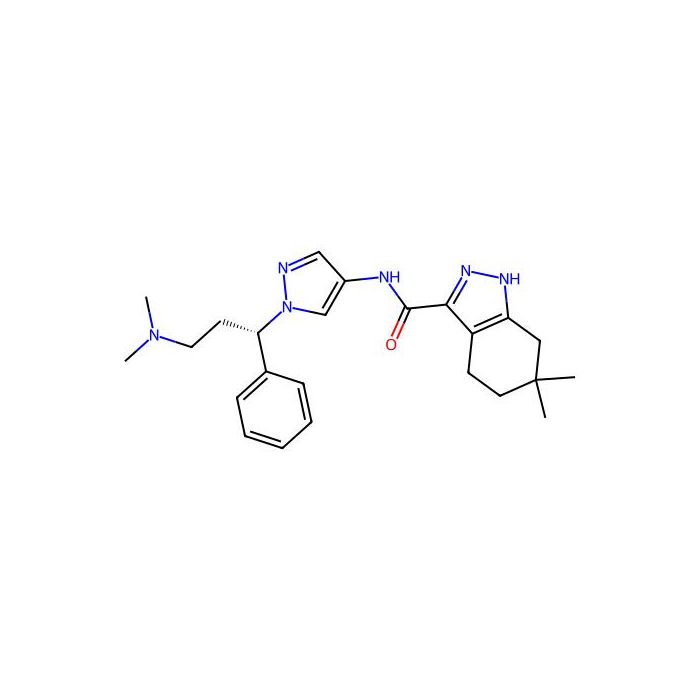
GNE-9822 is a potent, orally active and selective ITK inhibitor with a K i value of 0.7 nM. GNE-9822 has good ADME properties. GNE-9822 can be used in research of asthma.
In Vitro
GNE-9822 (compound 28) inhibits the phosphorylation of PLCγ with an IC 50 value of 55 nM. MCE has not independently confirmed the accuracy of these methods. They are for reference only.
In Vivo
GNE-9822 (compound 28; po and iv; 1 and 5 mg/kg) has good bioavailability and halflives observed in mouse and rats . MCE has not independently confirmed the accuracy of these methods. They are for reference only. Animal Model: BALB/c mouse and Sprague-Dawley rats Dosage: 1 and 5 mg/kg Administration: po (5 mg/kg) and iv (1 mg/kg) Result: 1.19 species route dose volume (mL/kg) dose (mg/kg) C max (μM) AUC (μM·h) Cl (mL/min/kg) T 1/2 (h) V ss (L/kg) %F mouse (BALB/c) IV 1.0 1.0 1.5 40 2.9 10 mouse (BALB/c) PO 5.0 50 3.8 2.7 36 Animal Model: BALB/c mouse and Sprague-Dawley rats Dosage: 1 and 5 mg/kg Administration: po (5 mg/kg) and iv (1 mg/kg) Result: 1.19 species route dose volume (mL/kg) dose (mg/kg) C max (μM) AUC (μM·h) Cl (mL/min/kg) T 1/2 (h) V ss (L/kg) %F rat (Sprague-Dawley IV 1.0 1.0 0.6 70 3.0 14 rat (Sprague-Dawley PO 2.0 5.0 0.2 1.1 40
Form:Solid
Specifiche
Meccanismi biochimici e fisiologici
GNE-9822 is a potent, orally active and selective ITK inhibitor with a K i value of 0.7 nM. GNE-9822 has good ADME properties. GNE-9822 can be used in research of asthma.
Condizioni di conservazione di stoccaggio
Store at -20°C
Spedito in
Ice chest + Ice pads
Questo prodotto richiede spedizione a catena fredda. I servizi di terra e altri servizi economici non sono disponibili.
Tipo di azione
INHIBITOR
Nomi e identificatori
Peso molecolare
420.55
Dati avanzati
Certificati (CoA, COO, BSE/TSE e tabella di analisi)
C of A & Other Certificates(BSE/TSE, COO):
Analytical Chart:
Proprietà chimiche e fisiche
Solubilità
DMSO : 62.5 mg/mL (148.61 mM; Need ultrasonic)
Calcolatori di soluzioni
Molarity Calculator
Determine the necessary mass, volume, or concentration for preparing a solution.
Dilution Calculator
Determine the dilution needed to prepare a stock solution.
Reconstitution Calculator
Recensioni
Recensioni dei clienti
Application Protocols
Tested applications and recommended conditions are not provided in the Product Data for this item.
Validated applications (WB, IHC, IF, FC, enzymatic assays, etc.): Not specified for this item; refer to CoA/Spec Sheet.
Recommended working concentrations/dilutions: Not specified for this item; refer to CoA/Spec Sheet.
For any internal protocols using this compound, establish handling, dilution, vehicle controls, and stability criteria experimentally and document per your lab’s SOPs.
Biological Roles
No biological target, pathway, or role is provided in the Product Data for GNE-9822. Without a disclosed structure or mechanism, biological function cannot be described for this listing.
General considerations for small-molecule research reagents (not item-specific)
Use context: Such compounds are often applied as chemical probes or reference standards in biochemical, cellular, or biophysical studies. Establish selectivity, potency, and off-target profiles via your internal data before drawing conclusions.
Interference controls: Evaluate assay artifacts (aggregation, redox cycling, PAINS alerts, fluorescence/absorbance overlap) to ensure observed effects are on-target.
ADME proxies: If biological exposure assessments are needed, determine basic properties such as solubility, stability in assay media, and plasma protein binding (high-throughput methods) using your validated procedures.
Important: No medical, diagnostic, or therapeutic use is implied. For research use only, as stated in the Product Data.
Buffer Applications
No buffer system recommendations are specified for this item. As a small organic research compound, it does not function as a buffer component itself.
General guidance for assay dilution (not item-specific)
Stock preparation: Dissolve in DMSO or ethanol; dilute into assay buffer while vortexing to avoid local supersaturation. Maintain final co-solvent typically at ≤0.1–1% v/v, depending on assay tolerance.
Common buffers: PBS (pH 7.2–7.4), HEPES (pH 7.0–7.5), Tris (pH 7.4–8.0). Pre-filter (0.22 μm) and degas if using optical or microfluidic readouts.
Solubility aids: If precipitation occurs, consider pH adjustment when consistent with compound ionization behavior, or include minimal nonionic surfactant (e.g., 0.01% Tween 80) after verifying assay compatibility.
For rigorous work, determine precipitation limits and stability over time under your exact buffer composition and temperature.
Green Alternatives
With no item-specific solubility or processing requirements provided, solvent choices can still be optimized for greener practice when handling small-molecule research compounds.
Comparison of common dissolution media (general guidance)
DMSO: High solvency, biodegradable; moderate EHS profile; typical assay co-solvent. Tradeoff: Can perturb biological systems above ~1% v/v; hygroscopic.
Ethanol (EtOH): Renewable routes available, lower toxicity; volatile and flammable; often tolerated biologically. Tradeoff: Limited solvency for very lipophilic compounds.
2-Propanol (IPA): Similar to EtOH with slightly different solvency; higher allowable use levels in some systems; flammable.
Propylene carbonate (PC): Dipolar aprotic with favorable green metrics; viscous, slower drying; compatibility must be verified.
PEG-400: Low volatility and toxicity; good for high-load stocks; viscosity and assay interference possible.
Suggested strategy
Start with EtOH or IPA for analytics where feasible; escalate to DMSO for broader solvency; reserve DMF/NMP for last resort due to worker-exposure concerns. For preparative work, consider ethyl acetate or 2-MeTHF over chlorinated solvents when chromatographing or recrystallizing, if compatible with the compound.
Note: These are general, literature-based considerations and not specifications for GNE-9822. Validate solvent effects on your specific assay or process.
Pharmaceutical Uses
No pharmacopeial status, excipient role, or formulation use is specified for this item. This product is supplied strictly for laboratory research use only and is not intended for human or veterinary applications.
General notes (not item-specific)
Preformulation research: Compounds of this class may be evaluated in discovery settings for solubility, stability, and compatibility with common vehicles (e.g., 0.5% methylcellulose, 10% Captisol, PEG/PG mixtures) in non-clinical experiments. Such activities require project-specific safety review.
Analytical standards: May serve as a reference material for method development (assay qualification/validation) in R&D, provided identity/purity are confirmed.
No clinical efficacy, safety, dosing, or therapeutic claims are made or implied for this product.
Physical Properties
Item-specific physicochemical parameters are not available in the provided Product Data.
Appearance: Not specified for this item; refer to CoA/Spec Sheet.
Melting point (MP): Not specified for this item; refer to CoA/Spec Sheet.
Boiling point (BP): Not specified for this item; refer to CoA/Spec Sheet.
Density: Not specified for this item; refer to CoA/Spec Sheet.
Solubility: Not specified for this item; refer to CoA/Spec Sheet.
pKa, logP/logD, refractive index, UV cutoff: Not specified for this item; refer to CoA/Spec Sheet.
General guidance (literature/best practice; not item-specific)
Solubility screening: For small molecules of unknown polarity, begin with DMSO (analytical grade) to prepare a 10–50 mM stock; evaluate miscibility on dilution into assay buffers (0.1–1% DMSO v/v final).
Solid form: If crystalline, characterize by DSC/TGA and PXRD for thermal behavior and polymorphism; determine water content by Karl Fischer if moisture sensitivity is suspected.
Spectroscopy: Acquire UV–Vis spectrum (200–400 nm) for approximate chromophore assessment and to select analytical wavelengths.
Partitioning: Estimate lipophilicity via shake-flask (octanol/water) or chromatographic indices if logP is operationally required.
Important: Treat any numerical values from third-party sources as literature estimates unless they appear on the Aladdin CoA/Spec Sheet for this exact SKU/lot.
Quality and Grades
Grade/Purity: Not specified for this item; refer to CoA/Spec Sheet.
Interpretation and guidance
Research-use reagent: Supplied for laboratory research only (not for human or veterinary use). For quantitative or screening applications, consult the lot-specific CoA for purity (e.g., HPLC/UPLC area%), identity confirmation (NMR/MS), residual solvents, and water content.
Typical documentation (what to look for on CoA):
Purity method and conditions (HPLC column, gradient, detection wavelength).
Identity: MS m/z (M±), optionally HRMS; 1H NMR (solvent, frequency) with essential resonances.
Appearance and form (solid/amorphous/oil), color.
Storage recommendation and retest date.
Stabilizers: Not specified for this item; refer to CoA/Spec Sheet. If stabilizers are present, they may influence UV baselines or bioassays; adjust controls accordingly.
Trace specifications (metals, peroxides, UV cutoff, etc.): Not specified for this item; refer to CoA/Spec Sheet. Do not assume absent—verify as needed for sensitive applications.
Best practices
If purity is borderline for your application, consider in-house re-purification (e.g., flash/Prep-HPLC) and document new characterization prior to use as a reference standard.
Reaction and Applications
No specific reactivity or application claims are provided for this compound in the Product Data. GNE-9822 is offered as a research-use small molecule; absent target/mechanism information, treat it as a reference/testing article rather than a synthetic intermediate.
General laboratory applications (not item-specific)
Reference standard: Can be used to develop and validate analytical methods (HPLC/UPLC retention behavior, MS response, stability-indicating methods) after confirming identity and purity.
Assay tool compound: Where mechanism is known from your internal program, prepare DMSO stock solutions (e.g., 10 mM) and evaluate concentration–response relationships, ensuring vehicle controls and solubility checks.
Stability studies: Subject to stress conditions (acid/base, oxidative, thermal, photolytic) to map degradation pathways and design storage and handling protocols.
Impurity profiling: Establish LC–MS methods to detect degradants and process-related impurities; create system suitability criteria using this reference.
Practical considerations
If using in biochemical assays, pre-screen for interference (intrinsic fluorescence/absorbance, redox activity, detergent sensitivity).
Avoid repeated freeze–thaw of stock solutions; aliquot at first dissolution.
Confirm carryover and adsorption behavior on plastics vs glass; pre-rinse pipette tips with solution to reduce loss at low nM–μM concentrations.
Reaction Conditions
No reaction condition data are provided for this item, and the structure is not disclosed. As such, specific temperatures, catalysts, or solvent systems cannot be recommended for chemical transformations of GNE-9822.
General guidance (not item-specific)
Stability screening: If chemical modification is contemplated, run small-scale tests under mild conditions first, monitoring by LC–MS. Map tolerance to acid/base, nucleophiles/electrophiles, and redox agents.
Temperature: Begin at ambient temperature; escalate cautiously while tracking degradation. Avoid prolonged heating until stability is established.
Atmosphere: Use inert gas (N2/Ar) if oxidation sensitivity is suspected; exclude moisture if hydrolysis is possible.
Workup: Quench carefully and select extraction solvents compatible with the compound’s polarity; verify recovery by mass balance and purity by HPLC.
Any numerical yields or named-condition recommendations should come from your internal route or literature specific to the disclosed structure.
Safety and Handling
Hazard classification was not provided in the Product Data for this item. Always consult the SDS for authoritative safety information.
GHS/CLP classification, pictograms, H/P statements: Not specified for this item; refer to SDS.
Signal word: Not specified for this item; refer to SDS.
General laboratory precautions (best practice)
PPE: Wear lab coat, safety goggles, and appropriate chemically resistant gloves (e.g., nitrile). Handle in a fume hood to avoid inhalation of dust/aerosols.
Storage: Store at −20°C as specified. Keep container tightly closed, protected from moisture; allow vial to warm to ambient temperature in a desiccator before opening to minimize condensation.
Incompatibilities (general): Until specific reactivity is known, segregate from strong oxidizers, strong acids/bases, and reactive reducing/alkylating agents. Avoid contact with sources of ignition and prolonged light exposure.
Hygiene: Avoid ingestion, inhalation, and skin/eye contact. Wash thoroughly after handling. Do not pipette by mouth.
First aid (overview): If inhaled—fresh air; skin—wash with soap and water; eyes—rinse with water for several minutes; ingestion—rinse mouth. Seek medical attention in all cases and provide SDS to responders.
Waste: Dispose in accordance with institutional and local regulations for organic laboratory chemicals. Do not release to the environment.
Shipping & handling note
Shipped in an ice chest with ice pads; inspect on receipt and return to −20°C storage promptly.
Solvent Selection
No solubility profile is provided for this item. The following is general guidance for small-molecule dissolution and assay compatibility.
Primary stock solvent (general): DMSO is the default for many discovery compounds due to broad solvency and biological compatibility at ≤1% v/v in assays.
Secondary options: DMF or NMP for highly lipophilic compounds; ethanol or isopropanol when aqueous miscibility and lower toxicity are prioritized; PEG-400 or propylene glycol for high-concentration stocks (viscous; assay dilution required).
Aqueous systems: If ionizable, adjust pH with minimal co-solvent to enhance solubility; include 0.01–0.05% nonionic surfactant (e.g., Tween 80) if precipitation on dilution is observed (method development only; verify assay tolerance).
Solvent purity: Use anhydrous, inhibitor-free grades as needed for sensitive analytics or long-term stocks. Filter through 0.22 μm if particulate is suspected.
Comparison (general)
DMSO: Broad solvency, miscible with water; can affect enzyme kinetics above ~1% v/v.
Ethanol: More volatile; often tolerated up to 1–2% v/v in cell-free assays.
DMF/NMP: Strong solvency; consider toxicity and material compatibility.
Practical tips
Perform a mini-solubility screen (DMSO, ethanol, DMF, buffer pH 5–9) at small scale. Record clarity, precipitation upon dilution, and stability over 24–48 h at room temperature and 4°C.
Storage and Reconstitution
Item-specific storage and shipping conditions are provided; reconstitution details are not.
Storage Conditions (from Product Data): Store at −20°C.
Shipped In (from Product Data): Ice chest with ice pads.
Appearance: Not specified for this item; refer to CoA/Spec Sheet.
Recommended diluent/solvent: Not specified for this item; refer to CoA/Spec Sheet.
General guidance (not item-specific)
Upon receipt: Allow the sealed container to equilibrate to room temperature before opening to minimize condensation. If moisture sensitivity is suspected, open in a dry box or under inert gas.
Reconstitution: For small-molecule reagents, prepare concentrated stocks in dry DMSO or ethanol when appropriate. Filter through 0.22 μm if particulate is present. Record final concentration, solvent, and preparation date on the vial.
Aliquoting: Divide into single-use portions to avoid freeze–thaw cycles. Store aliquots at −20°C (or colder if your stability study indicates) in tightly sealed, chemically compatible vials.
Light/air: If chromophores susceptible to photolysis are present (unknown here), protect from light (foil wrap/amber vials). Purge headspace with inert gas to limit oxidation for sensitive compounds.
Stability: Retest or replace solutions periodically; perform short stability checks (e.g., HPLC purity after 1–4 weeks at storage temperature) before critical experiments.
Always defer to the lot-specific CoA/Spec Sheet and SDS for any instructions superseding these general practices.
Structure and Identity
A Genentech-coded small molecule research compound. Item-specific structural identifiers are not provided in the Product Data for this listing.
SKU: G647995
Product Name: GNE-9822 (research reagent)
CAS: 1557232-32-2
SMILES: Not specified for this item; refer to CoA/Spec Sheet.
InChI / InChIKey: Not specified for this item; refer to CoA/Spec Sheet.
Molecular Formula: Not specified for this item; refer to CoA/Spec Sheet.
Molecular Weight: Not specified for this item; refer to CoA/Spec Sheet.
Structure description
Structural class: Small organic molecule (exact functional groups, rings, and stereochemistry not provided in Product Data).
2D features (general): Without a supplied structure, ring systems, heteroatoms, and stereocenters cannot be described. Please consult the Certificate of Analysis or the vendor’s Spec Sheet for definitive structural details.
Notes
Identity confirmation (general best practice): Verify by orthogonal methods such as 1H/13C NMR, LC–MS (ESI±), and HRMS when needed for regulated or quantitative studies.
Reference identifiers: If you require standardized identifiers (SMILES/InChIKey), request the latest documentation specific to your lot.
Synthetic Utility
No structural information is disclosed in the Product Data; consequently, specific synthetic transformations or functional-group reactivity for GNE-9822 cannot be described.
General positioning (not item-specific)
End-use reference: Treat as a terminal small molecule rather than a building block unless your internal route calls for derivatization. If derivatization is intended (e.g., biotinylation, photoaffinity tagging), first elucidate functional handles via spectroscopic characterization.
Analytical development: Use as a standard to benchmark synthetic batches, impurity profiles, and stability-indicating methods along your program’s route.
Salt form/polymorph: If applicable (not specified here), solid-form screens (counterions, solvates) can enhance handling and stability; document form identity to ensure lot-to-lot consistency.
Because no functional groups are specified, avoid assuming compatibility with reactive chemistries. Consult the CoA/Spec Sheet before planning any synthetic manipulations.
Target Specificity
Target/Pathway: Not specified for this item; refer to CoA/Spec Sheet.
Mechanism of action: Not specified for this item; refer to CoA/Spec Sheet.
Selectivity profile, species reactivity, binding constants: Not specified for this item; refer to CoA/Spec Sheet.
Note: No claims are made regarding biological specificity for this product. For research use only.
Domande frequenti
How should this product be stored?
Store at ?20 °C. Freezer storage is required to maintain the specified shelf life.
How is this product shipped?
This product ships in an insulated container with ice pads. Unpack on arrival and transfer it to the storage condition stated above.
What are the CAS number, molecular formula and molecular weight?
The CAS Number is 1557232-32-2, the molecular formula is C24H32N6O, and the molecular weight is 420.55 g/mol.
What documentation is provided?
Available product documentation, including Certificates of Analysis (COA), Safety Data Sheets (SDS), and specification sheets, is shown in the product document area. Document availability and access follow the current site policy.
Utilizziamo i cookie per garantire il corretto funzionamento del sito web e, ove consentito, per migliorare la tua esperienza. Puoi gestire le tue preferenze in qualsiasi momento nelle Impostazioni. Per saperne di più, consulta la nostra Cookie Policy.
Desidera che le inviamo un messaggio quando avremo sconti disponibili?
Ricordamelo più tardi
Grazie! Controlli la sua casella di posta per confermare.
Products are supplied to verified businesses, institutions, and qualified professionals for research and development use only. Not for use in humans, animals, diagnosis, or therapy.