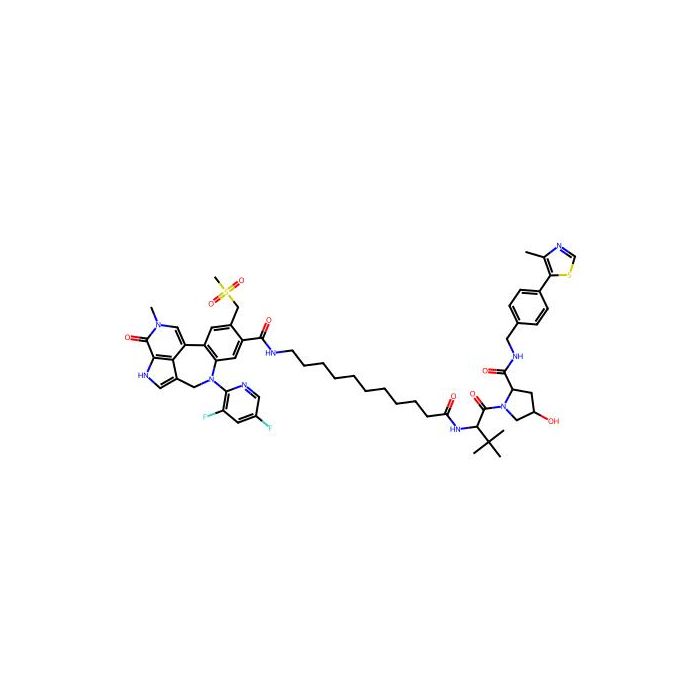
GNE-987 is a PROTAC connected by ligands for von Hippel-Lindau and BRD4 . GNE-987 exhibits picomolar cell BRD4 degradation activity ( DC 50 =0.03 nM for EOL-1 AML cell line). GNE-987 binds equipotently to the BD1 and BD2 bromodomains of BRD4 with low nanomolar affinities ( IC 50 =4.7 and 4.4 nM, respectively). GNE-987 incorporates a potent BET binder/inhibitor, a VHL-binding fragment, and a ten methylene spacer moiety. GNE-987 can be used in PROTAC-Antibody Conjugate (PAC)
In Vitro
GNE-987 inhibits EOL-1 and HL-60 cell viability with IC 50 s of 0.02 and 0.03 nM, respectively, and inhibits MYC expression with an IC 50 of 0.03 nM. GNE-987 (0.1-10 nM; 5 hours) degrades the BRD2 and BRD3 BET family proteins. MCE has not independently confirmed the accuracy of these methods. They are for reference only. Western Blot AnalysisCell Line: EOL-1 cells Concentration: 0.1, 1, 10 nM Incubation Time: 5 hours Result: Degraded the BRD2 and BRD3 BET family proteins.
GNE-987 is a PROTAC connected by ligands for von Hippel-Lindau and BRD4 . GNE-987 exhibits picomolar cell BRD4 degradation activity ( DC 50 =0.03 nM for EOL-1 AML cell line). GNE-987 binds equipotently to the BD1 and BD2 bromodomains of BRD4 with low nano
Condizioni di conservazione di stoccaggio
Store at 2-8°C
Spedito in
Wet ice
Questo prodotto richiede spedizione a catena fredda. I servizi di terra e altri servizi economici non sono disponibili.
This compound belongs to the class of organic compounds known as dipeptides. These are organic compounds containing a sequence of exactly two alpha-amino acids joined by a peptide bond.
External Descriptors
Not available
1. Djoumbou Feunang Y, Eisner R, Knox C, Chepelev L, Hastings J, Owen G, Fahy E, Steinbeck C, Subramanian S, Bolton E, Greiner R, and Wishart DS. ClassyFire: Automated Chemical Classification With A Comprehensive, Computable Taxonomy. Journal of Cheminformatics, 2016, 8:61.
Certificati (CoA, COO, BSE/TSE e tabella di analisi)
C of A & Other Certificates(BSE/TSE, COO):
Analytical Chart:
Proprietà chimiche e fisiche
Solubilità
DMSO : 150 mg/mL (136.82 mM; Need ultrasonic)
Calcolatori di soluzioni
Molarity Calculator
Determine the necessary mass, volume, or concentration for preparing a solution.
Dilution Calculator
Determine the dilution needed to prepare a stock solution.
Reconstitution Calculator
Recensioni
Recensioni dei clienti
Application Protocols
Only tested/validated application protocols from the Product Data may be listed here. None are provided for this product.
General, non-validated guidance (for planning only)
Stock preparation: Dissolve in anhydrous DMSO; typical lab stocks range 1–10 mM depending on solubility (confirm solubility for this item before preparing concentrated stocks).
Cell treatment: Dilute into pre-warmed media to the desired concentration, maintaining a constant vehicle percentage across wells; include time-course and dose-response matrices.
Readouts: Western blot for target protein levels; qPCR/RNA-seq for transcriptional effects; viability assays as context-specific secondary measures.
Note: These are general practices for PROTAC-class compounds and are not validated for this specific item by the manufacturer.
Biological Roles
Use context: For research use only. The following summarizes literature-general information on the biological role of BET degraders; verify the specific behavior of GNE-987 in your system with primary data.
Mechanistic class (literature-general)
Reported as a targeted protein degrader (PROTAC) designed to remove BET bromodomain proteins (e.g., BRD2/BRD3/BRD4) by recruiting an E3 ubiquitin ligase and promoting ubiquitin–proteasome–mediated turnover.
Degradation leads to rapid functional ablation compared with occupancy-based inhibition, enabling kinetic studies of transcriptional control.
Cellular readouts commonly examined
Loss of BRD proteins and downstream markers (e.g., MYC transcriptional signatures) by Western blot and RNA-seq.
Time- and dose-dependent degradation metrics: DC50 (concentration for 50% degradation), Dmax (maximal degradation), and recovery kinetics upon washout.
Pathway-dependence controls using proteasome inhibitors (e.g., MG132), CRL4–CRBN or VHL pathway inhibitors, and excess competitor ligands.
Selectivity considerations
PROTACs can display differential degradation across BET family members and cell types; proteomics profiling (TMT/SPS–MS3) helps assess off-targets.
Hook effects may occur at high concentrations due to binary complex saturation; careful titration is advised.
Systems biology applications
Acute perturbation of enhancer/super-enhancer programs for mapping transcriptional dependencies.
Combination studies with epigenetic modulators to dissect synthetic vulnerabilities in cell models.
Note: No therapeutic/clinical claims are made; this product is for laboratory research only.
Buffer Applications
This item is a bioactive small molecule, not a buffering agent. It is not typically used to establish or maintain solution pH.
Practical handling notes (general)
Prepare concentrated DMSO stocks and dilute into the experimental buffer/media immediately before use to minimize precipitation.
Maintain a consistent final DMSO percentage across all conditions (e.g., 0.1–0.5% v/v) to avoid solvent-related artifacts.
Use standard biological buffers (e.g., PBS, HBSS, HEPES-based media) per your assay requirements; buffering system choice is driven by the biology, not by this compound.
Green Alternatives
Context: GNE-987 is a specialized bioactive research compound used at very small scales (nM–µM in assays). “Green alternatives” generally pertain to process solvents and bulk reagents; for this item, sustainability considerations focus on handling and solvent choices rather than substituting the active itself.
Solvent and handling choices (general guidance)
Prefer DMSO and acetonitrile over chlorinated solvents for stock preparation and analytics when feasible.
Minimize solvent volumes; prepare concentrated master stocks to reduce waste.
Use reuseable glass vials where practical to reduce plastic waste; select low-bind yet recyclable labware when possible.
Comparison of common lab solvents (literature-general)
DMSO: Polar aprotic, low volatility, favorable EHS profile compared with DMF/NMP; broadly suitable for bioactive stocks.
Acetonitrile: Widely used in LC–MS; relatively lower toxicity than DMF/DCM; highly recoverable in solvent recycling systems.
Ethyl acetate/IPA: Preferred for workups in synthetic contexts; typically not required for day-to-day assay handling of this item.
Operational best practices
Consolidate analytical runs to maximize instrument efficiency and reduce solvent consumption.
Employ solvent recycling for LC mobile phases when validated.
Dispose of waste streams according to institutional green-chemistry policies and local regulations.
Pharmaceutical Uses
No pharmacopeial status, excipient role, or manufacturing use is specified in the Product Data for this research chemical.
General context (non-clinical)
GNE-987 is supplied strictly for research use only. Any discussion of formulation beyond lab assays (e.g., in vivo dosing vehicles) must rely on primary literature and institution approvals; no claims are made here.
For in vitro work, typical vehicles include DMSO stocks diluted into culture media. For nonclinical in vivo method development, vehicles often employ biocompatible co-solvents/surfactants (e.g., PEG400, captisol, Tween 80), but specific suitability for this item is not established here and must be validated independently.
Compliance note
Do not use for human or veterinary applications. Follow institutional and regulatory guidelines for any nonclinical studies.
Physical Properties
Item-specific properties
Appearance: Not specified for this item; refer to CoA/Spec Sheet.
Molecular weight: Not specified for this item; refer to CoA/Spec Sheet.
Molecular formula: Not specified for this item; refer to CoA/Spec Sheet.
Melting point: Not specified for this item; refer to CoA/Spec Sheet.
Boiling point: Not applicable/rarely reported for complex, high-MW PROTACs; consult CoA/Spec Sheet if required.
Density/refractive index: Not specified for this item; refer to CoA/Spec Sheet.
Solubility: Not specified for this item; refer to CoA/Spec Sheet.
Literature/general expectations for PROTAC-like small molecules (for planning only; not item-specific)
Often isolated as off-white to light-colored solids with high polarity and multiple H-bond donors/acceptors.
Typical stock preparation is in anhydrous DMSO; working dilutions made into assay buffers/media immediately before use to minimize precipitation or adsorption.
LogP/logD values vary widely with linker composition; amphiphilic behavior is common.
Aqueous solubility can be modest and strongly formulation-dependent (surfactants, co-solvents, or serum proteins may aid handling).
Notes for method development
For quantitation by LC–MS/MS, use soft ionization (ESI) and monitor potential in-source fragmentation of linker amides/ureas.
Adsorptive losses to plastics can occur; low-bind plastics or glass are recommended for dilute solutions.
Filter working solutions (0.22 µm PTFE/RC) as needed, evaluating compound recovery to avoid nonspecific loss.
Quality and Grades
Item-specific grade/purity
Grade/Purity: Not specified for this item; refer to CoA/Spec Sheet.
Interpreting quality for small-molecule library compounds (general guidance)
Research grade typically emphasizes structural identity and purity sufficient for in vitro and cellular assays (commonly ≥95% by HPLC/UPLC), but exact acceptance criteria must be verified on the item’s CoA.
Identity is often confirmed by HRMS and NMR; some catalogs provide qNMR content or residual solvent profiling. UV chromatograms alone may miss non-UV-absorbing impurities.
For bioactive degraders, minor isomeric or linker-related impurities can affect potency/degradation kinetics. Review impurity profiles on the CoA where available.
Stabilizers and additives
Not specified for this item; refer to CoA/Spec Sheet. If no stabilizer is present, minimize exposure to air/light and avoid repeated freeze–thaw of solutions.
What this means for your experiments
Reproducibility in phenotypic or degradation assays depends on both chemical purity and accurate concentration. Validate stock concentration by UV or quantitative NMR when precision is critical.
If LC peaks suggest multiple conformers/protomers, verify that your chromatographic method resolves the active species or that total area is suitable for quantitation.
Reaction and Applications
Scope: GNE-987 is intended for research use as a bioactive small molecule in chemical biology/biochemistry settings rather than as a synthetic reagent. No manufacturer application text was provided beyond “For research use only.” The following summarizes typical research applications reported for PROTAC-class BET degraders in the literature (informational only; verify specifics for this item in the primary literature and CoA/SDS).
Chemical biology applications (literature-general for BET degraders)
Rapid, catalytic degradation of BET family proteins (e.g., BRD2/BRD3/BRD4) to interrogate bromodomain function, transcriptional regulation, and enhancer biology.
Time-resolved studies (DC50/DT50/Dmax) to quantify degradation efficiency versus occupancy-based inhibition.
Proteomics workflows (TMT/SILAC) to assess proteome-wide selectivity and off-target degradation.
Genomic readouts (ChIP–seq, PRO–seq, RNA–seq) to connect target loss with chromatin occupancy and transcriptional changes.
Assay modalities
Western blot/qPCR for degradation biomarkers and pathway effects.
Live-cell imaging or reporter assays for phenotype kinetics.
Rescue experiments with proteasome or neddylation inhibitors to confirm UPS dependence.
Practical considerations
Use fresh DMSO stocks, minimize light/moisture exposure, and pre-clear solutions by micropore filtration if needed.
Include vehicle and inactive analog controls; titrate DMSO to constant final concentration across wells.
For mechanistic studies, titrate compound to map hook effects in ternary-complex–driven degradation.
Reaction Conditions
Not typically applicable. GNE-987 is supplied as a bioactive research compound, not as a reagent for facilitating chemical reactions.
For analytical/assay preparation (general guidance)
Stock solutions: Prepare at high concentration in anhydrous DMSO; vortex and, if necessary, gently warm (≤37°C). Avoid prolonged heating.
Working solutions: Dilute into assay buffer/media immediately before use; maintain constant final DMSO across samples.
Stability checks: Verify clarity and concentration by UV or LC–MS where critical; monitor for precipitation over incubation time.
For LC–MS method development (general)
Mobile phases: Water/ACN with 0.1% FA; include a shallow high-organic gradient to elute late-retained species.
Source: ESI+, evaluate cone voltage to limit in-source fragmentation; consider ESI− if acidic motifs dominate.
Columns: C18 or phenyl-hexyl; assess polar-embedded stationary phases for peak shape if tailing observed.
Safety and Handling
Safety classification (from Product Data)
GHS Classification: Not specified for this item; refer to SDS.
Signal Word: Not specified for this item; refer to SDS.
Hazard (H) statements: Not specified for this item; refer to SDS.
Pictograms: Not specified for this item; refer to SDS.
General laboratory precautions (for research use only)
Handle within a chemical fume hood using appropriate PPE: lab coat, safety glasses, and disposable nitrile gloves. Change gloves frequently when handling DMSO stocks.
Avoid inhalation of dust/aerosols and contact with skin or eyes. Prevent ingestion; wash hands after handling.
Use dedicated, labeled containers for stock solutions; ensure secondary containment for transport between labs.
Storage incompatibilities and controls
Segregate from strong oxidizers and acids/bases until compatibility is confirmed from SDS.
Protect solutions from light and moisture. Use inert gas blanket for long-term DMSO stocks if stability data warrant.
Spill/first-aid overview (general guidance; defer to SDS)
Small spill: Absorb with inert material, collect in a sealable waste container, and decontaminate surfaces with suitable solvent/detergent.
Eye/skin contact: Rinse with water for at least 15 min; remove contaminated clothing. Seek medical attention as needed.
Inhalation/ingestion: Move to fresh air; seek medical attention. Provide SDS to responders.
Waste disposal
Dispose of solids and solutions as halogen-free organic laboratory waste unless otherwise directed by institutional EHS and the SDS.
Solvent Selection
Applicability: As a complex, heterobifunctional small molecule, GNE-987 is typically handled as a DMSO stock solution for biological assays. Item-specific solubility is not provided; the following are general best practices.
Primary solvent for stocks
DMSO (anhydrous) is the default choice due to broad solvency for polyfunctional, high-MW compounds and assay compatibility at low final percentages.
DMF, NMP, or mixtures with ethanol/acetonitrile can assist dissolution for analytical sample prep. For aqueous delivery, prepare concentrated DMSO stocks and dilute into buffer/media immediately before use, keeping final DMSO ≤0.1–0.5% v/v as assays allow.
Miscibility/profile considerations
Anticipate limited direct water solubility; use serum-containing media or add gentle surfactants only if compatible with your assay.
Adsorption to plastics can reduce apparent concentration at low nM–µM levels; consider low-bind tubes or glass vials.
When to choose alternatives
If precipitation occurs upon dilution, increase the DMSO fraction slightly, warm briefly (≤37°C), or use co-solvent spikes. Avoid aggressive pH adjustments without stability data.
Practical tips
Verify clarity after dilution and after incubation at assay temperature. Filter if needed and confirm recovery.
For LC–MS, acetonitrile/water with 0.1% formic acid typically affords robust peak shape for polyfunctional analytes; optimize gradient for late-eluting species.
Storage and Reconstitution
Item-specific conditions (from Product Data)
Storage conditions: Store at 2–8°C.
Shipped in: Wet ice.
General reconstitution and handling guidance (not item-specific; verify with CoA/SDS)
Solid handling: Equilibrate to room temperature in a desiccator before opening to prevent moisture uptake.
Stock solutions: Prepare concentrated stocks in anhydrous DMSO. Filter sterilize (0.22 µm PTFE) if aseptic handling is required, verifying compound recovery.
Aliquoting: Dispense single-use aliquots to avoid repeated freeze–thaw and adsorption losses; store tightly sealed. If long-term frozen storage of solutions is needed, validate stability at −20°C or −80°C.
Light/moisture protection: Store protected from light; use desiccant and inert gas headspace for hygroscopic/oxidation-sensitive materials when appropriate.
Thawing/usage: Thaw on ice or at room temperature; mix gently to ensure homogeneity. Inspect for precipitation; warm briefly (≤37°C) and vortex if needed before dilution into buffers/media.
Stability note
No item-specific stability data are provided. For critical experiments, confirm concentration by UV or qNMR after preparation and recheck by LC–MS after storage. Always refer to the product’s CoA/Spec Sheet and SDS for definitive directions.
Structure and Identity
Brief overview: GNE-987 is listed in small-molecule libraries and is commonly referenced in the literature as a targeted protein degrader (PROTAC) designed to remove BET family bromodomain proteins in cells. Item-specific identifiers below reflect the provided catalog data; structural details not present in the data are left unspecified.
Item-specific identifiers (from Product Data)
SKU: G649187
Product name: GNE-987
CAS: 2417371-71-0
PubChem CID: 145925661
InChIKey: 388088 (as provided; note this appears truncated/non-standard — consult CoA/Spec Sheet for confirmation)
SMILES: Not specified for this item; refer to CoA/Spec Sheet.
Molecular formula: Not specified for this item; refer to CoA/Spec Sheet.
Molecular weight: Not specified for this item; refer to CoA/Spec Sheet.
Structural features (general literature context, not item-specific specs)
Reported in the literature as a heterobifunctional small molecule (PROTAC) with: (a) a BET bromodomain-binding moiety and (b) an E3 ligase–recruiting moiety linked by a flexible spacer.
Typical PROTAC architectures present multiple heteroatoms, amide/urea linkages, and aromatic systems; exact features for this item should be verified against the CoA/Spec Sheet.
PROTACs generally display two ligand heads joined via a linker, yielding a topologically extended, polyfunctional scaffold capable of ternary complex formation with a target protein and an E3 ligase. Specific ring systems and stereochemistry for this item are not provided in the Product Data.
Synthetic Utility
This product is intended as a finished bioactive small molecule for use in biological studies and screening. It is not typically employed as a synthetic building block or reagent.
General synthetic context (literature-general for PROTACs)
PROTAC synthesis commonly involves modular assembly of: (1) a target-binding ligand, (2) an E3-ligase recruiter, and (3) a linker, using amide/urea formation, click reactions, or carbamate/ether couplings.
Purification often requires preparative HPLC due to polarity and multiplicity of functional groups; salt selection (e.g., TFA, HCl) can improve handling but must be removed/converted for biological assays.
If derivatization is desired (user-driven R&D)
Late-stage diversification at the linker termini or via orthogonally protected handles may modulate permeability, efflux susceptibility, or ternary-complex cooperativity.
Maintain stereochemical integrity of chiral centers embedded in ligands/linkers; minor epimerization can alter degradation profiles.
Note: No specific synthetic routes, intermediates, or building blocks are provided for this catalog item.
Target Specificity
Only item-specific target details from the Product Data may be listed here. No such details are provided for this product.
Target(s): Not specified for this item; refer to CoA/Spec Sheet and primary literature.
Species reactivity/epitope/clone/isotype: Not applicable to this small-molecule product.
Domande frequenti
What is the purity of this product?
This product is supplied at ≥99% purity (chemical assay). Lot-specific values are stated on the Certificate of Analysis.
How should this product be stored?
Store at 2–8 °C. Refrigerated storage is required to maintain the specified shelf life.
How is this product shipped?
This product ships chilled on wet ice. Unpack on arrival and transfer it to the storage condition stated above.
What are the CAS number, molecular formula and molecular weight?
The CAS Number is 2417371-71-0, the molecular formula is C56H67F2N9O8S2, and the molecular weight is 1096.31 g/mol. InChIKey VTPSYVSGGUUAFN-GDNJTPAESA-N.
What documentation is provided?
Available product documentation, including Certificates of Analysis (COA), Safety Data Sheets (SDS), and specification sheets, is shown in the product document area. Document availability and access follow the current site policy.
Utilizziamo i cookie per garantire il corretto funzionamento del sito web e, ove consentito, per migliorare la tua esperienza. Puoi gestire le tue preferenze in qualsiasi momento nelle Impostazioni. Per saperne di più, consulta la nostra Cookie Policy.
Desidera che le inviamo un messaggio quando avremo sconti disponibili?
Ricordamelo più tardi
Grazie! Controlli la sua casella di posta per confermare.
Products are supplied to verified businesses, institutions, and qualified professionals for research and development use only. Not for use in humans, animals, diagnosis, or therapy.