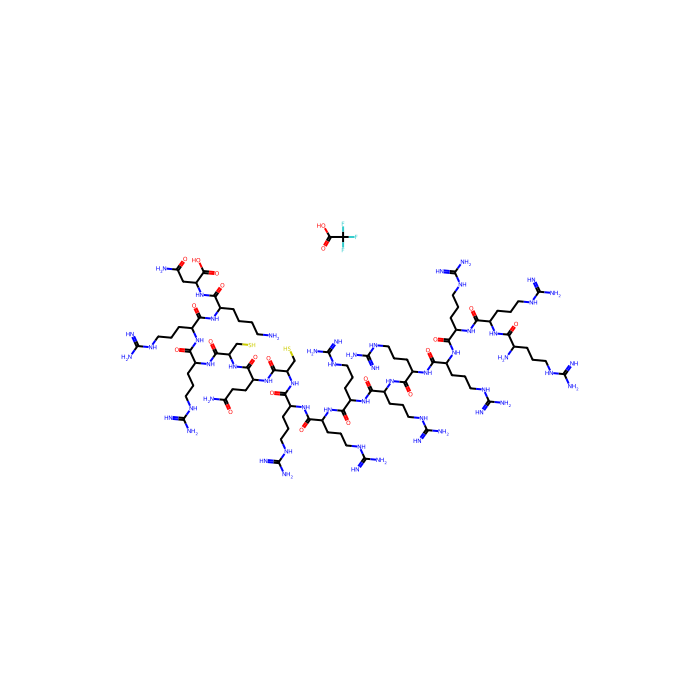
GO-203 - ≥95% , CAS No.1222186-26-6

CAS: 1222186-26-6 Cat. No.: G414108 Formula: C87H170N52O19S2.C2HF3O2 Peso molecolare: 2426.77 PubChem CID: 137967120
Disponibile su ordine
QUALITÀ & PUREZZA ≥95%
Storage
Store at -20°C
Shipped In
Ice chest + Ice pads
★
Dimensione
Germania (EU)
USA*
Prezzo
Qtà
2mg
G414108-2mg
—
3 Disponibile

175,20€

227,26€
Salva 52,06 € (22.91%)
5mg
G414108-5mg
—
3 Disponibile

367,83€

477,17€
Salva 109,34 € (22.91%)
10mg
G414108-10mg
—
2 Disponibile

551,80€

714,93€
Salva 163,13 € (22.82%)
25mg
G414108-25mg
—
1 Disponibile

1.057,69€

1.370,94€
Salva 313,25 € (22.85%)
50mg
G414108-50mg
—
1 Disponibile

1.516,72€

1.966,21€
Salva 449,49 € (22.86%)
100mg
G414108-100mg
—
1 Disponibile

2.553,67€

2.979,73€
Salva 426,06 € (14.30%)
Enter a quantity for the sizes you want to add.

Specifiche

Specifiche e purezza
≥95%
Condizioni di conservazione di stoccaggio
Store at -20°C
Spedito in
Ice chest + Ice pads
Questo prodotto richiede spedizione a catena fredda. I servizi di terra e altri servizi economici non sono disponibili.
Purezza
≥95%
Proprietà del prodotto
ALogP
-21.045
Conteggio HBD
41
Legame rotabile
98
Nomi e identificatori
Pubchem Sid
Pubchem Sid Url
https://pubchem.ncbi.nlm.nih.gov/substance/488203029
SMILES
C(CCN)CC(C(=O)NC(CC(=O)N)C(=O)O)NC(=O)C(CCCNC(=N)N)NC(=O)C(CCCNC(=N)N)NC(=O)C(CS)NC(=O)C(CCC(=O)N)NC(=O)C(CS)NC(=O)C(CCCNC(=N)N)NC(=O)C(CCCNC(=N)N)NC(=O)C(CCCNC(=N)N)NC(=O)C(CCCNC(=N)N)NC(=O)C(CCCNC(=N)N)NC(=O)C(CCCNC(=N)N)NC(=O)C(CCCNC(=N)N)NC(=O)C(CCCNC(=N)N)NC(=O)C(CCCNC(=N)N)N.C(=O)(C(F)(F)F)O
IUPAC Name
(2R)-4-amino-2-[[(2R)-6-amino-2-[[(2R)-2-[[(2R)-2-[[(2S)-2-[[(2R)-5-amino-2-[[(2S)-2-[[(2R)-2-[[(2R)-2-[[(2R)-2-[[(2R)-2-[[(2R)-2-[[(2R)-2-[[(2R)-2-[[(2R)-2-[[(2R)-2-amino-5-carbamimidamidopentanoyl]amino]-5-carbamimidamidopentanoyl]amino]-5-carbamimidamidopentanoyl]amino]-5-carbamimidamidopentanoyl]amino]-5-carbamimidamidopentanoyl]amino]-5-carbamimidamidopentanoyl]amino]-5-carbamimidamidopentanoyl]amino]-5-carbamimidamidopentanoyl]amino]-5-carbamimidamidopentanoyl]amino]-3-sulfanylpropanoyl]amino]-5-oxopentanoyl]amino]-3-sulfanylpropanoyl]amino]-5-carbamimidamidopentanoyl]amino]-5-carbamimidamidopentanoyl]amino]hexanoyl]amino]-4-oxobutanoic acid;2,2,2-trifluoroacetic acid
InChIKey
WIUOAIBLROIIFP-BHDSHVNUSA-N
InChI
1S/C87H170N52O19S2.C2HF3O2/c88-28-2-1-15-44(71(152)137-56(76(157)158)40-60(91)141)126-63(144)46(17-5-31-116-79(96)97)133-70(151)53(24-12-38-123-86(110)111)135-74(155)57(41-159)139-73(154)55(26-27-59(90)140)136-75(156)58(42-160)138-72(153)54(25-13-39-124-87(112)113)134-69(150)52(23-11-37-122-85(108)109)132-68(149)51(22-10-36-121-84(106)107)131-67(148)50(21-9-35-120-83(104)105)130-66(147)49(20-8-34-119-82(102)103)129-65(146)48(19-7-33-118-81(100)101)128-64(145)47(18-6-32-117-80(98)99)127-62(143)45(16-4-30-115-78(94)95)125-61(142)43(89)14-3-29-114-77(92)93;3-2(4,5)1(6)7/h43-58,159-160H,1-42,88-89H2,(H2,90,140)(H2,91,141)(H,125,142)(H,126,144)(H,127,143)(H,128,145)(H,129,146)(H,130,147)(H,131,148)(H,132,149)(H,133,151)(H,134,150)(H,135,155)(H,136,156)(H,137,152)(H,138,153)(H,139,154)(H,157,158)(H4,92,93,114)(H4,94,95,115)(H4,96,97,116)(H4,98,99,117)(H4,100,101,118)(H4,102,103,119)(H4,104,105,120)(H4,106,107,121)(H4,108,109,122)(H4,110,111,123)(H4,112,113,124);(H,6,7)/t43-,44-,45-,46-,47-,48-,49-,50-,51-,52-,53-,54-,55-,56-,57-,58-;/m1./s1
PubChem CID
137967120
Peso molecolare
2426.77

Dati avanzati

Certificati (CoA, COO, BSE/TSE e tabella di analisi)
C of A & Other Certificates(BSE/TSE, COO):
Analytical Chart:

Find and download the COA for your product by matching the lot number on the packaging.

13 results found

Lot NumberCertificate TypeDataOggetto
C2328791C2328791Certificate of AnalysisJan 26, 2026 G414108
C2328773C2328773Certificate of AnalysisJan 26, 2026 G414108
C2328766C2328766Certificate of AnalysisJan 26, 2026 G414108
C2328680C2328680Certificate of AnalysisJan 26, 2026 G414108
C2328669C2328669Certificate of AnalysisJan 26, 2026 G414108
C2328633C2328633Certificate of AnalysisJan 07, 2023 G414108
C2328644C2328644Certificate of AnalysisJan 07, 2023 G414108
C2328646C2328646Certificate of AnalysisJan 07, 2023 G414108
C2328647C2328647Certificate of AnalysisJan 07, 2023 G414108
C2328657C2328657Certificate of AnalysisJan 07, 2023 G414108
C2328675C2328675Certificate of AnalysisJan 07, 2023 G414108
C2328969C2328969Certificate of AnalysisJan 07, 2023 G414108
C2505242C2505242Certificate of AnalysisJan 07, 2023 G414108
Proprietà chimiche e fisiche
SensibilitàMoisture sensitive
Acqua (mg/mL) Solubilità massima100
Acqua (mM) Solubilità massima41.20703651
Calcolatori di soluzioni
Recensioni

Recensioni dei clienti

Application Protocols

Tested applications, recommended dilutions, and positive controls are not provided in the Product Data for this SKU.

General protocol guidance for bioactive tool compounds (to be adapted by the end user):

  • Stock preparation:
    • Dissolve the compound in DMSO or aqueous buffer to create a concentrated stock (e.g., 10–50 mM in DMSO, or mg/mL in water/buffer as solubility permits).
    • Aliquot and store at −20°C to avoid repeated freeze–thaw cycles.
  • Cell-based assays:
    • Prepare serial dilutions in culture medium ensuring final DMSO ≤0.1–0.5% v/v.
    • Include vehicle control and, where possible, an orthogonal reference compound.
    • Monitor cell health (viability assays) alongside pathway‑specific readouts.
  • Biochemical assays:
    • Optimize buffer pH (6.5–7.4), ionic strength, and additives to minimize nonspecific adsorption.
    • Use replicates and time‑course to assess onset/duration of action.

Item-specific concentrations, incubation times, or positive controls: Not specified for this item; refer to CoA/Spec Sheet.

Biological Roles

Item-specific biological mechanism and target details are not provided in the Product Data for this SKU. The following is general, literature-based context about the GO‑203 compound class; confirm applicability to this product on the CoA/Spec Sheet or primary literature before use.

  • Literature context: GO‑203-type molecules are reported as cationic, cell‑penetrating peptide derivatives designed to disrupt homodimerization of a specific oncoprotein cytoplasmic domain that contains a Cys‑X‑Cys motif. Such disruption has been used to interrogate downstream signaling cascades in cancer biology models.
  • Use in research: As a chemical probe to transiently modulate the activity of the targeted protein complex in cell lines, enabling evaluation of pathway dependence, feedback regulation, and synthetic lethality hypotheses.
  • Typical readouts: Changes in phosphorylation states, transcriptional signatures, ROS stress markers, and apoptosis pathway engagement in vitro (assay- and context-dependent).

Important notes:

  • No clinical or diagnostic claims are made for this item. Outcomes of cell‑based experiments depend on cell type, media, dosing vehicle, and exposure time; appropriate positive/negative controls are essential.
  • Target selectivity and off‑target profiles can vary by sequence, salt form, and concentration. Validate with orthogonal assays (e.g., genetic knockdown/CRISPR) where feasible.
Buffer Applications

This product is not a buffering agent and is not typically used to prepare buffer systems. However, appropriate buffer choice is important for its dissolution and biological assays.

General buffer guidance for peptide-like tool compounds:

  • pH: Prepare working solutions in near‑neutral buffers (pH 6.5–7.4) to balance solubility and stability.
  • Common buffers: PBS, HEPES (10–25 mM), or sodium acetate for mildly acidic conditions.
  • Ionic strength: Moderate salt (e.g., 100–150 mM NaCl) can reduce nonspecific adsorption and aggregation in some sequences.
  • Additives: 0.01–0.1% carrier protein (BSA) or 0.01–0.05% polysorbate can reduce surface adsorption in low‑dose assays, if compatible with the biology.
  • Sterility: Filter through 0.22 µm membranes for cell culture applications; avoid heat sterilization.

Item-specific buffer specifications, if any (e.g., recommended pH, stabilizers): Not specified for this item; refer to CoA/Spec Sheet.

Green Alternatives

Because this item is a bioactive research tool (peptide/small‑molecule class) rather than a process solvent or bulk reagent, “green alternatives” focus on greener handling and formulation practices rather than replacement chemotypes.

Greener handling/formulation strategies (general guidance):

  • Prefer aqueous buffers over high percentages of organic solvents where solubility permits.
  • Minimize DMSO content in working solutions (≤0.1–0.5% v/v) to reduce solvent hazards and cell assay confounders.
  • Use phosphate, HEPES, or acetate buffers prepared from high‑purity salts and deionized water; avoid unnecessary pH extremes that accelerate degradation and waste.

Small comparison (general):

  • DMSO stocks vs. aqueous stocks:
    • DMSO: Excellent solubilizer; higher EHS burden; requires careful waste management.
    • Aqueous buffer: Lower environmental impact; may require pH optimization and gentle warming for complete dissolution.

Operational sustainability:

  • Prepare concentrated master stocks and aliquot to reduce freeze–thaw cycles and waste.
  • Employ low‑bind, recyclable plastics where compatible; consolidate shipments with other cold‑chain materials to reduce packaging footprint.
Pharmaceutical Uses

This product is supplied strictly for research use only and is not approved for diagnostic or therapeutic applications.

Relevant formulation/manufacturing context (general information for this compound class):

  • Potential roles in preclinical workflows: reference standard, screening tool compound, or positive control in cell-based assays validating target pathways.
  • Salt/counter‑ion considerations: Peptide/small‑molecule salts (e.g., acetate, trifluoroacetate) influence mass balance, osmolality, and solution pH—critical when preparing dose solutions for in vitro studies.
  • Excipients (research context): For in vitro dosing solutions, common excipients include aqueous buffers, low levels of DMSO, and optional surfactants (e.g., polysorbates) to limit adsorption; selection must be justified by compatibility testing.

Pharmacopeial status, excipient monographs, or cGMP manufacturing details: Not applicable/not specified for this research-grade item.

Physical Properties

Item-specific physicochemical specifications were not provided in the Product Data. For release specifications and analytical acceptance criteria, consult the CoA/Spec Sheet.

  • Appearance: Not specified for this item; refer to CoA/Spec Sheet.
  • Molecular Weight: Not specified for this item; refer to CoA/Spec Sheet.
  • Molecular Formula: Not specified for this item; refer to CoA/Spec Sheet.
  • Melting point/Decomposition: Not specified for this item; refer to CoA/Spec Sheet.
  • Solubility (general guidance for peptide-like research tools; literature/typical):
    • Water, PBS, or aqueous buffers: often soluble for cationic peptides; adjust pH to ~6–7.4 to maintain protonation and minimize aggregation.
    • DMSO: commonly used to prepare concentrated stocks when aqueous solubility is limited.
    • Ethanol/MeOH: variable; typically less preferred for peptide tools.
  • LogP/LogD, pKa, refractive index, density: Not specified for this item; refer to CoA/Spec Sheet.

Notes for use (general, literature-based):

  • Peptidic analytes can be hygroscopic and may exhibit counter-ion-dependent solubility. Warm gently (room temperature) and vortex/sonicate briefly to aid dissolution. Filter sterilize (0.22 µm) if sterility is required for cell studies.
  • Avoid repeated high-temperature exposure; many peptide materials soften/decompose rather than show a sharp melting point.
Quality and Grades
  • Grade/Purity: Not specified for this item; refer to CoA/Spec Sheet.

How to interpret quality information for this product class (general guidance):

  • Peptide/small‑molecule research tools are commonly released with HPLC purity (e.g., ≥95% area) and LC–MS/HRMS identity confirmation. Specific thresholds, salt content, counter‑ion identity (e.g., acetate, trifluoroacetate), and residual solvent/moisture criteria are product‑specific—verify on the CoA.
  • If a stabilizer or counter‑ion is present, it will influence net mass, assay calculations (µmol), and sometimes solubility or UV profile. Always normalize by the free‑base/neutral equivalent weight if required for dosing.
  • Trace impurity controls (metals, residual reagents) and UV cutoffs are application-dependent and not listed for this SKU. Not specified for this item; refer to CoA/Spec Sheet.

What is specific to this item:

  • Research Use Note: For research use only (non‑GMP, not for diagnostic, therapeutic, or human/animal consumption).
  • Storage: Store at −20°C (per Product Data). Shipped in insulated ice chest with ice pads to maintain cold chain.
Reaction and Applications

This SKU is offered as part of a small‑molecule/compound library and is primarily intended as a bioactive research tool in chemical biology and cell signaling studies. It is not typically used as a synthetic reagent.

Research applications (general for GO‑203 class tools; literature-based):

  • Probe for modulation of intracellular signaling pathways associated with a specific oncoprotein cytoplasmic domain (literature describes GO‑203 as targeting a homodimerization motif). Use strictly for in vitro/in vivo-like research models; no clinical/therapeutic use.
  • Chemical biology: Time‑dependent target engagement studies, pulldown/chemoproteomic profiling (if suitably derivatized), and validation of pathway dependencies.
  • Assay development: Positive control/benchmark in high‑content imaging or reporter assays where pathway inhibition readouts are quantified.

Practical notes:

  • Stock preparation in DMSO or aqueous buffer as solubility permits; filter if needed.
  • Adsorption to plastics can bias low‑dose work—pre-block vessels with assay buffer containing carrier protein (e.g., 0.1% BSA) when compatible.
  • For mechanism studies, pair with orthogonal chemotypes to control for off‑target or formulation effects.

Not a substrate for synthetic named reactions; for preparative chemistry applications, consider unrelated building blocks reagents in the Aladdin catalog.

Reaction Conditions

Not typically applicable. GO‑203 is supplied as a bioactive research tool rather than a reagent for synthetic transformations.

General handling conditions for experimental use (not chemical reaction conditions):

  • Stock solutions: Prepare in sterile water, buffer (pH ~6.5–7.4), or DMSO depending on solubility; filter sterilize if required for cell culture.
  • Working concentrations: Assay-dependent; determine empirically with dose–response studies and appropriate controls.
  • Temperature: Maintain at ambient temperature during short handling. Avoid prolonged exposure to elevated temperatures that may promote degradation.
  • Light sensitivity: Unknown for this SKU. As a precaution, protect from strong light during extended incubations.

Item-specific kinetic/stability parameters, half-lives, or degradation pathways: Not specified for this item; refer to CoA/Spec Sheet.

Safety and Handling

Safety classification details are not provided in the Product Data and may vary with salt form, counter‑ions, and concentration. Always consult the product-specific SDS before handling.

  • GHS Classification: Not specified for this item; refer to SDS.
  • Signal Word / H-Statements / Pictograms: Not specified for this item; refer to SDS.

General laboratory precautions for peptide/small‑molecule research tools:

  • Engineering controls: Work in a chemical fume hood or biosafety cabinet as appropriate for your application (powder handling vs. sterile cell culture use).
  • PPE: Lab coat, safety glasses, and nitrile gloves; use double gloving for concentrated DMSO stocks to minimize skin exposure.
  • Incompatibilities: Strong oxidizers and strong acids/bases may degrade peptide bonds or sensitive side chains; avoid prolonged exposure. Minimize contact with reactive carbonyls and metal ions that may catalyze oxidation of sulfur-containing residues (if present).
  • Special risks: Fine powders may become airborne; avoid inhalation. Peptide materials can adsorb to plastics—prefer low-bind tubes and minimize repeated transfers.
  • First aid (overview): If inhaled—move to fresh air; if on skin—wash with soap/water; if in eyes—rinse cautiously with water for several minutes; if ingested—rinse mouth. Seek medical attention if symptoms persist. Defer to SDS.
  • Waste: Dispose according to institutional and local regulations for organic and bioactive research chemicals.
Solvent Selection

GO‑203 is supplied as a research tool compound; item-specific solubility data are not provided. The following guidance reflects general practice for peptide-like, cationic tool compounds.

  • Primary solvents/buffers:
    • Water / PBS (pH 6.5–7.4): Often suitable for initial dissolution of cationic peptides. Gentle warming (to room temperature) and vortexing may be helpful.
    • DMSO: Reliable for preparing concentrated stock solutions (e.g., 10–50 mM), followed by dilution into aqueous media. Beware of DMSO cytotoxicity in cell assays; keep final DMSO ≤0.1–0.5% v/v.
    • Acetate or HEPES buffers: Can improve solubility and pH stability for certain sequences.
  • Avoid/Use with caution:
    • Strongly basic solutions (pH > 9) can promote peptide backbone degradation.
    • Alcohols (MeOH/EtOH) provide limited solvation for many peptides and may cause precipitation upon aqueous dilution.
  • Practical tips:
    • Use low‑bind polypropylene tubes to minimize adsorption losses.
    • If forming persistent particulates, consider brief sonication or adding a small percentage of DMSO before aqueous dilution.
    • Filter sterilize (0.22 µm) when sterility is needed; avoid heat sterilization.

Comparison (general):

  • Aqueous buffers: most biocompatible, but solubility dependent.
  • DMSO: highest solvating power; easiest for stock prep; requires careful dilution to minimize biological interference.
Storage and Reconstitution

Storage and shipping (from Product Data):

  • Storage Conditions: Store at −20°C.
  • Shipped In: Ice chest + ice pads (maintain cold chain).
  • Research Use Note: For research use only.

General reconstitution guidance for peptide-like research tools (verify against CoA for this SKU):

  • Equilibrate the vial to room temperature in a desiccator before opening to prevent condensation.
  • Reconstitute initially in sterile water, buffer (pH 6.5–7.4), or DMSO to prepare a concentrated stock. If using DMSO, subsequent dilution into aqueous media is recommended.
  • If solubility is limited, add a small volume of DMSO to aid dissolution before buffer dilution; gentle vortexing/brief sonication can help.
  • Prepare single‑use aliquots to avoid freeze–thaw cycles; store aliquots at −20°C (or per CoA guidance). Avoid frost‑free freezers due to temperature cycling.
  • Stability after reconstitution: Not specified for this item; refer to CoA/Spec Sheet. As a precaution, use thawed aliquots promptly and discard if turbidity/precipitation or color change occurs.

Container and compatibility:

  • Use low‑bind polypropylene tubes to minimize adsorption losses.
  • Filter sterilize (0.22 µm) if sterility is required; do not heat sterilize.

Any item-specific stabilizers, counter‑ions, or concentration limits: Not specified for this item; refer to CoA/Spec Sheet.

Structure and Identity

Brief description: GO-203 is a cataloged small-molecule/peptidic research tool compound included in a small-molecule and compound library entry. Item-specific structure descriptors are largely not provided in the Product Data; consult CoA/Spec Sheet for definitive identity parameters.

  • SKU: G414108
  • Product Name: GO-203
  • CAS: 1222186-26-6 (literature identifier for GO‑203 class compounds)
  • PubChem CID: 137967120 (literature identifier)
  • InChIKey (from Product Data): 399572 (note: this is not a standard-length InChIKey; verify on CoA)
  • SMILES: Not specified for this item; refer to CoA/Spec Sheet.
  • Molecular Formula: Not specified for this item; refer to CoA/Spec Sheet.
  • Molecular Weight: Not specified for this item; refer to CoA/Spec Sheet.

Structural features (general/literature description, not item-specific):

  • GO‑203 is described in literature as a cationic, cell‑penetrating peptide-derived inhibitor scaffold; precise sequence/chemotype and any salt form should be confirmed on the CoA.
  • Expected functional group classes (general for this compound family): multiple amide bonds (peptide backbone), side‑chain cationic functionalities, and possible cysteine/thiol-derived motifs depending on variant. Stereochemistry is sequence-defined if peptidic.

2D structure in words (general):

  • A short linear peptide-like chain of repeat amide linkages with cationic side chains; may include a central motif that mimics/engages a Cys‑X‑Cys (CQC/CxC) region (literature). Exact atom connectivity for this SKU is not provided in the Product Data.
Synthetic Utility

GO‑203 is a bioactive research tool and is not typically used as a synthetic reagent, building block, or catalyst.

Context (general):

  • As a peptidic/cationic tool compound, it lacks the functional group handles and scalability typically sought for use in multistep organic synthesis.
  • It may, however, serve as a benchmark ligand/inhibitor in affinity or pull‑down experiments if derivatized (biotin/fluorophore tags), but such conjugates are distinct products with separate specifications.

For users seeking synthetic building blocks:

  • Consider amino acid derivatives, peptide coupling reagents, linkers, and protecting groups available elsewhere in the Aladdin catalog for peptide synthesis and conjugation workflows.
Target Specificity

Only include target information that is present in the Product Data. For this SKU, target/epitope/clone/isotype data are not provided.

  • Target name/epitope: Not specified for this item; refer to CoA/Spec Sheet.
  • Species reactivity: Not specified for this item; refer to CoA/Spec Sheet.
  • Assay validation: Not specified for this item; refer to CoA/Spec Sheet.

Note: While the literature discusses a mechanistic target for GO‑203-class compounds, Aladdin’s product listing for SKU G414108 does not specify target details. Users should confirm target engagement independently in their model system.

Domande frequenti

How should this product be stored?
Store at ?20 °C. Freezer storage is required to maintain the specified shelf life.
What is the purity of this product?
This product is supplied at ≥95% purity (chemical assay). Lot-specific values are stated on the Certificate of Analysis.
How is this product shipped?
This product ships in an insulated container with ice pads. Unpack on arrival and transfer it to the storage condition stated above.
What are the CAS number, molecular formula and molecular weight?
The CAS Number is 1222186-26-6, the molecular formula is C87H170N52O19S2.C2HF3O2, and the molecular weight is 2426.77 g/mol. InChIKey WIUOAIBLROIIFP-BHDSHVNUSA-N.
What documentation is provided?
Available product documentation, including Certificates of Analysis (COA), Safety Data Sheets (SDS), and specification sheets, is shown in the product document area. Document availability and access follow the current site policy.

Desidera che le inviamo un messaggio quando avremo sconti disponibili?

Ricordamelo più tardi

Grazie! Controlli la sua casella di posta per confermare.

Ops! Le notifiche sono disabilitate.