QUALITÀ & PUREZZAMoligand™?Moligand™ — Aladdin's line of ligands and bioactive small molecules. Use for receptor, pathway, and binding studies needing defined small-molecule tools.≥96%
A novel small-molecule Smo receptor agonist. Does not recognize the classic cyclopamine binding site.\xa0May have therapeutic interests in regenerative medicine.
Condizioni di conservazione di stoccaggio
Store at -20°C
Spedito in
Ice chest + Ice pads
Questo prodotto richiede spedizione a catena fredda. I servizi di terra e altri servizi economici non sono disponibili.
Grado
Moligand™
Tipo di azione
ALLOSTERIC MODULATOR
Meccanismo d'azione
Allosteric modulator of SMO
Nota
Refer to SDS for further information Need more advice on solubility, usage and handling? Please visit our frequently asked questions (FAQ) page for more details.
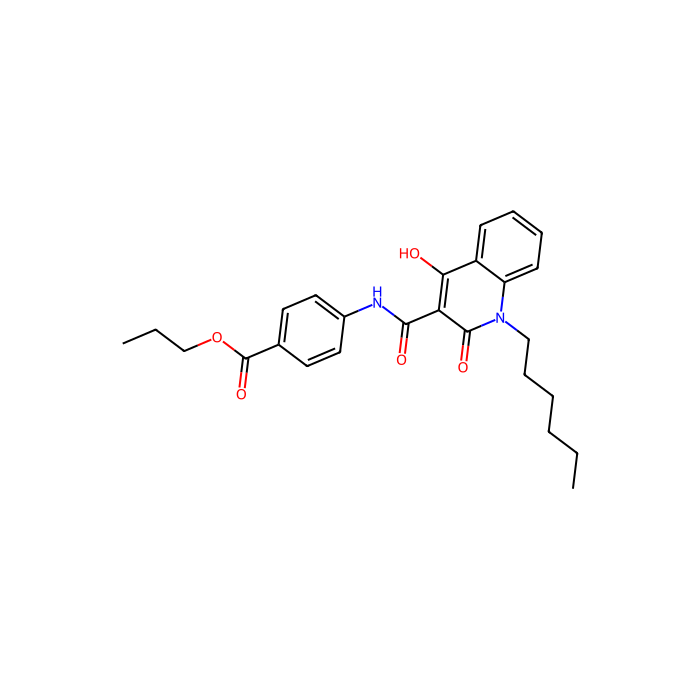
This compound belongs to the class of organic compounds known as aromatic anilides. These are aromatic compounds containing an anilide group in which the carboxamide group is substituted with an aromatic group. They have the general structure RNC(=O)R', where R= benzene, and R = aryl group.
External Descriptors
Not available
1. Djoumbou Feunang Y, Eisner R, Knox C, Chepelev L, Hastings J, Owen G, Fahy E, Steinbeck C, Subramanian S, Bolton E, Greiner R, and Wishart DS. ClassyFire: Automated Chemical Classification With A Comprehensive, Computable Taxonomy. Journal of Cheminformatics, 2016, 8:61.
Determine the necessary mass, volume, or concentration for preparing a solution.
Dilution Calculator
Determine the dilution needed to prepare a stock solution.
Reconstitution Calculator
Recensioni
Recensioni dei clienti
Application Protocols
Item-specific validated protocols: Not specified for this item; refer to CoA/Spec Sheet.
General protocols for screening compounds (not item-specific):
Preparing a DMSO stock solution:
Warm vial to room temperature in a desiccator before opening.
Add anhydrous DMSO to achieve 10–50 mM nominal concentration (based on weighed mass and assumed MW from CoA when available).
Vortex and, if needed, sonicate 5–10 minutes; confirm complete dissolution visually and by UPLC–UV.
Aliquot into low-bind tubes; store at −20 °C, protected from light.
10-point concentration–response in 384-well format:
Create a 3-fold or 10-fold serial dilution in DMSO (mother plate).
Transfer to assay plate to achieve final vehicle of 0.1–0.5% DMSO (assay-dependent).
Incubate per assay requirements; record signal and fit a 4PL curve to derive IC50/EC50.
Aggregation control assay (to flag colloidal artifacts):
Repeat key assay points with and without 0.01–0.05% nonionic detergent.
Loss of apparent activity upon detergent addition suggests aggregation-based interference.
Orthogonal confirmation:
Validate hits with an alternate detection modality (e.g., switch fluorescence → MS, or enzymatic rate → thermal shift) to exclude readout-specific artefacts.
Document lot number, exact stock concentration, and freeze–thaw history with each dataset.
Biological Roles
Item-specific:
Declared biological target, pathway, or mechanism of action: Not specified for this item; refer to CoA/Spec Sheet and primary literature associated with CAS 300833-95-8 or CID 54683103.
General context (not item-specific):
Moligand compounds are typically used as chemical tools in discovery biology to modulate proteins (enzymes, receptors, ion channels) or cellular pathways for research purposes.
In chemical biology experiments, such molecules can act as agonists, antagonists, inhibitors, activators, or allosteric modulators. Definitive role assignment requires empirical data in defined assays.
No endogenous biological role is implied for GSA10; it is a synthetic small molecule for research use only.
Experimental considerations:
Establish a concentration–response curve (8–12 points) to estimate apparent potency parameters (e.g., IC50/EC50) in your assay system.
Evaluate selectivity with counter-screens and orthogonal methods to distinguish on-target effects from assay artifacts (e.g., redox cycling, fluorescence quenching, colloidal aggregation).
Confirm cellular permeability and stability if using in cell-based assays; measure compound recovery from media and cell lysates by LC–MS.
Consider ADME-relevant in vitro assays (microsomal stability, plasma protein binding) for prioritization as a probe, recognizing that these data are model-dependent and not attributes of the catalog item unless provided in the CoA.
No medical or clinical utility is claimed or implied. Use strictly for research.
Buffer Applications
Applicability:
GSA10 is not a buffering reagent and does not constitute a defined buffer system. Therefore, there are no item-specific buffer recipes or pKa-based buffering ranges for this product.
General guidance for using small molecules in buffered assays (not item-specific):
Vehicle control: Prepare matched DMSO (or chosen solvent) controls at the same final percentage used for compound-treated samples to account for solvent effects.
Typical assay buffers: HEPES (pH 7.2–7.6), PBS (pH ~7.4), Tris (pH 7–8.5) are common; choose based on enzyme/pathway compatibility and temperature dependence (Tris pH is temperature sensitive; HEPES is more stable).
Additives to improve solubility: 0.01–0.05% nonionic surfactant (Tween‑20, Triton X-100 alternatives), 0.1% BSA, or 1–5% HPβCD can mitigate precipitation for hydrophobic compounds.
Order of addition: Add a small volume of concentrated compound stock to vigorously mixed buffer to avoid local supersaturation. Pre-wet pipette tips with buffer containing the same solvent fraction to reduce adsorption.
Filtration: If required for optical clarity, use low-binding membranes (PTFE or PVDF) and confirm no analyte loss by LC–MS.
Always verify that buffer components do not interfere with detection modalities (fluorescence, luminescence, MS) or react with the compound (e.g., amine-reactive buffers for electrophiles).
Green Alternatives
Context:
As a Moligand screening compound, GSA10 itself is the analyte rather than a process solvent or reagent. “Green alternatives” therefore center on greener choices for vehicles, diluents, and handling practices rather than substituting the compound.
Greener solvent choices for assay work (general guidance):
Prefer aqueous buffers with minimal DMSO (≤0.1–0.5% v/v) when performance permits.
Consider ethanol or isopropanol as co-solvents for optical assays if DMSO interference is problematic; they are more volatile and easier to remove from waste streams.
Use smaller-volume, higher-concentration stocks to reduce solvent consumption overall.
Comparison (general; not item-specific):
DMSO vs Ethanol: DMSO offers superior solvency for diverse chemotypes but persists in aqueous systems; ethanol is greener but may not solubilize highly lipophilic molecules.
NMP/DMF vs DMSO: NMP/DMF can raise EHS concerns; prefer DMSO when feasible and strictly limit final assay % of NMP/DMF if used.
Solubilization aids: Hydroxypropyl-β-cyclodextrin (HPβCD) or small amounts of nonionic surfactant can reduce reliance on high DMSO.
Operational practices:
Scale-down screening volumes (e.g., 384/1536-well formats) to minimize solvent and waste.
Segregate halogenated vs non-halogenated organic waste streams for improved disposal.
Store and handle at −20 °C in amber vials to extend shelf life and reduce re-synthesis demand.
All points above are general best practices and not specifications for this item.
Pharmaceutical Uses
Applicability statement:
This product is sold strictly for research use only. It is not approved for human or veterinary use, diagnostic procedures, or as a drug substance/excipient.
General context (not item-specific):
In early discovery, screening ligands like GSA10 may be used as chemical starting points (“hits”) in medicinal chemistry optimization. Any translation toward formulation or preclinical development requires extensive additional characterization (purity, polymorphism, stability, impurity profile) not specified for this item.
No pharmacopeial monograph or excipient designation is provided for this compound in the Product Data.
Operational notes for discovery settings:
If formulation-like vehicles are required for in vivo–adjacent models, typical research vehicles include aqueous buffer with minimal DMSO, plus solubilizers such as PEG400, Cremophor EL alternatives, or cyclodextrins. These are general practices and not recommendations for human use.
Quantify administered dose concentrations by validated analytical methods (HPLC/LC–MS) and confirm stability in the chosen vehicle over the dosing window.
Regulatory disclaimer:
No therapeutic claims are made or implied. Use of this material is limited to laboratory research by qualified personnel.
Physical Properties
Item-specific (from Product Data):
Appearance: Not specified for this item; refer to CoA/Spec Sheet.
Molecular weight: Not specified for this item; refer to CoA/Spec Sheet.
Other physico-chemical data (mp, bp, density, solubility, logP, pKa, refractive index): Not specified for this item; refer to CoA/Spec Sheet.
Literature/General guidance (not item-specific):
State: Small-molecule screening ligands are commonly supplied as solids or concentrated solutions. If solid, they are often crystalline or amorphous powders.
Solubility approach: Initial dissolution is typically attempted in anhydrous DMSO to prepare 10–50 mM stocks. If DMSO solubility is limited, co-solvents such as DMF, NMP, or ethanol may help; aqueous assay media can be used after dilution of DMSO to ≤0.1–1% v/v (assay-dependent).
Stability considerations: Many heteroaromatic ligands are stable at −20 °C in the dark under dry conditions. Hydrolysis- or oxidation-prone motifs (e.g., esters, aldehydes, anilines) may require light/oxygen/moisture protection.
Hygroscopicity/photolability: Variable among library members; evaluate empirically by monitoring HPLC purity and color change over time.
Practical tips:
Determine actual solubility by preparing a small DMSO stock (e.g., 10 mM), vortexing/sonicating, and confirming by HPLC/UV or LC–MS.
If precipitation occurs upon aqueous dilution, increase surfactant (e.g., 0.01–0.05% Tween‑20), add cyclodextrin, or reduce stock concentration and add more gradual DMSO into buffer while vortexing.
For any numerical property values, consult the lot-specific CoA.
Quality and Grades
Item-specific (from Product Data):
Grade/Purity designation: Moligand™
Purity value and analytical specifications: Not specified for this item; refer to CoA/Spec Sheet.
What Moligand™ implies (general description; not item-specific claims):
Moligand denotes compounds curated for molecular screening and ligand discovery workflows. Such materials are typically selected for chemical tractability and assay compatibility.
Typical QC package for screening ligands includes HPLC/UPLC purity, LC–MS mass confirmation, and may include 1H NMR and water content by Karl Fischer. Exact tests vary by item; defer to CoA.
UV transparency and residual solvent/metals are sometimes reported when relevant to optical assays; absence of such data in this listing means they are not specified for this item.
Best practices to verify quality in your lab:
Confirm identity/purity by orthogonal methods (e.g., UPLC–UV at multiple wavelengths, high-resolution MS).
If performing SAR or in vivo–adjacent studies, consider additional testing (2D NMR, residual solvent screen, counter-ion confirmation for salts).
Record lot number and retain a sample for reference stability testing.
Documentation:
For definitive grade details (purity threshold, analytical methods, acceptance criteria), rely on the lot-specific Certificate of Analysis and Specification Sheet accompanying the product.
Reaction and Applications
Applicability statement:
GSA10 is supplied as a Moligand library compound intended for biochemical and cell-based research. It is not primarily offered as a synthetic reagent. Consequently, classical “reaction applications” (e.g., coupling, reductions) are not the main use case for this item.
Research/application contexts (general, not item-specific):
Primary screening: Use as a test article in high-throughput or focused assays to evaluate effects on enzyme activity, receptor binding, protein–protein interactions, or phenotypic outputs.
Secondary profiling: Concentration–response studies, orthogonal assay confirmation (e.g., switch from fluorescence to mass-spec readouts), and selectivity panels.
Mechanistic follow-up: Thermal shift assays (DSF), microscale thermophoresis, SPR/BLI, or cellular target engagement (e.g., CETSA), contingent on the compound’s solubility and stability.
Chemical biology: Potential use as a provisional probe to perturb a pathway; suitable controls include vehicle-only and structural analogs when available.
Practical considerations:
Confirm identity/purity prior to screening (UPLC–MS).
Prepare fresh DMSO stocks and minimize freeze–thaw cycles to avoid decomposition or aggregation.
Assess aggregation risk (detergent sensitivity, light scattering) to rule out nonspecific assay interference.
Track lot numbers and exact concentrations (validate by UV or quantitative NMR if chromophore/protons permit).
Note: Any claim of molecular target or mode of action requires item-specific data; none are provided in this listing. Refer to CoA, literature tied to CAS 300833-95-8, or your internal assay results.
Reaction Conditions
Not typically applicable:
This product is intended as a screening ligand for biological assays, not as a reagent for chemical synthesis. Therefore, standardized “reaction conditions” are not defined.
General lab guidance (not item-specific):
If you plan to derivatize or immobilize the compound for probe development, establish compatibility by micro-scale trials. Common solvent systems include dry DMSO, DMF, acetonitrile, or dichloromethane, with temperatures from 0–60 °C depending on functional groups.
Monitor reactions by UPLC–MS to detect degradation or multiple product formation; adjust pH, temperature, and time accordingly.
For conjugation (if a handle exists), NHS-ester/amine coupling proceeds in mildly basic aqueous/organic mixtures; click-chemistry (CuAAC) requires an azide/alkyne handle and Cu(I) catalysis with appropriate ligands and oxygen control. These are generic examples and not recommendations for this specific item.
Because the structure and reactivity profile are not specified for GSA10, consult the CoA and perform preliminary scouting experiments before committing material.
Safety and Handling
Item-specific (from Product Data):
GHS classification: Not specified for this item; refer to SDS.
Signal word / Pictograms / H-statements: Not specified for this item; refer to SDS.
Storage conditions: Store at −20 °C.
Shipping: Ice chest + ice pads.
General safety guidance (not item-specific; defer to SDS):
Likely hazards: Small organic screening molecules can present risks of irritation, acute toxicity, and environmental hazards. Handle in a fume hood until hazards are characterized.
PPE: Safety glasses, lab coat, and appropriate chemically resistant gloves (e.g., nitrile). Avoid inhalation of dust/aerosols and skin contact.
Incompatibilities: Avoid strong oxidizers and strong acids/bases unless compatibility is known. Protect from moisture and light when stability is uncertain.
First aid (overview):
Inhalation: Move to fresh air; seek medical attention if symptoms persist.
Skin/eye contact: Rinse with water for ≥15 minutes. Remove contaminated clothing.
Ingestion: Rinse mouth; seek medical advice. Do not induce vomiting unless directed.
Spill response: Avoid dust generation. Absorb with inert material, place in chemical waste. Decontaminate area with suitable solvent/detergent per SDS.
Waste disposal: Dispose according to institutional and local regulations for organic laboratory waste.
Risk management:
Open vials at ambient temperature to minimize condensation. Allow cold shipments to equilibrate in a desiccator before opening.
For unknown hazard profiles, start with sub-milligram quantities and perform micro-scale dissolution and compatibility tests.
Solvent Selection
Item-specific:
Solubility profile: Not specified for this item; refer to CoA/Spec Sheet.
General guidance for small-molecule screening compounds (not item-specific):
Primary stock solvent: Anhydrous DMSO is the default due to broad solvating power and assay compatibility at ≤0.1–1% v/v.
Secondary solvents: DMF or NMP (high-boiling, polar aprotic); ethanol or isopropanol (less polar, more volatile); acetonitrile (moderately polar, UV-transparent). Choose based on downstream assay constraints.
Aqueous media: After preparing a concentrated DMSO stock, dilute into assay buffer with vigorous mixing to minimize precipitation. Consider adding 0.01–0.05% nonionic surfactant or 1–10% (v/v) cosolvent for challenging compounds.
pH effects: Ionizable compounds can show pH-dependent solubility; if the structure reveals acid/base functionality (consult CoA), adjust buffer pH accordingly.
Small comparison (general):
DMSO: Maximum solubilizing power; may affect some enzyme assays at >1%.
DMF/NMP: Similar solvency to DMSO; less preferred biologically—use at very low final % if required.
Ethanol/IPA: Volatile; better for optical assays sensitive to DMSO. Lower solvency for very lipophilic molecules.
PEG400 or Captisol: Useful vehicles for difficult compounds in biophysical assays; may interfere with some readouts.
Practical tips:
Start with 10 mM DMSO stock; verify clarity and stability over 24–48 h at ambient/4 °C.
Filter stocks (0.2 µm PTFE) only if mass is sufficient and adsorption losses are acceptable.
Storage and Reconstitution
Item-specific (from Product Data):
Storage conditions: Store at −20 °C.
Shipping: Ice chest + ice pads.
Appearance: Not specified for this item; refer to CoA/Spec Sheet.
General best practices (not item-specific):
Upon receipt: Allow the sealed container to warm to room temperature in a desiccator to prevent condensation before opening.
Reconstitution:
Prepare concentrated DMSO stock (typical 10–50 mM) using mass and molecular weight from the CoA; if MW is not available, determine concentration by quantitative 1H NMR or UV with an extinction coefficient when possible.
If aqueous stocks are required, assess solubility and stability; include appropriate co-solvent and surfactant if needed.
Aliquoting: Divide into single-use aliquots (e.g., 10–50 µL) in amber, low-bind tubes to minimize freeze–thaw and adsorption.
Storage of solutions: Keep at −20 °C in the dark. Avoid repeated freeze–thaw cycles; thaw on ice or at room temperature, mix gently, and use promptly.
Stability checks: Periodically verify integrity by HPLC/LC–MS, especially after 3–6 months or following any temperature excursion.
Disposal and housekeeping:
Clearly label aliquots with compound ID (GSA10), lot number, concentration, solvent, and date.
Dispose of unused material and solvent according to institutional protocols for organic chemical waste.
For any item-specific stability limits, solubility, or reconstitution instructions, consult the lot’s CoA/SDS.
Structure and Identity
Brief overview: GSA10 (SKU G275761) is listed in our Moligand small‑molecule/compound library. Detailed structural identifiers are limited in this catalog entry.
Item-specific (from Product Data):
Product name: GSA10
CAS: 300833-95-8
PubChem CID: 54683103
InChIKey: 216254 (as provided; note this is not a standard-length InChIKey. Refer to CoA/SDS for the definitive identifier.)
SMILES: Not specified for this item; refer to CoA/Spec Sheet.
Molecular formula: Not specified for this item; refer to CoA/Spec Sheet.
Molecular weight: Not specified for this item; refer to CoA/Spec Sheet.
Structural description (item-specific):
Functional groups, ring systems, stereochemistry: Not specified for this item; refer to CoA/Spec Sheet.
2D structure description: Not available in this listing; see CoA/SDS or supplier technical note for a structural depiction if provided.
General notes (for context only; not item-specific):
Moligand library compounds are typically drug-like organic molecules designed or selected for biochemical and cell-based screening. They often contain aromatic or heteroaromatic rings, H-bond donor/acceptor motifs, and cLogP in a range suitable for permeability. These general characteristics are provided for context and must not be interpreted as specifications for GSA10.
Always rely on the Certificate of Analysis (CoA) and Safety Data Sheet (SDS) packaged with the lot for definitive identifiers and structure.
Synthetic Utility
Applicability:
GSA10 is provided as a Moligand screening compound, not as a building block or reagent. Without an item-specific structure, discussing named transformations or functional group interconversions is not meaningful for this listing.
General considerations (not item-specific):
Reference standard: Library compounds can serve as analytical reference standards for method development (e.g., LC–MS retention time markers) if identity and purity are verified by independent analysis.
Derivatization feasibility: If the CoA reveals modifiable handles (e.g., anilines, phenols, carboxylates), analog generation or biotin/fluorophore tagging may be possible for target-ID workflows. Such activities require confirmed structure and IP clearance.
Stability under synthetic conditions: Prior to any modification, evaluate stability to base/acid, oxidants/reductants, and heating by small-scale tests and UPLC monitoring.
Because no structural features are provided in the Product Data, no specific synthetic schemes, named reactions, or protective-group strategies can be responsibly recommended for this item.
Target Specificity
Item-specific:
Molecular target, binding site/epitope, and selectivity profile: Not specified for this item; refer to CoA/Spec Sheet and primary literature (if available) for CAS 300833-95-8 or CID 54683103.
Notes:
Target specificity must be determined empirically in your assay system or obtained from validated literature. Absent explicit data, no claims are made regarding target class, potency, or selectivity for GSA10.
Domande frequenti
What is the purity of this product?
This product is supplied at ≥96% purity (chemical assay). Lot-specific values are stated on the Certificate of Analysis.
What is Moligand??
Moligand? is one of Aladdin Scientific's premium product lines, formulated for high-purity applications across multiple workflows. Compared to standard grades in the same workflow, Moligand? products typically offer tighter specifications, more rigorous QC, and stronger lot-to-lot consistency.
How should this product be stored?
Store at ?20 °C. Freezer storage is required to maintain the specified shelf life.
How is this product shipped?
This product ships in an insulated container with ice pads. Unpack on arrival and transfer it to the storage condition stated above.
What are the CAS number, molecular formula and molecular weight?
The CAS Number is 300833-95-8, the molecular formula is C26H30N2O5, and the molecular weight is 450.53 g/mol. InChIKey MDLUYYGRCGDKGL-UHFFFAOYSA-N.
What documentation is provided?
Available product documentation, including Certificates of Analysis (COA), Safety Data Sheets (SDS), and specification sheets, is shown in the product document area. Document availability and access follow the current site policy.
Hai bisogno di aiuto per scegliere la qualità?
La nostra guida alla selezione delle qualità copre purezza, stato dello stabilizzatore e idoneità all'applicazione per tutte le varianti del nostro catalogo.
Utilizziamo i cookie per garantire il corretto funzionamento del sito web e, ove consentito, per migliorare la tua esperienza. Puoi gestire le tue preferenze in qualsiasi momento nelle Impostazioni. Per saperne di più, consulta la nostra Cookie Policy.
Desidera che le inviamo un messaggio quando avremo sconti disponibili?
Ricordamelo più tardi
Grazie! Controlli la sua casella di posta per confermare.
Products are supplied to verified businesses, institutions, and qualified professionals for research and development use only. Not for use in humans, animals, diagnosis, or therapy.