QUALITÀ & PUREZZAMoligand™?Moligand™ — Aladdin's line of ligands and bioactive small molecules. Use for receptor, pathway, and binding studies needing defined small-molecule tools.≥98%
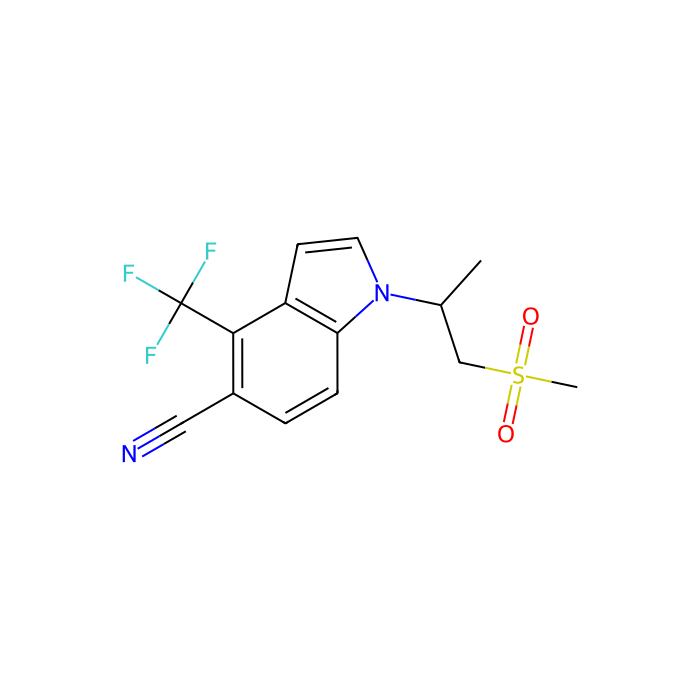
This compound belongs to the class of organic compounds known as n-alkylindoles. These are compounds containing an indole moiety that carries an alkyl chain at the 1-position.
External Descriptors
Not available
1. Djoumbou Feunang Y, Eisner R, Knox C, Chepelev L, Hastings J, Owen G, Fahy E, Steinbeck C, Subramanian S, Bolton E, Greiner R, and Wishart DS. ClassyFire: Automated Chemical Classification With A Comprehensive, Computable Taxonomy. Journal of Cheminformatics, 2016, 8:61.
Determine the necessary mass, volume, or concentration for preparing a solution.
Dilution Calculator
Determine the dilution needed to prepare a stock solution.
Reconstitution Calculator
Recensioni
Recensioni dei clienti
Application Protocols
No vendor-validated experimental protocols are provided for this item in the listing. The following are general, non-item-specific recommendations for small-molecule tool compounds in discovery research:
Biochemical enzyme assay (general):
Prepare a 10 mM DMSO stock; perform a 10-point, 3-fold serial dilution.
Keep final DMSO ≤1% v/v. Include vehicle controls.
Measure activity with a suitable readout (fluorescent, luminescent, colorimetric) and fit to a four-parameter logistic model.
Cellular assay (general):
Pre-screen for cytotoxicity of solvent; confirm compound solubility in media at 37 °C.
Treat cells across a concentration range and assess endpoint (e.g., reporter, viability, imaging-based phenotypes).
Include orthogonal confirmatory assays to mitigate artifacts.
Target engagement (general):
Use CETSA/ITDR, NanoBRET/thermal shift as applicable to your target class.
Documentation:
Record lot numbers, stock concentrations, solvent composition, and storage history. Confirm integrity by LC–MS before critical studies.
Any application-specific parameters for GSK-2881078 (e.g., concentration ranges known to be active, incubation times) are Not specified for this item; refer to CoA/Spec Sheet or literature.
Biological Roles
Item-specific biological targets, pathways, and mechanisms of action for GSK-2881078 are not provided in this listing. Accordingly, no claims are made here regarding its biochemical role.
General considerations for small-molecule ligands (non-item-specific):
Tool compounds can modulate protein function (enzymes, receptors, transporters) through competitive, allosteric, or covalent interactions. Binding mode and selectivity profiles must be established experimentally (e.g., enzymology, target engagement in cells, chemoproteomics).
Off-target assessments (broad receptor/enzyme panels) and aggregator/redox interference checks help ensure that observed phenotypes are on-target.
In cellular contexts, uptake and efflux (e.g., P-gp/BCRP) as well as intracellular sequestration (lysosomal trapping for basic compounds) can influence apparent activity.
Stability in biological matrices (microsomes, plasma) and reactive metabolite formation should be characterized when interpreting biology data.
Usage note:
For research use only. Not intended for diagnostic, therapeutic, or clinical applications.
If your work requires a defined biological mechanism for GSK-2881078, please consult the CoA/Spec Sheet and primary literature linked to the CAS (1539314-06-1) or PubChem CID (86709174), and verify under your experimental conditions.
Buffer Applications
This product is a discrete small-molecule ligand, not a buffering agent. Therefore, classical buffer preparation guidance (pKa-defined buffering ranges, buffer capacity calculations, electrophoresis buffers) is not directly applicable.
Practical notes for using small molecules in buffered systems (general, non-item-specific):
Prepare concentrated DMSO (or other suitable solvent) stocks and dilute into the assay buffer with vigorous mixing to minimize precipitation. Keep final organic solvent content as low as feasible (commonly ≤0.5–1% v/v for cell-based assays).
Common assay buffers include PBS, HEPES-buffered saline, Tris, and acetate or citrate buffers, selected based on target stability. Ensure buffer pH and ionic strength are validated for your biological system.
Some basic compounds can exhibit pH-dependent solubility; if precipitation is observed, adjust pH within assay tolerance or incorporate acceptable co-solvent/cyclodextrin.
Filter sterilize buffers prior to addition of compound if sterility is required; avoid filtering the compound solution itself unless adsorption/solubility have been evaluated.
Item-specific buffer compatibility, pKa, and aqueous solubility for GSK-2881078 are Not specified for this item; refer to CoA/Spec Sheet.
Green Alternatives
Green chemistry alternatives generally apply to solvents and reagents. As GSK-2881078 is a specific small-molecule ligand (end-use analyte), substitution for a “greener” alternative is not typically meaningful.
Context and guidance (non-item-specific):
If your workflows involve dissolving this compound, consider greener solvent systems when compatible with assay and solubility constraints:
Prefer water-based buffers with minimal DMSO where feasible.
When organic solvents are required in synthetic steps involving this molecule (e.g., for analog preparation), evaluate 2‑MeTHF or cyclopentyl methyl ether (CPME) instead of THF/Et2O; use ethyl acetate over chlorinated solvents when possible.
For purification of analogs, consider ethanol/ethyl acetate/MTBE combinations before resorting to dichloromethane or acetonitrile, provided performance is acceptable.
Mini comparison for dissolving stocks (general):
Water: Greenest option; often limited by solubility for hydrophobic scaffolds.
DMSO: Widely accepted in screening at ≤1% v/v final; handle hygroscopicity to reduce waste.
Ethanol: Potentially greener than amide solvents; biological compatibility constraints may apply.
Waste minimization:
Prepare only the quantity of stock needed and aliquot to reduce discard from freeze–thaw degradation.
Consolidate analytical runs (LC–MS/HPLC) to minimize solvent consumption, and employ microflow LC where available.
Pharmaceutical Uses
GSK-2881078 is supplied strictly for research use only. No claims are made regarding its suitability for human or veterinary use, diagnostics, or any clinical application.
Context for formulation scientists (general, non-item-specific):
As a discovery-stage tool compound, it may be explored in preclinical research settings for exposure/PK studies or target validation. If pursued, select excipients and vehicles guided by compound solubility and stability (e.g., PEG400/saline, Captisol, lipid emulsions), and comply with institutional and regulatory standards for animal research.
Pharmacopeial status (USP/EP/JP) and compendial specifications: Not applicable/not established for this research-grade material.
Impurity profile, residual solvents, and polymorph control may not meet clinical development requirements. If translation is anticipated, request enhanced analytics and stability data, or source under GMP with a formal Quality Target Product Profile (QTPP).
Item-specific details such as salt form, hydrate/solvate state, and excipient compatibility are Not specified for this item; refer to CoA/Spec Sheet.
Physical Properties
Item-specific physicochemical constants have not been provided for this catalog entry. Where a numerical value is not listed below, treat it as: Not specified for this item; refer to CoA/Spec Sheet.
Appearance: Not specified for this item; refer to CoA/Spec Sheet.
Molecular weight (MW): Not specified for this item; refer to CoA/Spec Sheet.
Molecular formula: Not specified for this item; refer to CoA/Spec Sheet.
Melting point (MP): Not specified for this item; refer to CoA/Spec Sheet.
Boiling point (BP): Not specified for this item; refer to CoA/Spec Sheet.
Density: Not specified for this item; refer to CoA/Spec Sheet.
Refractive index: Not applicable for solids; if oil/liquid, Not specified for this item; refer to CoA/Spec Sheet.
pKa(s): Not specified for this item; refer to CoA/Spec Sheet.
logP/logD: Not specified for this item; refer to CoA/Spec Sheet.
Solubility: Not specified for this item; refer to CoA/Spec Sheet.
General laboratory guidance for small-molecule tool compounds (non-item-specific):
Many heteroatom-rich drug-like ligands are sparingly soluble in water but soluble in polar aprotic solvents (DMSO, DMF) and mixed aqueous buffers with co-solvent (e.g., ≤1–2% DMSO in assays). Always determine solubility empirically for your batch.
Hygroscopicity and polymorphism can influence apparent MP and solubility; confirm against CoA.
For photolabile scaffolds, protect from light during handling and storage (amber vials) — item-specific light sensitivity is not provided here.
For authoritative numerical values and acceptance criteria, please consult the SDS and the item’s CoA/Spec Sheet.
Quality and Grades
Grade/Purity: Moligand™ (Product Data)
What Moligand™ typically signifies (general description):
A research-grade, screening-quality small molecule intended for biochemical/cellular assays, target validation, and medicinal chemistry exploration. Emphasis is placed on identity confirmation and assay-ready handling rather than process reagent specifications (e.g., trace metal limits or UV cutoff, which are more relevant to solvents/reagents).
Typically supplied with supporting documentation (CoA/Spec Sheet) describing identity (LC–MS, NMR as available) and purity by HPLC/UPLC. Exact purity threshold and analytical methods for this lot are Not specified for this item; refer to CoA/Spec Sheet.
Implications for users:
Suitable for high-throughput screening (HTS), SAR, and probe studies in discovery research. For GLP/GMP work, additional qualification may be required.
If low residual solvent content, water content, or salt form is critical for your application, confirm via CoA or request additional analytics. Specific residual limits (e.g., water ppm, residual solvents, peroxides, metal content) are Not specified for this item; refer to CoA/Spec Sheet.
Batch-to-batch considerations:
Maintain documentation of lot numbers in data packages. Where potency is sensitive to polymorph/tautomer, confirm consistency by orthogonal methods.
Contact Aladdin Scientific for expanded analytical packages if you require specific tests or tighter specifications.
Reaction and Applications
This product is supplied as a finished small-molecule ligand for discovery research rather than as a synthetic reagent. Consequently, classical synthetic “reaction applications” (e.g., use as a catalyst, base, coupling partner, or solvent) are not typically applicable.
Chemical biology: Use as a tool compound candidate in target engagement assays (biochemical enzyme assays, thermal shift, CETSA, NanoBRET), binding kinetics (SPR, MST, ITC), and cellular phenotypic screens. Item-specific target or mode of action is Not specified for this item; refer to primary literature or CoA if available.
ADME profiling: Solubility, permeability (PAMPA/Caco-2), metabolic stability (microsomes/hepatocytes), and plasma protein binding studies to characterize developability.
Formulation screening: Co-solvent systems or solid-dispersion excipients for in vivo exploratory research (ensure compliance with institutional approvals for animal studies; product is for research use only).
Good practices:
Prepare concentrated, aliquoted DMSO stocks and avoid repeated freeze–thaw.
Use orthogonal assay formats to confirm activity and reduce false positives due to aggregation or redox cycling. Include detergent controls when appropriate.
Confirm purity/identity by LC–MS prior to critical experiments; trace impurities can confound SAR.
Reaction Conditions
This catalog item is a finished small-molecule ligand and not a synthetic reagent. As such, there are no standard “reaction conditions” for using it to promote or undergo named organic reactions.
Guidance relevant to handling in research workflows (general, non-item-specific):
Stock preparation: Dissolve in anhydrous DMSO to 10–50 mM; vortex and, if necessary, sonicate briefly. Filter only if validated to prevent adsorption losses.
Assay dilution: Add stock to buffer under vigorous mixing to reach the desired final concentration; typical final DMSO ≤0.5–1% v/v in cellular assays. Confirm that no precipitation occurs at incubation temperature.
Stability checks: Evaluate bench-top and 37 °C stability in your matrix (buffer, media, plasma). Monitor by LC–MS over relevant time windows.
Light/oxidation: If the scaffold is unknown, adopt conservative protections: amber vials, minimal headspace, inert atmosphere for long incubations.
Item-specific parameters such as degradation kinetics, half-life in biochemical or cellular media, and known incompatibilities are Not specified for this item; refer to CoA/Spec Sheet and SDS.
Safety and Handling
Safety information specific to this item is limited in the listing. The following statements summarize what is known and provide general best practices for handling research-use small molecules.
GHS classification: Not specified for this item; refer to SDS.
Signal word / H-statements / Pictograms: Not specified for this item; refer to SDS.
Storage conditions: Store at −20 °C (Product Data). Keep container tightly closed. Minimize freeze–thaw cycling by aliquoting if dissolution and re-freezing is anticipated.
Shipping: Shipped in ice chest with ice pads (cold chain maintained).
General laboratory precautions (non-item-specific):
Use in a certified chemical fume hood. Avoid inhalation of dust/aerosols and contact with skin/eyes.
PPE: lab coat, safety glasses, and appropriate chemically resistant gloves (e.g., nitrile). Change gloves regularly and after contamination.
Avoid incompatible materials until confirmed by SDS; as a conservative rule, store away from strong oxidizers, strong acids/bases, and ignition sources.
First aid (general): In case of skin contact, wash with soap and water. For eye contact, rinse cautiously with water for several minutes; remove contact lenses if present and easy. If inhaled, move to fresh air. If ingested, rinse mouth and seek medical attention. Always consult the SDS for item-specific measures.
Waste: Dispose of contents/container in accordance with institutional and local regulations for organic laboratory chemicals.
For definitive hazard classification, exposure limits, and spill/fire-fighting measures, consult the SDS provided with the product.
Solvent Selection
Item-specific solubility data are not provided for GSK-2881078. The following guidance reflects common practice for small, drug-like ligands and should be confirmed experimentally for your batch.
Primary dissolution solvent for stocks: DMSO (anhydrous) is generally preferred due to broad solubilizing power and assay compatibility at low percentages. Start with 10–50 mM stocks.
Alternative solvents: DMF, NMP, or ethanol can be considered if DMSO solubility is limited or assay constraints require alternatives.
Aqueous working solutions: Dilute DMSO stocks into assay buffers, keeping final DMSO typically ≤0.5–1% v/v to minimize biological interference. Include DMSO vehicle controls.
Surfactants and cosolvents: If precipitation occurs, evaluate low levels of nonionic surfactants (e.g., 0.01–0.05% Tween-20) or cyclodextrins, subject to assay tolerance.
Quick comparison (general, non-item-specific):
DMSO: Highest solvency; excellent for cryostable stocks; hygroscopic and can oxidize some motifs slowly.
DMF/NMP: Good solvency; higher toxicity concerns; consider for chemistry workflows more than bioassays.
Ethanol/MeOH: Lower solvency for many heteroaromatics; better evaporation profile but may perturb cells/proteins at modest percentages.
Practical tips:
Filter sterilize (0.22 µm PTFE) only if validated; adsorption losses may occur.
Verify clarity after dilution into buffer at use temperature; some compounds show temperature-dependent solubility.
Document final solvent composition in all biological readouts.
Storage and Reconstitution
Storage conditions: Store at −20 °C (Product Data). Protect from moisture and, as a precaution, from light. Keep container tightly closed.
Shipping: Ice chest + ice pads (Product Data) to maintain a cold chain during transit.
Form supplied/appearance: Not specified for this item; refer to CoA/Spec Sheet.
Reconstitution (general guidance for small molecules; confirm empirically):
Prepare concentrated stock solutions in anhydrous DMSO (typical 10–50 mM). Vortex to dissolve; brief sonication may be used if needed.
If aqueous solutions are required, dilute the DMSO stock into buffer with vigorous mixing; verify absence of precipitation at the working concentration and temperature.
For sterile applications, consider preparing stocks with sterile-filtered solvents and perform manipulations in a clean environment. Avoid filtering the compound solution unless adsorption losses are assessed.
Aliquoting and stability:
Aliquot stock solutions to single-use vials to avoid repeated freeze–thaw cycles. Store aliquots at −20 °C (or below) in amber vials.
Record preparation date, solvent, and concentration on each aliquot. Reassess integrity by LC–MS/HPLC after extended storage.
Item-specific parameters such as aqueous solubility limits, pH stability, and long-term solution stability are Not specified for this item; refer to CoA/Spec Sheet and SDS.
Structure and Identity
GSK-2881078 is supplied as a research-use small molecule (Moligand grade) from Aladdin Scientific.
Product identifiers
SKU: G412293
Product Name: GSK-2881078
CAS: 1539314-06-1
PubChem CID: 86709174
InChIKey: Not specified for this item; refer to CoA/Spec Sheet. (Product data listed a placeholder "338128" which is not a complete InChIKey.)
SMILES: Not specified for this item; refer to CoA/Spec Sheet.
Molecular formula: Not specified for this item; refer to CoA/Spec Sheet.
Molecular weight: Not specified for this item; refer to CoA/Spec Sheet.
Structural description:
Detailed 2D/3D structure, ring systems, functional groups, and stereochemistry are not provided in the current listing. Please consult the Certificate of Analysis (CoA), specification sheet, or primary literature for structural elucidation, if needed.
Notes for identity verification (general guidance):
When receiving bioactive tool compounds, confirm identity by LC–MS (expected [M+H]+ from MW), check retention time versus reference, and, if material will be used for structure–activity studies, consider 1H/13C NMR (DMSO‑d6, CD3OD, or CDCl3 depending on solubility). Match spectra to vendor CoA or literature.
If chirality is relevant (not specified here), verify enantiomeric purity by chiral HPLC or derivatization methods.
All identity-critical parameters not explicitly listed above are Not specified for this item; refer to CoA/Spec Sheet.
Synthetic Utility
This product is intended as an end-use small-molecule ligand and is not generally used as a building block or reagent in synthetic chemistry. Therefore, classic synthetic “utility” (e.g., nucleophile/electrophile reactivity, cross-coupling handles) cannot be described without a disclosed structure.
General notes if analog synthesis is envisioned (non-item-specific):
If the scaffold is known from literature (via CAS or CID), identify privileged motifs and diversification vectors (heteroaryl cores, amide/urea linkers, anilides, sulfonamides, etc.) for SAR. Protecting-group strategies and chemoselectivity should be tailored to the functional group map of the scaffold.
Establish robust late-stage diversification routes (e.g., Suzuki–Miyaura, Buchwald–Hartwig, amide couplings, S-alkylations) to enable parallel synthesis, contingent on the presence of suitable handles.
Purification methods: Reverse-phase prep HPLC is often the most reliable for polar, multi-heteroatom drug-like compounds; normal-phase silica or crystallization can be used where feasible.
Because the structure is not provided in this listing, item-specific reactivity and derivatization options are Not specified for this item; refer to CoA/Spec Sheet and primary literature.
Target Specificity
Target, selectivity profile, and biochemical potency for GSK-2881078 are not provided in this product listing.
Antigen/epitope/clone/isotype: Not applicable — this product is a small molecule, not an antibody or biologic.
If a defined molecular target is required for your study, consult primary literature associated with CAS 1539314-06-1 or PubChem CID 86709174 and verify activity in your own hands using orthogonal assays.
All target-related claims are Not specified for this item; refer to CoA/Spec Sheet and peer-reviewed sources.
Domande frequenti
How should this product be stored?
Store at ?20 °C. Freezer storage is required to maintain the specified shelf life.
How is this product shipped?
This product ships in an insulated container with ice pads. Unpack on arrival and transfer it to the storage condition stated above.
What are the CAS number, molecular formula and molecular weight?
The CAS Number is 1539314-06-1, the molecular formula is C14H13F3N2O2S, and the molecular weight is 330.33 g/mol. InChIKey SKDVMPZQJMZEAC-SECBINFHSA-N.
What is the purity of this product?
This product is supplied at ≥98% purity (chemical assay). Lot-specific values are stated on the Certificate of Analysis.
What is Moligand??
Moligand? is one of Aladdin Scientific's premium product lines, formulated for high-purity applications across multiple workflows. Compared to standard grades in the same workflow, Moligand? products typically offer tighter specifications, more rigorous QC, and stronger lot-to-lot consistency.
What documentation is provided?
Available product documentation, including Certificates of Analysis (COA), Safety Data Sheets (SDS), and specification sheets, is shown in the product document area. Document availability and access follow the current site policy.
Hai bisogno di aiuto per scegliere la qualità?
La nostra guida alla selezione delle qualità copre purezza, stato dello stabilizzatore e idoneità all'applicazione per tutte le varianti del nostro catalogo.
Utilizziamo i cookie per garantire il corretto funzionamento del sito web e, ove consentito, per migliorare la tua esperienza. Puoi gestire le tue preferenze in qualsiasi momento nelle Impostazioni. Per saperne di più, consulta la nostra Cookie Policy.
Desidera che le inviamo un messaggio quando avremo sconti disponibili?
Ricordamelo più tardi
Grazie! Controlli la sua casella di posta per confermare.
Products are supplied to verified businesses, institutions, and qualified professionals for research and development use only. Not for use in humans, animals, diagnosis, or therapy.

 C2303548