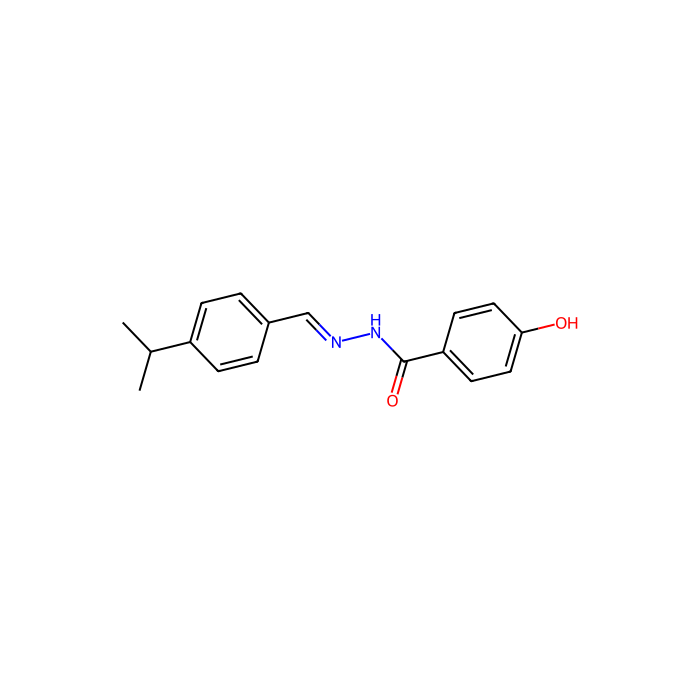
GSK 4716 - Moligand™, ≥98% , Agonist of Estrogen-related receptor-γ, CAS No.101574-65-6, Agonist of Estrogen-related receptor-γ

CAS: 101574-65-6 Cat. No.: G274953 Formula: C17H18N2O2 Peso molecolare: 282.34 Numero EC: 682-923-4
Disponibile su ordine
QUALITÀ & PUREZZA Moligand™ ? Moligand™ — Aladdin's line of ligands and bioactive small molecules. Use for receptor, pathway, and binding studies needing defined small-molecule tools. ≥98%
Synonyms
4-hydroxy-N''-[(1E)-[4-(propan-2-yl)phenyl]methylidene]benzohydrazide|4-hydroxy-N'-[(E)-[4-(propan-2-yl)phenyl]methylidene]benzohydrazide|4-hydroxy-N'-{[4-(propan-2-yl)phenyl]methylidene}benzohydrazide|4-Hydroxy-2-[(1E)-[4-(1-methylethyl)phenyl]methylene]hydrazide|4-hydroxy-N'-{(E)-[4-(propan-2-yl)phenyl]methylidene}benzohydrazide|Benzoic acid, 4-hydroxy-, 2-[[4-(1-methylethyl)phenyl]methylene]hydrazide|4-hydroxy-N-[(E)-(4-propan-2-ylphenyl)methylideneamino]benzamide|GSK 4716|4-hydroxy-N'-(4-isopropylbenzylidene)benzohydrazide|GW4716|4-Hydroxy-benzoic acid (4-isopropyl-benzylidene)-hydrazide|GSK4716
Storage
Store at -20°C
Shipped In
Ice chest + Ice pads
★
Dimensione
Germania (EU)
USA*
Prezzo
Qtà
5mg
G274953-5mg
—
3 Disponibile
20,74€
10mg
G274953-10mg
—
3 Disponibile
38,09€
25mg
G274953-25mg
—
2 Disponibile
69,33€
50mg
G274953-50mg
—
2 Disponibile
84,95€
100mg
G274953-100mg
Su ordinazione · 8–12 settimane
169,12€
Enter a quantity for the sizes you want to add.

Panoramica

Store at +4°C. The product can be stored for up to 12 months.

Specifiche

Sinonimi
4-hydroxy-N''-[(1E)-[4-(propan-2-yl)phenyl]methylidene]benzohydrazide | 4-hydroxy-N'-[(E)-[4-(propan-2-yl)phenyl]methylidene]benzohydrazide | 4-hydroxy-N'-{[4-(propan-2-yl)phenyl]methylidene}benzohydrazide | 4-Hydroxy-2-[(1E)-[4-(1-methylethyl)phenyl]methylene]hydrazide | 4-hydroxy-N'-{(E)-[4-(propan-2-yl)phenyl]methylidene}benzohydrazide Mostra altro
Specifiche e purezza
Moligand™, ≥98%
Meccanismi biochimici e fisiologici
GSK 4716 is an Estrogen-related receptors ERRβ and ERRγ agonist with minimal activity for ERRα, ERα and Erβ
Condizioni di conservazione di stoccaggio
Store at -20°C
Spedito in
Ice chest + Ice pads
Questo prodotto richiede spedizione a catena fredda. I servizi di terra e altri servizi economici non sono disponibili.
Grado
Moligand™
Tipo di azione
AGONIST
Meccanismo d'azione
Agonist of Estrogen-related receptor-γ
Nota
Wherever possible, you should prepare and use solutions on the same day. However, if you need to make up stock solutions in advance, we recommend that you store the solution as aliquots in tightly sealed vials at -20°C. Generally, these will be useable for up to one month. Before use, and prior to opening the vial we recommend that you allow your product to equilibrate to room temperature for at least 1 hour. Need more advice on solubility, usage and handling? Please visit our frequently asked questions (FAQ) page for more details.
Purezza
≥98%
Nomi e identificatori
Pubchem Sid
Pubchem Sid Url
https://pubchem.ncbi.nlm.nih.gov/substance/504763642
Sorrisi canonici
CC(C)C1=CC=C(C=C1)C=NNC(=O)C2=CC=C(C=C2)O
IUPAC Name
4-hydroxy-N-[(E)-(4-propan-2-ylphenyl)methylideneamino]benzamide
InChIKey
IKPPIUNQWSRCOZ-WOJGMQOQSA-N
INCHI
1S/C17H18N2O2/c1-12(2)14-5-3-13(4-6-14)11-18-19-17(21)15-7-9-16(20)10-8-15/h3-12,20H,1-2H3,(H,19,21)/b18-11+
Isomeri SMILES
CC(C)C1=CC=C(C=C1)/C=N/NC(=O)C2=CC=C(C=C2)O
Peso molecolare
282.34
Reaxy-Rn
24176628
Reaxys-RN_link_address
https://www.reaxys.com/reaxys/secured/hopinto.do?context=S&query=IDE.XRN=24176628&ln=

Dati avanzati

Taxonomic Classification

Taxonomy Tree

KingdomOrganic compounds
SuperclassLipids and lipid-like molecules
ClassePrenol lipids
SubclassMonoterpenoids
Intermediate Tree Nodes Not available
Direct ParentAromatic monoterpenoids
Alternative Parents Monocyclic monoterpenoids  Phenylpropanes  Cumenes  Benzoic acids and derivatives  Benzoyl derivatives  1-hydroxy-2-unsubstituted benzenoids  Carboxylic acids and derivatives  Organopnictogen compounds  Organooxygen compounds  Organonitrogen compounds  Organic oxides  Hydrocarbon derivatives  
Molecular FrameworkAromatic homomonocyclic compounds
Substituents P-cymene - Aromatic monoterpenoid - Monocyclic monoterpenoid - Benzoic acid or derivatives - Phenylpropane - Cumene - Benzoyl - 1-hydroxy-2-unsubstituted benzenoid - Phenol - Monocyclic benzene moiety - Benzenoid - Carboxylic acid derivative - Organic nitrogen compound - Organonitrogen compound - Organooxygen compound - Hydrocarbon derivative - Organic oxide - Organopnictogen compound - Organic oxygen compound - Aromatic homomonocyclic compound
DescrizioneThis compound belongs to the class of organic compounds known as aromatic monoterpenoids. These are monoterpenoids containing at least one aromatic ring.
External Descriptors monoterpenoid
Struttura 3D
Modello di struttura chimica interattiva


Obiettivi associati (umani)
ESRRG Tchem Estrogen-related receptor gamma (1 Activities)
Activity TypeActivity Value -log(M)Mechanism of ActionActivity ReferencePublications (PubMed IDs)
ESRRA Tchem Estrogen-related receptor alpha (573 Activities)
Activity TypeRelationActivity valueUnitsAction TypeJournalPubMed IddoiAssay Aladdin ID
ESRRG Tchem Estrogen-related receptor gamma (587 Activities)
Activity TypeRelationActivity valueUnitsAction TypeJournalPubMed IddoiAssay Aladdin ID
U2OS (164939 Activities)
Activity TypeRelationActivity valueUnitsAction TypeJournalPubMed IddoiAssay Aladdin ID
Obiettivi associati (non umani)
Alpha trans-inducing protein (VP16) (945 Activities)
Activity TypeRelationActivity valueUnitsAction TypeJournalPubMed IddoiAssay Aladdin ID
Meccanismi d'azione
Certificati (CoA, COO, BSE/TSE e tabella di analisi)
C of A & Other Certificates(BSE/TSE, COO):
Analytical Chart:

Find and download the COA for your product by matching the lot number on the packaging.

5 results found

Lot NumberCertificate TypeDataOggetto
A2206008A2206008Certificate of AnalysisJul 03, 2026 G274953
A2206051A2206051Certificate of AnalysisJul 03, 2026 G274953
A2206059A2206059Certificate of AnalysisJul 03, 2026 G274953
A2206062A2206062Certificate of AnalysisJul 03, 2026 G274953
A2206064A2206064Certificate of AnalysisJul 03, 2026 G274953
Proprietà chimiche e fisiche
SolubilitàSoluble in DMSO to 100 mM and in ethanol to 100 mM
Peso molecolare282.340 g/mol
XLogP33.300
Hydrogen Bond Donor Count2
Hydrogen Bond Acceptor Count3
Rotatable Bond Count4
Exact Mass282.137 Da
Monoisotopic Mass282.137 Da
Topological Polar Surface Area61.700 Ų
Heavy Atom Count21
Formal Charge0
Complexity352.000
Isotope Atom Count0
Defined Atom Stereocenter Count0
Undefined Atom Stereocenter Count0
Defined Bond Stereocenter Count1
Undefined Bond Stereocenter Count0
The total count of all stereochemical bonds1
Covalently-Bonded Unit Count1
Calcolatori di soluzioni
Recensioni

Recensioni dei clienti

Application Protocols

Only protocols explicitly provided in Product Data may be reported as validated for this SKU. None are specified.

General, non-validated guidance for small-molecule ligands (for planning only):

  • Preparing stocks: Weigh the compound quickly, dissolve in dry DMSO to 10–50 mM, vortex and, if needed, sonicate. Filter through 0.2 µm PTFE for sterile applications.
  • Aliquoting: Dispense single-use aliquots (e.g., 10–50 µL) in low-bind tubes; store at −20°C, protected from light.
  • Dose–response setup: Perform serial dilutions in DMSO, then back-dilute into assay buffer to maintain constant final DMSO (≤0.1–0.5% v/v). Include vehicle controls.
  • Plate-based assays: For 96/384-well formats, pre-mix ligand with media/buffer before addition to cells/enzymes to reduce edge effects and precipitation. Mix gently to avoid foaming.
  • Data QC: Monitor assay Z′ factor, check for compound autofluorescence/absorbance interference, and confirm compound integrity by LC–MS as needed.

These steps are illustrative and are not validated protocols for this product.

Biological Roles

Scope: The following reflects general, literature-based context for compounds referred to as GSK 4716 and is provided to aid experimental planning. It is not a clinical or therapeutic claim and is not an item-specific specification.

  • Tool-compound usage: Described in the literature as a small-molecule ligand used to probe nuclear receptor biology, particularly in transcriptional reporter assays and receptor-binding studies.
  • Experimental paradigms: Employed in cell-based assays to evaluate downstream gene expression changes, coactivator recruitment, and phenotypic outcomes tied to receptor activity. Typical workflows include time-course dosing, dose–response curves, and orthogonal verification via qPCR or proteomics.
  • Selectivity considerations: As with many research ligands, off-target interactions can occur at higher concentrations; comprehensive counterscreening (e.g., against related receptors or in null-background systems) is advisable.
  • Data integrity: Incorporate vehicle controls, inactive analogs, and concentration-matched controls. Confirm compound integrity (LC–MS) before and after long experiments to rule out degradation or adsorption losses.

Note: Exact receptor targets, EC50/IC50 values, and binding constants are not provided here. Consult primary literature and the lot-specific CoA for structural confirmation before drawing mechanistic conclusions.

Buffer Applications

Applicability: As a bioactive small molecule, GSK 4716 is not itself a buffer component. However, it is commonly dosed into biological buffers for assays.

General assay-buffer guidance (best practice; not item specification):

  • Stock preparation: Dissolve in high-purity DMSO to 10–50 mM. Confirm clarity; brief sonication may help.
  • Dosing into aqueous buffer: Add the DMSO stock to the assay buffer (e.g., PBS, HBSS, HEPES-buffered media) slowly with mixing to a final DMSO of ≤0.1–0.5% v/v, as tolerated by the system.
  • Precipitation control: If turbidity occurs, lower the dosing concentration, increase mixing time, slightly elevate temperature (room temp), or add a small proportion of a co-solvent compatible with the assay.
  • Adsorption mitigation: For low-nanomolar assays, reduce nonspecific binding by using low-bind plasticware and adding minimal carrier protein (e.g., 0.1% BSA) if compatible.
  • pH and ionic strength: Maintain standard buffer conditions for the biological target; the compound is typically added at low concentrations that do not materially alter buffer pH or osmolality.

Documentation: Record DMSO lot, buffer composition, and exact final % DMSO for reproducibility.

Green Alternatives

Context: For small-molecule ligands like this item, the principal environmental considerations arise from solvent choice in stock preparation, assay dilution, and analytical methods.

Greener handling options (general guidance):

  • Replace or reduce high volumes of acetonitrile and DMF in sample prep with ethanol or isopropanol where assay tolerance allows.
  • Consider 2-MeTHF or ethyl acetate for certain preparative or partition steps (analytical development), noting their improved environmental profiles relative to chlorinated solvents. Applicability depends on the ligand’s solubility profile.
  • For aqueous dosing, employ DMSO-minimization strategies: higher-concentration stocks with smaller dosing volumes, or use solubilizing excipients (e.g., hydroxypropyl-β-cyclodextrin) to reduce DMSO in final assays.

Illustrative comparison (general; not item-specific):

  • DMSO: high solvency, fully miscible with water; widely accepted biologically at ≤0.1–0.5% v/v, but not considered a “green” solvent by all frameworks.
  • Ethanol: bio-based routes available; broadly greener profile; may perturb biological systems at similar percentages—control carefully.
  • ACN: excellent for LC–MS; petrochemical origin and acute toxicity considerations; minimize volume and ensure recovery in closed systems.

Waste and footprint:

  • Consolidate DMSO/organic waste streams and employ solvent recovery when possible. Miniaturize assays (96/384/1536-well) to proportionally reduce solvent consumption.
Pharmaceutical Uses

This product is supplied strictly for research use only and is not intended for human or veterinary applications.

Formulation and industry context (general, non-clinical):

  • Reference standard/tool compound: May be used as a non-GMP analytical or bioassay reference in discovery settings for receptor engagement studies or assay qualification.
  • Pre-formulation research: Solubility profiling and stability screens (pH, light, oxidative stress) can inform medicinal chemistry optimization but are outside regulated drug-product development.

Not applicable to this item:

  • There are no pharmacopeial monographs, excipient roles, or approved drug-product uses specified for this SKU.

Compliance note:

  • For any application beyond basic research (e.g., GLP/GMP), users must independently qualify materials and obtain appropriate quality documentation. This listing provides no clinical, diagnostic, or therapeutic claims.
Physical Properties

Item-specific properties:

  • Appearance: Not specified for this item; refer to CoA/Spec Sheet.
  • Molecular Weight: Not specified for this item; refer to CoA/Spec Sheet.
  • Melting point: Not specified for this item; refer to CoA/Spec Sheet.
  • Boiling point: Not applicable/rarely reported for solid bioactive ligands; Not specified for this item.
  • Density: Not specified for this item; refer to CoA/Spec Sheet.
  • Refractive index: Not applicable for solids; Not specified for this item.
  • Solubility: Not specified for this item; refer to CoA/Spec Sheet.
  • LogP, pKa: Not specified for this item; refer to CoA/Spec Sheet.

General guidance (literature/typical for small-molecule ligands; not item specification):

  • Stock preparation is commonly performed in high-purity DMSO (e.g., 10–50 mM) before dilution into aqueous assay buffers. Actual solubility limits depend on structure and purity; verify experimentally.
  • For aqueous work, co-solvents (DMSO ≤0.1–0.5% v/v in final assay) or solubilizing excipients (e.g., non-ionic surfactants or cyclodextrins) may be used when compatible with the assay.
  • Hygroscopicity and light sensitivity can vary among ligands; handle quickly at ambient conditions and protect from light until item-specific data are confirmed.
Quality and Grades

Item-specific grade:

  • Grade/Purity: Moligand™ (Aladdin small-molecule ligand library grade)

What Moligand™ signifies (general guidance):

  • Intended for discovery research, screening, and mechanistic studies where reliable identity and purity are important for biochemical assays.
  • Emphasis is typically placed on identity verification and suitability for stock solution preparation in DMSO and related assay workflows; specific analytical thresholds (e.g., HPLC area%, water content, residual solvents, metal content, UV cutoffs) are Not specified for this item; refer to CoA/Spec Sheet.

Batch documentation and QC:

  • Users should consult the lot-specific Certificate of Analysis (CoA) for detailed purity, assay method (e.g., HPLC/UPLC), and any residual solvent or water content metrics.
  • If low-UV background or LC–MS compatibility is mission-critical, request or review chromatograms and impurity profiles for the specific lot.

Stabilizers/format:

  • Stabilizers, salt form, and counterions (if any) are Not specified for this item; refer to CoA/Spec Sheet.

Use implications:

  • For quantitative biology or SAR, we recommend verifying identity by an orthogonal method (e.g., LC–MS) and preparing single-use DMSO aliquots to preserve integrity across studies.
Reaction and Applications

Primary use domain: GSK 4716 is offered as part of a small-molecule/compound library for biochemical and cellular research. It is not primarily intended as a synthetic reagent or building block.

Research applications (general, literature context; not item specification):

  • Frequently used as a tool compound in mechanism and pathway interrogation studies where receptor-ligand interactions are monitored via biochemical, transcriptional, or phenotypic readouts.
  • Suitable for high-throughput screening (HTS), dose–response profiling, and orthogonal assay validation when used with appropriate controls and solvent tolerances.
  • Can serve as a reference comparator for SAR series or as a spike-in standard for LC–MS method development in bioanalytical workflows.

Not typically applicable:

  • Named-reaction chemistry (e.g., cross-couplings, Grignard) is not relevant for this finished ligand. For synthetic transformations, see our catalog of reagents and building blocks instead.

Practical tips:

  • Prepare concentrated DMSO stocks, verify solubility visually, and consider brief sonication if needed. Avoid repeated freeze–thaw by aliquoting.
  • Include vehicle controls matching the final DMSO percentage and, when applicable, inactive analog controls for specificity assessment.
Reaction Conditions

Not applicable: This SKU is a research ligand, not a synthetic reagent. Standard organic reaction conditions (catalysts, temperatures, yields) are not relevant to its primary use.

Assay handling conditions (general, literature-based guidance; not item specification):

  • Stock solutions: Prepare in anhydrous DMSO (e.g., 10–50 mM). Store aliquots at −20°C, protected from light.
  • Working concentrations: Determine empirically via dose–response; include vehicle controls with matching DMSO content.
  • Incubation parameters: Many receptor-ligand assays use 15 min to several hours of incubation at 20–37°C; optimize per assay format (binding vs. transcriptional response).
  • Stability checks: Verify by LC–MS or HPLC after storage or prolonged incubations to confirm integrity.

Note: No item-specific EC50/IC50 or kinetic parameters are provided here. Consult literature relevant to your biological system.

Safety and Handling

Safety classification for this SKU:

  • GHS Classification: Not specified for this item; refer to SDS.
  • Signal Word: Not specified for this item; refer to SDS.
  • Hazard (H) Statements: Not specified for this item; refer to SDS.
  • Pictograms: Not specified for this item; refer to SDS.

General laboratory precautions (good practice; defer to SDS for authoritative guidance):

  • Personal protective equipment: lab coat, safety glasses, and nitrile gloves as a minimum. Handle powders/solids in a fume hood to avoid inhalation and dust generation.
  • Avoid contact with skin, eyes, and clothing. Prevent ingestion and inhalation. Wash thoroughly after handling.
  • Storage incompatibilities: Keep away from strong oxidizers and strong acids/bases unless compatibility is known. Avoid prolonged exposure to light and moisture.
  • First aid (overview): In case of skin/eye contact, rinse with water for ≥15 minutes; remove contaminated clothing. If inhaled, move to fresh air. If ingested, rinse mouth and seek medical attention. Always follow the SDS and institutional protocols.
  • Spill/cleanup: Avoid dust formation; collect using inert absorbent or dampened wipe to minimize airborne particles. Dispose of waste according to local regulations.
  • For research use only; not for human or veterinary use.
Solvent Selection

Applicability: As a small-molecule ligand in a screening library, solvent choice primarily concerns preparation of concentrated stocks and compatibility with downstream assays.

General guidance (literature/best practice; not item specification):

  • Primary solvent for stocks: High-purity, anhydrous DMSO (common working stocks 10–50 mM). Filter if needed (0.2 µm PTFE) for sterile applications.
  • Co-solvents for method development: Acetonitrile (for LC–MS sample prep), ethanol, or DMF, chosen according to assay tolerance and solubility behavior.
  • Aqueous assay buffers: Dilute DMSO stocks into buffer while maintaining final DMSO typically ≤0.1–0.5% v/v to minimize biological effects. Pre-wet tips and add ligand last to reduce precipitation.
  • Solid-phase operations: If weighing small masses, consider antistatic tools and weigh boats; dissolve immediately after weighing to limit moisture uptake.

Polarity/miscibility notes:

  • DMSO is fully miscible with water and commonly compatible with enzymatic and cell-based assays at low percentages. Ethanol is widely used but may have stronger biological effects; evaluate in controls. ACN is preferable for LC–MS sample handling but is often less suitable for live-cell assays.

Verification:

  • Because item-specific solubility and partitioning are Not specified for this item, determine solvent suitability empirically with a small-scale solubility screen.
Storage and Reconstitution

Item-specific storage and shipping:

  • Storage Conditions: Store at −20°C.
  • Shipped In: Ice chest + ice pads.

General handling recommendations (best practice; not item specification):

  • Protect from light and moisture. If supplied as a solid, allow container to equilibrate to room temperature in a desiccator before opening to minimize condensation.
  • Reconstitution: Prepare concentrated stock solutions in anhydrous, high-purity DMSO (typical 10–50 mM), unless your CoA indicates an alternative solvent preference. Mix thoroughly to ensure complete dissolution.
  • Aliquoting: Divide into single-use aliquots to avoid repeated freeze–thaw. Store aliquots tightly capped at −20°C or below.
  • Freeze–thaw: Minimize cycles. Thaw rapidly at room temperature, use immediately, and return any unused, uncontaminated portion to cold storage promptly.
  • Stability: Lot-specific stability data, including solution stability and light sensitivity, are Not specified for this item; refer to CoA/Spec Sheet. If long-term storage in solution is required, consider storing at ≤−20°C under inert gas and protected from light.
  • Documentation: Record preparation date, solvent, concentration, and lot number on each aliquot for traceability.

Research use only: Not for human or veterinary applications.

Structure and Identity

Brief description: GSK 4716 is listed in our small-molecule library (Moligand grade). Specific structural identifiers for this catalog item are not fully provided below; consult the CoA/Spec Sheet for definitive identification.

  • SKU: G274953
  • Product Name: GSK 4716
  • CAS: 101574-65-6 (literature identifier)
  • PubChem CID: 5331325 (literature identifier)
  • InChIKey: Not specified for this item; refer to CoA/Spec Sheet.
  • SMILES: Not specified for this item; refer to CoA/Spec Sheet.
  • Molecular Formula: Not specified for this item; refer to CoA/Spec Sheet.
  • Molecular Weight: Not specified for this item; refer to CoA/Spec Sheet.

Structural features (general, literature context): GSK 4716 is widely described in the literature as a small-molecule ligand used in nuclear receptor research. Without item-specific structural strings provided here, stereochemistry, ring system details, and functional group annotations are not listed for this SKU. Please verify structural details and purity on the item’s Certificate of Analysis before use in quantitative studies.

2D structure (verbal description): Not specified for this item; refer to CoA/Spec Sheet for a structure diagram or structural line notation that unambiguously depicts ring systems, substituents, and heteroatoms.

Synthetic Utility

Not a synthetic building block: GSK 4716 in this catalog entry is intended as a finished small-molecule ligand for biological research. It is not typically used as a reagent or intermediate in multi-step synthesis.

General considerations (if derivatization is explored in research settings; literature context):

  • Structural modification campaigns (SAR) around a ligand scaffold often target substituent changes to adjust potency, selectivity, and ADME properties; such work requires access to the exact scaffold structure and is outside the scope of this finished product.
  • If analog synthesis is desired, consult primary literature for retrosynthetic disconnections and reagent choices. This SKU is not supplied with a synthetic route, protecting-group strategy, or functional-handle annotations.

Recommendation:

  • For synthetic explorations, acquire appropriate building blocks and reagents from our catalog; use this item as a comparator standard for bioactivity or analytical benchmarking.
Target Specificity

Only target information explicitly provided in Product Data may be reported here.

  • Target/antigen: Not specified for this item; refer to CoA/Spec Sheet.
  • Species reactivity/assay context: Not specified for this item; refer to CoA/Spec Sheet.
  • Mode of action/biological class: Not specified for this item; refer to CoA/Spec Sheet.

Note: While literature may discuss potential receptor interactions for compounds referred to as GSK 4716, no target claims are made for this SKU. Users should validate target engagement in their own assay systems.

Domande frequenti

What is the purity of this product?
This product is supplied at ≥98% purity (chemical assay). Lot-specific values are stated on the Certificate of Analysis.
How should this product be stored?
Store at ?20 °C. Freezer storage is required to maintain the specified shelf life.
How is this product shipped?
This product ships in an insulated container with ice pads. Unpack on arrival and transfer it to the storage condition stated above.
What are the CAS number, molecular formula and molecular weight?
The CAS Number is 101574-65-6, the molecular formula is C17H18N2O2, and the molecular weight is 282.34 g/mol. InChIKey IKPPIUNQWSRCOZ-WOJGMQOQSA-N.
What is Moligand??
Moligand? is one of Aladdin Scientific's premium product lines, formulated for high-purity applications across multiple workflows. Compared to standard grades in the same workflow, Moligand? products typically offer tighter specifications, more rigorous QC, and stronger lot-to-lot consistency.
What documentation is provided?
Available product documentation, including Certificates of Analysis (COA), Safety Data Sheets (SDS), and specification sheets, is shown in the product document area. Document availability and access follow the current site policy.

Hai bisogno di aiuto per scegliere la qualità?

La nostra guida alla selezione delle qualità copre purezza, stato dello stabilizzatore e idoneità all'applicazione per tutte le varianti del nostro catalogo.

Visualizza la guida alle qualità Moligand™ →

Desidera che le inviamo un messaggio quando avremo sconti disponibili?

Ricordamelo più tardi

Grazie! Controlli la sua casella di posta per confermare.

Ops! Le notifiche sono disabilitate.