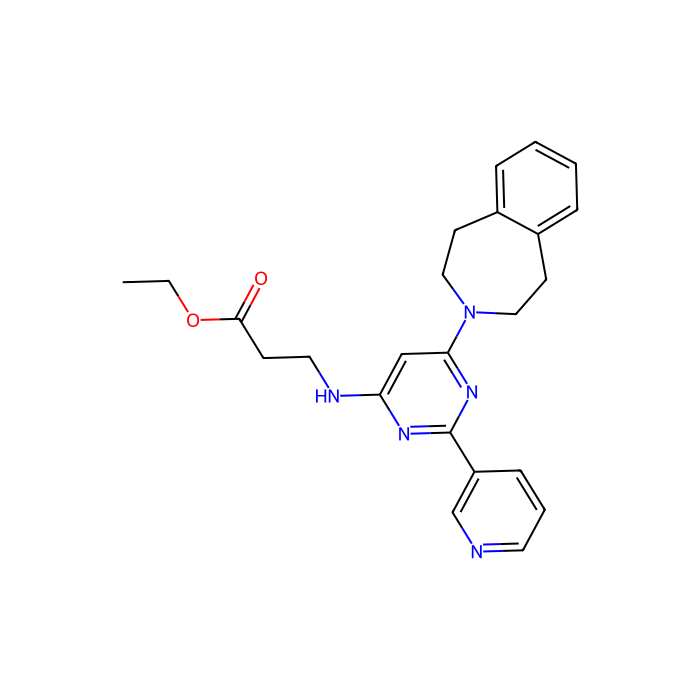
GSK-J5 - ≥97% , CAS No.1394854-51-3

CAS: 1394854-51-3 Cat. No.: G275489 Formula: C24H27N5O2HCl Peso molecolare: 453.97
Disponibile su ordine
QUALITÀ & PUREZZA ≥97%
Synonyms
N-[2-(3-Pyridinyl)-6-(1,2,4,5-tetrahydro-3H-3-benzazepin-3-yl)-4-pyrimidinyl]-β-alanineethylester
Storage
Store at 2-8°C,Desiccated
Shipped In
Wet ice
★
Dimensione
Germania (EU)
USA*
Prezzo
Qtà
10mg
G275489-10mg
Su ordinazione · 8–12 settimane
204,70€
Enter a quantity for the sizes you want to add.

Panoramica

Store at +4°C. Store under desiccating conditions. The product can be stored for up to 12 months.

Specifiche

Sinonimi
N-[2-(3-Pyridinyl)-6-(1,2,4,5-tetrahydro-3H-3-benzazepin-3-yl)-4-pyrimidinyl]-β-alanineethylester
Specifiche e purezza
≥97%
Meccanismi biochimici e fisiologici
Cell-permeable, inactive control for histone demethylase JMJD3/UTX inhibitor GSK-J4. Active in vitro .
Condizioni di conservazione di stoccaggio
Store at 2-8°C,Desiccated
Spedito in
Wet ice
Questo prodotto richiede spedizione a catena fredda. I servizi di terra e altri servizi economici non sono disponibili.
Tipo di azione
INHIBITOR
Nota
Wherever possible, you should prepare and use solutions on the same day. However, if you need to make up stock solutions in advance, we recommend that you store the solution as aliquots in tightly sealed vials at -20°C. Generally, these will be useable for up to one month. Before use, and prior to opening the vial we recommend that you allow your product to equilibrate to room temperature for at least 1 hour. Need more advice on solubility, usage and handling? Please visit our frequently asked questions (FAQ) page for more details.
Purezza
≥97%
Nomi e identificatori
SMILES
CCOC(=O)CCNC1=CC(=NC(=N1)C2=CN=CC=C2)N3CCC4=CC=CC=C4CC3
IUPAC Name
ethyl 3-[[2-pyridin-3-yl-6-(1,2,4,5-tetrahydro-3-benzazepin-3-yl)pyrimidin-4-yl]amino]propanoate
InChIKey
LQPGVGSKBNXQDU-UHFFFAOYSA-N
InChI
1S/C24H27N5O2/c1-2-31-23(30)9-13-26-21-16-22(28-24(27-21)20-8-5-12-25-17-20)29-14-10-18-6-3-4-7-19(18)11-15-29/h3-8,12,16-17H,2,9-11,13-15H2,1H3,(H,26,27,28)
Isomeri SMILES
CCOC(=O)CCNC1=CC(=NC(=N1)C2=CN=CC=C2)N3CCC4=CC=CC=C4CC3
Peso molecolare
453.97
Reaxys
28168692
Reaxys-RN_link_address
https://www.reaxys.com/reaxys/secured/hopinto.do?context=S&query=IDE.XRN=28168692&ln=

Dati avanzati

Taxonomic Classification

Taxonomy Tree

KingdomOrganic compounds
SuperclassOrganoheterocyclic compounds
ClasseDiazines
SubclassPyrimidines and pyrimidine derivatives
Intermediate Tree Nodes Not available
Direct ParentPyridinylpyrimidines
Alternative Parents Beta amino acids and derivatives  Benzazepines  Dialkylarylamines  Azepines  Aminopyrimidines and derivatives  Pyridines and derivatives  Imidolactams  Benzenoids  Heteroaromatic compounds  Carboxylic acid esters  Monocarboxylic acids and derivatives  Azacyclic compounds  Organic oxides  Hydrocarbon derivatives  Carbonyl compounds  
Molecular FrameworkAromatic heteropolycyclic compounds
Substituents Pyridinylpyrimidine - Benzazepine - Beta amino acid or derivatives - Dialkylarylamine - Aminopyrimidine - Azepine - Imidolactam - Benzenoid - Pyridine - Heteroaromatic compound - Carboxylic acid ester - Azacycle - Carboxylic acid derivative - Monocarboxylic acid or derivatives - Hydrocarbon derivative - Organonitrogen compound - Organooxygen compound - Carbonyl group - Organic oxygen compound - Organic nitrogen compound - Organic oxide - Amine - Aromatic heteropolycyclic compound
DescrizioneThis compound belongs to the class of organic compounds known as pyridinylpyrimidines. These are compounds containing a pyridinylpyrimidine skeleton, which consists of a pyridine linked (not fused) to a pyrimidine by a bond.
External Descriptors Not available
Struttura 3D
Modello di struttura chimica interattiva


Obiettivi associati (umani)
ABL1 Tclin Tyrosine-protein kinase ABL (18331 Activities)
Activity TypeRelationActivity valueUnitsAction TypeJournalPubMed IddoiAssay Aladdin ID
GSK3B Tclin Glycogen synthase kinase-3 beta (11785 Activities)
Activity TypeRelationActivity valueUnitsAction TypeJournalPubMed IddoiAssay Aladdin ID
CSNK1D Tchem Casein kinase I delta (4546 Activities)
Activity TypeRelationActivity valueUnitsAction TypeJournalPubMed IddoiAssay Aladdin ID
CDK2 Tchem Cyclin-dependent kinase 2 (9050 Activities)
Activity TypeRelationActivity valueUnitsAction TypeJournalPubMed IddoiAssay Aladdin ID
AURKA Tchem Serine/threonine-protein kinase Aurora-A (10240 Activities)
Activity TypeRelationActivity valueUnitsAction TypeJournalPubMed IddoiAssay Aladdin ID
U2OS (164939 Activities)
Activity TypeRelationActivity valueUnitsAction TypeJournalPubMed IddoiAssay Aladdin ID
BRD4 Tchem Bromodomain-containing protein 4 (13122 Activities)
Activity TypeRelationActivity valueUnitsAction TypeJournalPubMed IddoiAssay Aladdin ID
KDM6A Tchem Lysine-specific demethylase 6A (39 Activities)
Activity TypeRelationActivity valueUnitsAction TypeJournalPubMed IddoiAssay Aladdin ID
TRIM24 Tchem Transcription intermediary factor 1-alpha (2087 Activities)
Activity TypeRelationActivity valueUnitsAction TypeJournalPubMed IddoiAssay Aladdin ID
BRPF1 Tchem Peregrin (2217 Activities)
Activity TypeRelationActivity valueUnitsAction TypeJournalPubMed IddoiAssay Aladdin ID
Obiettivi associati (non umani)
Mapk1 MAP kinase ERK2 (650 Activities)
Activity TypeRelationActivity valueUnitsAction TypeJournalPubMed IddoiAssay Aladdin ID
Fgfr3 Fibroblast growth factor receptor 3 (21 Activities)
Activity TypeRelationActivity valueUnitsAction TypeJournalPubMed IddoiAssay Aladdin ID
Meccanismi d'azione
Certificati (CoA, COO, BSE/TSE e tabella di analisi)
C of A & Other Certificates(BSE/TSE, COO):
Analytical Chart:
Proprietà chimiche e fisiche
SolubilitàSoluble in DMSO to 100 mM
Peso molecolare417.5
XLogP34.300
Hydrogen Bond Donor Count1
Hydrogen Bond Acceptor Count7
Rotatable Bond Count8
Exact Mass417.216 Da
Monoisotopic Mass417.216 Da
Topological Polar Surface Area80.200 Ų
Heavy Atom Count31
Formal Charge0
Complexity546.000
Isotope Atom Count0
Defined Atom Stereocenter Count0
Undefined Atom Stereocenter Count0
Defined Bond Stereocenter Count0
Undefined Bond Stereocenter Count0
The total count of all stereochemical bonds0
Covalently-Bonded Unit Count1
Sicurezza e pericoli (GHS)
Precauzioni

P264:Wash hands [and …] thoroughly after handling.

Reaxys
28168692
Reaxys-RN_link_address
https://www.reaxys.com/reaxys/secured/hopinto.do?context=S&query=IDE.XRN=28168692&ln=
Calcolatori di soluzioni
Recensioni

Recensioni dei clienti

Application Protocols

No vendor-validated application protocols are provided in this product record.

  • Tested applications: Not specified for this item; refer to CoA/Spec Sheet.
  • Recommended working concentrations/dilutions: Not specified for this item; determine empirically in your assay system.

General practice (for small-molecule control probes):

  • Prepare a DMSO stock (e.g., 10–50 mM), aliquot, and store frozen. Thaw immediately before use and keep on ice during setup.
  • Include vehicle-only and active-probe controls. Apply identical dosing schedules and solvent percentages.
  • Verify solution clarity after dilution into buffer or media and monitor assay plates for precipitation over time.

If you require a validated, stepwise protocol for a specific assay platform, contact our technical support with your intended application details.

Biological Roles

GSK-J5 itself is used as a negative control compound in epigenetics research and does not serve a known endogenous biological role.

  • Role in studies (general/literature): Paired with the active probe GSK-J4 in assays interrogating histone methylation dynamics and chromatin regulation. GSK-J5 helps confirm that observed phenotypes require specific target engagement by the active probe rather than scaffold-agnostic or vehicle effects.
  • Use in target deconvolution: Combined with genetic perturbation (e.g., knockdown/knockout) and orthogonal chemical probes, GSK-J5 contributes to establishing causality between compound treatment and pathway modulation.
  • Selectivity context: As a control, it is designed to lack the key binding interactions necessary for enzymatic inhibition found in the active probe. Researchers should verify inactivity under their specific assay conditions.

Important limitations:

  • Absence of therapeutic or nutritional function; for research use only (product data).
  • Lack of item-specific potency/affinity data in this record; confirm with primary literature or internal validation.

Good practice:

  • Report both GSK-J4 and GSK-J5 data in publications, matching dose, timing, and vehicle, and include appropriate biological replicates.
Buffer Applications

This item is a small-molecule probe control and is not a buffering agent. However, practical considerations for using it in buffered systems include:

  • Vehicle control: Maintain identical DMSO percentage across all buffered conditions (e.g., HEPES, Tris, PBS) to control for solvent effects on pH and protein stability.
  • Order of addition: Add the DMSO stock of GSK-J5 last to a vigorously mixed buffer to prevent local supersaturation and precipitation.
  • Protein-containing buffers: In enzyme assays or cell culture media, low levels of carrier protein (e.g., BSA) can mitigate nonspecific adsorption; confirm compatibility with your readout.

Buffer specifications (pH ranges, capacities) are unrelated to this item and not applicable.

Green Alternatives

As a specialized chemical probe control, GSK-J5 is not readily substitutable by a “green” alternative the way commodity solvents or reagents are. However, greener practices can be applied to its use:

  • Solvent choices: Prefer minimal volumes of DMSO and aqueous buffers. Avoid chlorinated solvents for stock preparation or cleaning unless required by analytical methods.
  • Waste minimization: Prepare small aliquots at concentrations tailored to your highest anticipated assay dose to reduce surplus and disposal.
  • Energy efficiency: Store as directed (2–8°C desiccated) and transfer promptly from wet ice to cold storage to prevent unnecessary cooling cycles.
  • Safer handling: Use closed microtubes and low-retention plastics to limit exposure and loss.

Alternatives within study design (general):

  • For orthogonal negative controls, consider structurally distinct inactive analogs reported in the literature to assess chemotype-dependent artifacts. Note: any substitution must be scientifically justified and validated in your system.

Environmental notes:

  • Given the microgram-to-milligram usage typical of probe studies, environmental impact is dominated by solvent and plastic consumables. Implement solvent recycling where feasible and segregate halogenated vs non-halogenated waste streams.
Pharmaceutical Uses

This product is sold for research use only and is not intended for human or veterinary use, drug substance, or excipient applications.

Formulation context (research only):

  • In vitro and ex vivo studies commonly use DMSO stock solutions diluted into assay buffers or media. Ensure final solvent content is consistent across control and active probe treatments.
  • No pharmacopeial monograph or excipient status is indicated for this item.

Manufacturing/CMC considerations: Not applicable; no item-specific data on residual solvents, elemental impurities, or controlled specification attributes are provided in this record.

If a laboratory-scale preformulation assessment is required (e.g., solubility screening, stability in media), document all conditions, vehicles, and concentrations. Do not extrapolate research findings to clinical settings.

Physical Properties

Item-specific physicochemical data are not provided in the product record.

  • Appearance: Not specified for this item; refer to CoA/Spec Sheet.
  • Molecular weight: Not specified for this item; refer to CoA/Spec Sheet.
  • Melting point: Not specified for this item; refer to CoA/Spec Sheet.
  • Boiling point: Not applicable/unknown for a non-volatile small-molecule solid; item-specific value not specified.
  • Density: Not specified for this item; refer to CoA/Spec Sheet.
  • Solubility: Item-specific solubility is not specified. In general (literature/practice), GSK-class small-molecule probes are prepared as concentrated DMSO stocks (e.g., 10–50 mM) and diluted into aqueous assay buffers containing ≤1% DMSO.
  • LogP/logD, pKa, refractive index: Not specified for this item; refer to CoA/Spec Sheet.

Notes for use (general guidance, not item specifications):

  • For biochemical assays, dissolve in anhydrous DMSO to prepare a frozen master stock; verify clarity and absence of precipitate upon buffer dilution at the intended working concentration.
  • If the control is used alongside GSK-J4, match vehicle (final DMSO %) exactly across control and test conditions to ensure rigorous comparison.

Always verify lot-specific property data and solution stability on the CoA and SDS before experimental use.

Quality and Grades
  • Grade/Purity: Not specified for this item; refer to CoA/Spec Sheet.

Interpretation and implications:

  • For chemical probe controls such as GSK-J5, researchers typically expect high chemical purity and unambiguous identity (NMR, HRMS, HPLC/UPLC) to ensure that negative-control behavior arises from structure, not impurities. In the absence of an explicit grade statement here, defer to the lot-specific CoA for assay methods and thresholds (e.g., HPLC area %, residual solvents).
  • If an inhibitor/control pair will be compared quantitatively in biochemical or cellular assays, ensure similar analytical characterization across both materials (chromatographic method, wavelength set, impurity profiling) to minimize analytical bias.
  • Stabilizers: Not specified for this item; refer to CoA/Spec Sheet. If no stabilizer is listed, handle under dry, inert conditions to mitigate adventitious hydrolysis or oxidation.

Documentation best practices:

  • Record lot number, retest/expiry dates (if provided), and analytical release criteria from the CoA in lab notebooks and method validation files.
  • For regulated labs or publication, archive the CoA/SDS and provide details on solvent systems and detection wavelengths used in purity determinations.
Reaction and Applications

This product is supplied as a research chemical probe control rather than a synthetic reagent. It is not commonly used as a reagent or solvent in preparative organic chemistry.

Research applications (general, literature/practice):

  • Negative control for epigenetics studies conducted alongside GSK-J4. Employed to differentiate on-target effects of the active probe from off-target or vehicle-related phenomena in biochemical assays, target engagement studies, chemoproteomics, and cell-based phenotypic assays.
  • Method development and validation: Establishes baseline response in assays such as histone methylation state readouts, gene expression profiling, and cell viability, ensuring that observed effects require the active probe’s specific target engagement.

Practical tips:

  • Use identical handling, solvent, and dosing schemes as the active probe (e.g., same DMSO % and dilution schedule).
  • Include a vehicle-only control and serial dilutions of both active (GSK-J4) and control (GSK-J5) to assess assay window and non-specific effects.
  • Monitor for compound precipitation upon dilution and for time-dependent adsorption to plastics; precondition tips/plates with buffer containing carrier protein (e.g., 0.1% BSA) if nonspecific binding is suspected.

Synthetic chemistry use: Not typically applicable. If needed for SAR or analytical benchmarking, employ under dry conditions. No item-specific reactivity data are provided.

Reaction Conditions

Not applicable in the conventional synthetic sense. GSK-J5 is used as a control compound rather than as a reagent or catalyst.

Assay deployment conditions (general guidance for research use):

  • Stock solutions: Prepare in anhydrous DMSO (e.g., 10–50 mM). Filter through 0.2 µm PTFE if particulate is observed. Store aliquots at ≤−20°C and thaw immediately before use.
  • Working concentrations: Match to those used for the active probe in your assay (commonly sub- to low-micromolar ranges); verify solubility and absence of precipitation visually or by light scattering.
  • Temperature: Conduct biochemical assays at the temperature validated for the enzyme or cell system (often 25–37°C). Maintain consistent temperature across control and test conditions.
  • Incubation time: Align with the active probe protocol to ensure comparability (minutes to hours depending on endpoint).
  • Materials compatibility: Use low-binding plasticware; pre-rinse tips with DMSO or buffer to minimize adsorption.

Expected outcomes: As a negative control, GSK-J5 should not reproduce the on-target pharmacology of the active probe; nonetheless, confirm this experimentally under your exact conditions.

Item-specific kinetic/thermodynamic parameters: Not specified for this item; refer to CoA/Spec Sheet and literature.

Safety and Handling

Safety data specific to this SKU are not provided in the product record.

  • GHS classification, signal word, H-statements, pictograms: Not specified for this item; refer to SDS.
  • General hazards (class-based, literature/practice): Small-molecule organic research chemicals may cause skin/eye irritation and may be harmful if swallowed or inhaled. Avoid dust generation and aerosol formation.

Recommended PPE and engineering controls:

  • Wear lab coat, safety glasses, and appropriate chemical-resistant gloves (e.g., nitrile). Handle powders in a fume hood or ventilated enclosure. Use dust control techniques when weighing.

Handling and hygiene:

  • Avoid contact with skin, eyes, and clothing. Wash thoroughly after handling. Do not pipette by mouth. Prevent cross-contamination between control and active probe solutions.

Storage incompatibilities and precautions:

  • Store desiccated at 2–8°C as specified in the product data. Keep container tightly closed in a dry, inert atmosphere. Protect from moisture and prolonged light exposure. Segregate from strong oxidizers and strong acids/bases.

First-aid overview (general):

  • Inhalation: Move to fresh air; seek medical attention if symptoms occur.
  • Skin: Wash with soap and water; remove contaminated clothing.
  • Eyes: Rinse cautiously with water for several minutes; seek medical attention if irritation persists.
  • Ingestion: Rinse mouth; seek medical attention.

Always consult the official SDS for authoritative hazard, exposure limits, and emergency guidance.

Solvent Selection

GSK-J5 is typically handled as a DMSO stock for biochemical and cell-based assays.

  • Primary solvent (practice/literature): Anhydrous DMSO supports high-concentration stocks (e.g., 10–50 mM), good freeze–thaw stability, and compatibility with aqueous assay dilution at ≤1% DMSO final.
  • Alternative solvents: DMF or ethanol can dissolve many small molecules but may be less preferred due to cytotoxicity (EtOH) or assay interference (DMF). Aqueous buffers alone usually provide insufficient solubility for concentrated stocks.
  • Miscibility/compatibility: DMSO is miscible with water and common buffers (HEPES, Tris, PBS). Verify that the final DMSO fraction is matched across control and active probe wells.

Selection tips:

  • Choose DMSO when preparing long-lived master stocks stored at ≤−20°C; aliquot to avoid repeated freeze–thaw.
  • If precipitation is observed upon dilution, add stock more slowly with vigorous mixing, warm gently (room temperature), or increase dilution factor to keep the compound below its kinetic solubility limit.

Comparison (general):

  • DMSO: highest solvating power; can affect membrane integrity at >1–2%.
  • Ethanol: lower solvency; higher volatility; limit typically ≤0.5% v/v in cell culture.
  • Aqueous buffer: suitable only for immediate use at low micromolar levels if soluble; verify clarity.

Item-specific solubility values: Not specified for this item; refer to CoA/Spec Sheet.

Storage and Reconstitution

Storage (product data):

  • Store at 2–8°C, desiccated.
  • Shipped on wet ice. Transfer to specified storage upon receipt.

Container handling:

  • Keep tightly sealed under dry conditions. If available as a solid, minimize headspace humidity by equilibrating materials to room temperature before opening, then promptly reseal with desiccant.

Reconstitution (general guidance for small-molecule probes; item-specific solubility not provided):

  • Prepare a concentrated stock in anhydrous DMSO (e.g., 10–50 mM). Vortex to dissolve fully. If particulates persist, warm gently to room temperature and sonicate briefly.
  • Optional sterile handling: Pass through a 0.2 µm PTFE filter if sterility is required for cell-based assays.
  • Aliquot into single-use volumes to avoid repeated freeze–thaw.

Working solution preparation:

  • Dilute the DMSO stock into assay buffer or culture media with thorough mixing. Match final DMSO concentration across all conditions (control and active probe). Typical final DMSO is ≤0.1–1% v/v depending on assay tolerance.

Stability:

  • Long-term stability and retest date: Not specified for this item; refer to CoA/Spec Sheet.
  • Visual inspection: Discard solutions showing precipitation, discoloration, or unexpected odor.

For research use only.

Structure and Identity

Overview: GSK-J5 is widely used in epigenetics research as the structurally related negative control compound for GSK-J4. It is a small-molecule chemical probe control intended strictly for research.

  • CAS: 1394854-51-3 (product data)
  • PubChem CID: 78243729 (product data)
  • InChIKey: 206581 (product data; terse format as provided)
  • SMILES: Not specified for this item; refer to CoA/Spec Sheet.
  • Molecular formula: Not specified for this item; refer to CoA/Spec Sheet.
  • Molecular weight: Not specified for this item; refer to CoA/Spec Sheet.

Structural features (general/literature context):

  • GSK-J5 is reported in the literature as an isomeric/epimeric control analog of GSK-J4 (a prodrug of the KDM6-family demethylase inhibitor GSK-J1). The control preserves gross topology while disrupting target engagement. No item-specific stereochemical annotation is provided here; consult the CoA/SDS.
  • Functional groups typically mirror those of GSK-J4-class chemotypes (aromatic heterocycles and masked acid functionality in prodrug-like controls), but exact placement and configuration for this SKU are not specified in the provided data.

2D structure description (general):

  • The scaffold is a compact, polyfunctional, heteroatom-containing small molecule designed to resemble GSK-J4 but lacking productive binding to the intended metalloenzyme target (negative control role). For structure-confirmed details (rings, substituent positions, stereochemistry), refer to the official CoA/Spec Sheet for this lot.
Synthetic Utility

GSK-J5 is not typically employed as a reagent or intermediate in synthetic organic chemistry; it serves as a control probe in chemical biology. Consequently, classical synthetic transformations, protecting-group strategies, and reagent roles are not applicable.

However, in a medicinal chemistry or SAR context (general):

  • It can function as a benchmark negative control when profiling libraries derived from the GSK-J4 chemotype, allowing comparison of physicochemical properties (retention time, UV spectra) and off-target assay interference.
  • Analytical utility: Serves as an authentic reference standard for LC/UPLC method development (e.g., retention factor, peak purity, stability-indicating methods) alongside the active probe.

Functional-group reactivity and named reactions: Not applicable for this catalog item; no item-specific reactivity, pKa, or redox information is provided. If derivatization or tagging is desired for mechanistic studies, consult primary literature for precedented handle positions and perform new analytical qualification.

Target Specificity

Target, selectivity, and potency data are not provided in the product record for this SKU.

  • Item-specific target information: Not specified for this item; refer to CoA/Spec Sheet and primary literature.
  • Note: As a general concept in the literature, GSK-J5 is described as a negative control analog used alongside GSK-J4; however, no target-binding data are provided here and should not be assumed for this product listing.

For rigorous studies, determine inactivity/orthogonality under your assay conditions and report the exact concentrations and protocols used.

Domande frequenti

How is this product shipped?
This product ships chilled on wet ice. Unpack on arrival and transfer it to the storage condition stated above.
What are the CAS number, molecular formula and molecular weight?
The CAS Number is 1394854-51-3, the molecular formula is C24H27N5O2HCl, and the molecular weight is 453.97 g/mol. InChIKey LQPGVGSKBNXQDU-UHFFFAOYSA-N.
How should this product be stored?
Store at 2–8 °C, desiccated. Keep the container tightly closed with desiccant — the material is moisture-sensitive.
What is the purity of this product?
This product is supplied at ≥97% purity (chemical assay). Lot-specific values are stated on the Certificate of Analysis.
What documentation is provided?
Available product documentation, including Certificates of Analysis (COA), Safety Data Sheets (SDS), and specification sheets, is shown in the product document area. Document availability and access follow the current site policy.

Desidera che le inviamo un messaggio quando avremo sconti disponibili?

Ricordamelo più tardi

Grazie! Controlli la sua casella di posta per confermare.

Ops! Le notifiche sono disabilitate.