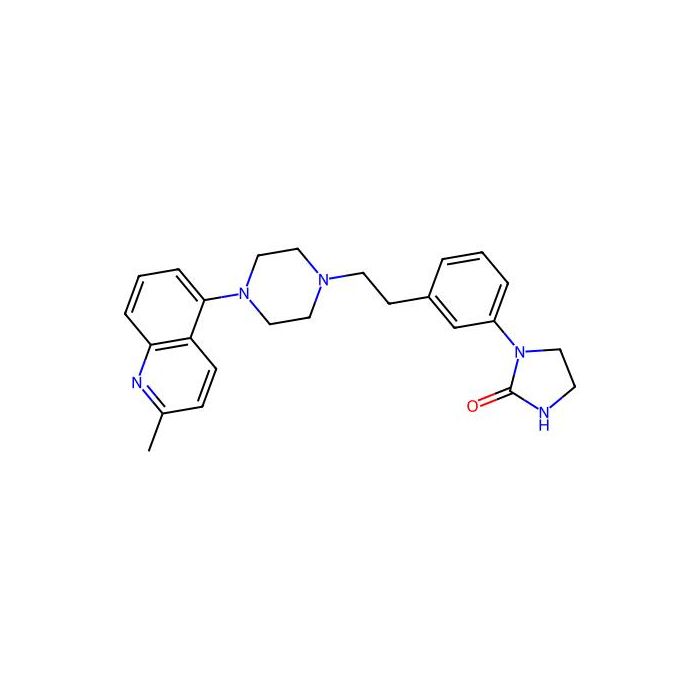
GSK163090 - 10mM in DMSO , Serotonin transporter antagonist, CAS No.844903-58-8, Serotonin transporter antagonist

CAS: 844903-58-8 Cat. No.: G656138 Formula: C25H29N5O Peso molecolare: 415.53 Numero EC: 629-856-9 PubChem CID: 11292933
Disponibile su ordine
QUALITÀ & PUREZZA 10mM in DMSO
Storage
Store at -80°C
Shipped In
Dry ice packs + Cold packs
★
Dimensione
Germania (EU)
USA*
Prezzo
Qtà
1ml
G656138-1ml
Su ordinazione · 8–12 settimane
62,39€
Enter a quantity for the sizes you want to add.

Panoramica

GSK163090 is a potent, selective and orally active 5-HT 1A/1B/1D receptor antagonist with pK i values of 9.4/8.5/9.7, respectively. GSK163090 inhibits the functional activity of serotonin reuptake transporter (SerT) with a pK i value of 6.1. GSK163090 has antidepressant and anxiolytic activities

In Vitro

GSK163090 (compound 36) is devoid of agonist activity at R1 receptors, but rather it demonstrates a moderate functional antagonismof the phenylephrineinduced contraction of rabbit aorta (pIC 50 =6.9). At 1 μM concentration, the ratio of the apparent permeabilities measured from basolateral-to-apical (BA) to apical-to-basolateral (AB) indicated that GSK163090 is a moderate P-glycoprotein (P-gp) substrate (BA/AB = 2.8). MCE has not independently confirmed the accuracy of these methods. They are for reference only.

In Vivo

In male Sprague-Dawley rats, GSK163090 (compound 36) treatment shows clear dose-dependent inhibition of the 8-OH-DPAT-induced hyperlocomotor activity (hLMA), with ED 50 values ranging from 0.03 to 1 mg/kg . MCE has not independently confirmed the accuracy of these methods. They are for reference only.

IC50& Target:5-HT 1A Receptor 9.4 (pKi) 5-HT 1B Receptor 8.5 (pKi) 5-HT 1D Receptor 9.7 (pKi) D 2 Receptor 6.3 (pKi) D 3 Receptor 6.7 (pKi) 5-HT 2A Receptor 6 (pKi) 5-HT 2B Receptor 6.3 (pKi) 5-HT 2C Receptor 5.8 (pKi) Human 5-HT 6 Receptor <5.3 (pKi) Human 5-HT 7 Receptor 6.8 (pKi)

Specifiche

Specifiche e purezza
10mM in DMSO
Meccanismi biochimici e fisiologici
GSK163090 is a potent, selective and orally active 5-HT 1A/1B/1D receptor antagonist with pK i values of 9.4/8.5/9.7, respectively. GSK163090 inhibits the functional activity of serotonin reuptake transporter (SerT) with a pK i value of 6.1. GSK163090 has
Condizioni di conservazione di stoccaggio
Store at -80°C
Spedito in
Dry ice packs + Cold packs
Questo prodotto richiede spedizione a catena fredda. I servizi di terra e altri servizi economici non sono disponibili.
Tipo di azione
ANTAGONIST
Meccanismo d'azione
Serotonin transporter antagonist
Proprietà del prodotto
ALogP
3.4
Nomi e identificatori
Isomeri SMILES
CC1=NC2=C(C=C1)C(=CC=C2)N3CCN(CC3)CCC4=CC(=CC=C4)N5CCNC5=O
CAS alternativo
844903-58-8
PubChem CID
11292933
Termini MeSH
1-(3-(2-(4-(2-methyl-5-quinolinyl)-1-piperazinyl)ethyl)phenyl)-2-imidazolidinone;GSK163090
Peso molecolare
415.53

Dati avanzati

Obiettivi associati (umani)
HTR1B Tclin 5-hydroxytryptamine receptor 1B (1 Activities)
Activity TypeActivity Value -log(M)Mechanism of ActionActivity ReferencePublications (PubMed IDs)
HTR1D Tclin 5-hydroxytryptamine receptor 1D (1 Activities)
Activity TypeActivity Value -log(M)Mechanism of ActionActivity ReferencePublications (PubMed IDs)
HTR1A Tclin 5-hydroxytryptamine receptor 1A (1 Activities)
Activity TypeActivity Value -log(M)Mechanism of ActionActivity ReferencePublications (PubMed IDs)
Certificati (CoA, COO, BSE/TSE e tabella di analisi)
C of A & Other Certificates(BSE/TSE, COO):
Analytical Chart:

Find and download the COA for your product by matching the lot number on the packaging.

1 results found

Lot NumberCertificate TypeDataOggetto
K2616194K2616194Certificate of AnalysisNov 18, 2026 G656138
Calcolatori di soluzioni
Recensioni

Recensioni dei clienti

Application Protocols

No item-specific, validated protocols are provided for GSK163090.

General, non-item-specific protocols for small-molecule screening

  • Stock preparation
    • Allow vial to equilibrate to room temperature in a desiccator before opening to prevent moisture condensation.
    • Prepare a 10–50 mM stock in dry DMSO. Vortex; if needed, sonicate briefly. Record exact concentration from mass and solvent volume.
    • Aliquot (e.g., 10–50 µL) into low-bind tubes; store frozen to avoid repeated freeze–thaw.
  • Working solution for biochemical assay
    • Add stock to buffer (e.g., HEPES 25 mM, NaCl 150 mM, pH 7.4) to reach target concentration with ≤0.1–1% DMSO final. Include vehicle controls.
    • Confirm solubility and absence of precipitation after 30–60 min at assay temperature.
  • Cell-based assay setup
    • Verify tolerability of final DMSO % for the cell line. Pre-warm media; add compound last with thorough mixing.
    • Consider adsorption mitigation (BSA 0.1%, low-bind plastics) if losses are suspected.
  • Data quality controls
    • Include positive/negative controls, a serial dilution (e.g., 1:3 or 1:2), and replicate wells to assess variability. Monitor for optical interference in readouts (fluorescence/absorbance).

These steps are offered as general best practices and are not validated specifically for GSK163090.

Biological Roles

Item-specific biological target(s) and mechanism are not provided for GSK163090.

  • Target / Pathway: Not specified for this item; refer to CoA/Spec Sheet and primary literature tied to CAS 844903-58-8 or CID 11292933.

General context for small-molecule research tools (non-item-specific)

  • Small molecules are commonly employed to modulate enzymes, receptors, ion channels, or protein–protein interactions to probe cellular pathways, validate targets, and generate SAR.
  • When the target is unknown or proprietary, typical first steps include unbiased panel profiling (e.g., kinases, GPCRs, ion channels) and phenotypic assays followed by deconvolution.
  • Orthogonal confirmation of activity should include counter-screens for assay interference (fluorescence quench/emit, redox cycling, aggregation) and selectivity panels to rule out broad off-target effects.
  • For cellular systems, verify cell permeability and efflux susceptibility (e.g., MDCK-MDR1 assays) and assess stability in microsomes/S9 to anticipate exposure in complex models.

Note: All uses are for research only. No clinical or diagnostic claims are made or implied for this product.

Buffer Applications

There is no specific buffer system associated with this item. However, for deploying small molecules in biochemical or cellular assays, buffer selection is critical to maintain compound solubility and assay robustness.

General guidance (not item-specific)

  • Common buffers: HEPES (pH 7.2–7.6), PBS (pH 7.2–7.4), Tris (pH 7.4–8.0). Choose based on target biology and compatibility with detection methods.
  • Keep final DMSO ≤0.1–1% v/v to limit solvent effects; include vehicle-only controls.
  • Additives: small amounts of Tween-20/80 (0.01–0.05%) or BSA (0.05–0.1%) can mitigate aggregation and nonspecific adsorption, where compatible.
  • Ionic strength and divalent cations (e.g., Mg2+, Ca2+) can modulate both protein stability and small-molecule binding; match in test and control wells.

Practical recipe example (illustrative)

  • HEPES 25 mM, NaCl 150 mM, pH 7.4; optional 0.01% Tween-20. Prepare compound from a concentrated DMSO stock to desired final concentration, mixing thoroughly and verifying absence of precipitate by visual check or nephelometry.

Note: The above constitutes general practice, not item-specific specifications.

Green Alternatives

Greener practices for dissolution and screening of small molecules focus on solvent choice, waste minimization, and process design. Since item-specific solubility is unknown, the following are general, literature-aligned recommendations.

  • Prefer aqueous buffers (HEPES, PBS) as the bulk phase whenever feasible; limit organic cosolvent to the lowest effective percentage.
  • Use DMSO efficiently: prepare high-concentration stocks to minimize volume and shipping footprint; aliquot to reduce waste from freeze–thaw.
  • Consider bio-based solvents (e.g., Cyrene, 2-MeTHF) for synthetic work-up if you later engage in analog synthesis; note that biological assay compatibility must be verified.
  • Employ microscale assays (384/1536-well) to dramatically cut solvent and plastic consumption.

Comparison (general, not item-specific)

| Practice | Conventional | Greener alternative | Trade-offs | |---|---|---|---| | Vehicle | High-volume DMSO at low conc. | High-conc. DMSO stocks, minimal final % | Requires accurate low-volume dispensing | | Solvent for prep | MeCN/DMF for cleanup | EtOH/water or 2-MeTHF where viable | Solubility limits | | Waste | Bulk organic streams | Segregated micro-waste; on-plate quench | Logistics, training |

Documentation and controls

  • Record solvent identities, sources, and volumes for green metrics (E-factors). Validate that greener substitutions maintain assay fidelity (positive/negative controls, Z’-factor) before full deployment.
Pharmaceutical Uses

No pharmacopeial or formulation role is specified for GSK163090. The product is supplied strictly for research use only.

General formulation context for discovery compounds (non-item-specific)

  • Early preformulation studies often evaluate solubility, pKa, and stability to identify feasible vehicles for in vitro and ex vivo work. Typical vehicles include aqueous buffers with minimal DMSO, or co-solvent systems with PEG400/propylene glycol as needed.
  • Salt selection (e.g., HCl, mesylate, maleate) may improve solubility and solid-state stability; confirmation requires analytical support (XRPD, DSC, TGA).
  • For in vivo method development (if permitted within institutional approvals), vehicles are chosen based on tolerability and compound solubility; however, this product listing does not provide suitability information and does not imply any use in animals or humans.

Compliance note

  • No medical, diagnostic, or therapeutic claims are made. Consult your institutional guidelines and the product SDS/CoA for any additional composition details before considering formulation studies.
Physical Properties

Item-specific physical constants are not provided in the product data.

  • Appearance: Not specified for this item; refer to CoA/Spec Sheet.
  • Melting point (MP): Not specified for this item; refer to CoA/Spec Sheet.
  • Boiling point (BP): Not applicable/rarely reported for solid drug-like small molecules; Not specified for this item; refer to CoA/Spec Sheet.
  • Density: Not specified for this item; refer to CoA/Spec Sheet.
  • Solubility: Not specified for this item; refer to CoA/Spec Sheet.
  • logP/logD, pKa, refractive index: Not specified for this item; refer to CoA/Spec Sheet.

General guidance (literature/practice, not item-specific)

  • Code-named screening compounds are frequently obtained as solids with solubility spanning poorly soluble (water) to freely soluble in polar aprotic solvents (DMSO, DMF) and alcohols (MeOH, EtOH). For assay use, prepare a 10–50 mM DMSO stock and dilute into aqueous buffer, keeping final DMSO ≤0.1–1% v/v to minimize assay interference.
  • If ionizable, apparent solubility may improve by pH adjustment (acidic media for basic amines; basic media for phenols/carboxylic acids). Evaluate precipitation visually and by nephelometry or light scattering.
  • When the compound is highly lipophilic, consider surfactant-assisted vehicles (e.g., 0.01–0.05% Tween-80) or co-solvents (propylene glycol, PEG400), after confirming compatibility with the biological system.
Quality and Grades

Item-specific grade and purity are not listed.

  • Grade/Purity: Not specified for this item; refer to CoA/Spec Sheet.

Context for screening compounds (general guidance)

  • Library/screening compounds are commonly supplied at ≥90–95% HPLC purity with verification by LC–MS. For this item, please consult the CoA for the definitive purity, chromatographic method (UV vs. ELSD), and detection wavelength.
  • If provided as a salt form, the CoA should state the counterion (e.g., HCl, mesylate) and stoichiometry. This is essential for accurate molarity calculations from weighed mass.
  • Low-level residual solvents or water can influence mass balance; confirm by KF titration and GC residual solvent data if included. For any unspecified attributes (metals, peroxides, UV cutoff), the correct statement is: Not specified for this item; refer to CoA/Spec Sheet.

Implications for use

  • For cell-based assays and biophysical studies (SPR, ITC), higher purity and well-defined form (free base vs. salt, polymorph) improve data quality and reproducibility.
  • If your workflow requires low UV background (chromatography) or endotoxin control (biology), request these specifications explicitly prior to use.
  • Retain CoA batch number and analytical chromatograms for traceability and regulatory documentation.
Reaction and Applications

This product is positioned as a code-named small molecule for research screening rather than as a synthetic reagent or catalyst.

  • Not typically used as a stoichiometric reagent or catalyst in preparative organic synthesis.
  • Primary applications are expected in biochemical, biophysical, or cell-based assay contexts to explore activity profiles in discovery workflows.

General guidance for assay deployment (non-item-specific)

  • Prepare 10–50 mM DMSO stock under dry conditions; vortex and, if necessary, sonicate gently to aid dissolution.
  • For aqueous assay media, add stock solutions to achieve final DMSO ≤0.1–1% v/v; verify compound solubility and absence of precipitation over the assay timeframe.
  • Mitigate nonspecific binding by using low-binding plastics and adding carrier protein (e.g., 0.1% BSA) when compatible.
  • For biophysical measurements (SPR, DSF, MST, ITC), match vehicle controls and buffer composition exactly to avoid artifacts.
  • Assess redox or aggregation liabilities using orthogonal assays (e.g., detergent-sensitive readouts, AMPylation/PAINS filters) when screening broad targets.

If synthetic derivatization is intended

  • Without structure, directed chemistry cannot be specified. Once structural data are available, implement SAR by conservative modifications (ring substitution, heteroatom tuning, stereochemical exploration) guided by computational docking or matched molecular pair analysis.
Reaction Conditions

Not applicable. This product is not presented as a reagent or catalyst, and no structure or functional groups are provided to define reaction behavior.

General note (for users intending follow-up chemistry once structure is known)

  • Consult literature for the identified scaffold to select appropriate solvents, catalysts, and temperatures. For drug-like molecules, typical ranges include 0–120°C in polar aprotic solvents (DMSO, DMF, NMP) or alcohols, with Pd/Cu-catalyzed couplings where aryl/heteroaryl handles exist. These are generic guidelines and are not item-specific.
Safety and Handling

Hazard classification specific to this item is not supplied in the current data. Treat as a bioactive small molecule of unknown hazard.

  • GHS Classification / H-Statements / Pictograms: Not specified for this item; refer to SDS.
  • Signal Word: Not specified for this item; refer to SDS.

Best-practice precautions (general laboratory guidance)

  • Handle in a chemical fume hood; avoid inhalation, ingestion, and skin/eye contact. Wear lab coat, nitrile gloves, and safety glasses.
  • Prepare DMSO or other solvent stocks carefully; many bioactive compounds can be readily absorbed through skin in DMSO.
  • Avoid generating dust/aerosols. Use closed-cap microtubes and secondary containment.
  • Storage incompatibilities: separate from strong oxidizers, strong acids/bases until compatibility is known. Protect from light and moisture as prudent default.
  • First aid (overview; defer to SDS):
    • Skin/eye contact: rinse with water for ≥15 minutes, remove contaminated clothing, seek medical attention if irritation persists.
    • Inhalation: move to fresh air; seek medical attention if symptoms occur.
    • Ingestion: rinse mouth; do not induce vomiting; seek medical attention.
  • Waste: Collect solutions and solids as hazardous organic waste per institutional and local regulations.

Special risks and handling

  • If thermolabile, avoid repeated freeze–thaw. Aliquot on first thaw.
  • Unknown endocrine, mutagenic, or acute toxicity potential: practice minimization of exposure and maintain a detailed inventory and usage log.
Solvent Selection

With structure and ionization state not provided, select solvents using a robust, stepwise approach commonly used for small-molecule libraries.

Recommended primary solvent

  • DMSO is the default vehicle for discovery compounds: high solvating power, miscible with water, and broadly compatible with biochemical/cellular assays at ≤0.1–1% v/v.

Secondary/co-solvents (if needed)

  • Ethanol or Methanol: Useful for pre-dissolution before DMSO or buffer dilution; monitor biological system tolerance.
  • PEG400 / Propylene glycol: Enhance solubility for hydrophobic compounds; viscosity can affect liquid handling.
  • Acetonitrile (MeCN): Good solvency; typically limited to low % in biology.
  • Aqueous buffers: If compound is sufficiently polar/ionizable; adjust pH to favor ionized form when appropriate.

Small comparison (general, not item-specific)

| Vehicle | Pros | Considerations | |---|---|---| | DMSO | Strong solvency; water-miscible; stable | Keep final assay % low; skin absorption risk | | EtOH/MeOH | Easy handling; fast evaporation | Cell tolerance limits; volatility | | PEG400 | Solubilizes hydrophobes | Viscous; may affect assays | | Buffer (HEPES/PBS) | Biocompatible | Solubility/pH limited |

Practical tips

  • Screen solubility at room temperature with incremental solvent addition; inspect for precipitation after aqueous dilution.
  • Filter through 0.2 µm PTFE/NYLON if particulates form (check adsorption losses).
  • Document solvent lots, pH, and final cosolvent % to ensure assay reproducibility.
Storage and Reconstitution

Item-specific conditions (from Product Data)

  • Storage Conditions: Store at -80°C.
  • Shipped In: Dry ice packs + Cold packs to maintain frozen/cold chain.

General best practices (non-item-specific)

  • On receipt, confirm the vial is intact and frozen. Record batch/lot and CoA.
  • Allow to equilibrate in a desiccator to room temperature before opening to avoid moisture uptake.
  • If a solid: reconstitute in dry DMSO to prepare a concentrated stock (e.g., 10–50 mM). If provided as a solution, verify concentration on CoA.
  • Prepare single-use aliquots in low-bind tubes. Store aliquots at -80°C (preferred for long-term) or -20°C (short-term), protected from light if chromophoric.
  • Avoid repeated freeze–thaw; thaw on ice or at room temperature, mix gently, and use promptly.
  • Moisture/light sensitivity are unknown; as precaution, handle under dry inert atmosphere if practical and protect from light.
  • Document reconstitution solvent, concentration, and date. Reassess integrity periodically by HPLC/LC–MS.

Note: Any unspecified attributes (e.g., exact shelf life, stabilizers, salt form) are: Not specified for this item; refer to CoA/Spec Sheet.

Structure and Identity

Concise identity overview for the screening compound GSK163090.

  • Product Name (Code): GSK163090 (GlaxoSmithKline internal code name; structure not disclosed here)
  • SKU: G656138 (Aladdin Scientific)
  • CAS: 844903-58-8
  • PubChem CID: 11292933
  • Molecular Formula: Not specified for this item; refer to CoA/Spec Sheet.
  • Molecular Weight: Not specified for this item; refer to CoA/Spec Sheet.
  • SMILES: Not specified for this item; refer to CoA/Spec Sheet.
  • InChIKey: Not specified for this item; refer to CoA/Spec Sheet.

Structural features

  • Item-specific structural details (functional groups, ring systems, stereochemistry) are not provided in the current product data. As GSK163090 is a code-designated small molecule, its exact 2D/3D structure should be confirmed from the supplied CoA/SDS or primary literature tied to the CAS number.

Practical notes for identity confirmation (general guidance)

  • For libraries and code-named small molecules, confirm identity by LC–MS (exact mass, isotopic pattern) and HPLC/UPLC purity. If available, corroborate with 1H/13C NMR in an appropriate solvent (often DMSO-d6 or CD3OD for polar/heteroatom-rich scaffolds).
  • If salt form is possible, determine counterion via ion chromatography or titration, and note the stoichiometry for accurate molarity calculations.
Synthetic Utility

GSK163090 is offered as a code-named small molecule for screening; without disclosed structure or functional groups, it is not positioned as a synthetic building block.

  • Item-specific reactivity, protecting-group strategy, and named-reaction compatibility cannot be outlined without structural information. Refer to the CoA or literature associated with CAS 844903-58-8 for any disclosed scaffold and derivatization strategies.

General considerations if pursuing analogs (non-item-specific)

  • Once a structure is available, apply retrosynthetic analysis to identify diversification sites (heteroaryl substituents, amide linkers, annulations) and to map convergent routes.
  • Typical transformations for drug-like scaffolds include cross-couplings (Suzuki–Miyaura, Buchwald–Hartwig), amide couplings (HATU/EDC), nucleophilic aromatic substitution, and heterocycle constructions (e.g., cyclocondensations). Reaction conditions, catalysts, and protecting groups depend on the actual functional handles.
  • Ensure purity and form (free base vs. salt, polymorph) before biological testing of any synthesized analogs.
Target Specificity
  • Intended/Verified Target(s): Not specified for this item; refer to CoA/Spec Sheet.
  • Mechanism of Action / Binding Site: Not specified for this item; refer to CoA/Spec Sheet.
  • Selectivity Profile / Off-targets: Not specified for this item; refer to CoA/Spec Sheet.

Note: GSK163090 is a code-named compound; absent explicit target data, it should be treated as a general screening molecule until characterized in your laboratory or corroborated by primary literature associated with CAS 844903-58-8 or CID 11292933.

Domande frequenti

How should this product be stored?
Store at ?80 °C. Ultra-low temperature storage is required to maintain the specified shelf life.
How is this product shipped?
This product ships frozen with dry ice and cold packs. Unpack on arrival and transfer it to the storage condition stated above; handle dry ice with insulated gloves in a ventilated area.
What are the CAS number, molecular formula and molecular weight?
The CAS Number is 844903-58-8, the molecular formula is C25H29N5O, and the molecular weight is 415.53 g/mol.
What documentation is provided?
Available product documentation, including Certificates of Analysis (COA), Safety Data Sheets (SDS), and specification sheets, is shown in the product document area. Document availability and access follow the current site policy.

Desidera che le inviamo un messaggio quando avremo sconti disponibili?

Ricordamelo più tardi

Grazie! Controlli la sua casella di posta per confermare.

Ops! Le notifiche sono disabilitate.