QUALITÀ & PUREZZAMoligand™?Moligand™ — Aladdin's line of ligands and bioactive small molecules. Use for receptor, pathway, and binding studies needing defined small-molecule tools.≥98%
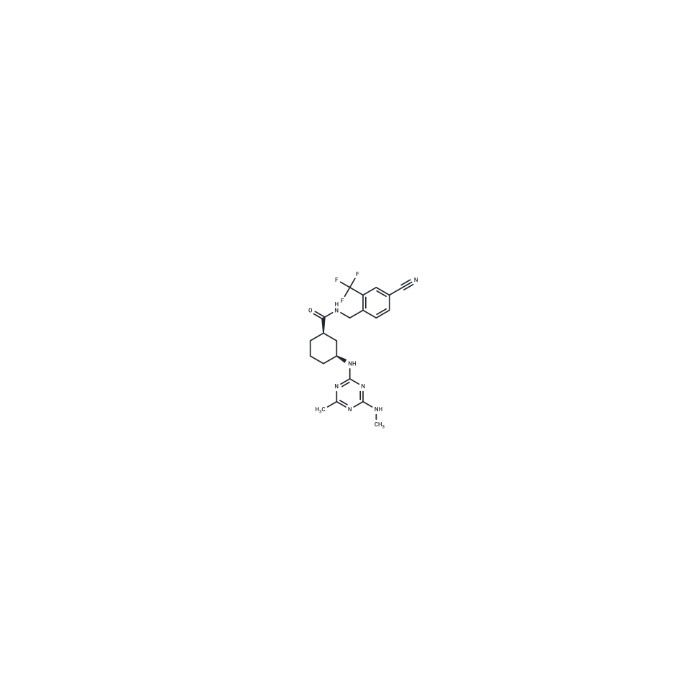
GSK2256294A (GSK 2256294) is a selective and orally active inhibitor of soluble epoxide hydrolase (sEH). GSK2256294A inhibits recombinant human sEH, rat sEH orthologs and murine sEH orthologs with IC50s of 27, 61 and 189 pM, respectively. GSK2256294A can be used for the research of chronic obstructive pulmonary disease (COPD) and cardiovascular disease
This compound belongs to the class of organic compounds known as gamma amino acids and derivatives. These are amino acids having a (-NH2) group attached to the gamma carbon atom.
External Descriptors
Not available
1. Djoumbou Feunang Y, Eisner R, Knox C, Chepelev L, Hastings J, Owen G, Fahy E, Steinbeck C, Subramanian S, Bolton E, Greiner R, and Wishart DS. ClassyFire: Automated Chemical Classification With A Comprehensive, Computable Taxonomy. Journal of Cheminformatics, 2016, 8:61.
Determine the necessary mass, volume, or concentration for preparing a solution.
Dilution Calculator
Determine the dilution needed to prepare a stock solution.
Reconstitution Calculator
Recensioni
Recensioni dei clienti
Application Protocols
Item-specific validated protocols are not provided in the Product Data for this molecule. The following are general, non-item-specific guidelines for using small-molecule tool compounds in biochemical and cellular assays.
Example general protocol (biochemical inhibition assay):
Prepare a 10–20 mM DMSO stock; make serial half-log dilutions in DMSO.
Add to assay buffer containing enzyme and substrate to achieve final inhibitor range (e.g., 0.1 nM–30 µM) at constant DMSO (≤1% v/v).
Preincubate 10–30 min if required; initiate reaction; measure initial rates.
Analyze IC50 with four-parameter logistic fit; for mechanism/affinity, determine Ki via global fitting of rate data vs substrate and inhibitor.
Example general protocol (cell-based assay):
Seed cells and allow to attach; prepare dosing solutions by diluting DMSO stocks into medium (final DMSO ≤0.1–0.5% v/v if tolerated).
Treat across an 8–12-point dilution series; include vehicle controls.
Incubate for defined period (e.g., 4–24 h); read appropriate endpoints (reporter, metabolite levels, imaging).
Quality controls:
Confirm compound integrity in dosing solutions by LC–MS.
Use low-bind plastics to minimize adsorption losses.
Note: Adapt conditions to your assay system. For lot-specific instructions, consult the CoA/Spec Sheet.
Biological Roles
General background (literature; not item-specific to a particular lot):
GSK2256294 has been reported in the literature as a potent, small-molecule enzyme inhibitor used as a chemical probe to study biochemical pathways. Such tool compounds enable interrogation of target function, downstream signaling, and metabolic impacts in vitro and in cell or tissue models.
As with any probe, interpretation of phenotypes requires appropriate controls: inactive analogs, genetic knockdown/knockout, and orthogonal chemotypes to confirm on-target effects.
Use in research paradigms:
Biochemical assays: Determination of inhibition kinetics, binding affinity, and mechanism (competitive, noncompetitive, etc.) using recombinant enzyme and defined substrates.
Cellular assays: Assessment of pathway modulation, changes in metabolite profiles, and transcriptional responses, with careful control of compound exposure time, concentration, and solvent percentage.
Selectivity and off-targets: Profiling across related enzymes and broad panels (e.g., safety pharmacology) is often conducted to characterize specificity; consult primary data before drawing conclusions.
Caveats:
Bioactive small molecules can interact with multiple targets at higher concentrations; titrate broadly and use mechanistic counterscreens.
Solvent and protein binding can alter apparent potency; report free concentrations where feasible.
Note: No medical or clinical claims are made. This product is for research use only.
Buffer Applications
Applicability: GSK2256294 is not a buffering agent. However, it is commonly used in buffered systems for biochemical and cellular assays.
General practice (literature/common workflows):
Stock preparation: Dissolve in anhydrous DMSO to 10–50 mM. Store in aliquots at −20 °C. Thaw immediately before use.
Aqueous dilution: Add the DMSO stock to assay buffer with vigorous mixing to the desired final concentration; typical final DMSO is maintained at ≤0.1–1% v/v depending on assay tolerance.
Typical assay buffers: HEPES (pH 7.2–7.6), Tris (pH 7.4–8.0), or PBS for biochemical assays; include detergents (e.g., 0.01–0.05% Tween-20) only if validated not to affect the readout.
Precipitation check: After dilution, visually inspect and, if critical, verify by light scattering or filtration (0.2 µm) to ensure a clear solution.
Controls:
Vehicle control: Buffer + equivalent DMSO percentage without compound.
Stability control: Incubate compound in buffer under assay conditions without enzyme/cells to assess non-enzymatic degradation.
Note: Composition, pH, and ionic strength should be tailored to the biological system under study. No buffer capacity or pKa data are specified for this item.
Green Alternatives
Context: GSK2256294 is a bioactive small molecule, not a process solvent or bulk reagent. “Green alternatives” therefore relate to how it is handled/used (solvent systems, waste minimization) rather than substituting the molecule itself.
Strategy (general best practices):
Solvent minimization: Use high-concentration DMSO stocks (e.g., 10–50 mM) to reduce total solvent volumes introduced into assays.
Prefer greener co-solvents: When aqueous dilution is required, consider water-rich buffers with minimal DMSO. Ethanol can be considered but verify biological tolerability; avoid DMF where possible in cell-based work.
Micro-scale assays: Implement miniaturized formats (384–1536-well) to cut chemical use and waste generation while maintaining statistical power.
Waste segregation: Collect DMSO/organic solutions separately for appropriate disposal; avoid chlorinated solvents unless required for analytics.
Comparison (general):
DMSO vs DMF: DMSO is typically favored for bioassays due to lower toxicity and better environmental profile; DMF should be avoided if a benign option suffices.
Aqueous-first approaches: Employ cyclodextrins or serum proteins in buffers to lower required organic co-solvent content, provided they do not confound assay readouts.
Operational tips:
Use inert-atmosphere vials with PTFE-lined caps to extend shelf-life of stocks and reduce repeated re-dissolutions.
Plan experiments to consume whole aliquots, limiting freeze–thaw and product loss.
Pharmaceutical Uses
Scope: This product is supplied strictly for research use only. No medical, diagnostic, or clinical use is intended or implied.
Research and development context (general, not item-specific):
Reference standard/probe: Employed as a comparator or tool compound in preclinical discovery studies to explore target biology, validate assays, and benchmark new chemotypes.
Formulation research: Small-scale solubility screening (cosolvents, pH adjustment, excipients) to understand compound behavior in biorelevant media for in vitro studies; any such work should remain within non-clinical, lab-scale contexts.
Analytical development: Method development for LC–MS/MS quantification in complex matrices (e.g., plasma, cell lysate) as part of exposure and stability studies in non-clinical settings.
Regulatory status:
No pharmacopeial monograph or compendial status is specified for this item.
Operational guidance:
For any ADME or exposure studies, ensure appropriate ethical approvals and institutional oversight. Handle and dispose according to SDS and local regulations.
Item-specific statements:
Excipient role, GMP status, and clinical formulation details: Not applicable/not specified for this item.
Physical Properties
Item-specific physical data:
Appearance: Not specified for this item; refer to CoA/Spec Sheet.
Molecular Weight: Not specified for this item; refer to CoA/Spec Sheet.
Molecular Formula: Not specified for this item; refer to CoA/Spec Sheet.
Literature/general guidance (not item-specific):
Many bioactive screening compounds are solids at ambient temperature and are prepared as DMSO stock solutions (e.g., 10–50 mM) for biochemical/cellular assays.
Typical solubility behavior: High solubility in polar aprotic solvents (DMSO, DMF); limited aqueous solubility without co-solvent or surfactant. Actual solubility limits must be determined empirically for each lot.
LogP/logD, pKa, refractive index, density, MP/BP: Not specified for this item; consult primary literature or determine experimentally as needed for your workflow.
Practical notes:
For aqueous work, consider co-solvent strategies (≤1% v/v DMSO in final assay buffer), cyclodextrins, or cosolubilizers (e.g., 0.01–0.05% nonionic surfactant) after verifying assay tolerability.
Filter stock solutions (0.2 µm PTFE) to remove particulates before quantitative assays.
For accurate dosing, prepare gravimetrically standardized stocks and verify concentration by UV-Vis only if a validated extinction coefficient is available for this compound; otherwise use quantitative NMR (qNMR) or LC–MS with an internal standard.
Quality and Grades
Item-specific grade:
Grade/Purity: Moligand™ (as provided). Specific purity metrics (e.g., HPLC area%, water, residual solvents, metals) are not specified for this item; refer to CoA/Spec Sheet.
What Moligand™ typically implies (general description):
Intended for ligand discovery, screening, and chemical biology use where identity and chromatographic purity are critical. Lots are typically qualified by structure-confirming analytics (e.g., NMR/LC–MS) and purity assessment by HPLC/UPLC; confirm the exact test suite on the CoA.
UV background and stability characteristics should be verified if using in spectroscopic readouts.
Practical quality guidance:
Request or download the lot-specific CoA/Spec Sheet to confirm: identity (NMR/HRMS), purity (% area by HPLC and method), residual solvents, and any stabilizers.
If quantitative SAR or PK-like in vitro assays are planned, consider orthogonal purity checks (e.g., qNMR, evaporative light scattering) to rule out co-eluting impurities.
For comparator studies across vendors/lots, normalize by verified assay concentration (qNMR or LC–MS with internal standard) rather than gravimetric concentration alone.
Stabilizers/additives:
None specified for this item; refer to CoA/Spec Sheet. If present, note any assay interference risks and account for them in controls.
Reaction and Applications
Scope: As a defined small-molecule probe, GSK2256294 is primarily used in biochemical and cellular studies rather than as a synthetic reagent.
Research applications (literature/general, not item-specific):
Chemical biology: Utilized as a tool compound to modulate a defined enzyme target in vitro and in cells, supporting target validation and pathway elucidation.
Screening workflows: Reference control in enzymatic inhibition assays; benchmarking for assay performance (Z′, signal window) and for validating substrate/assay conditions.
Mechanistic pharmacology: Time-dependence, reversibility, and competition studies to characterize binding mode using kinetic assays and washout experiments.
Practical implementation tips:
Prepare high-quality DMSO stocks and confirm concentration by qNMR or LC–MS to reduce variability in IC50/Ki determinations.
Maintain consistent final solvent percentage across wells/conditions; include vehicle controls and, if relevant, counterscreens for assay interference (e.g., redox cycling, fluorescence quench/inner-filter effects).
Validate selectivity using orthogonal assays (biochemical vs cellular readouts) and, where possible, test against related enzyme family members.
Assay analytics:
Use LC–MS to monitor compound integrity during incubations; track adsorption to plastics by mass balance tests (siliconized or low-bind plastics may reduce losses).
Perform control incubations without enzyme/cells to characterize non-enzymatic instability.
Note: For any specific biological findings or potencies, consult primary literature and verify with your own system.
Reaction Conditions
Not a synthetic reagent: GSK2256294 is not generally used to promote or undergo preparative chemical reactions in the lab context. Instead, it is dosed into biochemical or cellular systems.
Assay condition guidance (literature/common practice; not item-specific):
Stock solutions: 10–50 mM in anhydrous DMSO; store at −20 °C in aliquots under inert gas.
Biochemical enzyme assays: Typical final concentration range spans 0.1 nM to 30 µM depending on target potency. Maintain constant DMSO (≤1% v/v). Incubation 5–60 min at 25–37 °C is common before initiating reactions.
Cellular assays: Dose-response titrations across 8–12 half-log dilutions, exposure times 1–24 h, with attention to medium protein content and potential adsorption to plastics; use low-bind labware when needed.
Kinetic analysis: Use multiple inhibitor concentrations and substrate levels to deduce mechanism (competitive/noncompetitive) and determine Ki using appropriate models (e.g., global fitting of initial rates).
Data quality controls:
Include vehicle controls and, where relevant, orthogonal readouts to detect assay interference (fluorescence quenching, aggregation). Add 0.01% nonionic detergent if aggregation is suspected, after verifying assay compatibility.
Stability checks by UPLC or LC–MS during the assay window to ensure constant exposure.
Note: Specific buffer compositions, temperature dependencies, and potency values should be confirmed experimentally for your system.
Safety and Handling
Item-specific hazard data:
GHS Classification: Not specified for this item; refer to SDS.
Signal Word: Not specified for this item; refer to SDS.
H-Statements: Not specified for this item; refer to SDS.
Pictograms: Not specified for this item; refer to SDS.
Storage and transport (from Product Data):
Storage: Store at −20 °C, protected from light, argon charged.
Shipping: Ice chest + ice pads.
General laboratory precautions (not item-specific; follow your institutional EHS):
Handle in a chemical fume hood; avoid inhalation, ingestion, and skin/eye contact.
Recommended PPE: Lab coat, safety glasses, and appropriate chemically resistant gloves (e.g., nitrile). Change gloves regularly when handling DMSO stocks, which can enhance dermal absorption of solutes.
Avoid exposure to strong oxidizers and extreme pH until stability is known.
Weigh quickly on a clean, dry surface to minimize atmospheric moisture uptake and photodegradation; flush headspace with inert gas after use.
First-aid (general):
Skin/eye contact: Rinse with water for ≥15 minutes; remove contaminated clothing; seek medical attention if irritation persists.
Inhalation: Move to fresh air; seek medical attention if symptoms occur.
Ingestion: Rinse mouth; do not induce vomiting; seek medical advice.
Always consult the SDS for authoritative hazard, toxicological, and disposal guidance before use.
Solvent Selection
Applicability: GSK2256294 is a research-use small molecule typically handled as organic or mixed-solvent solutions for stock preparation and assays.
General solvent guidance (literature/practice, not item-specific):
Primary stock solvent: DMSO due to broad solvency and compatibility with biochemical assays (final assay DMSO often kept ≤0.1–1% v/v).
Alternative stock solvents: DMF or ethanol (if assay-tolerated); ensure solvent controls and verify solubility/chemical stability.
Aqueous work: Use co-solvent dilution into buffered saline (e.g., HEPES, PBS) with gentle mixing; watch for precipitation at low final DMSO.
Solubility/miscibility profile (typical for bioactive heteroaromatics; verify empirically):
Miscible: DMSO, DMF, acetonitrile.
Limited: Water; may require co-solvent or solubilizing excipients.
Comparison considerations:
DMSO vs DMF: DMSO is generally lower volatility, friendlier to enzymes/cells at ≤1% v/v; DMF may extract plastics more and is less favored in cell assays.
Ethanol: Convenient but may have stronger biological effects; limit to ≤0.1–0.5% v/v in sensitive systems.
Practical tips:
Prepare concentrated, single-use aliquots (e.g., 10–20 mM) to avoid freeze–thaw and moisture uptake.
Validate stability of solutions over study-relevant intervals (bench-top and refrigerated), using LC–MS/UPLC to track degradation and adsorption losses.
Storage and Reconstitution
Item-specific storage (from Product Data):
Store at −20 °C.
Protect from light.
Argon charged (maintain inert headspace after opening).
Shipped in an ice chest with ice pads.
Reconstitution (general guidance for small molecules; verify with your assay needs):
Solvent: Dissolve in anhydrous DMSO to prepare concentrated stocks (e.g., 10–50 mM). Actual solubility limit for this item is not specified; determine empirically.
Filtration: If particulate is observed, pass through a 0.2 µm PTFE syringe filter.
Aliquoting: Dispense into small, single-use vials or tubes to avoid repeated freeze–thaw cycles and moisture ingress. Backfill with argon or nitrogen before sealing.
Handling/stability tips:
Minimize time at room temperature and exposure to ambient humidity; recap promptly.
Record preparation date, solvent, and concentration on each aliquot.
Assess stability of solutions by LC–MS/UPLC over the expected use period (bench-top, refrigerated, frozen). Discard if significant degradation is detected.
Retest/review dates:
If no retest period is stated on the CoA, perform periodic quality checks (e.g., every 6–12 months) for solid material and every 1–3 months for solutions stored at −20 °C.
Note: For research use only. Consult the CoA/Spec Sheet and SDS for lot-specific details and safety guidance.
Structure and Identity
Overview: GSK2256294 is supplied as a research-use small molecule (Moligand™ grade) intended for chemical biology and screening workflows.
Item-specific (from Product Data):
SKU: G610702
Product Name: GSK2256294
CAS: 1142090-23-0
PubChem CID: 59448236
InChIKey: 206355 (as provided)
SMILES: Not specified for this item; refer to CoA/Spec Sheet.
Molecular Formula: Not specified for this item; refer to CoA/Spec Sheet.
Molecular Weight: Not specified for this item; refer to CoA/Spec Sheet.
Literature/context (general, not item-specific):
Compound class: Reported in the literature as a small-molecule enzyme inhibitor used as a chemical probe in target validation studies. Specific structural motifs and exact stereochemistry should be verified against primary literature or the CoA.
Structural features (general description): Typically, such probes feature multiple heteroatoms and aromatic/heteroaromatic systems enabling high-affinity target engagement; confirm the exact scaffold from primary references.
Practical identity notes:
Always verify identity by orthogonal methods (e.g., 1H/13C NMR, LC–MS, HRMS) against a trusted reference before critical studies.
If provided, compare measured chromatographic purity and exact mass to the values on the CoA/Spec Sheet for this lot.
Synthetic Utility
Applicability: GSK2256294 is a finished, bioactive small molecule supplied for use as a research probe/control. It is not typically employed as a synthetic building block or reagent.
General considerations (for chemists working with analogs):
If structure–activity relationship (SAR) studies are pursued, synthetic routes generally involve late-stage diversification on heteroaromatic/aryl motifs and careful control of stereochemistry (if present). Protecting-group and cross-coupling strategies (e.g., Suzuki–Miyaura, Buchwald–Hartwig) are common in related scaffolds.
Purification: Reverse-phase preparative HPLC is often used for polar, multifunctional inhibitors. Verify counterion content and salt form as it can affect solubility and assay performance.
Analytical characterization: Combine LC–MS, 1H/13C NMR, HRMS, and purity by HPLC/UPLC. qNMR is valuable for accurate assay stock quantification.
When to use this item:
As a benchmark tool compound to validate biological assays and to provide a reference activity profile during optimization of new chemotypes.
Item-specific reactive functional groups, pKa, or synthetic handles: Not specified for this item; consult primary literature or perform structural elucidation before planning derivatizations.
Target Specificity
Item-specific data: No target, epitope, clone, or species-reactivity information is provided in the Product Data. This is a small molecule, not an antibody or biologic.
Literature/general context:
Small-molecule tool compounds are typically designed to engage a defined protein target with high affinity and selectivity. Confirm the intended target, selectivity profile, and off-targets using primary literature and vendor-provided CoA/technical notes before drawing mechanistic conclusions.
Practical recommendations:
Verify target engagement with biochemical assays and orthogonal methods (e.g., CETSA, NanoBRET/bioluminescence resonance energy transfer, activity-based profiling) where applicable.
Profile against close homologs or a representative panel to assess specificity within the protein family of interest.
Note: For this catalog entry, target specificity details are not specified for this item; refer to CoA/Spec Sheet and primary references.
Domande frequenti
What is the purity of this product?
This product is supplied at ≥98% purity (chemical assay). Lot-specific values are stated on the Certificate of Analysis.
What is Moligand??
Moligand? is one of Aladdin Scientific's premium product lines, formulated for high-purity applications across multiple workflows. Compared to standard grades in the same workflow, Moligand? products typically offer tighter specifications, more rigorous QC, and stronger lot-to-lot consistency.
How should this product be stored?
Store at ?20 °C, protected from light, under argon. It is supplied under an argon blanket; reseal under inert gas after each use.
How is this product shipped?
This product ships in an insulated container with ice pads. Unpack on arrival and transfer it to the storage condition stated above.
What are the CAS number, molecular formula and molecular weight?
The CAS Number is 1142090-23-0, the molecular formula is C21H24F3N7O, and the molecular weight is 447.46 g/mol. InChIKey LQHDJQIMETZMPH-ZBFHGGJFSA-N.
What documentation is provided?
Available product documentation, including Certificates of Analysis (COA), Safety Data Sheets (SDS), and specification sheets, is shown in the product document area. Document availability and access follow the current site policy.
Hai bisogno di aiuto per scegliere la qualità?
La nostra guida alla selezione delle qualità copre purezza, stato dello stabilizzatore e idoneità all'applicazione per tutte le varianti del nostro catalogo.
Utilizziamo i cookie per garantire il corretto funzionamento del sito web e, ove consentito, per migliorare la tua esperienza. Puoi gestire le tue preferenze in qualsiasi momento nelle Impostazioni. Per saperne di più, consulta la nostra Cookie Policy.
Desidera che le inviamo un messaggio quando avremo sconti disponibili?
Ricordamelo più tardi
Grazie! Controlli la sua casella di posta per confermare.
Products are supplied to verified businesses, institutions, and qualified professionals for research and development use only. Not for use in humans, animals, diagnosis, or therapy.

 I2616550