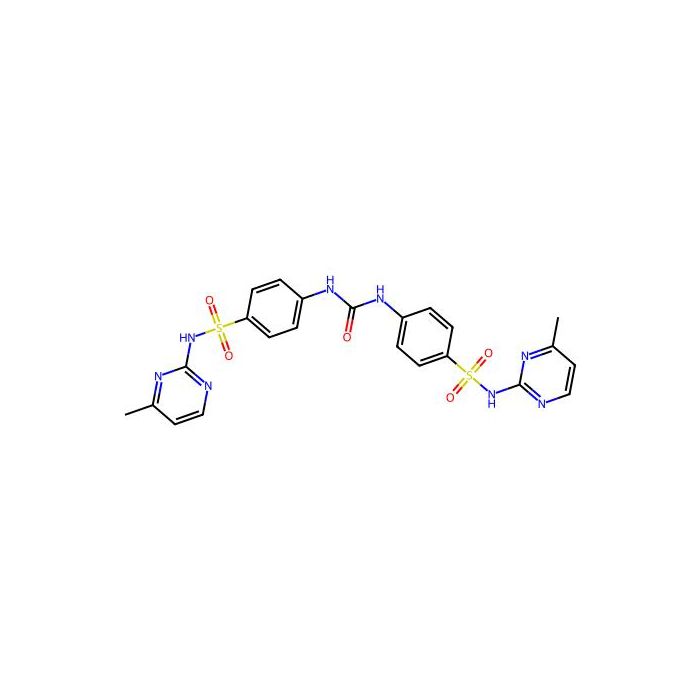
This compound belongs to the class of organic compounds known as benzenesulfonamides. These are organic compounds containing a sulfonamide group that is S-linked to a benzene ring.
External Descriptors
Not available
1. Djoumbou Feunang Y, Eisner R, Knox C, Chepelev L, Hastings J, Owen G, Fahy E, Steinbeck C, Subramanian S, Bolton E, Greiner R, and Wishart DS. ClassyFire: Automated Chemical Classification With A Comprehensive, Computable Taxonomy. Journal of Cheminformatics, 2016, 8:61.
Certificati (CoA, COO, BSE/TSE e tabella di analisi)
C of A & Other Certificates(BSE/TSE, COO):
Analytical Chart:
Proprietà chimiche e fisiche
Peso molecolare
554.600 g/mol
XLogP3
1.600
Hydrogen Bond Donor Count
4
Hydrogen Bond Acceptor Count
11
Rotatable Bond Count
8
Exact Mass
554.115 Da
Monoisotopic Mass
554.115 Da
Topological Polar Surface Area
202.000 Ų
Heavy Atom Count
38
Formal Charge
0
Complexity
908.000
Isotope Atom Count
0
Defined Atom Stereocenter Count
0
Undefined Atom Stereocenter Count
0
Defined Bond Stereocenter Count
0
Undefined Bond Stereocenter Count
0
The total count of all stereochemical bonds
0
Covalently-Bonded Unit Count
1
Calcolatori di soluzioni
Molarity Calculator
Determine the necessary mass, volume, or concentration for preparing a solution.
Dilution Calculator
Determine the dilution needed to prepare a stock solution.
Reconstitution Calculator
Recensioni
Recensioni dei clienti
Application Protocols
There are no validated application protocols provided for this product entry.
Item-specific
Not specified for this item; refer to CoA/Spec Sheet.
General planning guidance
For biochemical assays: prepare concentrated DMSO stocks (e.g., 10–50 mM), serially dilute in assay buffer, and include vehicle controls matched for final DMSO content.
For cell-based work (research use only): verify cytotoxicity independently; filter sterilize solutions if compatible; limit DMSO to ≤0.1–0.5% v/v as assay permits.
For analytical reference use: prepare gravimetrically with calibrated balances; document purity correction factors if using assay-by-HPLC values.
Please consult your internal SOPs and the SDS prior to use.
Biological Roles
No biological mechanism or target information is provided for Gsk837149A in this listing.
Item-specific (from Product Data)
No target, pathway, or mode-of-action data supplied. Research-use only.
General guidance
If this compound is intended as a tool molecule, consult peer-reviewed literature or vendor-provided technical notes linked to the CAS/CID to identify putative targets, binding constants, and selectivity profiles.
Prior to cellular use, confirm purity, residual solvent content, and salt form. Prepare DMSO stocks under low-moisture conditions and filter through 0.22 µm if compatible.
For biochemical assays, determine compound stability in buffer (pH 6–8), light sensitivity, and potential adsorption to plastics (test glass vs polypropylene).
Typical characterization (general)
Enzyme or receptor assays for activity/concentration-response curves.
Counterscreens against related targets to establish selectivity.
Basic ADME in vitro panels (solubility, microsomal stability, plasma protein binding) if relevant to your study.
Note: No medical or clinical claims are made. This material is supplied strictly for laboratory research use.
Buffer Applications
This product is not a buffering agent, and no buffer system parameters are specified.
Item-specific
No pKa values or buffer roles are provided for this item.
Practical notes (general)
When preparing assay solutions, dissolve the compound in a miscible organic solvent (commonly DMSO), then dilute into the desired buffer (e.g., PBS, HEPES, Tris) while monitoring final organic cosolvent ≤0.5–1% v/v to minimize assay interference.
If precipitation occurs upon dilution, adjust concentration, cosolvent percentage, temperature, or add a small amount of non-ionic surfactant compatible with the assay.
For true buffering needs, select a canonical buffer (HEPES pH 6.8–8.2, MOPS pH 6.5–7.9, Tris pH 7–9), following established recipes and ionic strength targets.
Green Alternatives
Without a known solvent role or transformation context for Gsk837149A, green-alternative guidance is necessarily general.
If used as a reaction solvent (general)
Prefer 2-MeTHF or CPME over THF/Et2O when feasible (better safety, lower peroxide risk; check solubility and selectivity).
Consider EtOAc, MeTHF, or toluene over DCM/CHCl3 for extractions or reactions, acknowledging performance trade-offs.
Replace DMF/NMP with propylene carbonate, sulfolane, or green amide solvents when suitable, mindful of removal challenges and reaction compatibility.
If used as an assay stock solvent (general)
Maintain low DMSO percentages; consider ethanol or PEG400 cosolvents for certain biological assays where compatible.
Peroxide risk | THF/Et2O (elevated) | 2-MeTHF/CPME (lower) | Different polarity, may affect rates
Always confirm that greener substitutes maintain target performance and do not compromise product integrity.
Pharmaceutical Uses
No pharmacopeial status, excipient role, or formulation guidance is provided for this item.
Item-specific
Not specified for this item; refer to CoA/Spec Sheet.
General notes (non-clinical)
If the compound is evaluated in preclinical formulations, typical approaches include DMSO cosolvent systems, aqueous buffers with solubilizers (e.g., hydroxypropyl-β-cyclodextrin), or lipid-based vehicles. Such use must be justified by independent data and regulatory guidance; this listing makes no claims of suitability.
For analytical reference use, confirm stability in relevant diluents and container compatibility (glass vs plastic) and document with forced-degradation studies for method validation.
This product is for research use only and is not an API, excipient, or for human/animal administration.
Physical Properties
Item-specific properties currently unavailable in this listing. Do not treat any values below as specifications; consult the CoA/Spec Sheet for authoritative values.
Item-specific (from Product Data)
Appearance: Not specified for this item; refer to CoA/Spec Sheet.
Molecular Weight: Not specified for this item; refer to CoA/Spec Sheet.
Commonly referenced physical parameters (literature/general, not item specifications)
Melting point (MP): Not available for this listing.
Boiling point (BP): Not available for this listing.
Density: Not available for this listing.
Solubility: Not available for this listing. For screening compounds, a typical starting point is dissolution in DMSO (analytical grade) to 10–50 mM, then dilution into assay buffers.
logP/logD, pKa, refractive index: Not available for this listing.
Practical guidance (general)
If the substance is a crystalline organic solid, expect limited aqueous solubility; perform a small solvent screen (DMSO, DMF, MeOH, EtOH, ACN, PBS with 0.1–1% DMSO) to determine working concentrations.
For unknown hygroscopicity, minimize ambient exposure; use desiccation and weigh quickly.
If volatility is unknown, avoid elevated temperatures and open-vessel evaporation until behavior is confirmed on milligram scale.
Quality and Grades
Item-specific (from Product Data)
Grade/Purity: Not specified for this item; refer to CoA/Spec Sheet.
Guidance on grades (general)
When grade/purity is unspecified, request the CoA to verify assay (%), residual solvents, and key impurities. For bioassays, >95% by HPLC/UPLC is commonly targeted; for SAR or QC reference use, ≥98% may be preferred.
If offered in multiple grades (e.g., research grade vs. HPLC grade), HPLC grade typically emphasizes low UV-absorbing impurities and suitability for chromatographic or spectroscopic work.
Stabilizers, if present, will be declared on the label/CoA. Absence of a declared stabilizer does not guarantee stabilizer-free; confirm if your application is sensitive (e.g., catalytic screens, photophysics).
Recommended verification (general)
Identity: 1H/13C NMR, HRMS/ESI, and comparison to a reference spectrum if available.
Purity: Orthogonal methods (UPLC-UV at multiple wavelengths, ELSD, and, if needed, qNMR). Assess salt form and residual water by Karl Fischer if relevant.
Solid form: If polymorph/solvate state matters, request XRPD/DSC/TGA.
Reaction and Applications
No manufacturer application notes are provided for this item beyond “Research use only.” Without a known structure, specific reaction classes cannot be assigned. The following guidance is general for small-molecule research materials.
Potential laboratory uses (general)
As a reference material or tool compound in biochemical or analytical assays (subject to identity confirmation and purity verification).
As a synthetic intermediate if a reactive handle is present (consult structure when available).
Practical tips (general)
If using in synthesis, establish reactivity via micro-scale trials. Run stability tests in representative conditions (acidic, basic, oxidative, reductive, photolytic) to identify compatible transformations.
Dry solvents and reagents if moisture sensitivity is suspected; employ inert atmosphere for air-sensitive species.
Analytics
Build a profiling panel: UPLC-UV at multiple wavelengths, HRMS, and, if feasible, 1H NMR in a deuterated solvent that gives clean baselines (DMSO-d6, CDCl3, or CD3OD depending on solubility).
Purification (general)
Choose normal-phase silica for nonpolar/neutral species, reversed-phase (C18) for polar/ionizable compounds. Consider preparative HPLC for high-purity needs.
Please refer to the CoA/specification to determine if the compound is intended as a reference standard, screening hit, or synthetic building block.
Reaction Conditions
No specific reaction conditions are applicable without a known structure or intended transformation. The following are general guardrails when exploring reactivity of an unfamiliar small molecule.
Condition scouting (general)
Start with neutral to mildly basic conditions in an aprotic solvent (e.g., acetonitrile, toluene, THF/2-MeTHF, or DCM/EtOAc) at ambient temperature; scale up only after stability is confirmed.
For coupling chemistry, screen Pd catalysts/ligands across bases (K3PO4, K2CO3, Cs2CO3) and solvents (toluene, dioxane, 2-MeTHF). Monitor by UPLC/MS.
Analytical control
Track conversions at multiple wavelengths to catch chromophore-specific impurities. Use HRMS to confirm mass balance and fragment identity.
Stability checks
Conduct forced-degradation mini-tests (acid/base/oxidant/reductant/light/heat) to inform protective handling and quench strategies.
Expected yields
Not applicable; no literature data for this item are provided.
Always adapt conditions based on the verified functional groups and pilot experiments.
Safety and Handling
Safety information in this listing is incomplete. Always consult the product-specific SDS before use.
Item-specific (from Product Data)
GHS Classification: Not specified for this item; refer to SDS.
Signal Word / H-Statements / Pictograms: Not specified for this item; refer to SDS.
Storage Conditions: Store at −20 °C.
Shipped In: Ice chest + ice pads.
Research Use: For research use only.
General laboratory precautions (good practice)
PPE: Safety glasses, lab coat, and appropriate chemical-resistant gloves (e.g., nitrile). Work in a fume hood to avoid inhalation of dust/vapors.
Incompatibilities (general): Avoid strong oxidizers and strong acids/bases until compatibility is known. Do not mix with reactive metals or reducing agents without prior assessment.
Handling: Minimize exposure to moisture and light if stability is unknown. Cap tightly; purge headspace with inert gas when feasible.
First-aid (overview): In case of contact, rinse affected area with water for at least 15 minutes. If inhaled, move to fresh air. Seek medical attention if symptoms occur. Refer to SDS for detailed instructions.
Spills: Avoid dust generation. Absorb liquids with inert material; collect solids mechanically. Dispose according to institutional chemical waste procedures.
Stability notes (general)
Low-temperature storage suggests potential sensitivity to heat and/or hydrolysis. Thaw only what is needed; avoid repeated warming cycles.
Solvent Selection
Item-specific solvent behavior is not provided. Use the following general strategy for small-molecule research compounds.
Practical solubility screening (general)
Start with DMSO to prepare a 10–50 mM stock. If solubility is poor at room temperature, warm gently (≤40 °C) and sonicate briefly.
Secondary solvents: DMF, NMP, methanol, ethanol, acetonitrile. For aqueous assays, dilute DMSO stocks into buffer, keeping final DMSO ≤0.5–1% v/v when possible.
For nonpolar compounds, consider ethyl acetate, dichloromethane, toluene, or MTBE for workup and purification.
Polarity/miscibility (general)
Without logP/pKa, predict behavior empirically. Perform a quick partition test (e.g., octanol/water) on milligram scale to anticipate extraction schemes.
Comparison notes (general)
DMSO vs DMF: DMSO is more benign and has broader solvating power; DMF can improve solubility of very polar/ionic species but is harder to remove and more regulated.
MeOH/EtOH vs ACN: Alcohols can aid dissolution via H-bonding; ACN offers lower viscosity and UV transparency for analytical work.
Compatibility cautions
Avoid strong acids/bases unless stability is known. For base- or acid-labile motifs, use neutral buffered aqueous phases during dilutions.
Note: For chromatography, choose eluents after a TLC solvent screen (hexanes/EtOAc, DCM/MeOH, or MeOH/water with 0.1% FA/NH4OH for reversed-phase).
Storage and Reconstitution
Item-specific (from Product Data)
Storage Conditions: Store at −20 °C.
Shipped In: Ice chest + ice pads.
General storage guidance
Keep container tightly closed under dry, inert atmosphere if possible. Protect from light until stability is known.
If hygroscopicity is unknown, store with desiccant; minimize freeze–thaw by preparing single-use aliquots.
Record opening date and maintain a stability log. Inspect periodically for discoloration, precipitate changes, or gas evolution.
Reconstitution (general)
For analytical/assay use, dissolve first in a suitable anhydrous solvent (commonly DMSO) to prepare a concentrated stock (e.g., 10–50 mM), then dilute to working strength.
If insoluble, test alternative solvents (DMF, MeOH, EtOH, ACN) or gentle warming (≤40 °C) and sonication. Avoid strong acids/bases unless stability is characterized.
Filter solutions through 0.22 µm PTFE or PVDF if particulate is observed and filtration is compatible.
Stability after reconstitution (general)
At room temperature: limit to working session only unless validated.
Refrigerated (2–8 °C): short-term holding for hours to days, pending stability tests.
Frozen (−20 °C or below): store aliquots; avoid repeated freeze–thaw.
For definitive shelf-life and retest intervals, consult the product’s CoA or stability data if available.
Structure and Identity
Brief overview: This listing is for a research-use small molecule designated Gsk837149A. Item-specific identifiers are limited in the current record.
Item-specific (from Product Data)
Product Name: Gsk837149A (SKU: G1031641)
CAS: 13616-29-0
CID: 57519517
InChIKey: 324745 (as provided; note this does not follow the typical 27-character InChIKey format)
SMILES: Not specified for this item; refer to CoA/Spec Sheet.
Molecular Formula: Not specified for this item; refer to CoA/Spec Sheet.
Molecular Weight: Not specified for this item; refer to CoA/Spec Sheet.
Structural features (general guidance)
Without a provided SMILES/InChI or structure image, functional groups, ring systems, stereochemistry, and tautomeric features cannot be described for this lot. Please consult the Certificate of Analysis (CoA) or reference database entry associated with the provided CAS/CID for definitive structural information.
2D structure description (general)
Not available in this listing. If you supply a structure file (SDF/Mol/SVG) or verified SMILES, we can annotate ring systems, heteroatom placement, and stereogenic centers in detail.
Notes
For unambiguous identity, best practice is to cross-validate CAS, exact mass, and a canonical SMILES or InChIKey from a trusted registry and match against the item’s CoA.
Synthetic Utility
Without structural information, specific synthetic transformations cannot be prescribed for Gsk837149A. The following describes general considerations for employing an unknown small-molecule substrate.
Functional group reconnaissance
Obtain or derive the structure (SMILES/InChI) to identify electrophiles, nucleophiles, heterocycles, reducible/oxidizable sites, and protecting-group needs.
Run rapid tests: TLC with multiple stains (UV, KMnO4, ninhydrin, phosphomolybdic acid) to infer functionality and polarity.
If aromatic/heteroaromatic motifs are present (general)
Cross-coupling tactics (Suzuki, Buchwald–Hartwig, Sonogashira) may be applicable when halide/boronate/amine handles exist.
Electrophilic substitutions and directed metalation can be leveraged if directing groups are present.
If carbonyl/amine/acid motifs are present (general)
Amide coupling (EDC/HOBt, HATU), reductive amination (NaBH3CN, BH3·THF), esterifications, and selective reductions/oxidations are typical.
Purification and form control
Assess salt formation to improve handling/solubility where appropriate; verify form by NMR and, if needed, XRPD/DSC.
Please consult the CoA and a verified structure before planning any synthetic sequences involving this material.
Target Specificity
No target, binding epitope, or selectivity information is provided for Gsk837149A in this listing.
Item-specific
Not specified for this item; refer to CoA/Spec Sheet or primary literature linked to the CAS/CID if available.
If you can share a verified structure or application note, we can summarize known targets, affinity (Kd/IC50), and selectivity panels with appropriate citations.
We use cookies to ensure the website functions properly and, where permitted, to improve your experience. You can manage your preferences at any time in Settings. Learn more in our Cookie Policy.
Shall we send you a message when we have discounts available?
Remind me later
Thank you! Please check your email inbox to confirm.
Products are supplied to verified businesses, institutions, and qualified professionals for research and development use only. Not for use in humans, animals, diagnosis, or therapy.