GRADE & PURITYMoligand™?Moligand™ — Aladdin's line of ligands and bioactive small molecules. Use for receptor, pathway, and binding studies needing defined small-molecule tools.10 mM in DMSO
Moligand™, 10 mM in DMSO Moligand™ for sensitive chromatographic and analytical workflows requiring minimal baseline interference.
🌡
Storage & shipping
Store at -80°C Ships Dry ice packs + Cold packs Check lot-specific COA for exact specifications.
📋
Quality documents
SDS, COA, datasheet, and spec sheet available for download. Lot-specific COA accessible via lot number lookup.
📚
Literature proof
Cited in 0 peer-reviewed publications across chromatography, organic synthesis, and cross-coupling reactions.
Panoramica
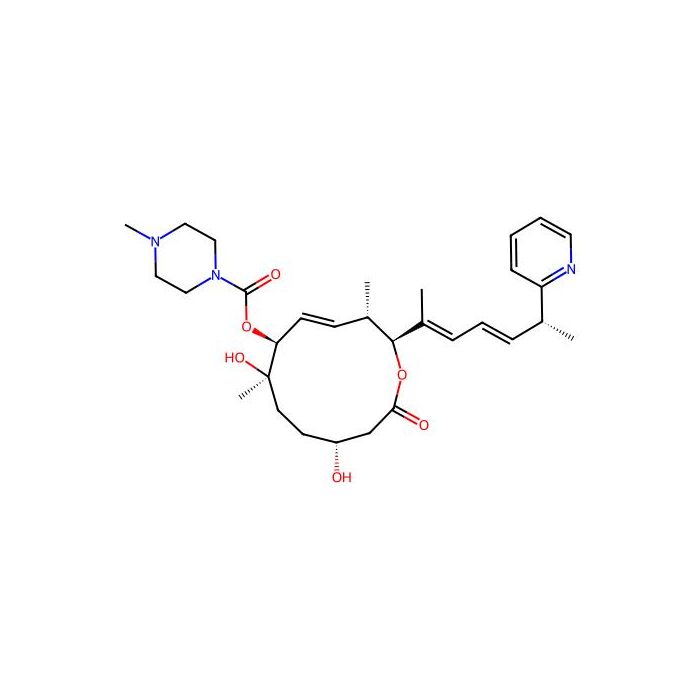
H3B-8800 is a potent and orally active SF3B splicing modulator. H3B-8800 direct interaction with the SF3b complex and shows anti-cancer activity. H3B-8800 has the potential for the research of acute myeloid leukemia (AML) with SF3B1 mutant.
Specifications
Specifiche e purezza
Moligand™, 10 mM in DMSO
Condizioni di conservazione di stoccaggio
Store at -80°C
Spedito in
Dry ice packs + Cold packs
Questo prodotto richiede spedizione a catena fredda. I servizi di terra e altri servizi economici non sono disponibili.
Certificati (CoA, COO, BSE/TSE e tabella di analisi)
C of A & Other Certificates(BSE/TSE, COO):
Analytical Chart:
Calcolatori di soluzioni
Molarity Calculator
Determine the necessary mass, volume, or concentration for preparing a solution.
Dilution Calculator
Determine the dilution needed to prepare a stock solution.
Reconstitution Calculator
Recensioni
Recensioni dei clienti
Application Protocols
No validated application protocols are provided for this specific item in the catalog entry.
Tested applications, recommended dilutions, and positive controls: Not specified for this item; refer to internal SOPs and peer-reviewed literature for assay-specific protocols involving H3B-8800.
General reminder: establish vehicle controls, concentration–response curves, and replicate numbers appropriate to your assay’s statistical power and QC requirements.
Biological Roles
Literature/general context: H3B-8800 is widely cited as a small-molecule modulator of the spliceosome, engaging the SF3B component of the U2 snRNP complex involved in branch-point recognition during pre-mRNA splicing. Modulation of this complex can alter splice-site selection, leading to changes in exon usage and intron retention across susceptible transcripts.
Research utilities stemming from this biology:
Mechanistic studies of co-transcriptional splicing dynamics and quality control pathways (e.g., nonsense-mediated decay) by perturbing spliceosome function.
Systems-level transcriptomic profiling to map splicing changes, employing RNA-seq and differential splicing analysis pipelines.
Synthetic lethality screens: probing dependencies created by spliceosome stress in defined genetic backgrounds (cell-line or CRISPR-engineered models).
Important notes:
The specific binding mode, target selectivity, and structure–activity relationships should be taken from primary literature on H3B-8800; verify with orthogonal target engagement assays in your system.
No medical or therapeutic claims are made; this material is provided strictly for research use to interrogate splicing biology.
Buffer Applications
This product is not a buffering reagent. However, buffers are integral to its use in biochemical and cell-based assays.
General guidance for assay buffers (practice-based):
Biochemical assays: use HEPES- or Tris-based buffers at physiological pH (7.2–7.5) with 0.01–0.05% nonionic surfactant (e.g., Tween-20) to reduce nonspecific adsorption if needed. Maintain ionic strength (e.g., 150 mM NaCl) and include Mg2+ or other cofactors appropriate to the spliceosomal assay.
Cell-based assays: prepare working solutions by diluting DMSO stocks directly into complete culture media. Keep final DMSO constant across treatments (commonly ≤0.1–0.5% v/v; optimize per cell type).
Stability: pre-warm media/buffers and add compound last with vigorous mixing to minimize precipitation.
Item-specific buffer recipes and pH ranges are not applicable. Consult your assay SOPs and validate compatibility experimentally.
Green Alternatives
As a bioactive probe used at low micromolar–nanomolar levels, the principal greenness considerations relate to solvent choice and waste minimization rather than replacing the active itself.
Greener handling strategies (general guidance):
Prefer ethanol or aqueous-compatible vehicles where feasible; however, solubility often necessitates DMSO. If DMSO is used, minimize final assay concentration (commonly ≤0.1–0.5% v/v) and keep consistent across controls.
Replace DMF/NMP with PEG-400:EtOH:water cosolvent systems for in vivo formulation development workups (if applicable to your research), noting potential impacts on exposure and compatibility.
Scale down: design experiments to use minimal volumes while ensuring data quality (microplate formats, automated low-volume dispensing).
Waste segregation: collect halogen-free organic waste separately; avoid mixing aqueous buffers with organic solvents to facilitate downstream treatment.
Illustrative comparison (general):
DMSO vs ethanol: DMSO offers higher solubility and stability for many drug-like molecules; ethanol is greener but may provide insufficient solubility and can perturb membranes at higher percentages.
Item-specific green alternatives do not apply because the active compound is the object of study; improvements focus on solvent systems and process efficiency.
Pharmaceutical Uses
This product is supplied strictly for research use and is not intended for human or veterinary use, diagnostic procedures, or as an excipient in commercial formulations.
Research/process-development context (general):
Employed as a chemical probe of spliceosome biology in discovery workflows and target validation studies.
If formulation-like studies are undertaken for pharmacology research, typical solvent systems include DMSO-based stocks diluted into aqueous vehicles or PEG-400:EtOH:saline mixtures. Such use cases are exploratory and require rigorous in-house qualification for stability, sterility, and compatibility.
No pharmacopeial monographs or excipient roles are associated with this item. No therapeutic or clinical claims are made.
Physical Properties
Item-specific physicochemical parameters are not provided with this listing.
Appearance: Not specified for this item; refer to CoA/Spec Sheet.
Melting point (literature/general): Not specified in this listing.
Boiling point (literature/general): Not applicable for a high-molecular-weight bioactive solid; decomposition may precede boiling.
Density: Not specified for this item; refer to CoA/Spec Sheet.
LogP/logD, pKa, refractive index: Not specified for this item; refer to CoA/Spec Sheet.
Solubility (general practice for drug-like ligands):
Organic: typically soluble in anhydrous DMSO; limited solubility expected in ethanol or DMF depending on structure (literature/general guidance).
Aqueous: generally low without a co-solvent or surfactant; prepare aqueous working solutions by serial dilution from a DMSO stock (general practice).
Practical notes (general):
Prepare concentrated DMSO stocks (e.g., single-use aliquots) and dilute into assay buffer/media immediately before use to minimize precipitation.
If solubility or precipitation is observed, consider warming gently to room temperature and sonicating briefly, then filtering through 0.22 µm PTFE.
For any specification-grade values and solubility limits, consult the lot-specific CoA/Spec Sheet.
Quality and Grades
Grade/Purity: Moligand™ (as listed). Moligand™ indicates a research- and screening-grade small-molecule ligand intended for biochemical/cellular assays and library applications.
What Moligand™ generally implies (catalog-wide context; not lot-specific specifications):
Identity typically confirmed by orthogonal analytical methods (e.g., LC–MS; occasional NMR verification where applicable). Specific test methods and acceptance criteria are provided on the CoA/Spec Sheet.
Purity suitable for discovery screening and mechanism-of-action studies; low levels of common residual solvents possible within internal quality limits. Exact purity percentage and impurity profile: Not specified for this item; refer to CoA/Spec Sheet.
Stabilizers/inhibitors: None indicated in this listing. If present in a particular lot, they will be declared on the CoA/Spec Sheet.
User guidance:
For quantitative biophysical work (Kd/IC50 determination) or in vivo exploratory studies, confirm lot-specific purity, counter-ion/solvate state, and water content via the CoA and, if necessary, in-house QC before use.
For sensitive optical assays, confirm background UV/Vis absorbance and fluorescence of the lot/solvent system prior to high-throughput screening.
Note: No item-specific specifications (e.g., water or metal content, UV cutoff) are provided here; consult the CoA/Spec Sheet for your lot.
Reaction and Applications
This product is supplied primarily as a bioactive research ligand rather than a synthetic reagent. Accordingly, its most relevant applications are in chemical biology and cell-based studies exploring pre-mRNA splicing modulation (literature/general).
Representative research applications (general):
Cellular assays: treat cultured cells with DMSO-dissolved H3B-8800 to study spliceosome-modulated transcript changes, intron retention, and splicing junction usage via RT–PCR, RNA-seq, or reporter minigenes.
Biochemical assays: evaluate spliceosome complex engagement using binding/competition assays or thermal shift (CETSA/DSF) in cell lysates (general practice).
Genetic interaction studies: combine with CRISPRi/CRISPRa or siRNA knockdown of spliceosome components to map pathway dependencies.
Chemoproteomics: if a suitable handle/analogue is available, profile target engagement and off-targets by pulldown-MS or photoaffinity labeling (literature approaches).
Practical considerations:
Prepare fresh working solutions; maintain constant vehicle concentration across treatments.
Include orthogonal readouts (e.g., splicing reporters and RNA-seq) to confirm on-target activity.
Verify compound stability over the experiment duration (light, temperature, and media components can impact stability). Conduct control incubations of compound in media to assess degradation or adsorption.
Note: No specific application data are provided in this listing; optimize concentrations/exposure times empirically for your system.
Reaction Conditions
Classical synthetic reaction conditions are not applicable. For biological experiments, practical exposure conditions are summarized here as general guidance (not item-specific specifications):
Stock preparation: dissolve in anhydrous DMSO to make a concentrated stock; aliquot into single-use vials and store at −80°C.
Working concentrations: optimize empirically based on assay sensitivity; many spliceosome-modulating probes are evaluated in the low-nanomolar to low-micromolar range. Always include a matched DMSO vehicle control.
Incubation: exposure times from 6 to 72 hours are common in cell-based assays examining splicing changes; shorter times may be adequate for acute biochemical readouts.
Temperature/light: protect from prolonged light and excessive heat during handling; maintain standard culture conditions for cells (e.g., 37°C, 5% CO2).
Readouts: RT–PCR of specific splice variants, reporter minigenes, RNA-seq for global splicing analysis, or thermal-shift/target-engagement assays (CETSA/DSF) for on-target confirmation.
Note: The above are literature/practice-based considerations, not specifications for this item. Validate all conditions in your specific biological model and consult the SDS for compatibility and safety constraints.
Safety and Handling
GHS and detailed hazard classifications are not provided in this listing and may vary by lot.
GHS classification, Signal word, H-statements, Pictograms: Not specified for this item; refer to SDS.
For research use only; not for human or veterinary use.
General laboratory precautions (defer to SDS for authoritative guidance):
PPE: lab coat, safety glasses, and appropriate chemical-resistant gloves. Handle powders in a fume hood to avoid inhalation of dust/aerosols.
Avoid contact with skin and eyes; avoid inhalation and ingestion. Wash thoroughly after handling.
Storage incompatibilities: keep away from oxidizing agents and moisture. Store segregated from foodstuffs and incompatible chemicals.
Spill/cleanup: contain solid with dampened disposable towels or HEPA-filtered vacuum; for solutions, absorb with inert material. Dispose according to institutional and local regulations.
First aid (overview): in case of contact, rinse affected area with water for 15 minutes; remove contaminated clothing. If inhaled, move to fresh air. Seek medical attention if symptoms occur. Always follow the SDS.
Special handling for bioactive small molecules (general):
Prepare DMSO stocks in a clean, dry environment; avoid repeated freeze–thaw cycles by aliquoting.
Use low-retention tips and polypropylene tubes to minimize adsorption.
Label solutions with concentration, solvent, and date; track cumulative freeze–thaw cycles.
Solvent Selection
H3B-8800 is a drug-like small molecule typically handled as concentrated DMSO stock for biological assays.
General solvent guidance (literature/practice-based):
Primary solvent: anhydrous DMSO for stock solutions; ensures high solvating power and compatibility with aqueous assay media upon dilution.
Secondary solvents: DMF or NMP (when higher solubility is required), ethanol or isopropanol (if compatible with the assay). Always verify compound stability in the chosen solvent.
Aqueous media: dilute DMSO stock directly into buffer or cell culture media while vortexing to a final DMSO content commonly ≤0.1–0.5% v/v to limit vehicle effects (general practice; optimize per assay).
Small comparison (general):
DMSO: highest solubility; broad assay compatibility; may affect cell membranes at >0.5–1%.
DMF/NMP: strong solvents; consider cytotoxicity and extractables; use sparingly.
Ethanol: greener option; solubility may be limited; evaporates readily.
Practical tips:
Warm to room temperature before opening frozen vials to avoid condensation. Sonication can help dissolve stubborn solids.
If precipitation occurs after dilution, reduce concentration, add solvent more slowly with vigorous mixing, or include a small amount of co-solvent compatible with the assay.
Item-specific solubility values are not provided; consult the CoA/Spec Sheet and verify empirically in your matrix.
Storage and Reconstitution
Storage conditions (as provided): Store at −80°C. Shipments are made on dry ice packs + cold packs to maintain ultra-low temperature.
Long-term stability: Not specified for this item; refer to CoA/Spec Sheet.
General reconstitution guidance for small-molecule probes:
Allow the sealed container to equilibrate to room temperature before opening to avoid condensation. If supplied as a solid, dissolve in anhydrous DMSO to prepare a concentrated stock. If supplied as a solution, record concentration and solvent from the label/CoA.
Aliquot into single-use volumes in low-bind polypropylene tubes. Minimize headspace and avoid repeated freeze–thaw cycles.
Storage of solutions: keep protected from light at −80°C. Thaw on ice or at room temperature just before use; mix thoroughly to ensure homogeneity.
Aqueous working solutions: prepare immediately before use by diluting the DMSO stock into buffer or media with vigorous mixing. Discard unused diluted solutions; do not refreeze.
Any item-specific stabilizers, solvate/counter-ion details, or shelf-life claims: Not specified for this item; refer to CoA/Spec Sheet.
Structure and Identity
A Moligand-grade small-molecule research ligand supplied for discovery screening and chemical biology studies.
SKU: H1494513
Product name: H3B-8800
CAS: 1825302-42-8
PubChem CID: 92135969
Molecular formula: Not specified for this item; refer to CoA/Spec Sheet.
Molecular weight: Not specified for this item; refer to CoA/Spec Sheet.
SMILES: Not specified for this item; refer to CoA/Spec Sheet.
InChIKey: Not specified for this item; refer to CoA/Spec Sheet.
Structural features (general/literature context):
H3B-8800 is described in the literature as a synthetic, drug-like small molecule that modulates the spliceosome (SF3B complex). Exact atom connectivity, functional groups, and stereochemical descriptors should be confirmed from primary literature or the CoA/Spec Sheet supplied with the lot.
2D structure description:
Not specified for this item; refer to CoA/Spec Sheet. If structural elucidation is required, consult the original disclosure and confirm identity by orthogonal methods (e.g., 1H/13C NMR, HRMS, LC–MS).
Synthetic Utility
This material is a finalized small-molecule probe and is not generally used as a synthetic building block.
Functional-group reactivity: Not applicable—handled as a target compound rather than a synthon.
Named reactions/derivatizations: If analogue synthesis or tagging (e.g., biotinylation, photoaffinity) is pursued, it requires medicinal-chemistry route design starting from disclosed intermediates in the primary literature; such protocols are outside the scope of this catalog entry.
For researchers seeking SAR expansion or probe derivatization, consult the original disclosure for retrosynthetic analysis, protecting-group strategies, and late-stage diversification opportunities.
Target Specificity
Item-specific target details are not provided in this listing.
Target, epitope/site, and selectivity profile: Not specified for this item; refer to CoA/Spec Sheet and primary literature on H3B-8800.
For research planning, consult peer-reviewed sources reporting molecular targets and binding characteristics, and verify on-target activity with orthogonal assays in your system.
Need help choosing the grade?
Our grade selection guide covers purity, stabilizer status, and application suitability for all variants in our catalog.
We use cookies to ensure the website functions properly and, where permitted, to improve your experience. You can manage your preferences at any time in Settings. Learn more in our Cookie Policy.
Shall we send you a message when we have discounts available?
Remind me later
Thank you! Please check your email inbox to confirm.
Products are supplied to verified businesses, institutions, and qualified professionals for research and development use only. Not for use in humans, animals, diagnosis, or therapy.