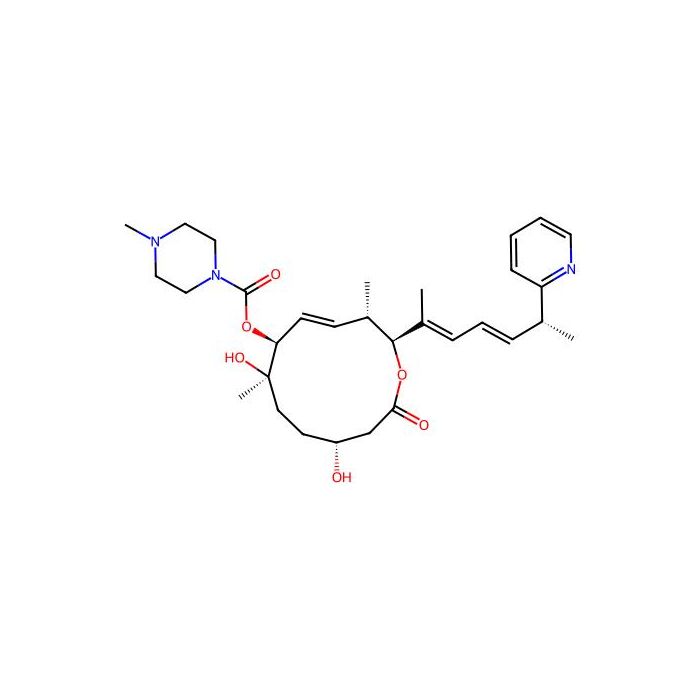
This compound belongs to the class of organic compounds known as piperazine carboxylic acids. These are heterocyclic compounds containing a piperazine ring substituted by one or more carboxylic acid groups.
External Descriptors
Not available
1. Djoumbou Feunang Y, Eisner R, Knox C, Chepelev L, Hastings J, Owen G, Fahy E, Steinbeck C, Subramanian S, Bolton E, Greiner R, and Wishart DS. ClassyFire: Automated Chemical Classification With A Comprehensive, Computable Taxonomy. Journal of Cheminformatics, 2016, 8:61.
Certificati (CoA, COO, BSE/TSE e tabella di analisi)
C of A & Other Certificates(BSE/TSE, COO):
Analytical Chart:
Calcolatori di soluzioni
Molarity Calculator
Determine the necessary mass, volume, or concentration for preparing a solution.
Dilution Calculator
Determine the dilution needed to prepare a stock solution.
Reconstitution Calculator
Recensioni
Recensioni dei clienti
Application Protocols
No vendor-validated protocols or tested applications are provided for this item.
Item-specific recommendations: Not specified for this item; refer to CoA/Spec Sheet.
General guidance for use as a research probe (non-binding suggestions):
Stock preparation: Dissolve in DMSO to 10–20 mM, aliquot, and store tightly capped. Thaw once; avoid repeated freeze–thaw cycles.
Cellular assays: Titrate across a broad range (e.g., 0.01–10 μM final) with matched vehicle controls; monitor cell health (e.g., resazurin/ATP readout) alongside mechanistic endpoints.
Transcript-level readouts: Use RT-PCR panels or RNA-seq to detect splicing alterations; include time-course points (e.g., 2, 6, 24 h) to capture dynamics.
Data integrity: Randomize plate layouts, include inter-plate standards, and apply appropriate statistical corrections for multiple testing in omics assays.
Documentation:
Record lot number, solvent batch, stock concentration (adjusted for purity/salt form if applicable), and preparation date in ELN/LIMS for traceability.
Biological Roles
Context from literature (not item-specific performance claims):
Functional theme:
H3B-8800 is reported as a small-molecule modulator of the spliceosome SF3B complex, influencing pre-mRNA splicing decisions. Such molecules can bias splice site selection, alter exon inclusion/skipping, and thereby change transcript isoform distributions in cellular systems.
Mechanistic considerations (general):
Modulation of SF3B components can affect branch-point recognition and the assembly/stability of spliceosomal subcomplexes. Transcription–splicing coupling and RNA-binding protein networks (e.g., SR proteins, hnRNPs) may show downstream shifts measurable by RNA-seq.
Chemical probes of splicing often exhibit time- and dose-dependent effects, with early transcriptional responses detectable within hours.
Experimental readouts commonly used:
RT-PCR or qPCR assays targeting known alternative splicing events.
RNA-seq to profile global splicing changes (e.g., intron retention, exon skipping, alternative 3'/5' sites).
Reporter minigenes to quantify splicing modulation in live cells.
Selectivity/off-target context:
While designed for SF3B engagement, broader impacts can arise from stress responses, altered transcriptional elongation, or secondary targets. Orthogonal validation (chemogenetic rescue, CRISPR knockdown, CETSA/thermal profiling) is recommended.
Use constraints:
For research use only. No clinical, diagnostic, or in vivo therapeutic use is implied. Confirm cell line compatibility, vehicle effects, and cytotoxicity windows prior to mechanistic interpretation.
Buffer Applications
This product is a bioactive small molecule rather than a buffering reagent; it does not serve as a pH buffer component.
Practical guidance (general):
Prepare working solutions by diluting concentrated DMSO stocks into biological buffers (e.g., PBS, HBSS, cell culture media) while maintaining consistent vehicle percentages across treatments.
When precipitation risk is observed, introduce the compound last into well-mixed buffer/medium, and consider modest amounts of co-solvent (e.g., 0.5–1% DMSO) or surfactant-free carrier proteins if biologically acceptable.
Verify solution stability over the experimental timeframe and avoid repeated freeze–thaw cycles of diluted solutions.
Buffer recipes: Not applicable to this compound type.
Green Alternatives
This product is a discrete bioactive small molecule used as a research probe; “green alternative” considerations primarily concern solvent selection and handling rather than substituting the compound itself.
Compound substitution:
Not applicable. Bioactive probes with specific target engagement are not interchangeable on green chemistry grounds without altering biological outcomes.
Greener handling strategies (general):
Prefer water-miscible, lower-toxicity solvents (e.g., aqueous buffers with minimal DMSO at ≤1% v/v) for dilutions where compatible with solubility and assay performance.
For chromatography and work-up, use ACN–water or MeOH–water gradients; recover and recycle organic solvents where facility infrastructure allows.
Minimize waste through microplate-based assays and low-volume dispensing; adopt sealed microvials to reduce evaporative losses.
Comparison of common stock solvents (general):
DMSO: High solvency; relatively low volatility; widely accepted in bioassays; disposal burden moderate.
DMF/NMP: Effective but less desirable due to toxicity concerns; avoid when DMSO suffices.
MeOH/EtOH: Useful co-solvents; flammable; easier to remove than DMSO in work-ups.
Environmental controls:
Implement solvent capture for HPLC waste; segregate halogenated from non-halogenated streams.
Use amber containers to extend solution stability and reduce repeat preparations, thereby lowering solvent consumption.
Pharmaceutical Uses
No excipient or pharmacopeial formulation role is specified for this item. The compound is sold strictly for research use.
Item-specific regulatory status:
No pharmacopeial monograph or GMP designation is provided. Grade/Purity: Not specified for this item; refer to CoA/Spec Sheet.
Laboratory formulation context (research only):
For in vitro studies, researchers commonly use DMSO stock solutions diluted into media or assay buffers.
For preclinical exploratory studies (non-clinical, non-GLP), dosing vehicles may include aqueous buffers with co-solvents (e.g., PEG 400, Tween 80, ethanol) as permitted by institutional protocols; establish stability and compatibility empirically.
Compliance note:
Not for human or veterinary use. Not for diagnostic or clinical applications. Any scale-up or formulation development should be conducted under appropriate research governance with risk assessments and SDS consultation.
Physical Properties
Item-specific physical constants are not provided in the listing and should be confirmed on the CoA/SDS prior to experimental planning.
Item-specific values:
Appearance: Not specified for this item; refer to CoA/Spec Sheet.
Molecular weight: Not specified for this item; refer to CoA/Spec Sheet.
Melting point (MP): Not specified for this item; refer to CoA/Spec Sheet.
Boiling point (BP): Not applicable/rarely reported for complex bioactive solids; Not specified for this item; refer to CoA/Spec Sheet.
Density: Not specified for this item; refer to CoA/Spec Sheet.
Solubility: Not specified for this item; refer to CoA/Spec Sheet.
logP/logD, pKa, refractive index: Not specified for this item; refer to CoA/Spec Sheet.
Literature/computational context (general, not item-specific specifications):
Bioactive screening compounds of similar class are often solid at ambient temperature, sparingly soluble in water, and soluble in polar aprotic organics (e.g., DMSO, DMF, NMP) and certain alcohols. Actual solubility and polymorph behavior must be verified experimentally.
Many heteroaromatic modulators exhibit multiple basic/neutral heteroatoms that influence pKa and logD; experimental values (e.g., from potentiometric titration or HPLC retention) are preferred over predictions for method development.
Practical guidance:
For assay work, researchers commonly prepare concentrated DMSO stock solutions (e.g., 10–20 mM) and dilute into buffered media, monitoring for precipitation. Employ serial dilution protocols and visual turbidity checks.
When establishing analytical methods (HPLC/UPLC), perform a solubility screen (water, buffers at pH 2–9, MeOH, ACN, DMSO) and determine stability under autosampler conditions (light/temperature) to prevent on-instrument degradation.
Quality and Grades
The listing does not specify a grade or purity. For procurement and QC planning, use the CoA for lot-specific data.
Item-specific quality information:
Grade/Purity: Not specified for this item; refer to CoA/Spec Sheet.
Stabilizers or salt form: Not specified for this item; refer to CoA/Spec Sheet.
Appearance and identification tests: Not specified for this item; refer to CoA/Spec Sheet.
How to interpret typical grades (general guidance):
“Screening library” or “bioactive” grade typically emphasizes identity confirmation (NMR/HRMS), purity by HPLC (often ≥95% area), and controlled residual solvents/metals. UV transparency is less critical than in chromatographic solvent grades.
If designated as “analytical standard,” expect higher documentation (purity by qNMR, certified content) and tighter uncertainty budgets.
Salt vs free base/acid: Verify exact form (e.g., HCl salt, TFA salt) as it impacts molecular weight, solubility, and dosing in assays.
Recommended QC checks upon receipt (practical tips):
Verify identity by LC–MS against the CAS/CID reference; check purity by HPLC/UPLC with orthogonal methods if possible.
Assess counter-ion content (if a salt), water content (Karl Fischer), and residual solvent profile (GC) when critical to downstream work.
Document lot-traceable potency calculations using the as-received purity and salt factor to avoid concentration errors in biological assays.
Reaction and Applications
This product is supplied as a finished small-molecule research compound rather than a synthetic reagent. It is not typically used as a stoichiometric reagent or solvent in organic synthesis.
Applicability to classical reactions:
Not commonly employed in Grignard, cross-coupling, oxidation/reduction, or condensation reactions as a reagent or catalyst.
Research applications (general/literature context):
H3B-8800 is discussed in the literature as a chemical probe targeting components of the spliceosome (SF3B complex) to modulate pre-mRNA splicing. Researchers use such probes to interrogate splicing biology, RNA processing pathways, and genotype–phenotype relationships in cellular models. Avoid clinical/diagnostic use.
Practical use in discovery assays:
Prepared as DMSO stocks for dose–response experiments, time-course studies, and combinatorial perturbation screens.
Often paired with transcriptomics (RNA-seq), RT-PCR splicing assays, or reporter systems to quantify splicing modulation.
Tips for reliable results:
Confirm compound identity/purity by LC–MS/HPLC before critical studies.
Use fresh dilutions, minimize freeze–thaw of stock solutions, and include vehicle controls (matching DMSO) and orthogonal readouts to deconvolute off-target effects.
Note: Always corroborate precise mechanism and on-target engagement with primary literature and internal controls; the supplier does not certify mechanism-of-action performance.
Reaction Conditions
Not typically applicable: H3B-8800 is not used as a reagent in named organic reactions; thus there are no standard “reaction conditions” to report for synthetic transformations.
For solution preparation (general laboratory conditions):
Stock solutions: Prepare at 10–20 mM in anhydrous DMSO under ambient lab conditions unless solubility dictates otherwise. Filter if needed (0.22 μm PTFE) to remove particulates.
Working dilutions: Add stock to assay buffer/media with vigorous mixing; target final DMSO typically ≤0.1–1% v/v depending on biological system tolerance.
Stability checks: Monitor for precipitation/turbidity over the assay window; evaluate light sensitivity by protecting samples with amber vials and using foil-wrapped plates where appropriate.
LC–MS: Reverse-phase C18, 0.1% formic acid in water (A) and ACN/MeOH (B); gradient 5–95% B over 5–15 min. Adjust as per retention.
Detection: UV 210–280 nm and MS (ESI±) as appropriate for heteroatom-containing scaffolds.
Note: These are general laboratory handling conditions for small-molecule probes and are not item-specific specifications. Verify with the item’s CoA/SDS and optimize for your particular assay or analytical platform.
Safety and Handling
Safety information specific to this item is not provided in the listing. Always consult the product’s SDS for authoritative guidance.
GHS classification (item-specific):
Signal word: Not specified for this item; refer to SDS.
Hazard statements (H-codes): Not specified for this item; refer to SDS.
Pictograms: Not specified for this item; refer to SDS.
General laboratory precautions (best practice for bioactive small molecules):
Use in a chemical fume hood and wear appropriate PPE: lab coat, safety glasses, and disposable nitrile gloves (double-glove for extended handling). Avoid inhalation, ingestion, and skin contact.
Prevent aerosol formation when weighing/diluting powdered solids. For hygroscopic or dusty materials, consider weighing boats with antistatic measures.
Avoid incompatible reagents until confirmed by SDS; as a conservative default, keep away from strong oxidizers, strong acids/bases, and reactive reducing agents.
Solution handling: Prepare DMSO or organic stocks using clean, dry glassware; cap tightly to minimize evaporation and water uptake.
First-aid overview (consult SDS for details):
Skin/eye contact: Rinse with water for at least 15 minutes; remove contaminated clothing; seek medical attention if irritation persists.
Inhalation: Move to fresh air; seek medical advice if symptoms develop.
Ingestion: Rinse mouth; do not induce vomiting; obtain medical attention.
Waste and decontamination:
Dispose according to institutional hazardous chemical waste procedures. Decontaminate benches with appropriate solvent/detergent; avoid discharge to drains.
Transport and storage risks:
Store tightly closed at room temperature (item-specific). Protect from light and moisture as a precaution pending SDS confirmation.
Solvent Selection
Because structure-specific solubility data are not provided, select solvents using general best practices for small-molecule screening compounds.
Item-specific solubility: Not specified for this item; refer to CoA/Spec Sheet.
General solvent strategy (for assay and stock preparation):
Primary stock solvent: DMSO is the default for many bioactive molecules due to broad solvency and assay compatibility at ≤0.1–1% v/v in final wells.
Secondary solvents for method development: MeOH, ACN, and DMF can assist in co-solvent systems or for LC method compatibility.
Aqueous media: Evaluate buffer tolerance across pH 2–9; consider minimal DMSO cosolvent (0.5–2%) to maintain solubility during dilutions.
Practical tips:
Perform a small-scale solubility screen: weigh ~1 mg and test incremental solvent additions (DMSO, MeOH, ACN, buffer) with vortex/sonication; record visual clarity and time-to-precipitation upon dilution.
Filter or centrifuge stocks to remove particulates before sensitive assays or HPLC injections.
Avoid strongly basic or strongly acidic aqueous media unless stability is confirmed (hydrolysis risk for many heteroatom-rich scaffolds).
Comparison (general):
DMSO vs DMF: DMSO is more assay-compatible; DMF can aid in dissolution but is less favored biologically.
MeOH vs ACN: MeOH offers protic hydrogen bonding and is easier to evaporate; ACN provides stronger elution in RP-HPLC and lower viscosity.
Storage and Reconstitution
Item-specific storage condition provided: Room temperature. Additional handling and solution guidance below is general best practice for small-molecule probes and should be confirmed against the item’s CoA/SDS.
Solid storage (item-specific + general):
Store at room temperature in the original, tightly closed container. Protect from moisture and direct light. If long-term storage is anticipated, consider a desiccator and ambient-to-cool dry conditions per institutional SOPs.
Reconstitution (general guidance):
Prepare concentrated stock solutions in anhydrous DMSO (commonly 10–20 mM). Vortex and, if needed, sonicate briefly to aid dissolution.
Filter through a 0.22 μm PTFE membrane if particulate matter is present. Record exact concentration, solvent, and date.
Solution handling and stability (general):
Aliquot stocks into low-bind, amber microvials to minimize adsorption, oxidation, and photolysis. Limit headspace to reduce solvent evaporation and oxygen exposure.
Working solutions in aqueous buffers should be prepared fresh before use; avoid prolonged storage unless stability has been established experimentally.
Freeze–thaw: Minimize cycles by aliquoting; if freezing DMSO stocks (e.g., –20 °C), allow to equilibrate to room temperature before opening to avoid moisture ingress.
Shipping/transport:
Shipped-in conditions are not specified; handle upon receipt as you would for room-temperature-stable research chemicals and place into controlled room-temperature chemical storage.
Documentation:
Note SKU, lot, storage conditions, and any observed changes (color, precipitation) in your ELN for quality assurance.
Structure and Identity
Brief overview: H3B-8800 is a cataloged small-molecule research compound supplied for discovery screening and mechanistic studies. The product listing provides limited structural metadata; key identifiers from public registries are included below where available.
Provided Product Data (item-specific):
Product name: H3B-8800 (SKU: H669620)
CAS: 1825302-42-8 (item-specific)
PubChem CID: 92135969 (item-specific)
InChIKey: 442613 (truncated as provided in the listing)
SMILES: Not specified for this item; refer to CoA/Spec Sheet.
Molecular formula: Not specified for this item; refer to CoA/Spec Sheet.
Molecular weight: Not specified for this item; refer to CoA/Spec Sheet.
Structural features (general/literature context, not item-specific specs):
H3B-8800 is reported in the literature as a small-molecule modulator of the spliceosome SF3B complex; structures disclosed in publications feature multiple heteroatoms and polycyclic/heteroaromatic motifs typical of kinase/protein–RNA interface modulators. Verify exact structure against primary literature or the item’s CoA.
2D structure description (general guidance):
Without an item-specific SMILES/InChI, a definitive 2D description cannot be provided here. Public databases (via the provided CAS/CID) typically depict a multi-ring scaffold with heteroatom substituents consistent with RNA splicing factor binders. Users should confirm atom connectivity, stereochemistry (if any), and protonation state directly from the supplier CoA or trusted databases before computational modeling or analytical method development.
Registry cross-reference tips:
Use the CAS (1825302-42-8) or CID (92135969) to retrieve a canonical SMILES/InChI from PubChem or ChemSpider for in silico work; reconcile with experimental CoA data prior to use.
Synthetic Utility
H3B-8800 is supplied as a finished bioactive small molecule and is not typically used as a synthetic intermediate or reagent.
Reagent role: Not applicable. The compound is not designed for functional group transfer, catalysis, or stoichiometric transformation in standard organic synthesis workflows.
When synthetic considerations do arise (general):
Users developing analogs or reference standards may consult the primary literature for retrosynthetic analyses, protecting-group strategies, and late-stage diversification appropriate for spliceosome modulators.
For analytical derivatization (e.g., to generate internal standards), ensure that modifications do not alter assay-relevant properties; isotope labeling (13C/2H/15N) is preferred for quantitative MS.
Handling for analytical method development:
Establish robust LC–MS methods (RP columns, acidic mobile phases) and orthogonal HILIC or ion-pairing methods if high polarity is encountered.
Reference lots should be qualified via NMR, HRMS, and HPLC purity to support use as an internal quality control standard in screening campaigns.
In summary, the compound’s value is as a biological probe; synthetic utility is limited unless you are pursuing SAR or internal standard preparation.
Target Specificity
Target specificity must be supported by item-specific validation data, which are not provided in the listing.
Item-specific data: Not specified for this item; refer to CoA/Spec Sheet or primary literature.
General literature context (non-validated for this lot):
H3B-8800 has been reported as a modulator of the spliceosome SF3B complex. However, the supplier does not warrant target engagement, selectivity, or activity for any biological application.
User recommendations:
Confirm on-target engagement using orthogonal assays (e.g., CETSA/TPP, chemoproteomics pull-down, or transcriptional signature correlation) and include appropriate positive/negative controls.
Establish concentration–response relationships and evaluate off-target liabilities using counterscreens to ensure phenotype specificity.
Domande frequenti
How should this product be stored?
Store at room temperature.
What are the CAS number, molecular formula and molecular weight?
The CAS Number is 1825302-42-8, the molecular formula is C31H45N3O6, and the molecular weight is 555.7 g/mol. InChIKey YOIQWBAHJZGRFW-WVRLKXNASA-N.
What documentation is provided?
Available product documentation, including Certificates of Analysis (COA), Safety Data Sheets (SDS), and specification sheets, is shown in the product document area. Document availability and access follow the current site policy.
Utilizziamo i cookie per garantire il corretto funzionamento del sito web e, ove consentito, per migliorare la tua esperienza. Puoi gestire le tue preferenze in qualsiasi momento nelle Impostazioni. Per saperne di più, consulta la nostra Cookie Policy.
Desidera che le inviamo un messaggio quando avremo sconti disponibili?
Ricordamelo più tardi
Grazie! Controlli la sua casella di posta per confermare.
Products are supplied to verified businesses, institutions, and qualified professionals for research and development use only. Not for use in humans, animals, diagnosis, or therapy.