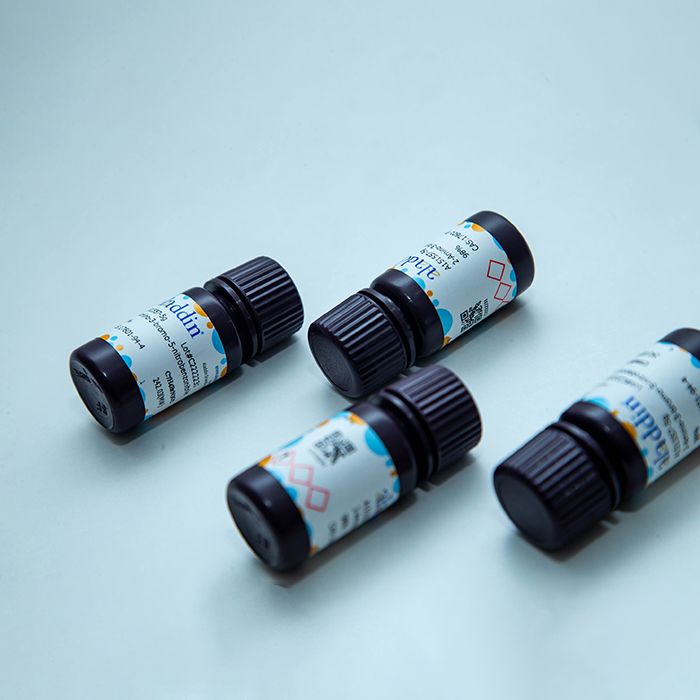
HA Peptide (TFA) is a nine amino acids peptide derived from the human influenza hemagglutinin (HA). HA Peptide (TFA) is extensively used to isolate, purify, detect, and track the protein of interest in cell biology and biochemistry .
Appearance:Solid
In Vitro:HA Peptide is a highly immunoreactive tag generally used for the separation of tagged proteins from cell culture supernatants and cell lysate under neutral pH conditions and thus are handy tools for coimmunoprecipitation but are also easily detected via w
Biological Activity:HA Peptide (TFA) is a nine amino acids peptide derived from the human influenza hemagglutinin (HA). HA Peptide (TFA) is extensively used to isolate, purify, detect, and track the protein of interest in cell biology and biochemistry.
Specifiche
Product Name
HA Peptide TFA, CAS No.H659313
Specifiche e purezza
≥99%
CAS
H659313
Tipo di molecola
Peptidi
Stoccaggio e spedizione
Condizioni di conservazione di stoccaggio
Desiccated,Store at -80°C
Spedito in
Dry ice packs + Cold packs
Dati avanzati
Certificati (CoA, COO, BSE/TSE e tabella di analisi)
C of A & Other Certificates(BSE/TSE, COO):
Analytical Chart:
Calcolatori di soluzioni
Molarity Calculator
Determine the necessary mass, volume, or concentration for preparing a solution.
Dilution Calculator
Determine the dilution needed to prepare a stock solution.
Reconstitution Calculator
Recensioni
Recensioni dei clienti
Application Protocols
No item-specific, validated application protocols, concentrations, or dilutions are provided in the Product Data.
Tested applications: Not specified for this item; refer to CoA/Spec Sheet.
Recommended working ranges: Not specified for this item; refer to CoA/Spec Sheet.
General note: For blocking/competition with anti-HA antibodies, researchers often titrate the peptide over a broad range (e.g., low µM to mM) to determine the minimum amount required for complete epitope blocking in their particular assay. These values are highly sequence-, antibody clone-, and assay-dependent and should be empirically optimized.
Biological Roles
Item-specific biological data are not provided. The notes below describe general roles of HA epitope peptides in research contexts.
Origin (literature): The HA tag sequence is derived from the influenza hemagglutinin protein. The minimal epitope recognized by widely used monoclonal antibodies (e.g., 12CA5, 3F10) is commonly reported as YPYDVPDYA.
Function in research systems: The free HA peptide is biologically inert in most in vitro assay contexts and serves as a defined epitope standard. It can competitively inhibit binding of anti-HA antibodies to HA-tagged fusion proteins, enabling specificity controls.
Structural/biochemical features: Short, linear epitope with defined aromatic and acidic residues that form the antibody-recognized motif. Lacks catalytic or receptor agonist/antagonist functions at typical concentrations used in immunoassays (general literature).
Cell culture considerations: Typically used at micromolar–millimolar levels for blocking or elution; cytotoxicity is uncommon but should be empirically evaluated for each cell line and assay conditions.
Important: No clinical or therapeutic claims are made. For sequence-specific biological properties (binding constants to particular anti-HA clones, cellular uptake, etc.), consult literature for the exact sequence and confirm that the item’s sequence (not provided here) matches those reports.
Buffer Applications
This section provides general, sequence-agnostic guidance for preparing peptide solutions for biochemical assays; item-specific buffer recommendations are not provided.
Stock preparation (typical approach):
Start with sterile water or assay buffer (e.g., PBS, pH 7.2–7.4). If insoluble, pre-wet with minimal DMSO or dissolve in dilute acid (e.g., 1–5 mM HCl) before dilution.
For blocking/competition studies, stock concentrations from 1–10 mg/mL are common; exact values depend on assay needs.
pH considerations:
Slight acidity due to TFA counterions may lower pH upon dissolution; adjust gently with dilute NaOH or buffer capacity.
Avoid extreme pH (>9 or <3) unless validated, as peptide backbone and sensitive side chains may degrade.
Additives:
50–100 mM arginine or 5–10% glycerol can mitigate aggregation without strongly impacting many assays (verify compatibility).
Sterility:
Filter through a 0.22 µm PVDF/nylon filter if sterile solutions are required and the peptide tolerates filtration.
Note: Buffer recipes and pH ranges above are general guidance for short research peptides. For this SKU, no specific buffer system is mandated; verify optimal conditions empirically.
Green Alternatives
Environmental considerations for peptide handling largely center on solvent choice and counterions.
Greener choices (general guidance):
Prefer aqueous buffers over high percentages of organic solvents. When organics are required, minimize DMSO/ACN usage and choose ethanol or isopropanol where compatible.
Replace TFA-containing mobile phases (in LC) with formic acid (FA) or acetic acid (AA) when sensitivity and peak shape allow; FA is often MS-friendly and less persistent than TFA.
Counterion selection: Where feasible, acetate, hydrochloride, or bicarbonate salts may be favored over TFA from a persistence perspective. For this SKU, the TFA salt form is specified by name; alternate counterions are not specified.
Comparison (general):
TFA vs FA (as mobile phase modifiers):
TFA: strong ion-pairing, sharp peaks, but MS signal suppression and environmental persistence.
FA: better MS sensitivity, more benign profile, sometimes broader peaks for basic peptides.
Operational green practices:
Prepare concentrated stocks to reduce solvent waste; aliquot to avoid repeated freeze–thaw.
Employ closed containers and precise dispensing to minimize emissions and spills.
Dispose of TFA-containing waste per institutional and regulatory guidance; segregate halogenated solvent streams.
Pharmaceutical Uses
No pharmacopeial status or formulation role is specified for this item. The content below reflects general, non-clinical laboratory context only.
Research-only note: This product is designated for research use only and is not intended for human or veterinary use.
Possible roles in pharmaceutical R&D workflows (general):
Analytical reference material or system suitability standard for LC/MS peptide methods.
Process development tool for evaluating peptide synthesis, purification, and counterion exchange conditions.
Affinity chromatography process scouting with anti-HA resins (e.g., defining elution conditions), strictly in non-clinical research.
Regulatory considerations:
No claims of GMP manufacturing, compendial compliance (USP/EP/JP), or suitability for clinical applications are made here. Any clinical/formulation use would require dedicated specifications, validations, and regulatory filings not covered by this listing.
For this item (SKU H659313):
Grade/Purity and any regulatory designations are Not specified for this item; refer to CoA/Spec Sheet.
Physical Properties
Item-specific numeric properties are not provided in the Product Data and should be confirmed on the CoA/Spec Sheet.
Appearance: Not specified for this item; refer to CoA/Spec Sheet.
Molecular Weight: Not specified for this item; refer to CoA/Spec Sheet.
Melting point/Boiling point: Not typically meaningful for peptides; decomposition may occur before melting (general literature).
Density/Refractive index: Not applicable for a solid peptide; Not specified for this item.
Solubility and solution behavior (general, literature-based guidance for short peptides and TFA salts):
Water/PBS: Many HA-tag peptides are readily soluble at 1–10 mg/mL; actual solubility depends on sequence and terminal modifications.
Acidic aqueous media (e.g., 0.05–0.1% TFA or dilute HCl): Often improves initial dissolution for basic or aggregation-prone sequences.
Basic buffers (e.g., 10–50 mM Tris, pH 8–8.5) or addition of salts (NaCl) and co-solutes (arginine, up to 50–100 mM) can reduce aggregation for hydrophobic sequences.
Organic co-solvents: Small volumes of DMSO, acetonitrile, or ethanol (typically ≤10–20% v/v) can aid solubilization; ensure compatibility with downstream assays.
Partitioning and ionization (general):
Peptides are polyionic; apparent pI/pKa profile depends on sequence. TFA counterions acidify aqueous solutions slightly. No item-specific pI/logP data are available for this SKU.
Quality and Grades
Item-specific grade, purity, and analytical specifications are not provided in the Product Data.
Grade/Purity: Not specified for this item; refer to CoA/Spec Sheet.
Typical peptide QC (general literature):
Analytical RP-HPLC for purity profile with UV at 214/220 nm and 254/280 nm as applicable.
Mass spectrometry (ESI/APCI/MALDI) to confirm molecular mass/adducts.
Counterion analysis (e.g., TFA content) by ion chromatography or 19F NMR.
Residual solvents/water content by GC/HS-GC and Karl Fischer, respectively.
Peptide content determination and salt correction for accurate concentration calculations.
Interpretation of common grades (general):
“Crude,” “desalted,” or “>70%”: screening-grade peptides for discovery assays.
“>85–95%”: commonly used for biochemical assays and immunological applications.
“>98%”: high-purity peptides for sensitive biophysical/biochemical studies.
Stabilizers and additives:
If present, volatile buffers (acetic acid, ammonium acetate) or lyoprotectants (trehalose, mannitol) are sometimes used. Not specified for this item; refer to CoA/Spec Sheet.
Recommendation: For quantitative studies (e.g., calibration curves, binding kinetics), confirm sequence, purity, net peptide content, and counterion percentage on the certificate before use.
Reaction and Applications
This product is intended for research use. While not a classical reagent for organic synthesis, HA peptides are widely used as epitope-tag standards and blocking/elution peptides in molecular biology and biochemistry.
Common research applications (general, literature):
Antibody validation and specificity controls: Preincubate anti-HA antibodies with excess HA peptide to confirm epitope-specific binding in WB, IF, IHC, or IP.
Competitive ELISA/assay development: Use free HA peptide as a competitor to calibrate assay sensitivity to HA-tagged targets.
Affinity chromatography: Elution of HA-tagged proteins from anti-HA resins using millimolar concentrations of HA peptide.
Method development and calibration: Benchmarking MS or HPLC methods for peptide detection/quantitation (with sequence-confirmed standards).
Chemical considerations:
Conjugation-ready: If the peptide has a free N-terminus/C-terminus or specific side chains (e.g., Lys, Cys), it can be derivatized for labeling or immobilization (e.g., NHS ester/EDC chemistry, maleimide-thiol, click chemistry), depending on the actual sequence and modifications (not specified for this item).
Counterion effects: TFA can suppress MS signals (ESI) and may slightly acidify samples; buffer-exchange or lyophilization from volatile acetate/bicarbonate may be considered when necessary.
Note: Consult the item’s CoA for exact sequence and purity prior to quantitative or conjugation workflows.
Reaction Conditions
There are no item-specific reaction conditions provided. The following general conditions apply to common manipulations of short peptides used as research tools:
Dissolution:
Pre-wet with minimal DMSO or dissolve in dilute acid (1–5 mM HCl or 0.05–0.1% TFA), then dilute into buffer (PBS, Tris, HEPES). Gentle vortexing and brief sonication may help.
Conjugation (if applicable to sequence):
NHS–amine coupling: pH 7.5–8.5 in phosphate/borate buffer; room temperature; 30–120 min; molar ratios 2–10× reagent over peptide amines; quench with Tris or ethanolamine.
Maleimide–thiol coupling: pH 6.5–7.2 in PBS/HEPES; 15–60 min at RT; protect from oxidation (add TCEP or degas buffer).
EDC/sulfo-NHS carboxyl activation: pH 5–6 for activation, pH 7–8 for coupling; perform freshly to minimize hydrolysis.
Affinity elution from anti-HA resins (general literature):
HA peptide concentrations in the range of 0.1–1 mg/mL (or 0.5–5 mM depending on sequence/MW) in TBS/PBS, often at 4–25°C for 10–30 min, with gentle mixing. Optimize empirically.
Analytical considerations:
For LC–MS, consider exchanging TFA for FA/AA in mobile phases to reduce ion suppression, or perform desalting prior to MS.
All conditions above are general guidance and should be optimized for the specific peptide sequence and downstream application.
Safety and Handling
Authoritative safety information is provided in the product SDS. The following are general laboratory precautions for peptide TFA salts.
GHS classification, pictograms, H-statements: Not specified for this item; refer to SDS.
Expected hazards (general): Short research peptides are typically of low acute toxicity, but avoid inhalation of dusts and contact with eyes/skin. The TFA counterion is associated with acidity; solutions can be mildly acidic.
Handling practices:
Use appropriate PPE: laboratory coat, safety glasses, and disposable nitrile gloves. Handle powders in a clean, low-draft area or fume hood to minimize aerosolization.
Hygroscopicity: Peptide TFA salts can be moisture-sensitive; keep vials tightly closed and desiccated.
Aseptic technique: If preparing sterile solutions (cell-based assays), use sterile diluents and 0.22 µm filtration as compatible with peptide stability.
First-aid overview (general):
Inhalation: Move to fresh air; seek medical attention if symptoms persist.
Skin/eye contact: Rinse with water for several minutes; remove contaminated clothing; seek medical advice if irritation persists.
Ingestion: Rinse mouth; do not induce vomiting; seek medical attention.
Incompatibilities and stability:
Avoid strong oxidizers and strong bases/acids that may degrade peptide bonds or side chains.
Protect from repeated freeze–thaw cycles and prolonged exposure to moisture and light.
Always defer to the SDS for definitive hazard, exposure limits, and spill/cleanup procedures.
Solvent Selection
Strategy focuses on ensuring complete dissolution while preserving biological activity and assay compatibility. Item-specific solubility is not provided; use the guidance below as general practice for short peptides.
Primary choices:
Water or PBS: first-line for hydrophilic sequences; adjust pH to 6.5–7.5 as needed.
Dilute acid (e.g., 0.05–0.1% TFA or 1–5 mM HCl): pre-wet and dissolve peptides that initially resist hydration; then dilute/neutralize.
Basic buffers (e.g., 10–50 mM Tris, pH 8–8.5): may improve solubility of acidic peptides by deprotonating side chains.
Co-solvents (as minimal % v/v): DMSO or acetonitrile to disrupt hydrophobic aggregation; ensure downstream tolerance.
Additives: 50–100 mM L-arginine or low ionic strength salts can reduce aggregation (literature).
Small comparison (general):
Water/PBS: maximal biocompatibility; may be insufficient for hydrophobic sequences.
Dilute acid: enhances initial dissolution; must account for acidic pH and potential assay interference.
DMSO: strong solvating power; keep final DMSO ≤0.5–2% for most cell assays.
Practical tips:
Warm gently to room temperature; avoid high heat. Vortex and briefly sonicate if compatible.
Prepare a small, concentrated stock (e.g., 1–10 mg/mL), then dilute into assay buffer.
Filter sterilize (0.22 µm) if sterility is required and peptide is filter-stable.
Storage and Reconstitution
Follow the item-specific storage instructions provided below. Where additional steps are suggested, they are general best practices for research peptides.
Storage conditions (from Product Data):
Desiccated, Store at −80°C.
Shipped on dry ice packs + cold packs.
Stability notes (general):
Protect from moisture and light. Minimize freeze–thaw cycles by aliquoting.
Peptide integrity is enhanced at −80°C in dry, sealed containers (e.g., under inert gas) and with desiccant.
General reconstitution guidance (sequence-agnostic):
Equilibrate the sealed vial to room temperature in a desiccated environment before opening to prevent condensation.
Briefly centrifuge to collect material from the cap and walls.
Start with sterile water, PBS, or compatible buffer. If insoluble, pre-wet with a small volume of DMSO or dissolve in dilute acid (1–5 mM HCl or 0.05–0.1% TFA) before diluting to the desired buffer and pH.
Optional: Filter-sterilize (0.22 µm) if required and compatible.
Aliquot into single-use portions; store aliquots at −80°C. Avoid repeated freeze–thaw.
Concentration determination:
Use absorbance at 205–214 nm or amino acid analysis/weight-by-content corrections (accounting for counterions and residual water) as appropriate. Item-specific peptide content and counterion percentage are Not specified for this item; refer to CoA/Spec Sheet.
Structure and Identity
Brief overview: This product is described as an HA Peptide supplied as the trifluoroacetate (TFA) salt. Item-specific structural identifiers are not provided in the Product Data.
SKU: H659313
Product Name: HA Peptide TFA
CAS: H659313 (catalog placeholder; not a registered CAS number)
Molecular Formula: Not specified for this item; refer to CoA/Spec Sheet.
Molecular Weight: Not specified for this item; refer to CoA/Spec Sheet.
SMILES: Not specified for this item; refer to CoA/Spec Sheet.
InChIKey: Not specified for this item; refer to CoA/Spec Sheet.
General chemistry (literature):
“HA peptide” commonly refers to the influenza hemagglutinin epitope tag peptide; a frequently used sequence is YPYDVPDYA (9-mer). Some variants include additional residues (e.g., YPYDVPDYAG or acetylated/amidated termini). The exact sequence for this item is not specified.
As a peptide TFA salt, the peptide’s basic sites (e.g., N-terminus/lysine, if present) are typically counterbalanced by trifluoroacetate anions.
2D structural description (generic): a short, linear, L-amino-acid oligopeptide composed of aromatic (Tyr), acidic (Asp), and possibly polar residues, lacking disulfide bonds and stereochemically defined at each alpha-carbon as L-configuration (literature, if using canonical L-residues).
Important note: Sequence, modifications (e.g., acetylation/amidation), and counterion content for this specific SKU are not provided here. Consult the CoA/Spec Sheet for definitive identity data (sequence, exact mass, purity, and counter-ion percentage).
Synthetic Utility
As an epitope peptide, this material is not a general-purpose reagent for small-molecule synthesis, but it can serve several roles in biochemical and bioconjugation workflows (general guidance; item-specific sequence not provided):
Affinity tools: Free HA peptide competes with HA-tagged proteins for anti-HA binding sites, enabling elution from affinity matrices or functional blocking in binding assays.
Bioconjugation substrate: If the peptide possesses reactive handles (e.g., free N-terminus/C-terminus, Lys ε-amine, Cys thiol), standard coupling chemistries can be applied:
Amide coupling via NHS esters (to Lys/N-terminus).
Maleimide–thiol coupling (to Cys).
Copper-free click (DBCO–azide) if appropriately functionalized.
Analytical standard: Use as a calibrant for LC/ESI-MS method development, retention-time markers, or ionization benchmarking (mind TFA suppression in ESI; consider exchanging counterions).
Caveats:
Exact reactivity depends on the actual sequence and terminal modifications (acetylation/amidation, presence/absence of Lys/Cys), which are not specified for this SKU.
Peptide integrity can be compromised by strong acids/bases, oxidants, or prolonged elevated temperature; plan conjugations under mild conditions (pH 6.5–8.5; ambient temperatures) and brief reaction times.
Target Specificity
No target or antibody specificity data are provided for this item.
Target/Antigen: Not specified for this item; refer to CoA/Spec Sheet.
Epitope/Sequence: Not specified for this item; refer to CoA/Spec Sheet.
Species reactivity, clone, isotype: Not applicable to this peptide product; any antibody-related details would pertain to separate anti-HA antibodies and are not included here.
Note: In general literature, “HA peptide” refers to the epitope recognized by anti-HA antibodies; however, sequence-level confirmation is required for this SKU.
Domande frequenti
What is the purity of this product?
This product is supplied at ≥99% purity (chemical assay). Lot-specific values are stated on the Certificate of Analysis.
What are the CAS number, molecular formula and molecular weight?
The CAS Number is H659313.
How should this product be stored?
Store at ?80 °C, desiccated. Keep the container tightly closed with desiccant — the material is moisture-sensitive.
How is this product shipped?
This product ships frozen with dry ice and cold packs. Unpack on arrival and transfer it to the storage condition stated above; handle dry ice with insulated gloves in a ventilated area.
What documentation is provided?
Available product documentation, including Certificates of Analysis (COA), Safety Data Sheets (SDS), and specification sheets, is shown in the product document area. Document availability and access follow the current site policy.
Utilizziamo i cookie per garantire il corretto funzionamento del sito web e, ove consentito, per migliorare la tua esperienza. Puoi gestire le tue preferenze in qualsiasi momento nelle Impostazioni. Per saperne di più, consulta la nostra Cookie Policy.
Desidera che le inviamo un messaggio quando avremo sconti disponibili?
Ricordamelo più tardi
Grazie! Controlli la sua casella di posta per confermare.
Products are supplied to verified businesses, institutions, and qualified professionals for research and development use only. Not for use in humans, animals, diagnosis, or therapy.