GRADE & PURITYMoligand™?Moligand™ — Aladdin's line of ligands and bioactive small molecules. Use for receptor, pathway, and binding studies needing defined small-molecule tools.10 mM in DMSO
Moligand™, 10 mM in DMSO Moligand™ for sensitive chromatographic and analytical workflows requiring minimal baseline interference.
🌡
Storage & shipping
Store at -80°C Ships Dry ice packs + Cold packs Check lot-specific COA for exact specifications.
📋
Quality documents
SDS, COA, datasheet, and spec sheet available for download. Lot-specific COA accessible via lot number lookup.
📚
Literature proof
Cited in 0 peer-reviewed publications across chromatography, organic synthesis, and cross-coupling reactions.
Panoramica
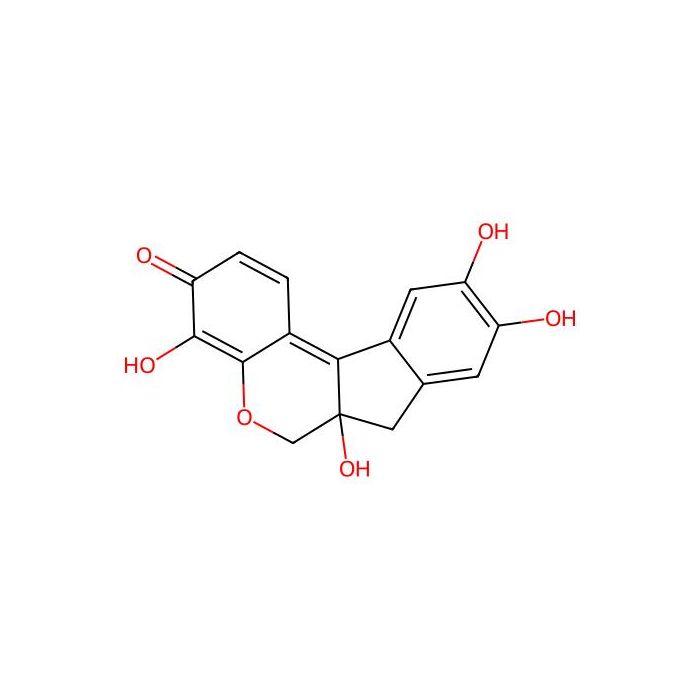
Hematein is a oxidation product of hematoxylin acted as a dye. Hematein is an allosteric casein kinase II inhibitor with an IC 50 of 0.74 μM. Hematein inhibits Akt/PKB Ser129 phosphorylation, the Wnt/TCF pathway and increases apoptosis in lung cancer cells.
Specifications
Specifiche e purezza
Moligand™, 10 mM in DMSO
Condizioni di conservazione di stoccaggio
Store at -80°C
Spedito in
Dry ice packs + Cold packs
Questo prodotto richiede spedizione a catena fredda. I servizi di terra e altri servizi economici non sono disponibili.
Determine the necessary mass, volume, or concentration for preparing a solution.
Dilution Calculator
Determine the dilution needed to prepare a stock solution.
Reconstitution Calculator
Recensioni
Recensioni dei clienti
Application Protocols
No item-specific, validated protocols are provided for this SKU. The following are literature-style examples intended as starting points for research optimization only.
Example A: Concentrated stock for screening
Dissolve hematein at 10–50 mM in DMSO (amber vial). Filter 0.2 µm. Store aliquots at ≤−20°C. For assays, dilute into buffer to ≤1–2% DMSO final.
Example B: Aluminum–hematein complex (acidic, alum-based)
Prepare 0.5–1.0% (w/v) hematein in 95% ethanol. Separately prepare alum solution (e.g., aluminum potassium sulfate dodecahydrate) in water, acidify lightly (acetate or trace HCl) to pH ~2–3. Combine with vigorous stirring; allow to mature 12–48 h until color stabilizes. Optimize dye:alum ratio and pH for your substrate.
Example C: Iron–hematein complex
Prepare hematein in ethanol/water. Add ferric chloride (or ferric ammonium sulfate) under acidic conditions with stirring. Adjust concentration and acidity to tune tone/intensity. Use immediately or after brief aging.
Good practices
Record pH, solvent composition, metal ion source, concentrations, and timing. Test on small samples first. Protect solutions from light and air to reduce drift.
Note: Always adapt to your substrate/system and confirm compatibility. These examples are not validated for this item lot.
Biological Roles
Literature perspective (no clinical/diagnostic claims)
Origin and relationship: Hematein is the oxidized form of hematoxylin, a natural product obtained from Haematoxylum campechianum (logwood). Oxidation generates a quinonoid system that enhances metal-chelation and color stability.
Binding/interaction mode: As a polyphenolic ligand, hematein forms coordination complexes with hard cations (especially Al3+ and Fe3+). These complexes exhibit strong affinity for anionic, phosphate-rich matrices. In research staining systems, aluminum-hematein (“hemalum”) preferentially localizes to nucleic-acid–dense regions via mordant-mediated interactions with phosphate groups.
pH/ionic effects: Ionization state and metal speciation govern hue and binding strength. Acidic conditions favor stable Al3+–hematein complexes with distinct spectral signatures; basic conditions increase phenolate formation and shift spectra/binding.
Use in bioassays/materials: Hematein–metal complexes serve as chromogenic probes for mapping polyanionic sites on biomaterials, testing decalcification/metal exchange in tissues and scaffolds, and developing educational demonstrations of ligand–biopolymer interactions.
Notes
Interactions are primarily coordination and electrostatic in nature; there is no sequence specificity. For quantitative biophysical studies, control ionic strength, competing ligands, and metal:ligand ratios.
Buffer Applications
Not a classical buffering reagent.
Literature guidance for related use
While hematein itself is not used to set or maintain pH, it is commonly formulated in buffered or mildly acidic solutions (e.g., acetate- or citrate-buffered alum solutions) to control complexation state and hue.
Practical tip: Select a buffer that maintains the desired acidity (often pH ~2–4 for aluminum complexes) without strongly chelating the mordant metal ion. Avoid phosphate buffers for aluminum complex systems, as phosphate can sequester Al3+ and diminish dye performance.
For buffer preparation details (pH range, ionic strength), consult your staining or complexation protocol and validate empirically for your substrate/system.
Green Alternatives
Greener practice focuses on solvent/mordant choice and waste minimization rather than replacing the chromophore itself.
Solvent and formulation choices (literature guidance)
Prefer ethanol/water mixtures over methanol or high-boiling aprotics when feasible. Ethanol–water can achieve sufficient solubility for many staining and complexation tasks with lower toxicity and easier recovery.
Avoid chlorinated solvents; hematein does not require them.
Use minimal DMSO/DMF for stock preparation; dilute into aqueous buffers promptly to reduce aprotic solvent waste.
Mordants and additives
Choose aluminum salts (e.g., alum) in place of heavier/less benign metals when color performance allows. Avoid chromium-containing mordants.
Buffer with citrate/acetate systems instead of strong mineral acids when compatible with performance.
Comparison (literature; qualitative)
Ethanol–water vs DMSO stocks: Ethanol–water offers safer handling and easier scaling; DMSO affords higher concentration but increases solvent hazard classification.
Aluminum vs iron mordants: Aluminum complexes generally use milder acidity and yield purple-blue tones; iron mordants may require stronger acidity and can increase metal-related waste challenges.
Operational green tips
Prepare only the quantity needed; many dye baths have limited shelf life.
Implement micro-scale staining/assay formats to reduce consumption.
Segregate metal-containing waste for appropriate recycling/disposal.
Pharmaceutical Uses
Not typically used as a pharmaceutical excipient or processing aid.
Literature context (formulation science)
Hematein is a research dye/ligand. In pharmaceutical development settings, its role would be limited to analytical visualization or material studies (e.g., surface functionalization assays), not as an API or compendial excipient.
Pharmacopeia status: No monograph known for hematein as an excipient (literature). Do not assume compliance with USP/EP/JP; consult regulatory resources if considering any non-clinical manufacturing application.
Operational note
Any use should remain within research and development labs. For regulated environments, verify impurity profiles and extractables/leachables of the full formulation independently.
Physical Properties
Item-specific specs
Appearance: Not specified for this item; refer to CoA/Spec Sheet.
Literature/typical properties (for reference; not item specifications)
Melting behavior: Often reported to darken/decompose on heating; sharp mp not reliably observed (literature).
Solubility: Sparingly soluble in water; soluble in ethanol and methanol; readily soluble in polar aprotic solvents (e.g., DMSO, DMF); enhanced solubility in alkaline aqueous media due to phenolate formation (literature).
Acid–base: Multiple phenolic pKa values typically in the ~7–11 range; quinone/phenol tautomerism influences apparent acidity and color (literature, qualitative).
UV–Vis: Strong absorption in the visible when metal-complexed (aluminum/iron lakes); free dye exhibits characteristic bands in near-UV/visible depending on pH/tautomer state (literature qualitative).
LogP/refractive index/density/UV cutoff: Not specified for this item; refer to CoA/Spec Sheet.
Practical notes
Color and spectral properties are highly sensitive to pH, oxidation state, and metal complexation; record conditions (pH, solvent, metal salt) alongside spectral data.
For quantitative solubility or extinction coefficients in your specific system, determine empirically as values vary with formulation.
What Moligand™ generally implies (program-level, not a specification)
Designed for discovery: Supplied as a research-grade small molecule suitable for screening, coordination studies, and method development.
Informatics-ready: Items are typically provisioned with structure/cas metadata to support library registration; verify exact identifiers on the item’s CoA/Spec Sheet before ELN/LIMS upload.
Purity/impurity profile: Not specified for this item; refer to CoA/Spec Sheet for exact purity, residual solvents, water, and elemental analysis if provided.
Relevance to hematein
Hematein’s utility as a chelating chromophore depends on oxidation state and trace-metal background. For reproducible complexation (e.g., Al3+/Fe3+ lakes), consider controlling/recording trace metal content of solvents and salts used in your protocol.
Stabilizers: None specified for this item. If you formulate long-lived solutions, protect from air/alkali or add stabilizers per your method; validate in-house as stabilizers may alter color/complexation equilibria.
Documentation
For lot-specific specifications, analytical methods (HPLC/LC–MS, NMR), and acceptance criteria, consult the CoA/Spec Sheet. These documents supersede general statements here.
Reaction and Applications
Application landscapes (literature; for research use only)
Metal–ligand complexation: Hematein forms intensely colored lakes with hard trivalent metal ions (e.g., Al3+, Fe3+). These chelates are useful models for coordination chemistry, colorant science, and as chromogenic indicators.
Acid–base/tautomeric equilibria: The phenol/quinone system supports reversible redox and keto–enol equilibria, enabling pH-dependent color changes and redox labeling studies.
Dye–substrate interactions: Through metal bridges (mordants), hematein complexes bind strongly to anionic substrates (e.g., phosphate-rich biomaterials), serving as probes for surface functionalization and adsorption studies.
Analytical staining systems: Alum/iron-hematein formulations (“hemalum/iron-hematein”) are classic nuclear stains; in research labs these systems provide robust contrast for microscopy method development and material visualization.
Practical tips
Control oxidation state: Stock solutions age; maintain consistency by preparing fresh or storing frozen, minimizing air exposure.
Metal source and pH: Aluminum potassium sulfate (alum) or ferric salts are common metal sources. Complexation typically proceeds in mildly acidic aqueous–alcoholic media; optimize pH for hue and contrast.
Background reduction: Trace metal contamination and buffer composition affect bath stability and tone; use high-purity salts and deionized water.
Documentation: Record exact reagent lots, metal:dye ratios, pH, solvent composition, and time/temperature—small deviations can yield visible differences.
Reaction Conditions
General conditions from literature (guidance only; optimize per system)
Metal complexation (aluminum-hematein): Dissolve hematein in ethanol/water, combine with aluminum potassium sulfate (“alum”) in mildly acidic medium (often acetate-adjusted to pH ~2–4). Typical dye:metal ratios range from 1:1 to 1:3 (mol). Gentle warming (25–40°C) can hasten complexation; allow maturation time for bath stabilization.
Iron complexation: Use ferric chloride or ferric ammonium sulfate in acidic aqueous–alcoholic media. Complexes are typically darker/black–blue; excess iron can over-oxidize or shift hue—titrate carefully.
O-alkylation/esterification of phenols: K2CO3 or Cs2CO3 in DMF/acetone, 20–60°C, with alkyl halides/acid chlorides. Protect from air and light; monitor by TLC/LC–MS as color masks UV visualization.
Redox interconversion: Reduction to hematoxylin achievable with mild reducing agents under controlled pH; re-oxidation by air or mild oxidants (literature qualitative). Track by UV–Vis/NMR rather than color alone.
Expected outcomes
Complexation is typically rapid (minutes to hours) but color intensifies with aging due to equilibrium and oxidation drift. Yields for derivatizations vary (40–80% typical for O-alkylation under optimized, small-scale conditions—literature ranges).
Notes
Report solvent grade, metal salt identity, pH, temperature, and time. Small changes markedly affect hue and binding properties.
Safety and Handling
Item-specific safety from Product Data
Signal word: Not specified for this item; refer to SDS.
H-statements: Not specified for this item; refer to SDS.
GHS classification/pictograms: Not specified for this item; refer to SDS.
General laboratory safety guidance (literature/practice; not a substitute for SDS)
Hazards: Phenolic/quinonoid dyes may cause skin/eye staining and irritation. Dust may be irritating to the respiratory tract. Avoid inhalation, ingestion, and skin/eye contact.
PPE: Use lab coat, nitrile gloves, and splash goggles. When handling powders or preparing solutions, work in a fume hood; consider a dust mask/respirator per institutional policy.
Incompatibilities: Strong oxidizers or reducers can alter dye oxidation state and color; strong bases/acids shift ionization and complexation behavior. Avoid contact with reactive metals in strongly basic solutions.
First aid (overview): In case of skin contact, wash with soap and water. For eye contact, rinse cautiously with water for several minutes; remove contact lenses if present and easy to do. If inhaled, move to fresh air. If swallowed, rinse mouth and seek medical advice. Always consult the SDS for authoritative instructions.
Special risks: Solutions in alcoholic or aprotic solvents are flammable as dictated by the solvent. Metal-complexing solutions (e.g., with Al3+ or Fe3+) are typically acidic—handle as corrosive per formulation.
Waste: Collect dye-containing and metal-mordant solutions as hazardous waste according to local regulations; avoid discharge to drains.
Solvent Selection
Solubility/miscibility profile (literature; general guidance)
Water: Sparingly soluble at neutral pH; significantly more soluble in basic aqueous media (phenolate formation). Color/hue is pH dependent.
Alcohols (EtOH, MeOH, i-PrOH): Good solubility; commonly used for stock solutions and dye formulation.
Polar aprotics (DMSO, DMF, NMP): Very good solubility—useful for high-concentration stocks for screening; dilute into buffered systems as needed.
Nonpolar solvents (hexanes, toluene): Poor solubility; generally unsuitable.
Selection tips
Screening/assays: Prepare a concentrated DMSO stock (e.g., 10–50 mM) and dilute into aqueous buffers with ≤1–2% DMSO final to minimize solvent effects.
Histochemical/mordant studies: Alcohol–water mixtures facilitate wetting and ensure uniform deposition prior to metal complexation.
Spectroscopy: Use ethanol or DMSO for baseline-stable spectra; report pH and metal content when applicable, as spectra shift markedly with complexation and ionization.
Small comparison (literature)
Ethanol vs DMSO: Ethanol is volatile, protic, and compatible with aqueous systems; DMSO provides higher solubility but may coordinate weakly and affect equilibria.
Aqueous base: Maximizes solubility but alters oxidation state/phenolate distribution; apply when the basic form is desired and control CO2 uptake.
Practical handling
Filter dye solutions (0.2 µm) before use to remove particulates. Use amber glass to limit photodegradation. Record solvent grade (e.g., anhydrous vs denatured) as trace impurities can influence color/complexation.
Storage and Reconstitution
Item-specific instructions from Product Data
Storage conditions: Store at −80°C.
Shipped in: Dry ice packs + Cold packs.
General guidance
Upon receipt: Minimize time at ambient temperature. Verify container integrity and allow the sealed vial to equilibrate to room temperature before opening to prevent moisture condensation.
Aliquoting: If frequent use is expected, aliquot the solid under dry conditions to minimize freeze–thaw and headspace oxygen exposure.
Light/air: Store in amber, airtight containers; limit exposure to air to maintain a defined oxidation state.
Solvents: DMSO, DMF, ethanol, or aqueous base can be used depending on application. Start with a small test dissolution to confirm clarity and color.
Filtration: Filter reconstituted solutions (0.2 µm PTFE) to remove particulates before analytical or staining use.
Working solution stability: Colored solutions may change over time with pH/air exposure. Prepare fresh when critical; otherwise, store chilled (≤4°C) for short periods or frozen (≤−20°C) for longer, protected from light. Exact shelf life is system-dependent and not specified for this item; refer to CoA/Spec Sheet.
Note
For authoritative, lot-specific handling and reconstitution instructions, consult the CoA and SDS. Research use only.
Structure and Identity
Item-specific identifiers from Product Data
SKU: H1495226
Product name: Hematein
CAS: 475-25-2
Grade/Purity: Moligand™
InChIKey: Not specified for this item; refer to CoA/Spec Sheet.
SMILES: Not specified for this item; refer to CoA/Spec Sheet.
Literature identity (for reference; not item specification)
Synonyms: Oxidized hematoxylin; hematein dye; hematein (aluminum lake forms “hemalum”)
Molecular formula (literature): C16H12O6
Molecular weight (literature): ~300.26 g/mol
Structural class: Polyphenolic/quinonoid natural-dye derivative (oxidation product of hematoxylin)
Functional groups: Multiple phenolic OH groups and an ortho-quinone motif capable of metal chelation (bidentate/hexadentate depending on tautomer/ionization state)
2D structural description (literature)
Aromatic polycyclic core bearing adjacent phenolic and quinonoid oxygens; intramolecular hydrogen bonding and keto–enol tautomerism are common. The phenolic array supports chelation to hard metal ions (e.g., Al3+, Fe3+) to form intensely colored “lakes.” No defined stereocenters.
Notes
The above literature details are provided to aid method development and ligand design. Always confirm structure-specific identifiers (SMILES, InChI/InChIKey) on the item’s CoA/Spec Sheet before reporting or informatics registration.
Synthetic Utility
Literature-based reactivity profile
Chelating polyphenol/quinone: Hematein’s adjacent phenolic and quinonoid oxygens render it a versatile O-donor ligand. It forms stable complexes with hard Lewis acids (Al3+, Fe3+, Zr4+), useful in model coordination chemistry and as chromogenic indicators.
Redox interconversion: Hematein and hematoxylin interconvert under redox conditions. This can be exploited in redox probes or to tune colorimetric responses.
Functional group transformations: Phenolic OH groups permit etherification, esterification, and carbamate formation to modulate solubility and metal-binding strength. Protective group strategies (e.g., methylation/benzylation) allow stepwise derivatization for structure–color studies.
Conjugation chemistry: Activation via carbonate or carbamate linkers enables immobilization on polymers/surfaces to create colorimetric sensors for metal ions/anions.
Lake pigment formation: Precipitation of hematein with metal salts yields insoluble pigments (“lakes”), applicable for coatings, printing inks, or as solid-phase indicators in test devices.
Practical tips
Control pH and oxygen during derivatization to maintain a defined oxidation state.
Use non-chelating bases (e.g., K2CO3, Cs2CO3) in aprotic solvents for O-alkylation; avoid amine bases that may coordinate and discolor.
Purify derivatives under inert/low-light conditions to prevent back-oxidation or photoisomerization.
Target Specificity
Not applicable to this product type.
This item is a small-molecule dye/ligand, not an antibody or targeted biologic. No antigen, clone, isotype, or species reactivity information applies.
Need help choosing the grade?
Our grade selection guide covers purity, stabilizer status, and application suitability for all variants in our catalog.
We use cookies to ensure the website functions properly and, where permitted, to improve your experience. You can manage your preferences at any time in Settings. Learn more in our Cookie Policy.
Shall we send you a message when we have discounts available?
Remind me later
Thank you! Please check your email inbox to confirm.
Products are supplied to verified businesses, institutions, and qualified professionals for research and development use only. Not for use in humans, animals, diagnosis, or therapy.