Heparin sodium - ≥95%(HPLC), wt3,000-5,000 , CAS No.9041-08-1

CAS: 9041-08-1 Cat. No.: H758710 Numero EC: 618-546-9 PubChem CID: 118989588
Disponibile su ordine
GRADE & PURITY ≥95%(HPLC) wt3,000-5,000
Storage
Store at -20°C
Shipped In
Ice chest + Ice pads
★
Size
Germania (EU)
USA*
Price
Qty
1mg
H758710-1mg
Su ordinazione · 8–12 settimane
77,14€
5mg
H758710-5mg
Su ordinazione · 8–12 settimane

273,25€

318,37€
Salva 45,12 € (14.17%)
10mg
H758710-10mg
—
1 Disponibile

540,51€

572,62€
Salva 32,11 € (5.61%)
Enter a quantity for the sizes you want to add.
🧪
Why this grade

≥95%(HPLC), wt3,000-5,000 for sensitive chromatographic and analytical workflows requiring minimal baseline interference.

🌡

Storage & shipping

Store at -20°C Ships Ice chest + Ice pads Check lot-specific COA for exact specifications.

📋

Quality documents

SDS, COA, datasheet, and spec sheet available for download. Lot-specific COA accessible via lot number lookup.

📚

Literature proof

Cited in 229 peer-reviewed publications across chromatography, organic synthesis, and cross-coupling reactions.

Panoramica

The specific biological function of heparin is achieved through the interaction between specific functional regions within its sugar chain and target proteins. For example, heparin molecules can inhibit factor Xa through the interaction between the special five sugar structure GlcNAc/NS (6S) - GlcA GlcNS (3S, 6S) - IdoA (2S) - GlcNS (6S) within the sugar chain and antithrombin ATIII. In order to meet the needs of customers for studying the structure-activity relationship of various glycosaminoglycans, we used heparanase I/II to partially degrade heparin, and prepared heparin oligosaccharides and low molecules with different polymerization degrees through gel filtration and ion exchange HPLC. At the same time, we can also customize heparin oligosaccharides and low molecular weight compounds with special structural requirements for customers by utilizing various unique structural selective degradation enzymes and modification enzymes according to their needs.

Specifications

Specifiche e purezza
≥95%(HPLC), wt3,000-5,000
Condizioni di conservazione di stoccaggio
Store at -20°C
Spedito in
Ice chest + Ice pads
Questo prodotto richiede spedizione a catena fredda. I servizi di terra e altri servizi economici non sono disponibili.
Purezza
≥95%(HPLC)
Nomi e identificatori
Sorrisi canonici
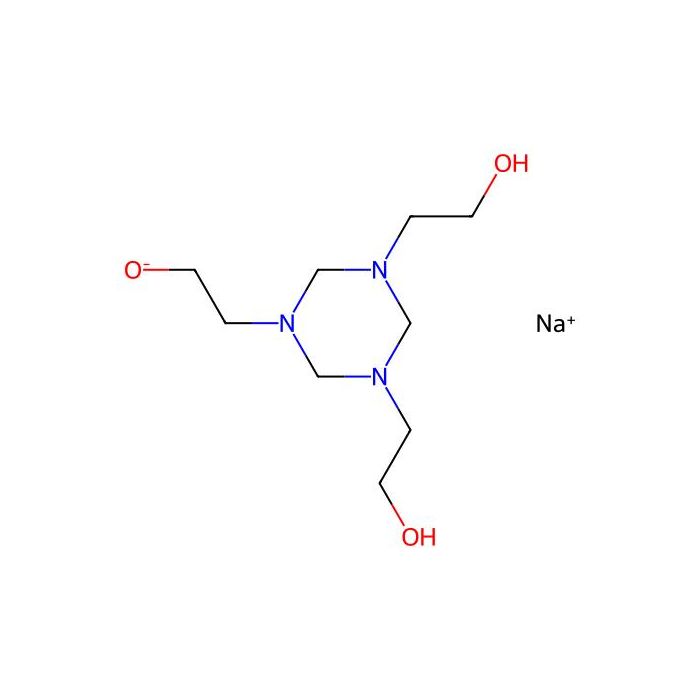
C1N(CN(CN1CCO)CC[O-])CCO.[Na+]
IUPAC Name
sodium;2-[3,5-bis(2-hydroxyethyl)-1,3,5-triazinan-1-yl]ethanolate
InChIKey
YOMTXLQWRQUKAK-UHFFFAOYSA-N
INCHI
1S/C9H20N3O3.Na/c13-4-1-10-7-11(2-5-14)9-12(8-10)3-6-15;/h13-14H,1-9H2;/q-1;+1
Isomeri SMILES
C1N(CN(CN1CCO)CC[O-])CCO.[Na+]
WGK Germania
2
RTECS
MI0850000
PubChem CID
118989588

Documentazione

📋 Safety Data Sheet (SDS)

Comprehensive hazard, handling, storage, and regulatory compliance document.

Download SDS →

✅ Certificate of Analysis (COA)

Lot-specific quality data. Enter your lot number to retrieve the exact COA.

Look up COA →

📊 Datasheet

Quick-reference summary of product specifications and applications.

View datasheet →

🔬 Specification Sheet

Full quality attributes and acceptance criteria for this grade.

View spec sheet →

Advanced Data

Taxonomic Classification

Taxonomy Tree

KingdomOrganic compounds
SuperclassOrganoheterocyclic compounds
ClasseTriazinanes
Subclass1,3,5-triazinanes
Intermediate Tree Nodes Not available
Direct Parent1,3,5-triazinanes
Alternative Parents Azacyclic compounds  Alkanolamines  Organopnictogen compounds  Organic zwitterions  Organic sodium salts  Organic oxides  Hydrocarbon derivatives  Alkoxides  Alcohols and polyols  
Molecular FrameworkAliphatic heteromonocyclic compounds
Substituents 1,3,5-triazinane - Azacycle - Organic alkali metal salt - Alkanolamine - Organic nitrogen compound - Organic oxygen compound - Organopnictogen compound - Organic oxide - Hydrocarbon derivative - Organic sodium salt - Organic salt - Organic zwitterion - Alkoxide - Organooxygen compound - Organonitrogen compound - Alcohol - Aliphatic heteromonocyclic compound
DescrizioneThis compound belongs to the class of organic compounds known as 1,3,5-triazinanes. These are triazinanes having three nitrogen ring atoms at the 1-, 3-, and 5- positions.
External Descriptors Not available
Struttura 3D
Modello di struttura chimica interattiva


Certificati (CoA, COO, BSE/TSE e tabella di analisi)
C of A & Other Certificates(BSE/TSE, COO):
Analytical Chart:

Find and download the COA for your product by matching the lot number on the packaging.

6 results found

Lot NumberCertificate TypeDataOggetto
E2609457Certificate of AnalysisApr 28, 2026 H758710
E2609502Certificate of AnalysisApr 28, 2026 H758710
J2511440Certificate of AnalysisSep 28, 2025 H758710
J2511441Certificate of AnalysisSep 28, 2025 H758710
C2511781Certificate of AnalysisFeb 26, 2025 H758710
C2511782Certificate of AnalysisFeb 26, 2025 H758710
Domande frequenti e articoli
Red Blood Cell Lysis Buffer — Technical Description & Operating Guide
Isolation, Culture, and Induced Differentiation of Bone Marrow Mesenchymal Stem Cells into Osteoclasts: Experimental Procedure
108 common laboratory cell lines
Magnetic Bead Isolation and Flow Cytometric Identification of Human Peripheral Blood CD4⁺ T Cells
From Anticoagulant to Research Tool: An Overview of the Structure and Applications of Heparin (Hep)
Molecular Mechanisms and Biomedical Applications of Heparinase
Technical Analysis and Application Guide for RNase Inhibitors
An Introduction to Research-Grade Carbohydrates: Decoding the “Glycan Language” and a Product-Selection Guide (with Tables 1–3)
Understanding Hydrophilic Polymers in Aqueous Systems: Hydration Mechanisms, Structural Knobs, and Task-Oriented Selection Guide (Including Tables 1–3)
Systematic Anticoagulant Selection Strategy
FGF2-Induced Angiogenesis Model: Standard Operating Procedure (Protocol)
dsDNase-Mediated Hydrolysis of Double-Stranded DNA: Enzymatic Characteristics, Methodological Strategies, and Bioanalytical Applications
Furin: A Review of Its Structural Features, Substrate Recognition, and Research Applications
Glycoprotein Hormone Family: Molecular Features, Signaling Bias, and In Vivo Pharmacokinetics
Regulatory Mechanisms of Extracellular Matrix Glycosylation in Tissue Homeostasis Maintenance and Remodeling
Sulfation Landscape Remodeling and Its Biological Effects
Research Value of Polyelectrolyte Multilayers: Layer-by-Layer Design of Interfacial Composition, Mass Transport, and Function
Effects of Cell Sample Preservation Systems on Morphological Integrity, Anticoagulant Stability, and Analytical Results
Key Judgments in Medical Hydrogel R&D: From Polymer Source and Crosslinking Strategy to Sterilization Planning, Scale-Up Feasibility, and Quality Control
Designing Hydrogel Scaffolds as Programmable Cell Microenvironments: From Click-Chemistry Functionalization to 3D Cell Culture Experimental Design
Evaluation of Blood-Brain Barrier Permeability: Tracer Extravasation, TEER Measurement, and Interpretation of In Vitro Model Results
Exosome-Related Ingredients in Skincare Products: Sources and Preparation, Quality Control, Evidence of Efficacy, and Safety Assessment
Structure and Functions of Fibronectin: Cell Adhesion, Cutaneous Wound Repair, and Topical Applications
Citations of This Product
Calcolatori di soluzioni
Recensioni

Recensioni dei clienti

Shall we send you a message when we have discounts available?

Remind me later

Thank you! Please check your email inbox to confirm.

Oops! Notifications are disabled.