This compound belongs to the class of organic compounds known as long-chain fatty acids. These are fatty acids with an aliphatic tail that contains between 13 and 21 carbon atoms.
External Descriptors
Straight chain fatty acids
1. Djoumbou Feunang Y, Eisner R, Knox C, Chepelev L, Hastings J, Owen G, Fahy E, Steinbeck C, Subramanian S, Bolton E, Greiner R, and Wishart DS. ClassyFire: Automated Chemical Classification With A Comprehensive, Computable Taxonomy. Journal of Cheminformatics, 2016, 8:61.
Determine the necessary mass, volume, or concentration for preparing a solution.
Dilution Calculator
Determine the dilution needed to prepare a stock solution.
Reconstitution Calculator
Recensioni
Recensioni dei clienti
Application Protocols
No assay-specific protocols are provided for this item in the Product Data. General, non-validated examples where heptadecanoic acid and its derivatives are commonly used (informational only):
GC-FAME internal standard: spike a known amount of C17:0 (or its methyl ester) into lipid extracts prior to transesterification; quantify by GC-FID/GC–MS versus calibration.
Ester/amide synthesis: follow standard Steglich or EDCI/HATU coupling procedures; confirm product by NMR/IR/GC–MS.
These examples are literature practices and are not validated procedures for this specific SKU. For research use only.
Biological Roles
Literature context (not product specifications):
Occurrence: Heptadecanoic acid (C17:0) is an odd-chain saturated fatty acid found at low levels in ruminant fats, dairy lipids, and certain microbial lipids.
Metabolism: Like other saturated fatty acids, it undergoes mitochondrial β-oxidation; because it is odd-chain, final rounds yield propionyl-CoA, which is converted via propionyl-CoA carboxylase/methylmalonyl-CoA mutase to succinyl-CoA (general biochemistry).
Biophysical properties: The fully saturated C17 chain packs well in lipid bilayers and crystalline phases; odd chain length can subtly alter melting/packing relative to neighboring even-chain homologues.
Analytical role: Its odd-chain nature makes it a useful internal/external standard in lipid quantification workflows (e.g., FAME GC), reducing co-elution with abundant even-chain endogenous species.
No medical or clinical claims are made. This product is for research use only, as indicated in the Product Data.
Buffer Applications
Heptadecanoic acid is not typically used to prepare aqueous buffer systems due to its very low water solubility as the free acid. For aqueous work, researchers usually:
Convert to a water-soluble salt (e.g., sodium heptadecanoate) to study micelles or soap behavior, or
Employ co-solvents/surfactants to disperse the free acid.
If a buffered system is required, consider preparing the sodium salt by neutralization with NaOH in aqueous ethanol, then diluting into the target buffer. Verify pH after dilution, as fatty acid salts can alter ionic strength and surfactant properties.
Green Alternatives
Improving the sustainability profile when working with heptadecanoic acid focuses on solvent/reagent choices rather than the substrate itself (a saturated fatty acid that can be bio-derived).
Greener solvent swaps (general guidance):
Replace DCM/chloroform with 2-MeTHF, CPME, or toluene for acyl chloride reactions and esterifications; modest heating may be required to match solvency.
Use ethanol or isopropanol as both solvent and reactant for Fischer esterification; apply Dean–Stark or molecular sieves to drive equilibrium.
Favor ethyl acetate or isopropyl acetate for extractions over chlorinated solvents.
Coupling chemistry alternatives:
Prefer carbodiimide couplings (DIC) in 2-MeTHF or EtOAc with catalytic DMAP, or use EDCI in aqueous-organic media to minimize chlorinated waste.
Consider CDI (carbonyldiimidazole) activation in green solvents to avoid acid chlorides and associated HCl off-gassing.
Energy considerations:
Take advantage of the low melting range (~60–62 °C, literature) to process in the melt, reducing solvent use in some esterifications or transesterifications.
Sourcing and waste:
When available, select bio-based heptadecanoic acid and document chain-of-custody for LCA reporting.
Comparison snapshot (general):
DCM vs 2-MeTHF: similar synthetic utility; 2-MeTHF is renewable, lower toxicity, but may require longer dissolution times.
SOCl2 vs CDI: SOCl2 is efficient but hazardous and generates acidic off-gas; CDI is milder, with imidazole byproduct more manageable in waste streams.
Pharmaceutical Uses
No pharmacopeial grade or specific formulation role is provided for this item; refer to the CoA/Spec Sheet for grade details. General, non-clinical context for saturated fatty acids (informational):
Excipients and materials: Long-chain fatty acids and their derivatives (esters, amides, glycerides) serve as hydrophobic excipients, permeability modifiers, and components of lipid-based formulations.
Pro-moieties: The carboxyl group enables formation of pro-moiety esters/amides with active pharmaceutical ingredients to modulate lipophilicity and release (conceptual chemistry; not a therapeutic claim).
Nanomaterials: Fatty acid tails are used in lipid nanoparticles or self-assembled systems when conjugated to headgroups (e.g., amines, PEG). Choice of chain length impacts melting behavior and stability.
Regulatory and quality notes:
For any GMP or clinical application, a defined compendial grade, impurity profile, and residual solvent limits are required; this product is designated for research use only per Product Data.
Verify peroxides, aldehydes, and homolog distribution if employing in sensitive formulations; saturated C17 typically shows good oxidative stability compared to unsaturated analogs.
Physical Properties
Item-specific numerical specifications (e.g., exact melting point, residual water, metal content) are not provided for this SKU. Refer to the CoA/Spec Sheet for authoritative values.
Literature/typical properties for heptadecanoic acid (for reference; not item specifications):
Appearance: white to off-white waxy solid or flakes (literature)
Melting point: ~60–62 °C (literature)
Boiling point: ~350–360 °C at 1 atm, often with decomposition; distills at lower T under reduced pressure (literature)
Density: ~0.85–0.86 g/cm³ at 25 °C (literature, solid/liquid near melt)
pKa (carboxyl): ~4.8–5.0 in water (literature)
LogP (octanol/water): very high; estimated >7 (literature/estimates for C17 saturated acids)
Solubility: insoluble in water; soluble in common organic solvents such as ethanol (hot), isopropanol (hot), methanol (hot), acetone, diethyl ether, chloroform, dichloromethane, hexanes, toluene; readily soluble in DMSO and DMF (literature)
Critical micelle/aggregation behavior: the sodium/potassium salts form soaps that exhibit surfactant behavior (general)
Notes for use:
Warmth above the melting point facilitates dissolution and weighing accuracy for preparative work.
For aqueous systems, convert to a salt (e.g., Na+, K+) or use co-solvents/emulsifiers to enable dispersion.
Quality and Grades
Item-specific grade/purity: Not specified for this item; refer to CoA/Spec Sheet.
Guidance on grades for fatty acids (general information to help selection):
Chemical grade/AR: suitable for general synthetic use; assays often by GC after derivatization. Trace moisture and residual solvents may be present within typical limits.
High-purity/GC reference grade: optimized for analytical applications (e.g., internal standard in FAME GC analysis), with low background impurities and tight isomer/odd–even homologue control.
Stabilizers: saturated fatty acids typically do not require antioxidants; absence/presence of stabilizers should be declared on the CoA if applicable. For sensitive analytical work, select material with “no added stabilizer.”
UV/LC applications: saturated fatty acids have weak UV absorbance; for LC-UV work, matrix cleanliness (low UV-absorbing impurities) is more relevant than the acid itself.
What to check on the CoA/Spec Sheet for this SKU:
Assay (e.g., GC area %), identity confirmation (IR/NMR/GC–MS), residual solvent, water (Karl Fischer) if reported, and specific isomer/homologue content. Confirm storage condition matches “Store at 2–8 °C” and shipping on wet ice (as provided).
Reaction and Applications
Heptadecanoic acid is a versatile C17 saturated carboxylic acid used as both a synthetic building block and an analytical reference.
Synthetic transformations (general/literature):
Esterification: Fischer (alcohol, catalytic H2SO4 or p-TsOH; heat; Dean–Stark for higher alcohols). Steglich esterification (DCC or DIC + DMAP in DCM) at 0–25 °C affords mild conditions.
Amide formation: EDCI/HOBt or HATU-mediated couplings in DMF/DCM with amines; or via the acid chloride.
Acid chloride: SOCl2 or oxalyl chloride (0–25 °C) with catalytic DMF; enables acylation of alcohols/amines. The long chain often crystallizes products readily.
Anhydrides/mixed anhydrides: use DCC or acyl chloroformates for subsequent acyl transfer chemistry.
Materials/colloids:
Soap formation: neutralization with NaOH/KOH gives carboxylate surfactants with distinct CMCs and wetting behavior (odd-chain variant).
Self-assembled films and hydrophobic surface modification via ester/amide tethering to substrates.
Analytical use (literature/common practice):
Widely employed as an internal standard in lipidomics and fatty acid methyl ester (FAME) GC methods due to its odd chain length (minimal overlap with endogenous even-chain profiles in many matrices).
Methyl heptadecanoate is a common calibration/retention marker in GC-FID/GC–MS.
Practical tips:
Warm gently above the melting point to facilitate homogeneous mixing before charging reactors.
Ensure thorough drying of reagents/solvents for coupling chemistry; residual base converts to soaps and can complicate phase behavior.
Reaction Conditions
General literature conditions for common transformations of heptadecanoic acid (for guidance; not item specifications):
Fischer esterification: heptadecanoic acid + ROH (3–10 eq) with catalytic H2SO4 or p-TsOH; 60–120 °C depending on alcohol; remove water via Dean–Stark or molecular sieves. Typical reaction times 2–16 h; GC monitoring recommended.
Steglich esterification: heptadecanoic acid (1.0 eq), alcohol (1.1–1.5 eq), DCC or DIC (1.1–1.5 eq), DMAP (0.05–0.1 eq) in DCM or 2-MeTHF at 0–25 °C, 2–6 h; filter urea byproduct, wash, and purify.
Acid chloride formation: SOCl2 (2–5 eq) with catalytic DMF (0.05 eq) in toluene or neat; 0–70 °C for 1–3 h. Remove volatiles under reduced pressure; keep dry. Subsequent acylations typically proceed at 0–25 °C in DCM/Et3N.
Amide coupling: EDCI·HCl (1.2–1.5 eq), HOBt or HOAt (1.0–1.2 eq), base (DIPEA, 2.0–3.0 eq) in DMF/DCM, 0–25 °C for 2–12 h. Alternatively, HATU (1.1 eq) under similar conditions.
Reduction to alcohol: LiAlH4 (2–3 eq) in THF at 0 °C to reflux; quench carefully; gives heptadecanol. BH3·THF offers chemoselectivity for acids in presence of esters.
Workup/purification tips:
Warm solutions above the acid’s melting point to avoid precipitation during transfers.
Use nonpolar eluent systems (hexanes/EtOAc) for chromatographic separation of derivatives.
Avoid strong aqueous base during extraction to prevent soap emulsions; if formed, salt out with saturated brine or break with ethanol.
Safety and Handling
Item-specific GHS classification and hazard statements are not provided in the Product Data. Always consult the product SDS for authoritative safety information.
General safety considerations for long-chain saturated fatty acids (informational):
Expected hazards: typically low acute toxicity and mild eye/skin irritation potential; combustible as an organic solid. Dust from finely divided material may form combustible dust–air mixtures.
PPE: lab coat, safety glasses or goggles, and appropriate chemical-resistant gloves (e.g., nitrile). Use local exhaust ventilation when handling powders or during heated operations to avoid aerosols/fumes.
Handling: avoid generating dust; minimize inhalation and contact. When heating near/above the melting point, use a fume hood to avoid thermal decomposition fumes.
Incompatibilities (general): strong oxidizing agents; strong bases will form soaps (carboxylate salts) with altered handling properties (foaming, wetting). Avoid strong reducing agents and acylation catalysts in presence of unintended nucleophiles.
First aid (overview; follow SDS protocols):
Skin/eye contact: rinse with water for several minutes; remove contaminated clothing; seek medical attention if irritation persists.
Inhalation: move to fresh air; seek medical attention if symptoms occur.
Ingestion: rinse mouth; do not induce vomiting; seek medical advice if large quantities are involved.
Fire-fighting: use standard Class B methods (CO2, dry chemical, foam). Combustion may produce CO/CO2.
Solvent Selection
Heptadecanoic acid is highly hydrophobic; solvent choice is driven by dissolving the long alkyl chain while accommodating the polar carboxyl group.
Polarity/miscibility (general):
Water: practically insoluble as the free acid; solubility greatly increases upon neutralization to its sodium/potassium salt.
Alcohols (MeOH, EtOH, i-PrOH): soluble when hot or with gentle heating; good for Fischer esterification.
Polar aprotics (DMSO, DMF, NMP): good solvency at ambient temperature.
Nonpolar solvents (hexanes, heptane, toluene, cyclohexane): soluble/wettable when warmed; useful for acyl chloride or anhydride chemistry.
Chlorinated solvents (DCM, chloroform): excellent solvency; commonly used for DCC/EDC couplings and Steglich esterifications.
Selection tips:
For esterification: use the corresponding alcohol as solvent with catalytic acid (Dean–Stark for higher alcohols) or use DCM/DMF for DCC/EDC methods at ambient temperature.
For amide coupling: DCM, DMF, or MeCN with EDCI/HOBt, HATU, or DIC/DMAP.
For analytical sample prep (GC-FAME): methanol or BF3–MeOH/methanolic HCl systems are typical methylation media.
Brief comparison (general):
DCM/chloroform: fast dissolution, easy workups; environmental and safety drawbacks.
2-MeTHF/CPME/toluene: greener options for acyl chloride/esterification steps; may need gentle heat to achieve full solubility.
DMSO/DMF: maximize solubility but can complicate isolation; reserve for coupling steps or stock solutions.
Storage and Reconstitution
Storage conditions (from Product Data): Store at 2–8 °C. Ship on wet ice.
Container: Keep tightly closed in a dry, well-ventilated place. Use moisture-tight packaging to avoid hydrolysis/soap formation in presence of base.
Stability notes (general): Saturated fatty acids are oxidatively stable relative to unsaturated analogs; nonetheless, minimize prolonged exposure to heat and strong light. Under recommended storage, long shelf-life is typical.
Reconstitution and working solutions (general guidance; not item specifications):
To prepare stock solutions, dissolve in a suitable solvent such as DMSO, DMF, ethanol (warm if needed), isopropanol (warm), or chloroform/DCM. Typical laboratory stocks range 10–200 mg/mL depending on solvent and application.
For aqueous systems, convert to the sodium/potassium salt by neutralization in aqueous alcohol, or use co-solvent systems (e.g., 1–5% DMSO or ethanol with surfactant) to disperse the free acid.
Handling tip: If the material solidifies in the bottle, gently warm (40–60 °C water bath) to liquefy before aliquoting; avoid overheating and keep cap loosely vented to prevent pressure buildup.
Always consult the CoA/SDS for product-specific stability and storage guidance.
Structure and Identity
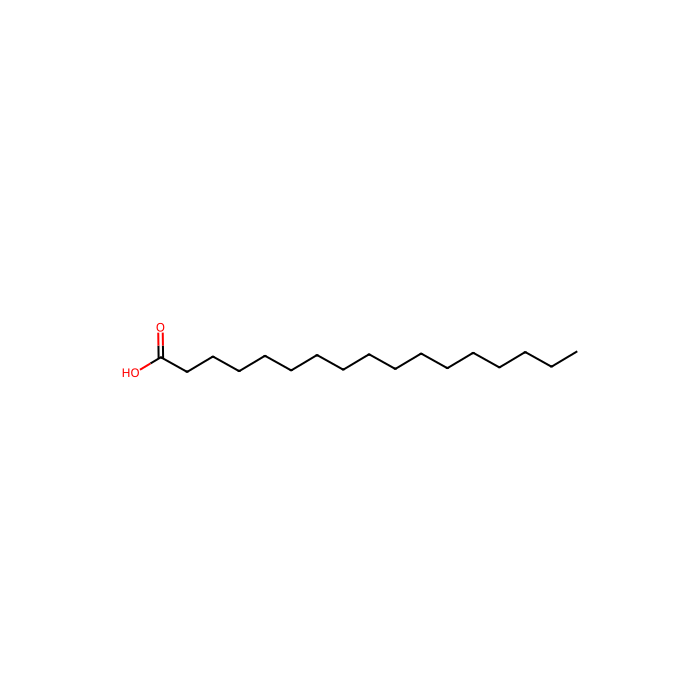
Heptadecanoic acid (also known as margaric acid) is a saturated, straight-chain C17 fatty acid with a terminal carboxylic acid.
Item identifiers (from Product Data):
SKU: H122278
CAS: 506-12-7
PubChem CID: 10465
InChIKey: Not specified for this item; refer to CoA/Spec Sheet.
SMILES: Not specified for this item; refer to CoA/Spec Sheet.
Literature structural information (for reference; not item specifications):
Common name: Margaric acid; C17:0 fatty acid
Molecular formula: C17H34O2 (literature)
Molecular weight: 270.45 g/mol (literature)
Functional groups: one terminal carboxylic acid (–CO2H); saturated aliphatic chain of 15 methylenes (–(CH2)15–) between the carboxyl and terminal methyl
Reductions: conversion to alcohols via LiAlH4 or BH3·THF; to aldehydes via reduction of acid chloride (Rosenmund) or DIBAL-H on esters.
Decarboxylative tactics: less common with long-chain saturated acids, but possible via Hunsdiecker- or Kolbe-type chemistry (specialized conditions).
Retrosynthetic value:
As a protected hydrophobic handle to install C17 tails onto small molecules, peptides (via amide coupling to lysine side chains), polymers (via esterification of polyols), or surfaces (via carbodiimide coupling to carboxylate-terminated SAMs).
Materials/surfactants:
Neutralization produces soaps with chain-length-dependent CMCs and emulsification properties useful in templating and colloid stabilization.
Practical considerations:
The high hydrophobicity simplifies crystallization of many derivatives (esters/amides) and can aid purification by trituration.
Limit strong base during workups to avoid unintended saponification or persistent emulsions from soap formation.
Target Specificity
Not applicable. This product is a small-molecule fatty acid, not a biological targeting reagent or antibody. No antigen/epitope specificity, species reactivity, clone, or isotype data apply.
We use cookies to ensure the website functions properly and, where permitted, to improve your experience. You can manage your preferences at any time in Settings. Learn more in our Cookie Policy.
Shall we send you a message when we have discounts available?
Remind me later
Thank you! Please check your email inbox to confirm.
Products are supplied to verified businesses, institutions, and qualified professionals for research and development use only. Not for use in humans, animals, diagnosis, or therapy.

 I2620132