Determine the necessary mass, volume, or concentration for preparing a solution.
| Activity Type | Relation | Activity value | Units | Action Type | Journal | PubMed Id | doi | Assay Aladdin ID |
|---|

Taxonomy Tree
| Kingdom | Organic compounds |
|---|---|
| Superclass | Organoheterocyclic compounds |
| Classe | Lactams |
| Subclass | Beta lactams |
| Intermediate Tree Nodes | Penams |
| Direct Parent | Penicillins |
| Alternative Parents | Phenylimidazolidines Alpha amino acids and derivatives Imidazolidinones Benzene and substituted derivatives Thiazolidines Tertiary carboxylic acid amides Amino acids Azetidines Thiohemiaminal derivatives Monocarboxylic acids and derivatives Azacyclic compounds Dialkylthioethers Dialkylamines Carboxylic acids Carbonyl compounds Hydrocarbon derivatives Organic oxides Organopnictogen compounds |
| Molecular Framework | Aromatic heteropolycyclic compounds |
| Substituents | Penicillin - Phenylimidazolidine - Alpha-amino acid or derivatives - Monocyclic benzene moiety - Imidazolidinone - Benzenoid - Imidazolidine - Thiazolidine - Tertiary carboxylic acid amide - Amino acid or derivatives - Azetidine - Amino acid - Carboxamide group - Carboxylic acid derivative - Carboxylic acid - Secondary aliphatic amine - Azacycle - Dialkylthioether - Monocarboxylic acid or derivatives - Hemithioaminal - Thioether - Secondary amine - Amine - Organic oxygen compound - Organopnictogen compound - Organic oxide - Organonitrogen compound - Organooxygen compound - Carbonyl group - Hydrocarbon derivative - Organic nitrogen compound - Aromatic heteropolycyclic compound |
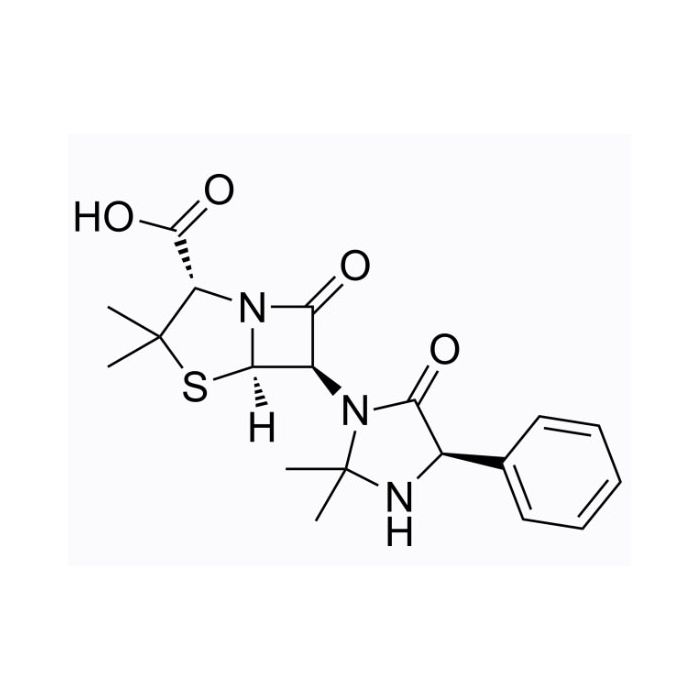
| Descrizione | This compound belongs to the class of organic compounds known as penicillins. These are organic compounds containing the penicillin core structure, which is structurally characterized by a penam ring bearing two methyl groups at position 2, and an amide group at position 6 [starting from the sulfur atom at position 1]. |
| External Descriptors | penicillin |
| Activity Type | Relation | Activity value | Units | Action Type | Journal | PubMed Id | doi | Assay Aladdin ID |
|---|
| Activity Type | Relation | Activity value | Units | Action Type | Journal | PubMed Id | doi | Assay Aladdin ID |
|---|
| Activity Type | Relation | Activity value | Units | Action Type | Journal | PubMed Id | doi | Assay Aladdin ID |
|---|
| Activity Type | Relation | Activity value | Units | Action Type | Journal | PubMed Id | doi | Assay Aladdin ID |
|---|
| Activity Type | Relation | Activity value | Units | Action Type | Journal | PubMed Id | doi | Assay Aladdin ID |
|---|
| Activity Type | Relation | Activity value | Units | Action Type | Journal | PubMed Id | doi | Assay Aladdin ID |
|---|
Find and download the COA for your product by matching the lot number on the packaging.
| Lot Number | Certificate Type | Data | Oggetto |
|---|---|---|---|
 G2610365 | Certificate of Analysis | Jan 30, 2026 | H610818 |
| G2610366 | Certificate of Analysis | Jan 30, 2026 | H610818 |
| G2610367 | Certificate of Analysis | Jan 30, 2026 | H610818 |
| G2610368 | Certificate of Analysis | Jan 30, 2026 | H610818 |
| Peso molecolare | 389.500 g/mol |
|---|---|
| XLogP3 | -0.600 |
| Hydrogen Bond Donor Count | 2 |
| Hydrogen Bond Acceptor Count | 6 |
| Rotatable Bond Count | 3 |
| Exact Mass | 389.141 Da |
| Monoisotopic Mass | 389.141 Da |
| Topological Polar Surface Area | 115.000 Ų |
| Heavy Atom Count | 27 |
| Formal Charge | 0 |
| Complexity | 688.000 |
| Isotope Atom Count | 0 |
| Defined Atom Stereocenter Count | 4 |
| Undefined Atom Stereocenter Count | 0 |
| Defined Bond Stereocenter Count | 0 |
| Undefined Bond Stereocenter Count | 0 |
| The total count of all stereochemical bonds | 0 |
| Covalently-Bonded Unit Count | 1 |
Validated application data (e.g., specific assay types, recommended concentrations, or biological protocols) are Not specified for this item; refer to CoA/Spec Sheet.
General research-use examples (illustrative; adjust empirically):
Always verify concentration by analytical assay (e.g., quantitative NMR or HPLC with a reference standard) due to possible degradation during handling.
Context for research use only (no clinical claims):
Item-specific biological data (potency, kinetics, selectivity): Not specified for this item; refer to primary literature and CoA as available.
Not a buffering agent. This compound does not serve as a pH buffer system.
Research-use handling in buffers (general guidance):
For work requiring stable aqueous beta-lactam solutions, consider on-ice handling, protected from light, and rapid analysis by HPLC to verify integrity.
This section addresses greener handling/formulation strategies rather than substituting the compound itself (a unique research ligand).
Greener solvent and workflow considerations (general):
Illustrative comparison (general trends; verify experimentally):
Note: Substitution of the active molecule with a “green alternative” is not applicable; instead, implement greener solvents and micro-scale protocols to reduce environmental footprint.
No therapeutic or clinical claims are made for this research-grade material.
Formulation context for research (general):
Stability in formulations (general):
Item-specific specifications
Typical/literature characteristics for hetacillin and closely related penam structures (informational; not item specifications):
Practical notes
What Moligand™ signifies (general description):
Implications for use:
Item-specific notes:
This compound is primarily used as a research tool compound (Moligand™) rather than a solvent or routine reagent. Nonetheless, its functional groups enable distinctive chemistries relevant to derivatization and mechanistic studies.
Chemical reactivity (general, literature-based):
Applications in the lab:
Practical notes:
General guidance for transformations relevant to hetacillin (literature-based; adjust empirically). These are not product specifications.
Analytical controls:
Authoritative safety guidance must be taken from the SDS. The following summarizes general considerations for beta-lactam penams and this catalog item.
GHS information (item-specific)
Key hazards and precautions (general for beta-lactams; not item-specific):
PPE and engineering controls
Incompatibilities and stability (general):
First-aid overview (general):
Waste disposal: Collect as hazardous organic waste; follow local regulations and institutional policies.
Hetacillin is a polar, heteroatom-rich beta-lactam with an organic acid functionality and an acetone-derived protecting group, yielding a more lipophilic profile than ampicillin (literature). Solvent choice should balance solubility against hydrolytic stability.
General guidance (not item specifications):
Polarity/miscibility (literature trends for penams):
When to choose alternatives:
Practical tips:
Item-specific storage and shipping
Reconstitution and handling (general recommendations for beta-lactam research compounds; not item specifications):
Stability notes (general):
For precise shelf-life and re-test periods, and any stabilizers present, refer to the batch-specific CoA/Spec Sheet.
Brief overview: Hetacillin is a beta-lactam (penicillin-class) small molecule supplied as a Moligand™ screening compound for research use.
Key structural features (general, literature-based description):
2D structure in words: A bicyclic penam ring system (four-membered lactam fused to a five-membered thiazolidine) bearing a carboxylate and an amide side chain terminating in an acetone-protected alpha-aminobenzyl moiety.
Although primarily a screening/ligand tool, hetacillin’s functional group array allows selective transformations in a synthesis or derivatization context.
Transformable sites (general, literature-based):
Retrosynthetic value:
Practical considerations:
Item-specific target data (e.g., enzyme selectivity, Kd/IC50 values, organism spectrum, antibody epitopes) are Not specified for this item; refer to CoA/Spec Sheet and primary literature.
General mechanistic context for beta-lactam penams (literature):
Note: Use in biochemical assays should be guided by pilot studies to map concentration–response and time-dependent inactivation consistent with the intended target(s).
La nostra guida alla selezione delle qualità copre purezza, stato dello stabilizzatore e idoneità all'applicazione per tutte le varianti del nostro catalogo.
Visualizza la guida alle qualità Moligand™ →