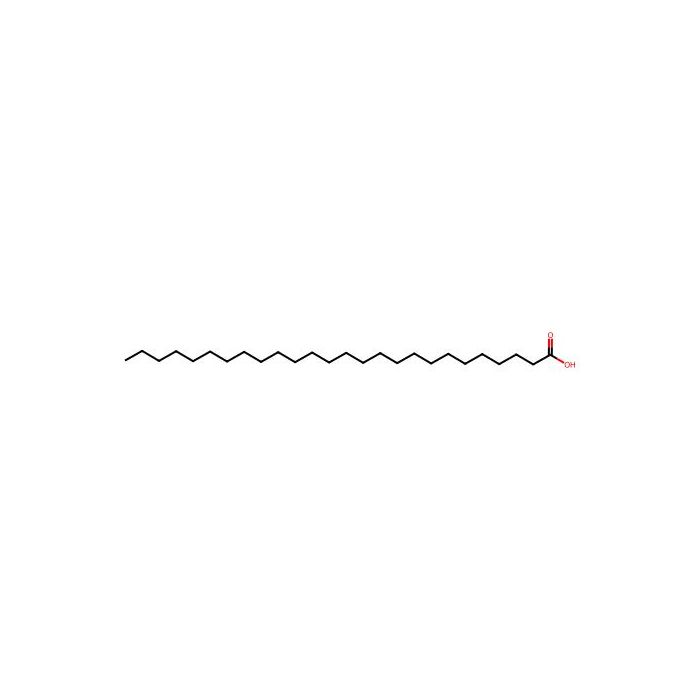
Hexacosanoic acid-d 4 -11 is the deuterium labeled Hexacosanoic acid. Hexacosanoic acid is a long-chain fatty acid related to various diseases such as adrenoleukodystrophy (ALD), adrenomyeloneuropathy (AMN) and atherosclerosis.
In Vitro
Stable heavy isotopes of hydrogen, carbon, and other elements have been incorporated into drug molecules, largely as tracers for quantitation during the drug development process. Deuteration has gained attention because of its potential to affect the pharmacokinetic and metabolic profiles of drugs. MCE has not independently confirmed the accuracy of these methods. They are for reference only.
Form:Solid
Specifiche
Specifiche e purezza
≥98%
Meccanismi biochimici e fisiologici
Hexacosanoic acid-d 4 -11 is the deuterium labeled Hexacosanoic acid. Hexacosanoic acid is a long-chain fatty acid related to various diseases such as adrenoleukodystrophy (ALD), adrenomyeloneuropathy (AMN) and atherosclerosis.
Condizioni di conservazione di stoccaggio
Store at -20°C
Spedito in
Ice chest + Ice pads
Questo prodotto richiede spedizione a catena fredda. I servizi di terra e altri servizi economici non sono disponibili.
This compound belongs to the class of organic compounds known as very long-chain fatty acids. These are fatty acids with an aliphatic tail that contains at least 22 carbon atoms.
External Descriptors
Not available
1. Djoumbou Feunang Y, Eisner R, Knox C, Chepelev L, Hastings J, Owen G, Fahy E, Steinbeck C, Subramanian S, Bolton E, Greiner R, and Wishart DS. ClassyFire: Automated Chemical Classification With A Comprehensive, Computable Taxonomy. Journal of Cheminformatics, 2016, 8:61.
Determine the necessary mass, volume, or concentration for preparing a solution.
Dilution Calculator
Determine the dilution needed to prepare a stock solution.
Reconstitution Calculator
Recensioni
Recensioni dei clienti
Application Protocols
No assay validations or protocol parameters are specified for this item. For research use, the following literature-style outlines may be adapted and validated in-house:
LC–MS internal standard use (lipidomics):
Prepare a stock (e.g., 1–5 mg/mL) in CHCl3:MeOH (2:1) or isopropanol; store aliquots at −20 °C under inert gas.
Spike a fixed amount into samples prior to extraction (e.g., 10–100 ng depending on matrix and instrument sensitivity).
Process samples with your extraction method (e.g., MTBE or IPA-based). Analyze by LC–MS/MS monitoring the M+4 transition.
GC–MS via methyl ester:
React with BF3·MeOH or HCl/MeOH to form the FAME; extract into hexane; inject using a high-temperature nonpolar column.
These are general literature practices and not item-specific validated protocols. Optimize concentrations and instrument settings for your system.
Biological Roles
Hexacosanoic acid (cerotic acid, C26:0) is a very-long-chain saturated fatty acid present at low levels in animals and abundant in plant cuticular waxes and certain sphingolipids. The d4-labeled analog is used as a tracer or internal standard to study these roles; it is not intended for clinical use.
Metabolism (literature):
In animal cells, VLCFAs are activated to acyl‑CoAs and degraded by peroxisomal β‑oxidation, often undergoing chain shortening before mitochondrial oxidation.
Incorporation into complex lipids: can be elongated from shorter precursors (ELOVL enzymes) and incorporated into ceramides/very-long-chain sphingolipids that influence membrane properties.
Structural/biophysical aspects:
The long saturated chain increases bilayer thickness and order; incorporation into lipids modulates membrane phase behavior.
In plants and microbes, C26:0 is a precursor to wax esters and cutin components that form hydrophobic barriers.
Use of d4 label:
Enables isotope-dilution quantitation of endogenous C26:0.
Facilitates flux analysis by tracking d-label through β‑oxidation intermediates or complex lipids via MS.
Note: Biological effects and toxicology for THIS item are not specified; follow institutional guidelines for handling research chemicals and consult the SDS.
Buffer Applications
This product is a long-chain fatty acid and is not used as a buffer component. It has negligible aqueous solubility in its protonated form and provides no useful buffering capacity near physiological pH.
Practical guidance:
For aqueous work, convert to a salt (e.g., sodium hexacosanoate) to obtain dispersions/micelles, but this is for delivery/solubilization rather than buffering.
For experiments requiring defined pH control, use conventional buffer systems (e.g., phosphate, HEPES) alongside organic cosolvents to keep the fatty acid in solution if needed.
Green Alternatives
As a substance, hexacosanoic acid‑d4‑1 is not replaceable by a “greener” chemical when isotopic labeling is required. However, the environmental footprint of methods using it can be improved by solvent and process choices.
Greener handling choices (literature/guidance):
Prefer ethanol, isopropanol, ethyl acetate, or 2‑MeTHF over chlorinated solvents where compatible with your method.
For lipid extraction, consider IPA/ACN/water blends as alternatives to CHCl3-based systems when instrument sensitivity allows.
Use microscale workflows and pre-weighed ampoules to minimize waste.
Example comparison (general):
Chloroform vs 2‑MeTHF or ethyl acetate
Safety: CHCl3 is toxic and problematic; 2‑MeTHF/EtOAc are less hazardous.
Performance: CHCl3 excels at dissolving long-chain lipids; 2‑MeTHF/EtOAc may require warming/sonication.
Energy/resource efficiency:
Dissolve with mild heating (40–50 °C) and sonication instead of reflux.
Use SPE-based cleanup to reduce solvent volumes versus liquid–liquid extraction.
Note: When isotopic integrity is critical, verify that alternative solvent systems do not promote side reactions (e.g., transesterification) or adsorption losses.
Pharmaceutical Uses
No therapeutic or clinical claims apply. For research and development contexts, deuterated fatty acids are primarily analytical standards.
Potential roles in pharma R&D/manufacturing (general):
Reference standard/internal standard for QC of fatty acid content in raw materials, excipients (waxes, lipids), and finished dosage forms analyzed by GC–MS or LC–MS.
Process development: tracer for studying lipid excipient stability (e.g., oxidation, migration) or extraction recoveries.
Impurity profiling: benchmark for validating methods that quantify very-long-chain fatty acids.
Regulatory notes:
Pharmacopeial monographs for hexacosanoic acid may exist, but isotopically labeled analogs typically do not. This product is for research use only; verify suitability for any regulated workflow.
Formulation context:
If used as an analytical spike in formulation matrices (oils, waxes), confirm compatibility with sample prep (saponification/derivatization) and absence of matrix-induced isotope effects.
Physical Properties
Item-specific specifications have not been provided; see below for literature/general guidance useful for method development. Do not treat literature values as specifications.
Appearance: Not specified for this item; refer to CoA/Spec Sheet.
Melting point (literature, cerotic acid/d-labeled analogs): typically in the 80–88 °C range for C26:0 acids; isotopic substitution has negligible effect on Tm.
Boiling point: Not practical (fatty acids of this chain length decompose before distillation under ambient pressure; distillation, if any, requires high vacuum). Literature only.
Density: Not specified for this item; refer to CoA/Spec Sheet. (Long-chain fatty acids are waxy solids near RT.)
pKa (literature, long-chain saturated fatty acids): ~4.8–5.0 in water–alcohol mixtures; apparent acidity lower in nonaqueous media.
LogP/logD: Very high (strongly lipophilic; literature qualitative). Numeric values are model-dependent and not provided as an item spec.
Solubility (literature):
Water: negligible at neutral pH; forms soaps/suspensions only upon neutralization to the carboxylate.
Organic: soluble in chloroform, dichloromethane, hot ethanol/methanol, 2-propanol (with heating), ethyl acetate, toluene, hexane, and DMSO; often dissolved in CHCl3:MeOH (2:1) for lipidomics.
Refractive index: Not applicable to a solid/wax; not specified.
Note: Exact values for THIS item (e.g., assay, residual solvents, water, metals) are Not specified for this item; refer to CoA/Spec Sheet.
Quality and Grades
Grade/Purity: Not specified for this item; refer to CoA/Spec Sheet.
Interpretation and implications (general guidance for deuterated standards):
Isotopic enrichment: For quantitative MS applications, both isotopic enrichment (atom % D) and isotopomer distribution (M+4 vs. other) matter. These are typically reported on the CoA; verify before use in isotope-dilution workflows.
Chemical purity vs. isotopic purity: Chemical purity (e.g., HPLC/GC area %) and isotopic purity (fractional deuterium incorporation) are distinct metrics. High chemical purity with poor isotopic enrichment can compromise quantitation; confirm both.
Residual solvents, water, and stabilizers: Not specified for this item; refer to CoA/Spec Sheet. If present, stabilizers (e.g., BHT) can affect oxidation profiles and MS baselines; account for them in blanks.
Identity/traceability: Match CAS 1194984-85-4 and the provided InChIKey on incoming QC where possible; corroborate with HRMS and 1H/2H NMR.
Suitability for use:
Lipidomics/internal standard: verify response factor linearity across your calibration range and absence of interfering isobars.
Synthesis building block: ensure acid value and absence of peroxides (if specified) meet your process requirements.
Always defer to the lot-specific CoA/Spec Sheet for assay, isotopic enrichment, and impurity limits.
Reaction and Applications
This deuterated VLCFA is optimized for analytical and tracer applications, and also serves as a labeled building block in synthesis.
Internal standard for quantifying C26:0 (cerotic acid) and its derivatives in biological matrices by GC–MS or LC–MS/MS.
Isotope-dilution workflows: spike known amounts prior to extraction to correct for recovery and ionization variability; M+4 shift ensures chromatographic coelution with minimal interference.
Derivatization: prepare methyl esters (FAMEs) for GC; the d4 label persists and provides clear mass offsets.
Metabolic tracing:
Probe peroxisomal β-oxidation of VLCFAs; monitor chain-shortening products carrying the d-label.
Track incorporation into complex lipids (ceramides, wax esters) in cell/organism studies.
Synthetic applications:
Precursor to d4-labeled acyl chlorides, esters, and amides for preparing isotopically labeled lipids, surfactants, or probes.
Surface functionalization: formation of self-assembled monolayers or hydrophobically modified materials using the long C26 tail.
Practical tips:
Dry solvents and maintain anhydrous conditions for acid chloride formation and coupling reactions.
For MS use, minimize exposure to basic media that can promote H/D exchange at the carboxyl proton; deuteriums on aliphatic positions are generally non-exchangeable under mild conditions.
Validate linear response and absence of in-source fragment overlaps at the chosen collision energy.
Reaction Conditions
General literature guidance for common transformations of long-chain saturated carboxylic acids (apply with standard precautions; optimize to your system). Values are not specifications for this item.
Acid chloride formation:
Reagents: SOCl2 (3–5 equiv) or oxalyl chloride (2–3 equiv) with a catalytic drop of DMF.
Solvent: dry DCM or toluene; 0–25 °C initiation, then reflux 1–3 h (reflux temp depends on solvent).
Workup: remove volatiles under reduced pressure; keep under inert gas to avoid hydrolysis.
Typical outcomes: good to excellent yields for primary alcohols; waxy products crystallize upon cooling.
Amide coupling:
HATU/HBTU (1.1–1.5 equiv), base (DIPEA 2–3 equiv), DMF/DCM, 0–25 °C, 2–16 h.
Fischer esterification (for FAME standards):
MeOH with catalytic H2SO4 or HCl, 60–70 °C, 1–4 h; remove acid thoroughly post-reaction to avoid hydrolysis.
Reduction to alcohol:
BH3·THF (1–2 M), 0–25 °C to gentle reflux, 2–6 h; quench cautiously.
Analytical preparation for GC–MS:
Convert to methyl ester using BF3·MeOH or HCl/MeOH; extract into hexane; analyze with nonpolar columns; d4 provides +4 m/z shift.
Note: Preserve the d-label by avoiding harsh protic acid at high temperature or radical bromination conditions that could lead to isotopic scrambling.
Safety and Handling
Hazard classification for this specific item is not provided. Always consult the product SDS for authoritative safety information.
GHS information (item-specific):
Signal word: Not specified for this item; refer to SDS.
Hazard statements / pictograms / classification: Not specified for this item; refer to SDS.
General handling (long-chain fatty acids; literature best practice):
Low volatility solid/wax; dust generation is minimal but avoid aerosolization of powders. Handle in a well-ventilated area.
Avoid skin/eye contact; wear appropriate PPE: lab coat, nitrile gloves, safety glasses/goggles. Wash thoroughly after handling.
Thermal hazards: molten material can cause burns; heat gently with temperature control if melting is required for dissolution.
Chemical stability: saturated fatty acids are relatively stable but can undergo slow autoxidation at elevated temperature or prolonged air exposure; protect from excessive heat, light, and air.
Incompatibilities (general): strong oxidizers; strong bases will form soaps (carboxylate salts) that can alter handling and extraction behavior.
First aid (overview; defer to SDS): rinse eyes/skin with water for ≥15 minutes upon exposure; if inhaled, move to fresh air; if ingested, rinse mouth and seek medical advice.
Environmental: avoid release to drains; collect waste in appropriate organic waste streams.
Solvent Selection
Hexacosanoic acid-d4-1 is a highly lipophilic, long-chain carboxylic acid with negligible aqueous solubility in its protonated form. Choose solvents based on your end application (lipid extraction, LC–MS, derivatization, or synthesis).
Polarity and miscibility (literature/general):
Polarity class: nonpolar to weakly polar solute; dissolves best in moderately nonpolar to polar aprotic organic solvents.
Good solvents: chloroform, dichloromethane, toluene, hexane/heptane (often with warming), ethyl acetate, THF, diethyl ether, acetone; DMSO and DMF for stock solutions.
Alcohols: methanol, ethanol, 2-propanol—solubility improves with heating; CHCl3:MeOH (2:1) is standard for lipid stocks.
Aqueous systems: insoluble at neutral pH; convert to salts (e.g., sodium hexacosanoate) to disperse in water (micelles/soaps).
When to choose which solvent:
LC–MS lipidomics: CHCl3:MeOH or isopropanol for extraction/stocks; switch to acetonitrile/isopropanol/water mobile phases post-dilution.
Derivatization (methyl/ethyl esters): use anhydrous MeOH/EtOH with acid/base catalysts; or toluene for acid chloride routes.
Amide coupling: DMF/DCM with coupling reagents (EDC/HATU) and catalytic DMAP.
Practical tips:
Warm gently (40–60 °C) and vortex/sonicate to speed dissolution; avoid prolonged heating to limit autoxidation.
Use glassware rinsed with the chosen solvent system to minimize adsorption on surfaces due to the waxy, hydrophobic chain.
Storage and Reconstitution
Storage conditions (item-specific): Store at −20 °C. Shipped in an ice chest with ice pads.
Container and atmosphere (best practice):
Keep tightly closed in amber glass to limit light exposure.
Purge headspace with inert gas (nitrogen/argon) after each use to minimize autoxidation over long-term storage.
Avoid repeated freeze–thaw of bulk; prepare single-use aliquots.
Stability notes (general for VLCFAs):
Stable as a solid/wax at −20 °C for extended periods. Monitor for signs of oxidation (odor, color changes) if stored improperly.
Reconstitution/dissolution (general guidance; not a specification):
Prepare concentrated stocks (e.g., 10–50 mg/mL) in CHCl3, CHCl3:MeOH (2:1), isopropanol, DMSO, or ethyl acetate. Warm gently (40–50 °C) and sonicate if needed.
For aqueous applications, convert to a salt (e.g., Na+ carboxylate) or use solvent carriers and surfactants; verify compatibility with your assay.
Documentation: Record lot number, preparation date, solvent, and concentration on aliquots. Consult the CoA/Spec Sheet for any lot-specific stability or storage notes.
Research Use Note: For research use only.
Structure and Identity
Hexacosanoic acid‑d4‑1 is a deuterium-labeled very-long-chain saturated fatty acid (VLCFA) derived from hexacosanoic acid (cerotic acid, C26:0). The d4 isotopic tag improves mass spectrometric discrimination in lipidomics and tracer studies.
Item-specific identifiers (from Product Data):
SKU: H651611
CAS: 1194984-85-4
InChIKey: 421620
SMILES: Not specified for this item; refer to CoA/Spec Sheet.
Molecular formula: Not specified for this item; refer to CoA/Spec Sheet.
Molecular weight: Not specified for this item; refer to CoA/Spec Sheet.
Structure description (general/literature):
Core scaffold: a linear, unbranched aliphatic chain of 26 total carbons terminating in a carboxylic acid group (–CO2H) at C1; fully saturated (no C=C bonds).
Isotopic labeling: four protium atoms are replaced with deuterium (2H, D). Exact labeling positions are not provided in the Product Data.
Functional groups: one terminal carboxylic acid (weak acid), long hydrophobic alkyl chain (lipophilic tail); no heterocycles or additional heteroatoms beyond the acid moiety.
Computed/literature reference values (for hexacosanoic acid-d4, positional isomer not specified):
Typical empirical formula: C26H48D4O2 (literature approximation for a d4 isotopologue).
Typical average molecular weight: ~400.7 g/mol (literature, +4 vs. non-labeled cerotic acid ~396.7 g/mol).
Synthetic Utility
As a labeled C26 saturated carboxylic acid, hexacosanoic acid‑d4‑1 is a versatile starting material for preparing isotopically labeled derivatives.
Transformations (literature):
Acid chloride formation: SOCl2 or (COCl)2 with catalytic DMF; enables synthesis of labeled esters and amides with high efficiency.
Esterification: Fischer (ROH + acid catalyst), Steglich (EDC/DMAP), Mitsunobu (with ROH); yields labeled wax esters or FAMEs for GC.
Amide coupling: HATU/HBTU/EDC + base (DIPEA) to give labeled acylated amines, lipidoids, or ceramide analogs.
Reduction: borane (BH3·THF) or LiAlH4 to the labeled C26 primary alcohol (hexacosanol-d4) for surfactant/materials applications.
Salt formation: sodium/potassium carboxylates for aqueous dispersions or soap studies.
Strategic value:
The d4 tag provides an unambiguous MS signature for tracking acyl moieties through multistep syntheses and biological assays.
High hydrophobicity aids phase separation and purification of derivatives from polar byproducts.
Considerations:
Maintain anhydrous, oxygen-limited conditions during activation (acid chlorides) to minimize hydrolysis/oxidation.
Verify that coupling conditions do not promote H/D exchange; aliphatic C–D bonds are generally robust, but strongly acidic or radical conditions should be avoided if isotopic integrity is critical.
Target Specificity
Not applicable. This product is a small-molecule fatty acid standard, not an antibody, enzyme, or affinity reagent. No target, epitope, clone, or species reactivity information applies.
Domande frequenti
What is the purity of this product?
This product is supplied at ≥98% purity (chemical assay). Lot-specific values are stated on the Certificate of Analysis.
How is this product shipped?
This product ships in an insulated container with ice pads. Unpack on arrival and transfer it to the storage condition stated above.
How should this product be stored?
Store at ?20 °C. Freezer storage is required to maintain the specified shelf life.
What are the CAS number, molecular formula and molecular weight?
The CAS Number is 1194984-85-4, the molecular formula is C26H48D4O2, and the molecular weight is 400.71 g/mol. InChIKey XMHIUKTWLZUKEX-QZPARXMSSA-N.
What documentation is provided?
Available product documentation, including Certificates of Analysis (COA), Safety Data Sheets (SDS), and specification sheets, is shown in the product document area. Document availability and access follow the current site policy.
Utilizziamo i cookie per garantire il corretto funzionamento del sito web e, ove consentito, per migliorare la tua esperienza. Puoi gestire le tue preferenze in qualsiasi momento nelle Impostazioni. Per saperne di più, consulta la nostra Cookie Policy.
Desidera che le inviamo un messaggio quando avremo sconti disponibili?
Ricordamelo più tardi
Grazie! Controlli la sua casella di posta per confermare.
Products are supplied to verified businesses, institutions, and qualified professionals for research and development use only. Not for use in humans, animals, diagnosis, or therapy.