Determine the necessary mass, volume, or concentration for preparing a solution.
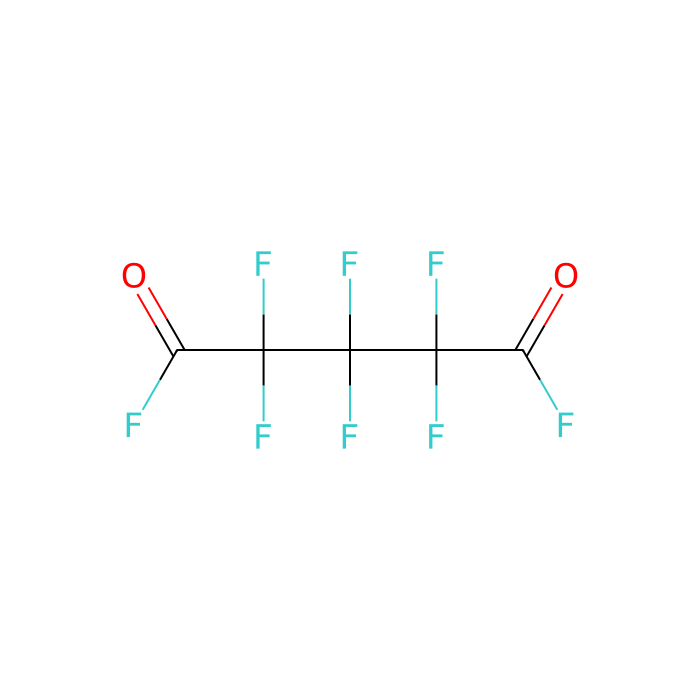
Hexafluoroglutaryl fluoride , CAS No.678-78-4
Disponibile su ordine
Storage
Store at 2-8°C
Shipped In
Wet ice

Taxonomy Tree
| Kingdom | Organic compounds |
|---|---|
| Superclass | Organohalogen compounds |
| Classe | Acyl halides |
| Subclass | Acyl fluorides |
| Intermediate Tree Nodes | Not available |
| Direct Parent | Acyl fluorides |
| Alternative Parents | Organofluorides Organic oxides Hydrocarbon derivatives Carbonyl compounds Alkyl fluorides |
| Molecular Framework | Aliphatic acyclic compounds |
| Substituents | Acyl fluoride - Organic oxygen compound - Organic oxide - Hydrocarbon derivative - Organooxygen compound - Organofluoride - Carbonyl group - Alkyl halide - Alkyl fluoride - Aliphatic acyclic compound |
| Descrizione | This compound belongs to the class of organic compounds known as acyl fluorides. These are organic compounds containing the functional group -CO-F. |
| External Descriptors | Not available |
| Punto di ebollizione (°C) | 46-47° C |
|---|---|
| Peso molecolare | 244.04 |
| XLogP3 | 2.300 |
| Hydrogen Bond Donor Count | 0 |
| Hydrogen Bond Acceptor Count | 10 |
| Rotatable Bond Count | 4 |
| Exact Mass | 243.977 Da |
| Monoisotopic Mass | 243.977 Da |
| Topological Polar Surface Area | 34.100 Ų |
| Heavy Atom Count | 15 |
| Formal Charge | 0 |
| Complexity | 267.000 |
| Isotope Atom Count | 0 |
| Defined Atom Stereocenter Count | 0 |
| Undefined Atom Stereocenter Count | 0 |
| Defined Bond Stereocenter Count | 0 |
| Undefined Bond Stereocenter Count | 0 |
| The total count of all stereochemical bonds | 0 |
| Covalently-Bonded Unit Count | 1 |
H302:Harmful if swallowed
H311:Toxic in contact with skin
H314:Causes severe skin burns and eye damage
H331:Toxic if inhaled
P260:Do not breathe dust/fume/gas/mist/vapors/spray.
P261:Avoid breathing dust/fume/gas/mist/vapors/spray.
P264:Wash hands [and …] thoroughly after handling.
P270:Do not eat, drink or smoke when using this product.
P271:Use only outdoors or in a well-ventilated area.
P280:Wear protective gloves/protective clothing/eye protection/face protection.
P321:Specific treatment (see ... on this label).
P330:Rinse mouth.
P363:Wash contaminated clothing before reuse.
P301+P330+P331:IF SWALLOWED: Rinse mouth. Do NOT induce vomiting.
P302+P352:IF ON SKIN: wash with plenty of water.
P304+P340:IF INHALED: Remove person to fresh air and keep comfortable for breathing.
P361+P364:Take off immediately all contaminated clothing and wash it before reuse.
P405:Store locked up.
P403+P233:Store in a well-ventilated place. Keep container tightly closed.
P501:Dispose of contents/container to an approved waste disposal plant.
P301+P317:IF SWALLOWED: Get medical help.
P305+P354+P338:IF IN EYES: Immediately rinse with water for several minutes. Remove contact lenses if present and easy to do. Continue rinsing.
P302+P361+P354:IF ON SKIN: Take off Immediately all contaminated clothing. Immediately rinse with water for several minutes.
P316:Get emergency medical help immediately.
Not applicable in the context of immunoassays or bioassays (e.g., WB, IHC, IF, FC). This product is a reactive chemical used in synthetic chemistry. For practical use, refer to the Reaction Conditions and Application notes sections for step-by-step guidance on handling and coupling reactions.
This product is a synthetic, perfluorinated diacyl fluoride intended for research and chemical synthesis. It is not a metabolite or biomolecule and has no known endogenous biological role.
General context (literature)
Research-use framing
In practice, chemists employ this reagent in synthetic/materials workflows rather than biological systems. For biochemical applications requiring fluorinated linkers, consider pre-formed amide/ester building blocks derived from this reagent instead of the acid fluoride itself.
Not typically applicable. Hexafluoroglutaryl fluoride is a moisture-sensitive, reactive acylating agent and is unsuitable for aqueous buffer preparation or use. If aqueous workup is required after a reaction, hydrolysis will convert it to the corresponding diacid with concomitant HF formation; neutralize carefully and follow HF-safe procedures.
When choosing an acylating reagent, consider reactivity, byproducts, and solvent/process mass intensity. Acyl fluorides like hexafluoroglutaryl fluoride can offer cleaner byproduct profiles (HF) compared to acid chlorides (HCl + chlorinated waste), but HF poses significant safety and waste-neutralization challenges.
| Option | Reactivity | Hydrolytic stability | Byproduct | Safety/Waste considerations | |---|---|---|---|---| | Hexafluoroglutaryl fluoride | High toward amines/alcohols | Moderate (better than acid chlorides; still moisture sensitive) | HF | HF hazards; neutralization needed (Ca/Mg salts) | | Corresponding diacid + coupling agent (e.g., CDI, DCC, EDC) | Tunable | Good (diacid stable) | Urea salts/imidazole | Solid waste generation; easier handling, often less corrosive | | Acid chloride analogue | Very high | Lower (more prone to hydrolysis) | HCl | Corrosive gas evolution; often higher chlorinated waste | | Symmetric anhydride | Moderate–high | Moderate | Carboxylate | Fewer inorganic wastes; may require activating catalysts |
This product is not an excipient and is not intended for clinical use. No pharmacopeial monograph is indicated.
Formulation/manufacturing context (general)
Regulatory considerations
No therapeutic claims are made. For research and development use only (per Product Data).
Item-specific specifications are not provided in the Product Data; consult the CoA/Spec Sheet for certified values.
Item-specific values
Literature/computed properties (non-binding, for guidance only)
Practical notes (general)
All numerical values above are literature/computed guidance only; do not treat as product specifications.
Item-specific grade/purity: Not specified for this item; refer to CoA/Spec Sheet.
Interpreting grades for reactive acid derivatives (general guidance)
Stabilizers and inhibitors
Recommended QC checks prior to use (general best practice)
Hexafluoroglutaryl fluoride (literature: perfluoroglutaroyl difluoride) functions as a bifunctional acylating reagent enabling incorporation of a perfluoroalkylene spacer into molecules and materials.
Representative transformations (literature)
Chemoselectivity and mechanism
Practical considerations
General literature guidance for using diacyl fluorides; adjust to your substrates and consult primary sources. Values below are not product specifications.
Amidation (diamine coupling to diamide)
Esterification (diol to diester)
Hydrolysis to diacid (for reference/quench)
Workup and purification
Typical outcomes (literature)
Always consult the SDS for authoritative safety information. Item-specific GHS details are not provided in Product Data.
Item-specific hazard data
General hazards of acyl fluorides and perfluorinated diacyl fluorides (literature)
PPE and engineering controls (good practice)
Incompatibilities and storage cautions (general)
First-aid overview (general guidance; defer to SDS)
This compound is a moisture-sensitive, electrophilic diacyl fluoride. Solvent choice should balance substrate solubility, control of reactivity, and suppression of hydrolysis.
Polarity and miscibility (general)
Selection by transformation
Comparison notes (literature trends)
Practical tips
Item-specific storage and shipping
General handling/storage best practices (literature)
Stability considerations
Reconstitution
For research use only (per Product Data). Always consult the CoA/SDS for authoritative guidance on storage, stability, and safe handling.
A perfluorinated bifunctional acyl fluoride derived from glutaric acid; useful as a highly reactive diacylating reagent.
Item-specific identifiers (from Product Data)
Literature/computed identifiers (for reference; not item-specific specs)
Structural features (literature-based description)
Note: Structural/literature identifiers are for educational reference; consult the product CoA/SDS for definitive item-specific identity data.
As a symmetrical diacyl fluoride, hexafluoroglutaryl fluoride is a powerful bifunctional electrophile for constructing fluorinated linkers and materials.
Functional group behavior (literature)
Uses in synthesis
Retrosynthetic value
Characterization tips
Not applicable. This product is a small-molecule acylating reagent and is not an antibody, enzyme, or affinity reagent. No target/epitope specificity information is associated with this item.