QUALITÀ & PUREZZAMoligand™?Moligand™ — Aladdin's line of ligands and bioactive small molecules. Use for receptor, pathway, and binding studies needing defined small-molecule tools.≥98%
Hh-Ag1.5 (SAG-1.5) is a potent Hedgehog (Hh) agonist (EC50: 1 nM) and Smoothened (Smo) receptor agonist, with an EC50 of 1 nM and Ki values between 0.5 and 2.3 nM for Smo. Hh-Ag1.5-mediated reprogramming breaks the quiescent state of non-injured hepatic stem cells and thus rescues liver failure. Hh-Ag1.5 induced differentiation of hiPSCs into skin precursor cells, spinal motor neurons and spinal sensory neurons.
Hh-Ag1.5 (SAg1.5) is a potent Hedgehog ( Hh ) agonist with an EC 50 of 1 nM. Hh-Ag1.5 mediated reprogramming breaks the quiescence of noninjured liver stem cells for rescuing liver failure.
Condizioni di conservazione di stoccaggio
Protected from light,Store at -20°C,Argon charged
Spedito in
Ice chest + Ice pads
Questo prodotto richiede spedizione a catena fredda. I servizi di terra e altri servizi economici non sono disponibili.
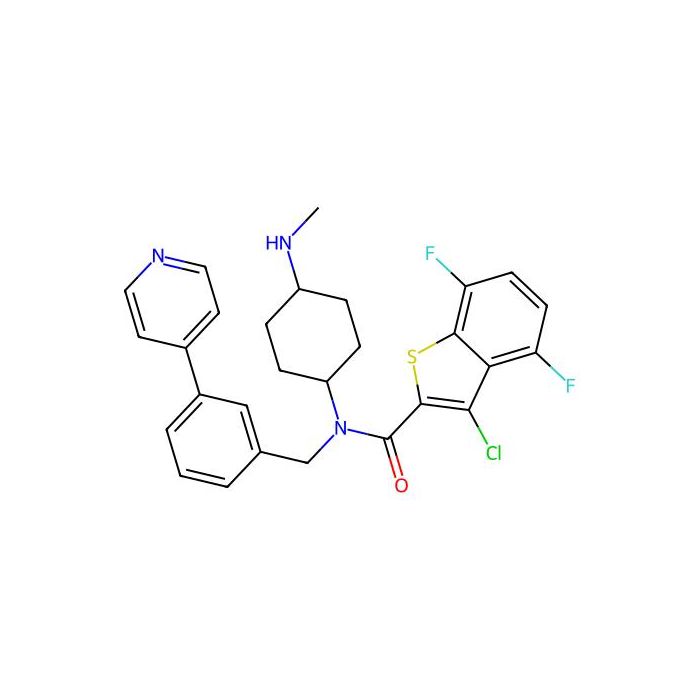
This compound belongs to the class of organic compounds known as phenylpyridines. These are polycyclic aromatic compounds containing a benzene ring linked to a pyridine ring through a CC or CN bond.
External Descriptors
Not available
1. Djoumbou Feunang Y, Eisner R, Knox C, Chepelev L, Hastings J, Owen G, Fahy E, Steinbeck C, Subramanian S, Bolton E, Greiner R, and Wishart DS. ClassyFire: Automated Chemical Classification With A Comprehensive, Computable Taxonomy. Journal of Cheminformatics, 2016, 8:61.
Determine the necessary mass, volume, or concentration for preparing a solution.
Dilution Calculator
Determine the dilution needed to prepare a stock solution.
Reconstitution Calculator
Recensioni
Recensioni dei clienti
Application Protocols
Only tested application protocols from the product data may be listed. No validated protocols, dilutions, or control recommendations are provided for this item.
Recommended applications: Not specified for this item; refer to CoA/Spec Sheet.
Working concentrations/dilutions: Not specified for this item; refer to CoA/Spec Sheet.
General suggestion
Establish assay-specific protocols empirically, beginning with small pilot experiments to define solubility limits, vehicle tolerance, dose–response, and exposure times in your model system.
Biological Roles
Context from scientific literature (for background only; not a specification of this product’s performance)
Compounds denoted “Hh-Ag” in the literature are described as small-molecule agonists of the Hedgehog (Hh) signaling pathway, often acting via the Smoothened (SMO) receptor. Hh-Ag1.5 specifically has been reported as a potent pathway activator in various cellular systems (literature).
Such ligands are commonly used to study developmental signaling, pathway crosstalk, and transcriptional responses governed by GLI-family transcription factors (downstream of Hedgehog signaling).
Use in research workflows (general guidance)
Reporter assays: luciferase/fluorescent reporters under GLI-responsive promoters are typical readouts for Hh pathway modulation.
Gene expression: qPCR analysis of canonical Hh target genes can provide orthogonal confirmation of pathway activation.
Phenotypic assays: morphology and differentiation endpoints may be monitored in stem/progenitor cell models, with rigorous vehicle and off-target controls.
Important caveats
Activity, potency, and selectivity can vary across cell types, assay formats, and lots. Do not assume equivalence across vendors or lots; verify activity with system-specific controls.
Avoid clinical or diagnostic interpretation; this product is for research use only, as stated in the Product Data.
Buffer Applications
This item is a bioactive small-molecule ligand and is not used to formulate buffering systems. Consequently, standard buffer recipes and pH control applications do not apply.
Practical note
When preparing working solutions in biological buffers, dissolve first in a suitable organic cosolvent (commonly DMSO), then dilute into the target buffer/media with vigorous mixing to avoid precipitation. Maintain a constant vehicle percentage across all conditions.
Green Alternatives
As a bioactive small-molecule ligand supplied for research assays, this product is typically used in micro- to milligram quantities and dissolved into DMSO or compatible vehicles. Green chemistry considerations center on solvent choice and waste minimization rather than reagent substitution.
Greener handling options (general)
Prefer DMSO over DMF for primary stocks where solubility allows; DMSO has a more favorable EHS profile for many labs and is widely assay-compatible.
Minimize organic solvent volumes by preparing higher-concentration stocks and accurate small-volume dilutions.
Use ethanol (anhydrous) as an alternative vehicle for specific assays if compatible, recognizing tighter limits for live systems.
Apply microscale assay formats (384/1536-well plates) to reduce solvent and compound consumption.
Trade-offs (general)
DMSO: greener than many dipolar aprotics but hygroscopic; water uptake can affect concentration over time.
Ethanol: renewable and low-toxicity but can disrupt membranes at modest percentages.
Aqueous cyclodextrin carriers can enhance apparent solubility, reducing organic solvent use, but may introduce pharmacology artifacts; validate controls.
Waste considerations
Segregate DMSO- and DMF-containing waste per institutional guidelines. Utilize cold traps and ventilated enclosures to minimize fugitive emissions during solvent handling.
Pharmaceutical Uses
This product is supplied strictly for research use and screening. It is not an excipient, not manufactured to GMP, and not intended for human or veterinary use.
Formulation context in research (general)
Tool-compound stocks are typically formulated in DMSO for in vitro work. For in vivo research (if permitted by your institution), vehicle systems may include aqueous buffers with limited DMSO and solubilizers; however, no use is endorsed or specified for this item by the Product Data.
Regulatory note
There is no pharmacopeial monograph or clinical formulation guidance associated with this catalog item. Any translational or preclinical formulation work requires independent qualification of identity, purity, stability, and safety consistent with institutional governance.
Physical Properties
Item-specific physicochemical specifications have not been provided for this catalog entry.
Appearance: Not specified for this item; refer to CoA/Spec Sheet.
Melting point (MP): Not specified for this item; refer to CoA/Spec Sheet.
Boiling point (BP): Not applicable/not determined for typical use; solid bioactives are not distilled. Literature values not consolidated here.
Density: Not specified for this item; refer to CoA/Spec Sheet.
Refractive index: Not applicable to solids; Not specified for this item.
pKa, logP, logD: Not specified for this item; refer to CoA/Spec Sheet or literature computation as needed.
Solubility: Not specified for this item; typical practice for bioactive ligands is to prepare concentrated stocks in anhydrous DMSO and dilute into assay medium (general guidance only; see Solvent Selection).
General guidance (literature/practice; not item-specific)
Many hydrophobic small-molecule ligands are sparingly soluble in aqueous buffers but dissolve at 10–50 mM in DMSO (literature/practice). Always verify solubility empirically for your lot.
Hygroscopicity and photolability vary by structure; this product is shipped cold and labeled “Protected from light,” suggesting prudent light minimization during handling (general precaution).
Quality and Grades
Grade/Purity: Moligand™ (as provided). Exact assay/purity, water/peroxide/metal limits, and UV cutoff: Not specified for this item; refer to CoA/Spec Sheet.
What Moligand™ typically implies (program description; not a specification)
Internal designation used for bioactive, ligand-class small molecules suitable for screening, target engagement studies, and mechanistic biology.
Emphasis is generally on identity verification and suitability for research assays rather than solvent-grade chromatographic attributes. For quantitative work, verify purity by HPLC/LC–MS on receipt.
Batch-specific documentation
CoA should list lot-specific identification (e.g., NMR/LC–MS), purity method/assay, and any residual solvent limits. If stabilizers or form (free base vs. salt) are relevant, they will be stated on the CoA.
Notes on use
For screening campaigns, consider in-house QC (orthogonal purity check, potency benchmarking) before deployment across large panels.
If your workflow is sensitive to trace impurities (e.g., biophysical binding, SPR, ITC), perform an additional polish (prep-HPLC) as appropriate, then re-verify identity and concentration by quantitative NMR or calibrated UV where applicable.
Reaction and Applications
This catalog item is provided as a bioactive small-molecule ligand for research use, not as a general synthetic reagent. Accordingly, classical synthetic reaction applications (e.g., coupling, reductions) are not typically applicable.
Research applications (general, literature-based for Hh-Ag class ligands; verify suitability for your system)
Pathway modulation studies: used as a chemical tool in cell-based or biochemical assays to probe signaling cascades (e.g., Hedgehog pathway agonism reported in the literature for similarly named ligands). Employ appropriate positive/negative controls and pathway reporters.
Target engagement: prioritize orthogonal readouts (reporter assays, qPCR of pathway-responsive genes, or biochemical binding/thermal shift where feasible) to confirm on-target effects.
SAR and profiling: suitable for panel screening, concentration–response curve generation, and time-course studies to characterize potency, efficacy, and kinetics in your assay.
Practical tips
Prepare concentrated, filter-sterilized DMSO stocks (0.2 µm PTFE) where sterility is required.
Titrate vehicle to a constant final percentage across treatments.
Monitor for precipitation upon dilution into high-protein media; gentle warming or slower addition with mixing can help.
Note: Do not infer biological activity for this specific lot without experimental verification. Consult primary literature and perform in-house controls.
Reaction Conditions
Not typically applicable. This product is not supplied for use as a reagent in chemical synthesis, and no item-specific reaction conditions are provided.
General laboratory handling conditions (for solution preparation)
Dissolution: prepare concentrated stocks in anhydrous DMSO under low light. Sonication or gentle warming (≤40°C) may aid dissolution; avoid prolonged heating.
Sterile work: for cell-based assays, consider 0.2 µm PTFE filtration of stock solutions.
Dilution: add DMSO stock to aqueous buffers/media slowly with mixing to minimize precipitation and ensure homogeneity.
For any synthetic manipulations or conjugations you may pursue independently, establish conditions de novo based on the confirmed chemical structure and standard organic chemistry practice.
Safety and Handling
Safety classification and hazard statements
GHS classification, signal word, pictograms, and H-statements: Not specified for this item; refer to the product SDS for authoritative safety data.
General laboratory precautions (good practice; not item-specific)
Personal protective equipment (PPE): lab coat, safety glasses or goggles, and appropriate chemical-resistant gloves.
Engineering controls: handle in a fume hood to avoid inhalation of dust/aerosols. Avoid exposure to light in accordance with the Product Data.
Incompatibilities: Unknown for this specific item; avoid strong oxidizers, strong acids/bases, and reducing agents until compatibility is known (general precaution for organic small molecules). Prevent moisture/air exposure when possible, as the item is supplied argon charged.
First aid (overview; consult SDS): in case of skin contact, wash with soap and water; eye contact, rinse cautiously with water for several minutes; inhalation, move to fresh air; ingestion, rinse mouth and seek medical attention.
Spill/cleanup: avoid dust generation; collect with inert absorbent; dispose per institutional and local regulations.
Defer to the SDS provided with the shipment for definitive hazard information, exposure limits, decomposition products, and firefighting measures.
Solvent Selection
This product is a small-molecule ligand intended for biological assays; item-specific solubility is not provided. The following is general, literature-based guidance for stock preparation and assay dilution of hydrophobic bioactives (verify empirically for your lot):
Primary stock solvent: anhydrous DMSO is the default choice owing to broad solubilizing power and compatibility with most cell-based and biochemical assays up to 0.1–1% v/v DMSO final (assay-dependent).
Alternative solvents: DMF and ethanol can sometimes dissolve compounds refractory to DMSO; however, DMF is less desirable for live-cell assays and ethanol concentrations >0.5% can perturb membranes.
Cosolvent systems: for aqueous working solutions, pre-dissolve in DMSO, then dilute into buffer while vortexing. Consider inclusion of serum or carrier proteins in cell culture media to mitigate precipitation.
Avoid repeated freeze–thaw of concentrated DMSO stocks; prepare single-use aliquots.
Miscibility and polarity (general)
DMSO is fully miscible with water and many organics; DMF and ethanol are miscible with water. Solvent choice should balance solubilization with biological compatibility of the final vehicle.
Ethanol: volatile; good solvency for mid-polar organics; stricter assay limits.
DMF: strong solvency; consider cytotoxicity/background; handle with care.
Always confirm visible clarity after dilution and maintain consistent vehicle controls across assay conditions.
Storage and Reconstitution
Storage (as provided in Product Data)
Store at −20°C.
Protect from light.
Supplied argon charged.
Shipped in ice chest with ice pads to maintain a cold chain.
Practical guidance (general; align with Product Data)
Upon receipt: allow the sealed container to equilibrate to room temperature before opening to minimize moisture condensation. Open under dry, inert atmosphere if possible, consistent with the argon charge.
Long-term storage: keep tightly closed, under inert gas (argon or nitrogen) at −20°C, away from light. Store in a desiccated secondary container if available.
Aliquoting: prepare small, single-use aliquots of concentrated stock solutions (e.g., in anhydrous DMSO) to avoid repeated freeze–thaw and headspace moisture uptake.
Light protection: use amber vials or wrap containers in foil during handling and storage.
Reconstitution (item-specific solubility not provided)
Solvent: start with anhydrous DMSO. If needed, test alternative vehicles (ethanol, DMF) on a small scale.
Concentration: determine empirically by incremental addition with mixing until a clear solution persists. Document final concentration and vehicle for reproducibility.
For any lot-specific stability or solubility limits, consult the CoA/Spec Sheet and SDS. This product is for research use only.
Structure and Identity
Concise identity summary for this Moligand-series small molecule screening ligand.
SKU: H649711 (Aladdin Scientific)
Product Name: Hh-Ag1.5
CAS: 612542-14-0
PubChem CID: 44195701 (literature identifier)
InChIKey: 328985 (as provided in Product Data)
SMILES: Not specified for this item; refer to CoA/Spec Sheet.
Molecular Formula: Not specified for this item; refer to CoA/Spec Sheet.
Molecular Weight: Not specified for this item; refer to CoA/Spec Sheet.
Structural description
2D structure: Not specified in the Product Data; refer to CoA/Spec Sheet.
Functional groups, ring systems, stereochemistry: Not specified for this item; refer to CoA/Spec Sheet.
Notes
Item-level identifiers above reflect the Product Data. Any additional structural or registry information should be confirmed against the accompanying Certificate of Analysis (CoA) and SDS for the shipped lot.
Hh-Ag1.5 is widely referenced in the literature as a bioactive small molecule used as a pathway probe; specific structural descriptors must be verified for this catalog item prior to computational or analytical work.
Synthetic Utility
This catalog item is intended as a bioactive ligand for pathway studies and screening rather than as a synthetic building block or reagent.
Consequently:
Named reactions, protecting-group strategies, and functional-group interconversions are not typically relevant to its intended use.
If derivatization or conjugation is desired (e.g., for probe development or immobilization), users should obtain the full structure (from CoA or literature) and assess feasible handles for modification, then confirm that alterations preserve biological activity through comparative assays.
Recommendation
For medicinal chemistry or SAR campaigns, start from authenticated structure and purity data for this specific lot, then design analogs with attention to solubility, permeability, and metabolic stability, supported by orthogonal analytical QC (NMR, LC–MS, HRMS).
Target Specificity
Only product-data-sourced target details may be listed here. For this catalog entry, target, epitope, and related specificity details are not provided.
Target/Pathway: Not specified for this item; refer to CoA/Spec Sheet.
Species reactivity / selectivity: Not specified for this item; refer to CoA/Spec Sheet.
Note: Background literature may discuss Hedgehog/Smoothened pathway modulation by similarly named compounds, but such claims are not assigned to this specific lot or product without manufacturer data.
Domande frequenti
How is this product shipped?
This product ships in an insulated container with ice pads. Unpack on arrival and transfer it to the storage condition stated above.
What is the purity of this product?
This product is supplied at ≥98% purity (chemical assay). Lot-specific values are stated on the Certificate of Analysis.
What is Moligand??
Moligand? is one of Aladdin Scientific's premium product lines, formulated for high-purity applications across multiple workflows. Compared to standard grades in the same workflow, Moligand? products typically offer tighter specifications, more rigorous QC, and stronger lot-to-lot consistency.
How should this product be stored?
Store at ?20 °C, protected from light, under argon. It is supplied under an argon blanket; reseal under inert gas after each use.
What are the CAS number, molecular formula and molecular weight?
The CAS Number is 612542-14-0, the molecular formula is C28H26ClF2N3OS, and the molecular weight is 526.04 g/mol. InChIKey RXZDWPYJFCAZCW-UHFFFAOYSA-N.
What documentation is provided?
Available product documentation, including Certificates of Analysis (COA), Safety Data Sheets (SDS), and specification sheets, is shown in the product document area. Document availability and access follow the current site policy.
Hai bisogno di aiuto per scegliere la qualità?
La nostra guida alla selezione delle qualità copre purezza, stato dello stabilizzatore e idoneità all'applicazione per tutte le varianti del nostro catalogo.
Utilizziamo i cookie per garantire il corretto funzionamento del sito web e, ove consentito, per migliorare la tua esperienza. Puoi gestire le tue preferenze in qualsiasi momento nelle Impostazioni. Per saperne di più, consulta la nostra Cookie Policy.
Desidera che le inviamo un messaggio quando avremo sconti disponibili?
Ricordamelo più tardi
Grazie! Controlli la sua casella di posta per confermare.
Products are supplied to verified businesses, institutions, and qualified professionals for research and development use only. Not for use in humans, animals, diagnosis, or therapy.

 J2609593