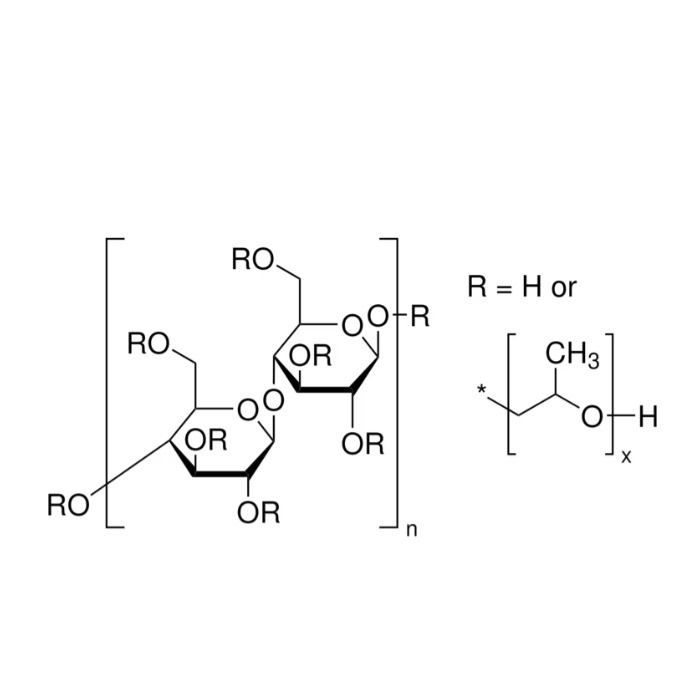
Hydroxypropyl cellulose(HPC) - average Mw ~370,000,powder,20 mesh particle size (99% through) , CAS No.9004-64-2

CAS: 9004-64-2 Cat. No.: H434476 Numero EC: 618-388-0
Disponibile su ordine
QUALITÀ & PUREZZA average Mw ~370,000,powder,20 mesh particle size (99% through)
Storage
Argon charged,Room temperature
Shipped In
Normal
★
Dimensione
Germania (EU)
USA*
Prezzo
Qtà
5g
H434476-5g
—
3 Disponibile
87,55€
25g
H434476-25g
—
1 Disponibile
208,17€
100g
H434476-100g
—
1 Disponibile
333,13€
500g
H434476-500g
Su ordinazione · 8–12 settimane
694,10€
Enter a quantity for the sizes you want to add.

Panoramica

Hydroxypropyl cellulose (HPC) is a nonionic derivativeof cellulose. It is a thermosensitive, biodegradable polymer with low criticalsolution temperature.

Specifiche

Specifiche e purezza
average Mw ~370,000,powder,20 mesh particle size (99% through)
Condizioni di conservazione di stoccaggio
Argon charged,Room temperature
Spedito in
Normal
Nomi e identificatori
Pubchem Sid
PH
5.0-8.5
WGK Germania
1

Dati avanzati

Certificati (CoA, COO, BSE/TSE e tabella di analisi)
C of A & Other Certificates(BSE/TSE, COO):
Analytical Chart:

Find and download the COA for your product by matching the lot number on the packaging.

8 results found

Lot NumberCertificate TypeDataOggetto
G2409437G2409437Certificate of AnalysisJun 29, 2024 H434476
G2409440G2409440Certificate of AnalysisJun 29, 2024 H434476
G2409441G2409441Certificate of AnalysisJun 29, 2024 H434476
G2409442G2409442Certificate of AnalysisJun 29, 2024 H434476
G2409513G2409513Certificate of AnalysisJun 29, 2024 H434476
G2409514G2409514Certificate of AnalysisJun 29, 2024 H434476
G2409515G2409515Certificate of AnalysisJun 29, 2024 H434476
H2514156H2514156Certificate of AnalysisJun 29, 2024 H434476
Proprietà chimiche e fisiche
SolubilitàH2O: insoluble (above 45 °C); polar organic solvents: soluble
SensibilitàMoisture sensitive
Domande frequenti e articoli
Microcrystalline Cellulose (MCC): A Comprehensive Primer and Selection Guide—Structural Features, Key Performance Metrics, and Application Scenarios
Materials Can “Switch”: How Smart Polymers Respond to Temperature, pH, and Light (with Experimental Selection Tips & Product Navigation)
Understanding Hydrophilic Polymers in Aqueous Systems: Hydration Mechanisms, Structural Knobs, and Task-Oriented Selection Guide (Including Tables 1–3)
From Structure to Rheology: How Carbomer Forms Gel Structures and Enables Thickening, Suspension, and Auxiliary Emulsion Stabilization
From Structure to Rheology: Thickening, Stabilization, and Selection Logic of Cellulose Ethers for Personal Care Applications
Analysis of the Production Process of Hydroxypropyl Methylcellulose (HPMC) for Putty: Understanding Differences in Substitution Structure and Gelation Temperature from High-Ratio and Low-Ratio Formulations
Types, Mechanisms of Action, Key Quality Indicators, and Selection and Application of Common Cellulose Ethers in Wall Putty
Influencing Factors and Control Strategies for Blistering in Neutral Wall Putty: An Experimental Analysis Based on HPMC Dosage, Viscosity, and Ground Calcium Carbonate Fineness
Differences and Application Selection of Cassava- and Corn-Based Pregelatinized Starch in Neutral Putty Formulations
What Is Direct Compression? Process Characteristics, Suitability Criteria, and Excipient Selection
Citations of This Product
Calcolatori di soluzioni
Recensioni

Recensioni dei clienti

Desidera che le inviamo un messaggio quando avremo sconti disponibili?

Ricordamelo più tardi

Grazie! Controlli la sua casella di posta per confermare.

Ops! Le notifiche sono disabilitate.