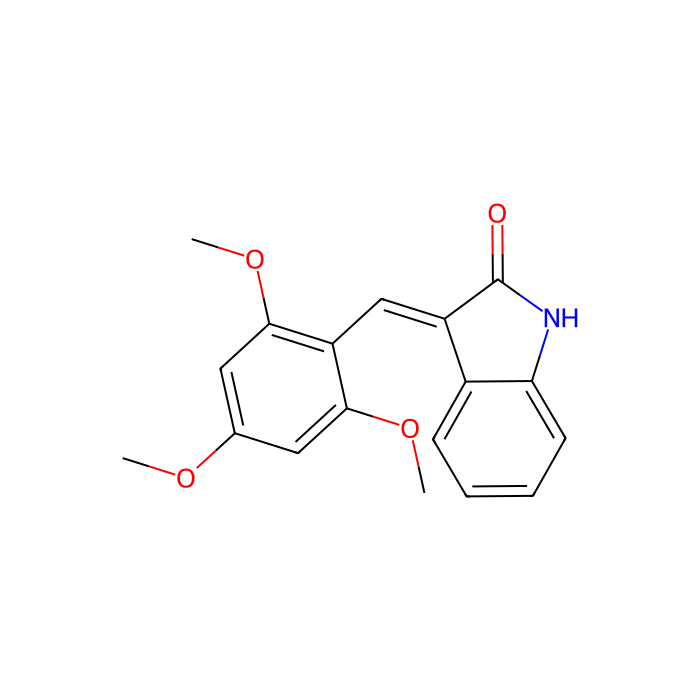
IC 261 - Moligand™, ≥99% , Inhibitor of casein kinase 1 alpha 1;Inhibitor of casein kinase 1 delta;Inhibitor of casein kinase 1 epsilon, CAS No.186611-52-9, Inhibitor of casein kinase 1 alpha 1;Inhibitor of casein kinase 1 delta;Inhibitor of casein kinase 1 epsilon

CAS: 186611-52-9 Cat. No.: I275786 Formula: C18H17NO4 Peso molecolare: 311.34
Disponibile su ordine
GRADE & PURITY Moligand™ ? Moligand™ — Aladdin's line of ligands and bioactive small molecules. Use for receptor, pathway, and binding studies needing defined small-molecule tools. ≥99%
Synonyms
NCGC00015546-02 | NCGC00015546-03 | HMS3229I10 | IDI1_012141 | Lopac0_001017 | SR-01000075566 | ic261 | NCGC00015546-01 | IC 261 | (3E)-3-[(2,4,6-trimethoxyphenyl)methylidene]-1,3-dihydro-2H-indol-2-one | LP01017 | BRD-K09638361-001-01-4 | DB03083 | 3-[(2
Storage
Protected from light,Store at -20°C,Desiccated
Shipped In
Ice chest + Ice pads
★
Size
Germania (EU)
USA*
Price
Qty
5mg
I275786-5mg
—
3 Disponibile
16,40€
25mg
I275786-25mg
—
3 Disponibile
49,37€
100mg
I275786-100mg
—
2 Disponibile
117,06€
250mg
I275786-250mg
—
2 Disponibile
258,50€
500mg
I275786-500mg
—
2 Disponibile
407,75€
Enter a quantity for the sizes you want to add.
🧪
Why this grade

Moligand™, ≥99% Moligand™ for sensitive chromatographic and analytical workflows requiring minimal baseline interference.

🌡

Storage & shipping

Protected from light,Store at -20°C,Desiccated Ships Ice chest + Ice pads Check lot-specific COA for exact specifications.

📋

Quality documents

SDS, COA, datasheet, and spec sheet available for download. Lot-specific COA accessible via lot number lookup.

📚

Literature proof

Cited in 0 peer-reviewed publications across chromatography, organic synthesis, and cross-coupling reactions.

Panoramica

Store at -20°C. It is important to note that this product is reported to be light sensitive. Store In the Dark. Store under desiccating conditions.

Specifications

Sinonimi
NCGC00015546-02 | NCGC00015546-03 | HMS3229I10 | IDI1_012141 | Lopac0_001017 | SR-01000075566 | ic261 | NCGC00015546-01 | IC 261 | (3E)-3-[(2,4,6-trimethoxyphenyl)methylidene]-1,3-dihydro-2H-indol-2-one | LP01017 | BRD-K09638361-001-01-4 | DB03083 | 3-[(2
Specifiche e purezza
Moligand™, ≥99%
Meccanismi biochimici e fisiologici
Selective CK1δ and CK1ε inhibitor. Potent microtubulin polymerization inhibitor. Induces cell cycle arrest and apoptosis. Selectively inhibits tumor cells growth. Shows antitumor effects in vivo.
Fonte
Synthetic
Condizioni di conservazione di stoccaggio
Protected from light,Store at -20°C,Desiccated
Spedito in
Ice chest + Ice pads
Questo prodotto richiede spedizione a catena fredda. I servizi di terra e altri servizi economici non sono disponibili.
Grado
Moligand™
Tipo di azione
INHIBITOR
Meccanismo d'azione
Inhibitor of casein kinase 1 alpha 1;Inhibitor of casein kinase 1 delta;Inhibitor of casein kinase 1 epsilon
Nota
Wherever possible, you should prepare and use solutions on the same day. However, if you need to make up stock solutions in advance, we recommend that you store the solution as aliquots in tightly sealed vials at -20°C. Generally, these will be useable for up to one month. Before use, and prior to opening the vial we recommend that you allow your product to equilibrate to room temperature for at least 1 hour. Need more advice on solubility, usage and handling? Please visit our frequently asked questions (FAQ) page for more details.
Purezza
≥99%
Nomi e identificatori
Pubchem Sid
Pubchem Sid Url
https://pubchem.ncbi.nlm.nih.gov/substance/504763518
Sorrisi canonici
COC1=CC(=C(C(=C1)OC)C=C2C3=CC=CC=C3NC2=O)OC
IUPAC Name
(3E)-3-[(2,4,6-trimethoxyphenyl)methylidene]-1H-indol-2-one
InChIKey
JBJYTZXCZDNOJW-JLHYYAGUSA-N
INCHI
1S/C18H17NO4/c1-21-11-8-16(22-2)14(17(9-11)23-3)10-13-12-6-4-5-7-15(12)19-18(13)20/h4-10H,1-3H3,(H,19,20)/b13-10+
Isomeri SMILES
COC1=CC(=C(C(=C1)OC)/C=C/2\C3=CC=CC=C3NC2=O)OC
Peso molecolare
311.34
Reaxy-Rn
14433656
Reaxys-RN_link_address
https://www.reaxys.com/reaxys/secured/hopinto.do?context=S&query=IDE.XRN=14433656&ln=

Documentazione

📋 Safety Data Sheet (SDS)

Comprehensive hazard, handling, storage, and regulatory compliance document.

Download SDS →

✅ Certificate of Analysis (COA)

Lot-specific quality data. Enter your lot number to retrieve the exact COA.

Look up COA →

📊 Datasheet

Quick-reference summary of product specifications and applications.

View datasheet →

🔬 Specification Sheet

Full quality attributes and acceptance criteria for this grade.

View spec sheet →

Advanced Data

Taxonomic Classification

Taxonomy Tree

KingdomOrganic compounds
SuperclassOrganoheterocyclic compounds
ClasseIndoles and derivatives
SubclassIndolines
Intermediate Tree Nodes Not available
Direct ParentIndolines
Alternative Parents Phenoxy compounds  Methoxybenzenes  Anisoles  Alkyl aryl ethers  Secondary carboxylic acid amides  Lactams  Azacyclic compounds  Organopnictogen compounds  Organonitrogen compounds  Organic oxides  Hydrocarbon derivatives  Carbonyl compounds  
Molecular FrameworkAromatic heteropolycyclic compounds
Substituents Dihydroindole - Phenoxy compound - Anisole - Methoxybenzene - Phenol ether - Alkyl aryl ether - Monocyclic benzene moiety - Benzenoid - Carboxamide group - Lactam - Secondary carboxylic acid amide - Carboxylic acid derivative - Ether - Azacycle - Hydrocarbon derivative - Organic oxygen compound - Organic nitrogen compound - Organic oxide - Carbonyl group - Organopnictogen compound - Organonitrogen compound - Organooxygen compound - Aromatic heteropolycyclic compound
DescrizioneThis compound belongs to the class of organic compounds known as indolines. These are compounds containing an indole moiety, which consists of pyrrolidine ring fused to benzene to form 2,3-dihydroindole.
External Descriptors Not available
Struttura 3D
Modello di struttura chimica interattiva


Obiettivi associati (umani)
CYP1A2 Tchem Cytochrome P450 1A2 (1 Activities)
Activity TypeActivity Value -log(M)Mechanism of ActionActivity ReferencePublications (PubMed IDs)
CSNK1D Tchem Casein kinase I isoform delta (1 Activities)
Activity TypeActivity Value -log(M)Mechanism of ActionActivity ReferencePublications (PubMed IDs)
CSNK1E Tclin Casein kinase I isoform epsilon (1 Activities)
Activity TypeActivity Value -log(M)Mechanism of ActionActivity ReferencePublications (PubMed IDs)
CSNK1A1 Tchem Casein kinase I isoform alpha (1 Activities)
Activity TypeActivity Value -log(M)Mechanism of ActionActivity ReferencePublications (PubMed IDs)
CHRM1 Tclin Muscarinic acetylcholine receptor M1 (12690 Activities)
Activity TypeRelationActivity valueUnitsAction TypeJournalPubMed IddoiAssay Aladdin ID
VDR Tclin Vitamin D receptor (26531 Activities)
Activity TypeRelationActivity valueUnitsAction TypeJournalPubMed IddoiAssay Aladdin ID
CSNK1D Tchem Casein kinase I delta (4546 Activities)
Activity TypeRelationActivity valueUnitsAction TypeJournalPubMed IddoiAssay Aladdin ID
ARSA Tbio Cerebroside-sulfatase (655 Activities)
Activity TypeRelationActivity valueUnitsAction TypeJournalPubMed IddoiAssay Aladdin ID
CSNK1E Tclin Casein kinase I epsilon (1412 Activities)
Activity TypeRelationActivity valueUnitsAction TypeJournalPubMed IddoiAssay Aladdin ID
ALDH1A1 Tchem Aldehyde dehydrogenase 1A1 (77053 Activities)
Activity TypeRelationActivity valueUnitsAction TypeJournalPubMed IddoiAssay Aladdin ID
CYP2D6 Tclin Cytochrome P450 2D6 (33882 Activities)
Activity TypeRelationActivity valueUnitsAction TypeJournalPubMed IddoiAssay Aladdin ID
CYP1A2 Tchem Cytochrome P450 1A2 (26471 Activities)
Activity TypeRelationActivity valueUnitsAction TypeJournalPubMed IddoiAssay Aladdin ID
CYP2C9 Tchem Cytochrome P450 2C9 (32119 Activities)
Activity TypeRelationActivity valueUnitsAction TypeJournalPubMed IddoiAssay Aladdin ID
CYP2C19 Tchem Cytochrome P450 2C19 (29246 Activities)
Activity TypeRelationActivity valueUnitsAction TypeJournalPubMed IddoiAssay Aladdin ID
CYP3A4 Tclin Cytochrome P450 3A4 (53859 Activities)
Activity TypeRelationActivity valueUnitsAction TypeJournalPubMed IddoiAssay Aladdin ID
TP53 Tchem Cellular tumor antigen p53 (48468 Activities)
Activity TypeRelationActivity valueUnitsAction TypeJournalPubMed IddoiAssay Aladdin ID
SH-SY5Y (11521 Activities)
Activity TypeRelationActivity valueUnitsAction TypeJournalPubMed IddoiAssay Aladdin ID
HEK293 (82097 Activities)
Activity TypeRelationActivity valueUnitsAction TypeJournalPubMed IddoiAssay Aladdin ID
HIF1A Tchem Hypoxia-inducible factor 1 alpha (6027 Activities)
Activity TypeRelationActivity valueUnitsAction TypeJournalPubMed IddoiAssay Aladdin ID
EHMT2 Tchem Histone-lysine N-methyltransferase, H3 lysine-9 specific 3 (93046 Activities)
Activity TypeRelationActivity valueUnitsAction TypeJournalPubMed IddoiAssay Aladdin ID
TDP1 Tchem Tyrosyl-DNA phosphodiesterase 1 (345557 Activities)
Activity TypeRelationActivity valueUnitsAction TypeJournalPubMed IddoiAssay Aladdin ID
SMN1 Tchem Survival motor neuron protein (34246 Activities)
Activity TypeRelationActivity valueUnitsAction TypeJournalPubMed IddoiAssay Aladdin ID
LMNA Tbio Prelamin-A/C (36751 Activities)
Activity TypeRelationActivity valueUnitsAction TypeJournalPubMed IddoiAssay Aladdin ID
BLM Tchem Bloom syndrome protein (4248 Activities)
Activity TypeRelationActivity valueUnitsAction TypeJournalPubMed IddoiAssay Aladdin ID
HPGD Tchem 15-hydroxyprostaglandin dehydrogenase [NAD+] (24926 Activities)
Activity TypeRelationActivity valueUnitsAction TypeJournalPubMed IddoiAssay Aladdin ID
THPO Tbio Thrombopoietin (834 Activities)
Activity TypeRelationActivity valueUnitsAction TypeJournalPubMed IddoiAssay Aladdin ID
GMNN Tbio Geminin (128009 Activities)
Activity TypeRelationActivity valueUnitsAction TypeJournalPubMed IddoiAssay Aladdin ID
RAB9A Tbio Ras-related protein Rab-9A (22488 Activities)
Activity TypeRelationActivity valueUnitsAction TypeJournalPubMed IddoiAssay Aladdin ID
PMP22 Tbio Peripheral myelin protein 22 (699 Activities)
Activity TypeRelationActivity valueUnitsAction TypeJournalPubMed IddoiAssay Aladdin ID
CBX1 Tbio Chromobox protein homolog 1 (92434 Activities)
Activity TypeRelationActivity valueUnitsAction TypeJournalPubMed IddoiAssay Aladdin ID
ATAD5 Tbio ATPase family AAA domain-containing protein 5 (122566 Activities)
Activity TypeRelationActivity valueUnitsAction TypeJournalPubMed IddoiAssay Aladdin ID
MPHOSPH8 Tbio M-phase phosphoprotein 8 (656 Activities)
Activity TypeRelationActivity valueUnitsAction TypeJournalPubMed IddoiAssay Aladdin ID
ATXN2 Tbio Ataxin-2 (54410 Activities)
Activity TypeRelationActivity valueUnitsAction TypeJournalPubMed IddoiAssay Aladdin ID
RGS4 Tchem Regulator of G-protein signaling 4 (13867 Activities)
Activity TypeRelationActivity valueUnitsAction TypeJournalPubMed IddoiAssay Aladdin ID
Obiettivi associati (non umani)
Mapk1 MAP kinase ERK2 (650 Activities)
Activity TypeRelationActivity valueUnitsAction TypeJournalPubMed IddoiAssay Aladdin ID
Hdac6 Histone deacetylase 6 (222 Activities)
Activity TypeRelationActivity valueUnitsAction TypeJournalPubMed IddoiAssay Aladdin ID
Saccharomyces cerevisiae (19171 Activities)
Activity TypeRelationActivity valueUnitsAction TypeJournalPubMed IddoiAssay Aladdin ID
lef Anthrax lethal factor (7585 Activities)
Activity TypeRelationActivity valueUnitsAction TypeJournalPubMed IddoiAssay Aladdin ID
rep Replicase polyprotein 1ab (378 Activities)
Activity TypeRelationActivity valueUnitsAction TypeJournalPubMed IddoiAssay Aladdin ID
pfk 6-phospho-1-fructokinase (7870 Activities)
Activity TypeRelationActivity valueUnitsAction TypeJournalPubMed IddoiAssay Aladdin ID
Txnrd1 Thioredoxin reductase 1, cytoplasmic (45279 Activities)
Activity TypeRelationActivity valueUnitsAction TypeJournalPubMed IddoiAssay Aladdin ID
Mapt Microtubule-associated protein tau (6 Activities)
Activity TypeRelationActivity valueUnitsAction TypeJournalPubMed IddoiAssay Aladdin ID
Nfe2l2 Nuclear factor erythroid 2-related factor 2 (214 Activities)
Activity TypeRelationActivity valueUnitsAction TypeJournalPubMed IddoiAssay Aladdin ID
FTL Ferritin light chain (43324 Activities)
Activity TypeRelationActivity valueUnitsAction TypeJournalPubMed IddoiAssay Aladdin ID
nfo Endonuclease 4 (425 Activities)
Activity TypeRelationActivity valueUnitsAction TypeJournalPubMed IddoiAssay Aladdin ID
NS1 Nonstructural protein 1 (33327 Activities)
Activity TypeRelationActivity valueUnitsAction TypeJournalPubMed IddoiAssay Aladdin ID
Meccanismi d'azione
Certificati (CoA, COO, BSE/TSE e tabella di analisi)
C of A & Other Certificates(BSE/TSE, COO):
Analytical Chart:

Find and download the COA for your product by matching the lot number on the packaging.

5 results found

Lot NumberCertificate TypeDataOggetto
K2203421Certificate of AnalysisAug 04, 2026 I275786
K2203437Certificate of AnalysisAug 04, 2026 I275786
K2203438Certificate of AnalysisAug 04, 2026 I275786
K2203453Certificate of AnalysisAug 04, 2026 I275786
K2203475Certificate of AnalysisAug 04, 2026 I275786
Proprietà chimiche e fisiche
SolubilitàSoluble in DMSO to 50 mM
Sensibilitàlight sensitive
Punto di fusione (°C)214 °C
Peso molecolare311.300 g/mol
XLogP32.800
Hydrogen Bond Donor Count1
Hydrogen Bond Acceptor Count4
Rotatable Bond Count4
Exact Mass311.116 Da
Monoisotopic Mass311.116 Da
Topological Polar Surface Area56.800 Ų
Heavy Atom Count23
Formal Charge0
Complexity450.000
Isotope Atom Count0
Defined Atom Stereocenter Count0
Undefined Atom Stereocenter Count0
Defined Bond Stereocenter Count1
Undefined Bond Stereocenter Count0
The total count of all stereochemical bonds1
Covalently-Bonded Unit Count1
Calcolatori di soluzioni
Recensioni

Recensioni dei clienti

Application Protocols

Not specified for this item; no tested applications or recommended dilutions are provided in the product data.

General guidance for small-molecule tool compounds (non-validated suggestions):

  • Prepare a sterile-filtered DMSO stock (e.g., 10–50 mM). Store as single-use aliquots at −20 °C protected from light.
  • For cell-based assays: titrate across a broad range (e.g., 0.01–30 µM final) to determine system-specific response; maintain constant vehicle percentage across conditions. Validate cytotoxicity and off-target effects appropriate to your model.
  • For biochemical assays: perform concentration–response curves with appropriate enzyme and substrate concentrations; include time controls and orthogonal assays to confirm mechanism. These are generic suggestions and are not item-specific recommendations.
Biological Roles

Scope note: IC 261 is a synthetic small-molecule tool compound used to interrogate cellular pathways. The following content summarizes literature/general knowledge and is not an item-specific claim.

  • Functional class: bioactive small-molecule probe commonly employed in kinase biology. It is used to perturb serine/threonine kinase signaling in vitro and in cells to study pathway dependencies and timing.
  • Typical research contexts (literature): pathway mapping, target validation, and phenotypic assays where transient, reversible chemical modulation enables time-resolved studies.
  • Systems studied: recombinant enzymes, cell lines, and cell-free extracts; often combined with orthogonal biochemical readouts (e.g., phosphorylation-state assays) to confirm pathway effects.
  • Practical considerations:
    • Use appropriate vehicle controls to discern solvent effects.
    • Perform concentration–response profiling and include exposure-time controls to distinguish primary from downstream effects.
    • Confirm on-target engagement via biochemical assays or chemoproteomic approaches where feasible.

Important restrictions:

  • For research use only (product data). No use in humans or animals for therapeutic or diagnostic purposes.
  • Do not infer clinical efficacy or safety from in vitro or cellular data; this product is intended strictly for laboratory research.
Buffer Applications

This product is a hydrophobic research ligand and is not a buffering agent. Therefore, classical buffer system guidance (pKa, buffer capacity, recipe tables) does not apply.

Practical handling in buffered systems (general):

  • Prepare a concentrated DMSO stock and dilute into the working buffer with vigorous mixing. Keep final DMSO low (typically ≤0.1–1% v/v) as allowed by your assay.
  • If precipitation occurs on dilution, increase mixing rate, slightly warm the buffer (e.g., to room temperature), or include permissible solubilizing aids (e.g., HPβCD). Validate any additives for assay compatibility.
Green Alternatives

Context: IC 261 is a research ligand; “green” considerations pertain mainly to solvent choice for dissolution and assay use rather than process chemistry.

General guidance (literature/best practice):

  • Prefer DMSO over DMF for stock solutions when feasible, due to broader acceptance and handling familiarity in bioassays. Keep final DMSO levels as low as assay design allows (≤0.1–1% v/v) to minimize solvent burden.
  • Explore aqueous enabling strategies to reduce organic content:
    • Cyclodextrin inclusion complexes (e.g., HPβCD) to enhance apparent solubility.
    • Co-solvent blends with ethanol or propylene glycol in small percentages, verifying biological compatibility.
    • pH adjustment is typically ineffective for neutral, non-ionizable scaffolds like indolinones; avoid unnecessary buffer modifications.
  • Waste minimization: prepare small, single-use aliquots to reduce discard of degraded solutions; use amber vials to extend shelf life and minimize repeated preparations.

Comparison (general; not item-specific specifications):

  • DMSO: high solvency, low volatility, broadly accepted in screening; environmental and safety profile manageable at small scales.
  • Ethanol: renewable, greener profile but often insufficient solvency for hydrophobic scaffolds at low volumes.
  • Aqueous carriers (cyclodextrins/surfactants): reduce organic solvent use but add components that may interact with assay readouts—validate carefully.

No greener “substitute compound” exists for IC 261’s biochemical role; the greener strategy is primarily solvent optimization and right-sizing experimental scales.

Pharmaceutical Uses

Not applicable for this catalog item. IC 261 is supplied for research use only (product data) and is not an excipient or a GMP drug-substance intermediate.

General context (non-clinical):

  • In discovery research, compounds of this class may be used as reference ligands or tool compounds in early screening and mechanistic studies. They are not formulated for human or veterinary administration.
  • No pharmacopeial monograph is indicated for this item. Any formulation-like handling (e.g., for in vivo models) is outside the scope of this listing and must adhere to institutional approvals and regulations. No medical or clinical claims are made or implied.
Physical Properties

Item-specific specifications (this listing):

  • Appearance: Not specified for this item; refer to CoA/Spec Sheet.
  • Molecular weight: Not specified for this item; refer to CoA/Spec Sheet.
  • Molecular formula: Not specified for this item; refer to CoA/Spec Sheet.
  • Melting point, boiling point, density, refractive index, water/peroxide/metal limits: Not specified for this item; refer to CoA/Spec Sheet.

Literature/general properties for IC 261 (for context only; not lot specifications):

  • Physical state: typically a solid organic compound used as a dry powder standard for preparation of DMSO stocks.
  • Solubility: commonly soluble in DMSO and other strong aprotic organic solvents (e.g., DMF); sparingly soluble to practically insoluble in water; limited solubility in aqueous buffers unless co-solvents or carriers (e.g., cyclodextrins, surfactants) are used.
  • Polarity/partitioning: hydrophobic small molecule; stocks are usually prepared at millimolar concentrations in DMSO.

Practical notes (general guidance):

  • Prepare concentrated DMSO stocks (e.g., 10–50 mM), then dilute into assay buffer keeping final DMSO ≤0.1–1% v/v as tolerated by the system.
  • Sonication or brief warming (≤40 °C) may assist dissolution; avoid prolonged heating or light exposure.

Always treat literature values as indicative only. For authoritative values governing acceptance and use, consult the item’s CoA/Spec Sheet and SDS.

Quality and Grades
  • Grade/Purity designation: Moligand™ (product data). Moligand is used to denote small-molecule ligands/tool compounds provided for research use. This typically implies suitability for biochemical and cell-based assays, with emphasis on identity and purity control appropriate for discovery research.

What Moligand™ generally implies (general guidance; not item-specific specifications):

  • Identity confirmation by orthogonal analytical methods (e.g., 1H NMR/LC–MS/HPLC). Exact methods and acceptance criteria vary; consult the CoA for this SKU/lot.
  • Purity intended for research applications (e.g., screening, target validation). UV cutoff, residual solvents, inorganic residue, water content, and related impurity profiles are defined per internal specifications but are not listed here.

Stabilizers/additives:

  • Not specified for this item; refer to CoA/Spec Sheet.

Batch documentation and traceability:

  • For citable work, retain the CoA/Spec Sheet and lot number. If low-UV or trace-metal specifications are critical, request documentation prior to use.

Fit-for-purpose notes:

  • For analytical or bioassay work, verify solubility and purity in your assay matrix by quick pre-checks (HPLC/UPLC purity in your eluent; mass confirmation). Where stringent thresholds (e.g., for quantitative biophysics) are required, set in-house acceptance criteria based on your method and consult the CoA before release to study.
Reaction and Applications

Scope for this product: IC 261 is primarily used as a biochemical tool compound rather than as a synthetic reagent.

Research applications (literature/general):

  • Widely used in kinase-focused studies and chemical biology as a small-molecule probe to modulate specific serine/threonine kinase activity in cells and lysates. Employed in pathway interrogation, phenotypic screens, and target-validation experiments.
  • Utilized in timing- and dose–response studies to dissect signaling cascades in vitro and in cell culture, including mechanistic assays with recombinant enzymes and cellular reporters.
  • Serves as a reference/contrast ligand in structure–activity relationship (SAR) campaigns on indolinone/arylmethylene scaffolds.

Practical guidance (general):

  • Prepare fresh or thawed single-use DMSO aliquots to maintain consistency across experiments.
  • Include matched vehicle controls (same final DMSO%) and, where possible, orthogonal probes to confirm on-target phenotypes.
  • Verify compound integrity by LC–MS or HPLC after extended storage or repeated freeze–thaw.

Not a typical reagent for synthetic transformations: IC 261 is not commonly employed as a catalyst, coupling partner, or protecting-group reagent. For chemical synthesis content, see the Synthetic Utility section, which focuses on scaffold derivatization considerations rather than reactions using IC 261 as a reagent.

Reaction Conditions

Not typically applicable. IC 261 is supplied as a finished research ligand and is not commonly used as a reagent, catalyst, or coupling partner in synthetic transformations.

General handling for solution preparation (literature/guidance):

  • Solvent: DMSO for concentrated stocks; dilute into assay buffer immediately before use.
  • Temperature: dissolve at ambient temperature; brief warming (≤40 °C) or sonication can aid dissolution. Avoid prolonged heating and protect from light.
  • Atmosphere: no special atmosphere is generally required for solution prep; keep containers tightly closed and desiccated to limit moisture ingress.
Safety and Handling

GHS classification and hazards for this specific item:

  • Signal word: Not specified for this item; refer to SDS.
  • Hazard statements (H-Statements): Not specified for this item; refer to SDS.
  • GHS classification/pictograms: Not specified for this item; refer to SDS.

General safety considerations for small-molecule research ligands (literature/best practice):

  • Potential hazards: may be harmful if swallowed, inhaled, or absorbed through skin; may cause irritation to skin, eyes, and respiratory tract. Treat as a bioactive compound of unknown toxicity.
  • PPE: wear lab coat, nitrile gloves, and safety glasses/goggles. Handle powders in a fume hood to avoid dust/aerosol exposure.
  • Handling: minimize light exposure (product data: protect from light). Avoid contact with oxidants and strong acids/bases unless stability is known. Prevent inhalation of dust and contact with skin/eyes.
  • First aid (overview; defer to SDS):
    • Inhalation: move to fresh air; seek medical attention if symptoms persist.
    • Skin: wash with soap and water; remove contaminated clothing.
    • Eyes: rinse cautiously with water for several minutes; remove contact lenses if present and easy; seek medical attention for persistent irritation.
    • Ingestion: rinse mouth; seek medical attention.
  • Special risks and precautions: Bioactive small molecules can affect cellular pathways; avoid exposure and environmental release. Use secondary containment for stock solutions. Dispose of waste according to institutional and local regulations.

Always consult the official SDS for authoritative hazard, exposure controls, and first-aid guidance.

Solvent Selection

Use-case focus: preparing concentrated stocks for biochemical and cell-based assays.

General solvent behavior (literature/general):

  • Polarity: hydrophobic, neutral small molecule; poor water solubility is typical.
  • Recommended primary solvent: DMSO for stock solutions due to strong solvating power and assay compatibility in low percentages.
  • Alternative solvents: DMF or ethanol may dissolve the compound, but DMSO generally offers superior stability and solubility for aromatic indolinone scaffolds.
  • Aqueous systems: direct dissolution in buffer is usually limited. Use co-solvent dilution from a DMSO stock; maintain final DMSO ≤0.1–1% v/v as tolerated by the system.

Practical tips (general):

  • Order of addition: add DMSO to the weighed solid, vortex, brief sonication, then dilute into pre-warmed buffer with rapid mixing to minimize precipitation.
  • Solubilization aids: hydroxypropyl-β-cyclodextrin (HPβCD) or non-ionic surfactants (e.g., 0.01–0.05% Tween-20) can increase apparent solubility in aqueous media; verify assay compatibility.
  • Filtration: if needed, use 0.22 µm PTFE or PVDF filters. Avoid nylon if strong H-bonding interactions reduce recovery.

Comparison snapshot (general):

  • DMSO: highest solvency; good chemical stability; widely accepted in screening.
  • Ethanol: lower solvency; more volatile; higher assay interference risk at comparable solvent percentages.
  • DMF: high solvency but more hygroscopic; consider toxicity/handling constraints.

Item-specific solubility data are not provided in the product data; verify empirically in your intended matrix.

Storage and Reconstitution

Item-specific storage/shipping (product data):

  • Storage: store at −20 °C, desiccated, protected from light.
  • Shipping: ice chest + ice pads.

General reconstitution guidance for hydrophobic research ligands (literature/best practice; not a specification):

  • Solvent: dissolve the solid in anhydrous DMSO to prepare a concentrated stock (e.g., 10–50 mM). Vortex and, if needed, sonicate briefly. Avoid prolonged exposure to ambient light.
  • Aliquoting: dispense into amber or foil-wrapped, low-bind microtubes in single-use portions to minimize freeze–thaw.
  • Storage of solutions: store aliquots at −20 °C, protected from light and moisture. Allow to equilibrate to room temperature before opening to prevent condensation ingress.
  • Stability checks: periodically confirm integrity by LC–MS/HPLC, especially after >3–6 months or if color/clarity changes are observed.
  • Aqueous working solutions: prepare immediately before use by diluting the DMSO stock into buffer with vigorous mixing; use within the experimental timeframe and discard leftovers.

Notes:

  • Appearance and item-specific solubility are not provided; consult the CoA/Spec Sheet for lot-specific guidance.
  • Always label aliquots with compound name, concentration, solvent, date, and lot number to preserve traceability.
Structure and Identity

Brief overview: IC 261 is a small-molecule research ligand (Moligand grade) widely used as a biochemical tool compound.

  • CAS: 186611-52-9 (product data)
  • PubChem CID: 5288600 (product data)
  • InChIKey: 155904 (product data)
  • SMILES: Not specified for this item; refer to CoA/Spec Sheet.
  • Molecular formula: Not specified for this item; refer to CoA/Spec Sheet.
  • Molecular weight: Not specified for this item; refer to CoA/Spec Sheet.

Structural features (literature/general):

  • IC 261 belongs to the indolinone/arylmethylene chemotype. It is commonly described as an indolin-2-one core bearing an arylmethylene substituent (conjugated enone-like system) on C-3.
  • Functional groups typically include: a lactam (indolin-2-one), an exocyclic C=C linking to an aryl ring; overall neutral, moderately hydrophobic scaffold.
  • 2D description (literature): a bicyclic indole-derived lactam fused ring (benzene + five-membered nitrogen heterocycle) with an exocyclic alkene to a substituted phenyl ring.

Notes:

  • Exact stereochemical or tautomeric depiction and definitive identifiers for this specific lot are not specified in the product data; consult the CoA/SDS for authoritative identity attributes.
Synthetic Utility

This product is procured as a finished bioactive ligand and is not typically used as a building block or reagent in synthetic sequences.

Literature/general chemistry notes on scaffold derivatization:

  • The indolin-2-one/arylmethylene framework is a well-studied privileged scaffold in medicinal chemistry. Modifications at the aryl ring (electronic and steric tuning), the exocyclic C=C (E/Z geometry control, hydrogenation), and the indolinone N-1 (alkylation, sulfonylation) are common routes to probe structure–activity relationships (SAR).
  • Typical transformations applied to related scaffolds include:
    • Knoevenagel-type condensations to install the arylmethylene onto the 3-position of indolin-2-one.
    • Electrophilic substitutions on the pendant aryl ring for diversification.
    • Reduction or Michael-type additions across the exocyclic alkene to explore 3D analogs.
  • Stability considerations: conjugated enone-like systems may undergo photoisomerization or slow degradation under strong light/oxidants; protect from light (aligns with product data) during synthetic manipulations of analogs.

If you intend to derivatize IC 261 itself, verify purity and identity after each step and consider starting from indolin-2-one to build analogs de novo for cleaner routes.

Target Specificity

Not specified for this item; refer to CoA/Spec Sheet.

Note: While literature may discuss biochemical targets associated with IC 261, Aladdin’s catalog listing for SKU I275786 does not specify target, selectivity, or binding constants. Users should consult primary literature and verify target engagement experimentally within their specific system.

Shall we send you a message when we have discounts available?

Remind me later

Thank you! Please check your email inbox to confirm.

Oops! Notifications are disabled.