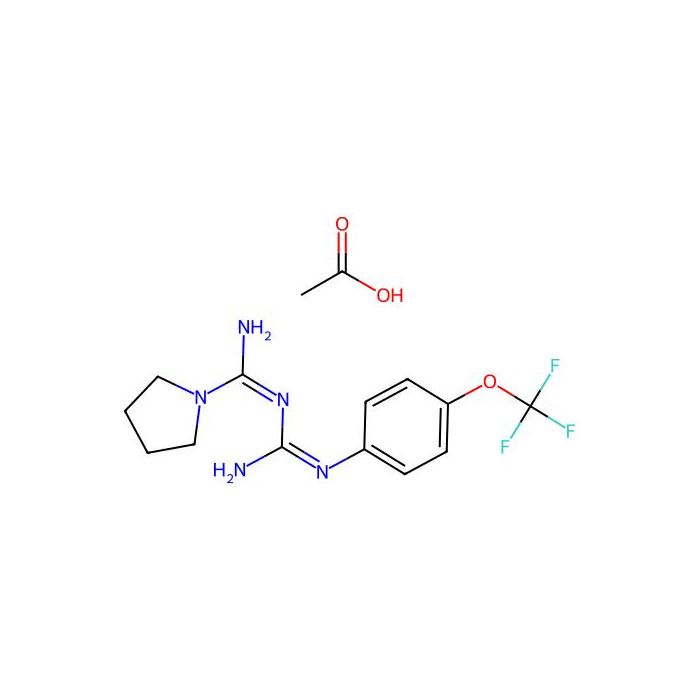
IM156 (HL156A; HL271 acetate), a chemical derivative of Metformin , is a potent and orally active AMPK activator that increases AMPK phosphorylation. IM156 attenuates aging-associated cognitive impairment in animal model IM156 is a potent oxidative phosphorylation (OXPHOS) inhibitor which can be used for the research of solid tumors
In Vitro
IM156 (0.31-10 μM) phosphorylates AMPKα1 Thr172 in a dose- and time-dependent manner in NIH3T3 mouse fibroblast cells. IM156 does not affect the expression of key factors involved in glucose homeostasis such as glucose-6-phosphatase (G6pase) or phosphoenolpyruvate carboxykinase 1 (Pck1). MCE has not independently confirmed the accuracy of these methods. They are for reference only. Western Blot AnalysisCell Line: NIH3T3 cells Concentration: 0.31 μM, 0.62 μM, 1.25 μM, 2.5 μM, 5 μM, 10 μM Incubation Time: 4 hours Result: Significantly increased the AMPK phosphorylation rate.
In Vivo
IM156 does not affect metabolic regulation assessed by body weight, blood glucose, insulin levels and lipid metabolite content in mice with diet-induced obesity . IM156 (50 mg/kg; for 2 months) does not affect body weight, general locomotion, or anxiety. IM156 significantly attenuates the aging-induced decline in novel object recognition memory and spatial working memory. IM156 significantly increases AMPK activation in the hippocampus of aged mice. MCE has not independently confirmed the accuracy of these methods. They are for reference only. Animal Model: C57BL/6J mice (young group/12-16 weeks, old groups/20-22 months)Dosage: 50 mg/kg Administration: Oral administration (drinking water), for 2 months Result: Attenuated age-related cognitive decline.
Form:Solid
IC50& Target:AMPK, OXPHOS
Specifiche
Specifiche e purezza
≥99%
Meccanismi biochimici e fisiologici
IM156 (HL156A; HL271 acetate), a chemical derivative of Metformin ( HY-B0627 ), is a potent and orally active AMPK activator that increases AMPK phosphorylation. IM156 attenuates aging-associated cognitive impairment in animal model. IM156 is a p
Condizioni di conservazione di stoccaggio
Store at 2-8°C,Protected from light,Desiccated
Spedito in
Wet ice
Questo prodotto richiede spedizione a catena fredda. I servizi di terra e altri servizi economici non sono disponibili.
This compound belongs to the class of organic compounds known as phenol ethers. These are aromatic compounds containing an ether group substituted with a benzene ring.
External Descriptors
Not available
1. Djoumbou Feunang Y, Eisner R, Knox C, Chepelev L, Hastings J, Owen G, Fahy E, Steinbeck C, Subramanian S, Bolton E, Greiner R, and Wishart DS. ClassyFire: Automated Chemical Classification With A Comprehensive, Computable Taxonomy. Journal of Cheminformatics, 2016, 8:61.
Certificati (CoA, COO, BSE/TSE e tabella di analisi)
C of A & Other Certificates(BSE/TSE, COO):
Analytical Chart:
Proprietà chimiche e fisiche
Solubilità
DMSO : 100 mg/mL (266.42 mM; Need ultrasonic)
Calcolatori di soluzioni
Molarity Calculator
Determine the necessary mass, volume, or concentration for preparing a solution.
Dilution Calculator
Determine the dilution needed to prepare a stock solution.
Reconstitution Calculator
Recensioni
Recensioni dei clienti
Application Protocols
No vendor-validated protocols or application notes are provided for this product.
General guidance for small-molecule handling in research assays
Stock preparation: Dissolve in dry DMSO to 10–50 mM. Vortex, sonicate briefly if needed, and verify concentration by UV (if chromophore) or qNMR.
Working solutions: Dilute into assay buffer immediately before use; keep final DMSO ≤0.5–1% v/v to minimize vehicle effects.
Plate handling: Use low-binding plasticware for hydrophobic compounds. Pre-dispense vehicle controls matched to the highest solvent concentration.
Light protection: Given the storage note, use amber vials/plates or wrap with foil during assay setup and incubation, as appropriate.
Stability checks: Reassess by LC–MS after multiple freeze–thaw events or prolonged bench exposure. Replace stocks that show new impurity peaks or precipitation.
All steps should be adapted to your assay platform and confirmed by pilot experiments. Refer to the SDS and CoA for any item-specific constraints.
Biological Roles
Biological function, target class, and pathway engagement for IM156 are not specified for this item; refer to primary literature or the CoA/Spec Sheet if available.
General best practices for small molecules used in biological research (not item-specific)
Confirm identity and purity prior to biological testing (orthogonal LC–MS/NMR), as minor impurities can confound assay readouts.
Establish solubility and aggregation behavior in the exact assay matrix (buffer composition, pH, surfactants) to avoid colloidal artifacts.
Determine stability in assay media (chemical and metabolic, as applicable) and light sensitivity given the storage note to protect from light.
Include counterscreens (e.g., enzymatic orthogonals, redox/fluorescence interference panels) to control for mechanism-agnostic interference.
Data reporting
Report batch/lot, stock solvent, concentration verification (qNMR/UV), and final vehicle composition in all biological figures.
Note: No claims of therapeutic use are made. This product is supplied strictly for research use only, as indicated by the Research Use Note.
Buffer Applications
This product is a small organic research compound and is not a classical buffering agent. No buffer capacity, pKa, or buffer recipes are specified for this item.
Practical guidance
If the compound must be formulated in aqueous media for assays, prepare concentrated DMSO or ethanol stocks and dilute into the desired buffer (e.g., PBS, HEPES, Tris) keeping final organic solvent ≤0.5–1% v/v when possible.
For limited aqueous solubility, consider inclusion of 0.01–0.05% nonionic surfactant or use of cyclodextrin carriers, pending compatibility with the biological system.
For true buffer selection (not related to this item), choose buffering agents based on target pH range and ionic strength requirements.
Green Alternatives
Because the structure and use-case of IM156 are not provided, specific greener substitutes cannot be identified. General guidance for greener practice with small molecules:
Prefer greener solvents for preparation and workup when feasible: water, ethanol, isopropanol, ethyl acetate, 2-MeTHF, CPME (selection depends on the molecule’s solubility and stability). This is general guidance and not item-specific.
Minimize DMSO concentration in biological assays to ≤0.5–1% v/v to reduce environmental and biological burden while maintaining solubility.
Implement microscale reactions and high-throughput experimentation (HTE) to cut solvent and reagent usage.
Use LC–MS with short gradients and low-flow columns (micro/UPLC) to reduce solvent consumption during analytical runs.
Waste management: Segregate halogenated from non-halogenated solvent waste; absorbent materials used for spills should be disposed as hazardous waste.
Tradeoffs (general)
Greener solvents may reduce solubility for highly lipophilic compounds, potentially requiring co-solvents or temperature to achieve dissolution.
Lower-toxicity reagents/solvents can influence reaction rate or selectivity; conduct small-scale trials before scaling any greener substitution.
Note: No item-specific green alternative is proposed due to absent structural and application data.
Pharmaceutical Uses
Pharmacopeial status: Not specified for this item; refer to CoA/Spec Sheet. IM156 is provided for research use only and is not an excipient or an approved pharmaceutical ingredient per the supplied data.
Formulation-related considerations for research use (general)
If used in pre-formulation or delivery research, determine solid-state form (free base/acid vs. salt, solvate/hydrate) and perform hygroscopicity assessment to inform handling, as storage calls for desiccation and light protection.
Solubilization strategies for in vitro work: DMSO stock dilution, cosolvent systems, pH adjustment for ionizable compounds, or complexation (e.g., HP-β-CD). Verify that any enabling excipients do not interfere with the assay.
For any in vivo exploratory research (outside the scope of this catalog item), institutional approvals and additional safety data would be required; this listing does not provide such authorization.
Regulatory note
No medical or clinical claims are made. This material is not intended for human or veterinary use, diagnostic procedures, or as a drug substance.
Physical Properties
Item-specific physicochemical parameters were not provided with this listing. Do not treat typical or literature values as specifications for this item.
Appearance: Not specified for this item; refer to CoA/Spec Sheet.
Melting point: Not specified for this item; refer to CoA/Spec Sheet.
Boiling point: Not specified for this item; refer to CoA/Spec Sheet.
Density: Not specified for this item; refer to CoA/Spec Sheet.
Refractive index: Not applicable/unknown for solids; Not specified for this item; refer to CoA/Spec Sheet.
Solubility profile: Not specified for this item; refer to CoA/Spec Sheet.
logP/logD: Not specified for this item; refer to CoA/Spec Sheet.
pKa(s): Not specified for this item; refer to CoA/Spec Sheet.
UV–Vis characteristics: Not specified for this item; refer to CoA/Spec Sheet.
Practical guidance (general, not item-specific specifications)
For unknown small molecules, initial solubility screening can be run in DMSO (5–50 mM stock), DMF, ethanol, acetonitrile, and buffered aqueous vehicles with 1–5% cosolvent and/or 0.01–0.1% nonionic surfactant.
If a chromophore is suspected, collect a quick UV–Vis scan (200–400 nm) to guide HPLC detection; otherwise use ELSD/CAD or MS-based detection.
Determine thermal behavior by DSC/TGA to set any custom storage or processing limits. All values generated in-house should not be assumed to match vendor specifications without confirmation from the CoA.
Quality and Grades
Grade/Purity: Not specified for this item; refer to CoA/Spec Sheet.
What to expect in the CoA/Spec Sheet
Identification tests: Typically LC–MS (m/z match), HPLC purity (area %), and 1H NMR. Confirm which were applied for this lot.
Purity reporting: HPLC area % at a specified wavelength and method. Note that area % is method-dependent; request chromatogram/method details for critical applications.
Counterions/solvates: If the material is supplied as a salt or solvate, the CoA should indicate the form and assay on anhydrous/free-base/free-acid basis.
Implications for use
For screening and medicinal chemistry, a purity ≥95% is often preferred, but this listing provides no specification—verify before use in SAR or biophysical assays.
Trace residual solvents, water content, and inorganic impurities: Not specified for this item; refer to CoA/Spec Sheet. If relevant to your work (e.g., catalysis, MS quantitation), request KF, ICP, and residual solvent data.
Stabilizers/additives
Stabilizers or inhibitors: Not specified for this item; refer to CoA/Spec Sheet. If present, note their assay interference potential.
Documentation best practices
Record lot number, retain CoA, and annotate your internal database with analytical confirmation (e.g., orthogonal LC method) upon receipt.
Reaction and Applications
No manufacturer application notes were supplied for this item. Without a disclosed structure, reaction-specific guidance cannot be provided for this compound. The following are general-use contexts for library small molecules in R&D:
Screening and profiling: Use as a discrete test article in biochemical, biophysical, or cell-based assays. Validate identity and purity before generating SAR.
Analytical characterization: Establish retention time and MS fingerprint under your platform LC–MS method to enable QC and stability-indicating assays.
Stability studies: Conduct forced-degradation screening (acid/base, oxidative, light, heat) to map liabilities; use results to set handling limits.
Solid-form evaluation: If extended work is planned, consider polymorph/solvate screening and moisture uptake (DVS) to support consistent performance.
Derivatization: If structure is later confirmed and contains modifiable handles, plan analogue synthesis or linker installation for target ID (e.g., photoaffinity or biotinylated probes). This is contingent on known functionality and is not specific to this item.
Important: Do not assume reactivity, functional groups, or protecting-group requirements for this compound until the CoA or a trusted database entry provides definitive structural information.
Reaction Conditions
No reaction conditions can be recommended for IM156 without disclosure of its structure and functional groups. The following general notes apply only if you later pursue synthesis or modifications once the structure is confirmed:
Solvent and temperature: Select based on functional group compatibility and stability. Begin with room temperature trials and escalate cautiously while monitoring by TLC/LC–MS.
Atmosphere: Use inert gas (N2/Ar) if air/moisture sensitivity is suspected. Light sensitivity is implied by storage guidance; exclude light during reactions and workups when prudent.
Catalysis: Choose catalysts (acid/base/transition metal/organocatalyst) according to the intended transformation and known tolerance of the scaffold. Screen heterogeneous vs. homogeneous systems for practicality.
Workup and purification: Develop stability-indicating methods. For unknown chromophores, consider LC–MS-directed fraction collection or non-UV detectors (ELSD/CAD). Avoid prolonged exposure to aqueous phases if hydrolysis is a concern.
Analytical follow-up: Record LC–MS methods, retention times, and mass spectra for both starting material and products to maintain traceability.
Note: None of the above constitutes item-specific conditions.
Safety and Handling
GHS classification, signal word, pictograms, and H-statements: Not specified for this item; refer to the SDS.
General hazards: Treat as a research chemical of unknown toxicity. Avoid inhalation, ingestion, and skin/eye contact. Use only in a chemical fume hood.
PPE and engineering controls
Wear lab coat, safety glasses or chemical splash goggles, and appropriate chemically resistant gloves (e.g., nitrile). Use a certified fume hood for weighing, dissolution, and transfers.
Handling guidance
Prevent exposure to light and moisture as indicated by storage instructions. Minimize headspace oxygen if the compound is air- or light-sensitive (store in amber vials; purge with inert gas if appropriate).
Avoid incompatible materials until identity and functionality are confirmed. Typical incompatibilities (general): strong oxidizers, strong acids/bases, and reactive metals.
First-aid overview (refer to SDS for authoritative instructions)
Skin/eye contact: Rinse with water for at least 15 minutes; remove contaminated clothing; seek medical evaluation.
Inhalation: Move to fresh air; assist breathing if needed; obtain medical attention.
Ingestion: Rinse mouth; do not induce vomiting unless directed by medical personnel.
Spill and waste
Small spills: Absorb with inert material; collect in sealed container for disposal. Decontaminate area with appropriate solvent/detergent.
Disposal: Manage as hazardous chemical waste in accordance with institutional and local regulations.
Special risks and stability
Protect from light and moisture per product data. If peroxide-forming functionality or other labile motifs are suspected, test prior to concentration; however, no such information is specified for this item.
Solvent Selection
Item-specific solubility data are not provided. The following guidance is general for small-molecule solids used in screening and chemistry workflows.
Primary stock solvent: DMSO is the default for discovery stocks (typical 10–50 mM). Confirm stability in DMSO over intended storage (e.g., 4 °C vs. −20 °C) and in the presence of ambient moisture.
Alternative organic solvents: DMF, NMP, ethanol, methanol, and acetonitrile can be used for solubility screening or as co-solvents in aqueous buffers (1–5%).
Aqueous delivery: For biological assays, dilute DMSO stocks into buffer to a final DMSO content ≤0.5–1% v/v when possible. Employ surfactants (e.g., 0.01–0.05% Tween 80 or Pluronic F-68) to mitigate aggregation if needed.
pH adjustment: If the compound bears ionizable functionality (unknown here), dissolving as the salt form or using minimal acid/base can enhance solubility. Avoid strong pH extremes unless stability is confirmed.
Analytical compatibility: Choose HPLC eluents based on chromophore presence. If UV response is weak or unknown, pair UV with MS, ELSD, or CAD detection.
Quick comparison (general)
DMSO: strongest solvating power; widely compatible with assays; hygroscopic and can promote base-catalyzed degradation for sensitive motifs.
DMF/NMP: strong solvation; higher boiling; consider toxicity and removal challenges.
EtOH/MeOH: greener profile; limited solubility for very lipophilic scaffolds.
Note: None of the above constitutes item-specific specifications.
Storage and Reconstitution
Storage conditions (as provided): Store at 2–8 °C, protected from light, desiccated.
Shipping: Shipped on wet ice.
Reconstitution and stock preparation (general guidance; not item-specific specifications)
Upon receipt, allow the sealed container to equilibrate to room temperature in a desiccator before opening to prevent moisture condensation.
For solid material: Prepare a concentrated stock in an anhydrous solvent (commonly DMSO) at 10–50 mM. Filter through a 0.22 μm PTFE filter if particulate is observed and the compound is filter-stable.
For supplied solutions (if applicable): Record solvent, concentration, and any stabilizers from the label/CoA. Aliquot to minimize headspace and freeze–thaw cycles.
Light protection: Use amber vials and minimize ambient light exposure during handling and storage, consistent with the “protect from light” instruction.
Aliquoting and stability
Prepare single-use aliquots to avoid repeated freeze–thaw. Store primary DMSO stocks at 2–8 °C for short term or −20 °C for longer term unless the CoA indicates otherwise.
Periodically verify integrity by LC–MS/HPLC. Discard if significant degradation or precipitation is observed.
Unspecified parameters
Appearance, exact purity, water content, and stabilizers: Not specified for this item; refer to CoA/Spec Sheet.
Expiry/retest date: Refer to product label or CoA for lot-specific information.
Structure and Identity
Product name: IM156 (SKU: I647864)
CAS: 1422365-94-3
PubChem CID: 154573779
InChIKey: Not specified for this item; refer to CoA/Spec Sheet. (Note: truncated value “4716” was provided and is insufficient for identity.)
SMILES: Not specified for this item; refer to CoA/Spec Sheet.
Molecular formula: Not specified for this item; refer to CoA/Spec Sheet.
Molecular weight: Not specified for this item; refer to CoA/Spec Sheet.
Structural features
Item-specific structure (ring systems, functional groups, stereochemistry): Not specified for this item; refer to CoA/Spec Sheet.
Notes on identity and documentation
This listing is part of a small-molecule/compound library category. Where structural identifiers are absent, identity should be verified against the Certificate of Analysis (CoA) or a vendor-provided spectral dossier (NMR, LC–MS, HRMS) before use in quantitative work.
For screening or mechanistic studies, we recommend recording exact batch identifiers and retaining vendor labels for traceability.
2D/3D description (general guidance)
In the absence of a provided structure, users should consult the CoA or a primary database entry (PubChem CID 154573779) to retrieve canonical SMILES/InChI and construct 2D/3D models for docking, ADME prediction, or analytical method development.
Synthetic Utility
Synthetic applications cannot be described without structural information. No functional groups, reactivity patterns, or protecting-group strategies are available for this item.
General considerations if structure becomes available
Functional group analysis: Identify nucleophilic/electrophilic centers, heterocycles, and potential liabilities (e.g., benzylic oxidation, hydrolysis-prone moieties) to plan transformations.
Late-stage diversification: If the scaffold tolerates, consider C–H activation, borylation, or SNAr to generate analogs; ensure that any derivatization aligns with stability constraints noted in storage instructions.
Conjugation/handle installation: For chemoproteomics, photoaffinity tags (diazirines/benzophenones) or bioorthogonal handles (alkynes/azides) may be appended if the structure allows.
Please consult the CoA/Spec Sheet or primary database entry to obtain definitive structural data prior to attempting synthesis or derivatization.
Target Specificity
This section is primarily applicable to biologics (e.g., antibodies, peptides) or annotated chemical probes with defined targets. For this product, no target, selectivity profile, or binding data are provided.
Target/epitope: Not specified for this item; refer to CoA/Spec Sheet or primary literature.
Species reactivity/assay class: Not specified for this item; refer to CoA/Spec Sheet.
If used as a test article in target-based assays, establish target engagement with orthogonal methods (e.g., enzymatic IC50 with counter-screens, biophysical binding by SPR/DSF/ITC), and report conditions transparently. No medical or clinical claims are made.
Utilizziamo i cookie per garantire il corretto funzionamento del sito web e, ove consentito, per migliorare la tua esperienza. Puoi gestire le tue preferenze in qualsiasi momento nelle Impostazioni. Per saperne di più, consulta la nostra Cookie Policy.
Desidera che le inviamo un messaggio quando avremo sconti disponibili?
Ricordamelo più tardi
Grazie! Controlli la sua casella di posta per confermare.
Products are supplied to verified businesses, institutions, and qualified professionals for research and development use only. Not for use in humans, animals, diagnosis, or therapy.