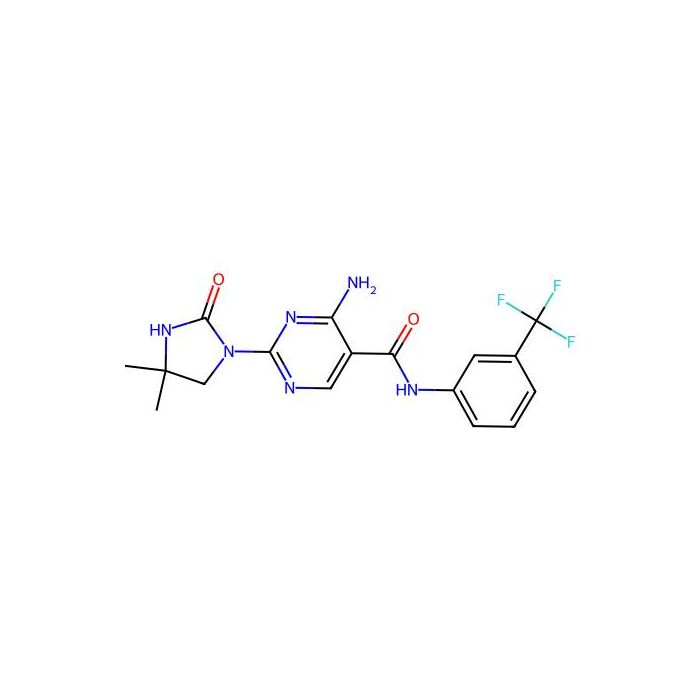
Imanixil (HOE-402 free base) is an inducer of the LDL receptor (LDLR). Imanixil (HOE-402 free base) is also a potent cholesterol-lowering compound, which inhibits very low density-lipoprotein (VLDL) production, and consequently attenuates atherosclerosis development.
Specifiche
Specifiche e purezza
10mM in DMSO
Meccanismi biochimici e fisiologici
Imanixil (HOE-402 free base) is an inducer of the LDL receptor (LDLR). Imanixil (HOE-402 free base) is also a potent cholesterol-lowering compound, which inhibits very low density-lipoprotein (VLDL) production, and consequently attenuates atherosclerosis
Condizioni di conservazione di stoccaggio
Store at -80°C
Spedito in
Dry ice packs + Cold packs
Questo prodotto richiede spedizione a catena fredda. I servizi di terra e altri servizi economici non sono disponibili.
Certificati (CoA, COO, BSE/TSE e tabella di analisi)
C of A & Other Certificates(BSE/TSE, COO):
Analytical Chart:
Calcolatori di soluzioni
Molarity Calculator
Determine the necessary mass, volume, or concentration for preparing a solution.
Dilution Calculator
Determine the dilution needed to prepare a stock solution.
Reconstitution Calculator
Recensioni
Recensioni dei clienti
Application Protocols
No manufacturer-validated application protocols are provided for this specific item. The following outlines general best practices for small-molecule screening in vitro (not item-specific):
Stock preparation and plating:
Dissolve in anhydrous DMSO to 10–50 mM. Sonicate gently or warm (≤40°C) if needed; avoid prolonged heating.
Filter through 0.22 µm PTFE if particulate persists and if the compound is known to be stable.
Aliquot into low-bind tubes; store at −80°C. Avoid repeated freeze–thaw cycles.
Assay setup:
Prepare serial dilutions (e.g., 1:3 or 1:10) in DMSO, then back-dilute into assay buffer to achieve final DMSO ≤0.1–1% v/v.
Include vehicle controls, positive controls (assay-dependent), and orthogonal counterscreens to detect assay interference.
Confirm absence of precipitation post-dilution by visual inspection or light scattering.
Data quality:
Verify compound identity/purity by LC–MS prior to critical experiments.
Track plate maps, lot numbers, and freeze–thaw count in your ELN/LIMS.
Safety:
Handle all solutions in a fume hood with appropriate PPE. Dispose of waste per institutional guidelines.
These steps are general and should be adapted based on assay type, detection modality, and any structural information you obtain for Imanixil.
Biological Roles
Item-specific biological function, targets, or pathways for Imanixil are not provided in this listing.
General context for small-molecule libraries (not item-specific):
Screening compounds may act on diverse target classes (enzymes, receptors, transporters) or display phenotypic effects; definitive biological roles require empirical determination (binding assays, activity profiling, chemoproteomics).
If literature associated with CAS 75689-93-9 or CID 216289 suggests a target class, follow with orthogonal validation (e.g., thermal shift, CETSA, SPR/ITC) and confirm selectivity across related isoforms.
ADME-relevant properties (permeability, solubility, microsomal stability) should be profiled early to contextualize any observed biological activity.
Important: No therapeutic or clinical claims are made. This product is supplied strictly for research use, and any biological role must be established experimentally by the end user.
Buffer Applications
No dedicated buffering capacity is expected or claimed for this item; it is a small-molecule library member rather than a buffer reagent. However, reliable buffer handling is essential for preparing assay solutions.
Practical guidance (general, not item-specific):
Stock solution: Prepare in anhydrous DMSO (e.g., 10–50 mM). Store as single-use aliquots at −80°C.
Working solutions: Dilute into assay buffers such as PBS (pH 7.2–7.4), HEPES (pH 7.2–7.6), or Tris (pH 7.4–8.0). Keep final DMSO ≤0.1–1.0% v/v depending on assay tolerance.
Order of addition: Add the DMSO stock to vigorously mixed buffer or to a small volume of buffer containing 0.01–0.05% nonionic surfactant to mitigate precipitation/adherence in plasticware if needed.
Solubility checks: Inspect for turbidity after dilution; use 0.22 µm filtration if compatible with the compound and assay.
Adsorption control: Use low-bind tubes/plates for hydrophobic compounds; pre-condition plasticware with buffer containing protein or surfactant when appropriate.
Buffer recipes (general reference only):
PBS 1×: 137 mM NaCl, 2.7 mM KCl, 10 mM Na2HPO4/1.8 mM KH2PO4, pH 7.4.
HEPES: 10–50 mM HEPES, 150 mM NaCl, pH 7.4.
Note: No compound-specific pKa or stability-in-buffer data are available for this listing.
Green Alternatives
Green chemistry considerations for handling small-molecule library members primarily concern solvent choice, waste minimization, and energy-efficient storage/handling.
Greener solvent and handling options (general guidance):
Prefer aqueous buffers for final assay dilutions; keep DMSO ≤0.1–0.5% v/v when compatible.
When organic stock solvents are required, DMSO and ethanol are generally more benign than DMF/NMP for routine lab work. Avoid chlorinated solvents unless necessary for analytics.
For preparative workups or recrystallization (if applicable), consider ethanol or ethyl acetate over less sustainable options; validate compound stability.
Trade-offs (general):
DMSO vs DMF/NMP: DMSO offers better hazard profile but can still enhance dermal absorption of solutes; maintain strict PPE.
Aqueous media: Environmentally preferred but may induce precipitation or hydrolysis for some chemotypes; confirm stability.
Waste and energy:
Consolidate small-volume organic waste streams; use micro-scale assays to reduce solvent usage.
Minimize door-open time for −80°C storage; use secondary cold blocks to stage plates/tubes and reduce freeze–thaw cycling.
Note: No item-specific environmental metrics (e.g., solvent selection guides, LCA) are available for this product; adapt the above to your institutional green-chemistry policy.
Pharmaceutical Uses
No pharmacopeial status or excipient role is provided for this product, and it is not offered for human or veterinary use.
Regulatory/compendial status: Not specified for this item; refer to CoA/Spec Sheet. No claims of USP/EP/JP compliance.
Formulation context: If used in research formulation studies (preclinical, in vitro only), common vehicles include DMSO, ethanol, PEG400, or aqueous buffers with co-solvents/surfactants. Validate solubility, stability, and compatibility with your model system.
Manufacturing/CMC: Not applicable for this catalog entry; no GMP grade is stated.
Important: For research use only. No therapeutic claims are made or implied, and this material is not an API or excipient for clinical applications.
Physical Properties
Item-specific physicochemical specifications are not provided in this catalog entry.
Molecular weight: Not specified for this item; refer to CoA/Spec Sheet.
Molecular formula: Not specified for this item; refer to CoA/Spec Sheet.
Appearance: Not specified for this item; refer to CoA/Spec Sheet.
Melting/boiling point: Not specified for this item; refer to CoA/Spec Sheet.
Density/refractive index: Not specified for this item; refer to CoA/Spec Sheet.
Solubility (water/organic): Not specified for this item; refer to CoA/Spec Sheet.
LogP, pKa: Not specified for this item; refer to CoA/Spec Sheet.
General laboratory guidance (literature/practice, not item-specific):
For novel or library compounds, initial solubility screening commonly starts with anhydrous DMSO to prepare 10–50 mM stocks, followed by serial dilutions into assay buffer with careful control of final DMSO (≤0.1–1% v/v).
Determine aqueous solubility and stability empirically across pH 2–9. Use co-solvents (DMSO, ethanol) or surfactants (0.01–0.1% Tween-80 or Pluronic F-68) as compatible with the assay.
If the compound contains ionizable groups (to be confirmed from structure), Henderson–Hasselbalch analysis guides salt selection and pH for maximum solubility.
Confirm identity and purity by LC–MS and 1H NMR after receipt; this is best practice for library members lacking detailed physical specs in the catalog listing.
Quality and Grades
Grade/Purity: Not specified for this item; refer to CoA/Spec Sheet.
Library compounds are typically supplied with a Certificate of Analysis (CoA) documenting identity (e.g., LC–MS, NMR), purity by chromatographic area %, water/volatile content (if measured), and appearance. Because grade is not specified here, consult the lot-specific CoA for exact acceptance criteria.
For screening and SAR work, low baseline UV impurities and accurate mass confirmation are recommended; request additional documents (full LC trace, HRMS) if your workflow is sensitive to trace contaminants.
Quality considerations and tips (general, not item-specific):
Verify salt form/solvation state upon receipt to ensure consistency across assays.
If using for quantitative biology, perform in-house QC (LC–MS, 1H NMR, residual solvent check) and re-dry under high vacuum if hygroscopic.
Track lot numbers in ELN/LIMS; record preparation date and storage history for each aliquot.
Documentation availability:
CoA/Spec Sheet and SDS: Please request from Aladdin Scientific customer support if not already provided with your shipment.
Reaction and Applications
This product is positioned as a research library small molecule rather than a synthetic reagent with a defined reaction role. No manufacturer application notes were provided for this specific entry.
Research applications (general, not item-specific):
Biological screening: Use as part of high-throughput screening (HTS), focused library profiling, or target-agnostic phenotypic assays to identify structure–activity relationships (SAR) and preliminary hits.
Biochemical assays: Evaluate modulation of enzyme or receptor activities when the target class is hypothesized or known from literature; include counter-screens for assay interference.
Chemical biology: Potential probe candidate pending target deconvolution, binding validation (e.g., DSF, SPR, ITC), and orthogonal cellular readouts.
Assay development tips:
Prepare concentrated, single-use DMSO aliquots to avoid freeze–thaw. Verify solubility at the highest screening concentration.
Include vehicle controls and assay interference controls (detergent presence, redox cycling, fluorescence quench/inner-filter checks as appropriate).
Confirm identity/purity by LC–MS before committing to scale-up or mechanistic studies.
Because the precise structure and reactivity are not provided here, no specific synthetic or named-reaction applications can be assigned to Imanixil from this listing alone.
Reaction Conditions
No compound-specific reaction conditions can be provided without a disclosed structure or functional group profile.
General considerations if derivatization is pursued (not item-specific):
Solvents: Begin with anhydrous polar aprotics (DMF, DMSO, MeCN) or alcohols (MeOH/EtOH) as appropriate to the identified reactive handles.
Temperature: Screen ambient to 80°C for substitutions/couplings; protect sensitive motifs by lowering temperature and minimizing base strength.
Catalysts/bases: Choose based on functional groups (e.g., Pd(0) for cross-couplings, HATU/EDC for amide formation). Verify absence of catalyst-poisoning moieties.
Workup: Favor green solvents (EtOAc, IPA, EtOH) and miniaturized purifications for rapid SAR.
Note: These are literature-based generalities. For Imanixil specifically, consult structural data from CoA or databases before planning any transformations.
Safety and Handling
GHS/SDS details are not included in this listing and must be obtained from the product’s SDS.
GHS classification: Not specified for this item; refer to SDS.
Signal word / hazard statements / pictograms: Not specified for this item; refer to SDS.
Research Use Note: For research use only.
General laboratory precautions (good practice for small molecules):
Handle in a certified chemical fume hood. Avoid inhalation of dust/aerosols and contact with skin/eyes.
PPE: lab coat, safety glasses or face shield, and appropriate chemical-resistant gloves (nitrile recommended). Change gloves regularly when working with DMSO solutions due to enhanced dermal permeation potential of many solutes.
Storage incompatibilities: Until the structure is confirmed, segregate from strong oxidizers and acids/bases. Store in tightly sealed, chemically compatible vials.
Thermal stability: Store at −80°C as specified; warm to room temperature before opening to prevent condensation ingress. Minimize freeze–thaw cycles by aliquoting.
Spill/first aid (general): For small spills, absorb with inert material and collect for disposal. In case of skin/eye contact, rinse cautiously with water for 15 minutes and seek medical evaluation. If inhaled, move to fresh air.
Always defer to the official SDS and institutional EHS guidance for authoritative hazard, exposure controls, and disposal procedures.
Solvent Selection
With structure-specific solubility data unavailable, solvent selection should follow a pragmatic screening workflow tailored to small-molecule libraries.
Recommended sequence (general guidance):
Primary stock solvent: Anhydrous DMSO (widely compatible with HTS and cell-based assays); attempt 10–50 mM.
Secondary solvents for recalcitrant compounds: DMF or NMP (analytical prep only), or ethanol/MeOH when biologically compatible. Assess stability over 24–72 h at ambient and 4°C.
Aqueous dilution: Dilute DMSO stocks into assay buffer (e.g., PBS, HEPES, Tris) maintaining final DMSO ≤0.1–1% v/v to mitigate vehicle effects.
pH tuning: If an ionizable compound (to be confirmed), adjust buffer pH to favor ionization for solubility or unionization for permeability, as dictated by assay goals.
Small comparison (general, not item-specific):
DMSO: Highest solvency; may enhance dermal absorption; widely accepted in screening.
Ethanol: Good miscibility; cytotoxicity at higher %; less solvating for highly lipophilic compounds.
PEG400/propylene glycol: Useful for in vivo formulation research (not medical use); viscosity may limit pipetting in HTS plates.
Practical tips:
Filter 0.22 µm if precipitates are observed following dilution.
Pre-wet tips with DMSO to improve volumetric precision at low µL transfers.
Validate absence of precipitation at working concentration by visual check and light scattering (if available).
Storage and Reconstitution
Item-specific storage and shipping:
Storage conditions: Store at −80°C (per Product Data).
Additional best practices (general, not item-specific):
Protect from moisture and light. Allow vials to equilibrate to room temperature in a desiccator before opening to avoid condensation.
Upon first use, subdivide into single-use aliquots in inert, airtight vials to minimize freeze–thaw cycles.
Reconstitution guidance (general):
Preferred solvent: Anhydrous DMSO for primary stocks (target 10–50 mM). Actual solubility may vary; confirm empirically.
Mixing: Vortex and, if needed, brief sonication. Avoid elevated temperatures (>40°C) or extended heating.
Working solutions: Dilute DMSO stocks into the assay buffer of choice, maintaining final DMSO ≤0.1–1.0% v/v depending on system tolerance.
Stability checks: Assess stability of stock and working solutions by LC–MS or HPLC over the intended use period.
Specifications not provided in this listing:
Appearance, purity grade, moisture/peroxide/metal limits, and exact solubility: Not specified for this item; refer to CoA/Spec Sheet and SDS for definitive guidance.
Structure and Identity
Imanixil is offered as a research-only small-molecule library member. The detailed structural identifiers are not included in this listing.
SKU: I656817 (Aladdin Scientific)
Product name: Imanixil
CAS: 75689-93-9
PubChem CID: 216289 (reference identifier; consult primary databases for structure)
Chemical name (systematic): Not specified for this item; refer to CoA/Spec Sheet.
Molecular formula: Not specified for this item; refer to CoA/Spec Sheet.
Molecular weight: Not specified for this item; refer to CoA/Spec Sheet.
SMILES: Not specified for this item; refer to CoA/Spec Sheet.
InChIKey: Not specified for this item; refer to CoA/Spec Sheet.
Structural features (general guidance):
Because the exact structure is not provided here, no item-specific functional groups, ring systems, or stereochemical descriptors can be stated. Please consult the batch CoA/SDS or PubChem entry for a definitive 2D/3D representation.
Notes for informatics users:
Use the CAS RN (75689-93-9) or CID (216289) to cross-reference external cheminformatics repositories for canonical SMILES/InChI prior to registering the compound in ELN/LIMS.
Verify tautomers, salt/solvate forms, and stereochemical flags when importing from third-party sources; align to the CoA to avoid lot-to-lot mismatches.
Synthetic Utility
Because the chemical structure and functional groups of Imanixil are not included in this listing, no specific synthetic transformations or named-reaction roles can be assigned with confidence.
General guidance for library compounds (not item-specific):
If the structure is obtained from the CoA or external databases, assess reactive handles (e.g., halides, boronates, amines, acids) to determine whether the material can serve as a building block for analog synthesis.
For hit-to-lead work, develop tractable routes that retain putative pharmacophores while enabling rapid SAR (e.g., amide couplings, SNAr, Suzuki–Miyaura, Buchwald–Hartwig, reductive amination), provided the compound’s scaffold supports such diversification.
Confirm stability under standard reaction conditions (base/acid, oxidants/reductants) before derivatization; run small-scale compatibility tests.
In absence of the structure, treat Imanixil primarily as a screening analyte rather than a synthetic intermediate.
Target Specificity
No target, pathway, or selectivity profile is provided for this product.
Target(s): Not specified for this item; refer to CoA/Spec Sheet and primary literature for CAS 75689-93-9 / CID 216289 if available.
Species reactivity / off-target paneling: Not specified for this item; to be established experimentally.
Guidance (general, not item-specific):
Establish preliminary specificity using biochemical potency assays, counterscreens against close homologs, and orthogonal binding methods (SPR/ITC/DSF).
Run PAINS/aggregator filters and include detergent controls to exclude assay artifacts.
Domande frequenti
What are the CAS number, molecular formula and molecular weight?
The CAS Number is 75689-93-9, the molecular formula is C17H17F3N6O2, and the molecular weight is 394.35 g/mol.
How should this product be stored?
Store at ?80 °C. Ultra-low temperature storage is required to maintain the specified shelf life.
How is this product shipped?
This product ships frozen with dry ice and cold packs. Unpack on arrival and transfer it to the storage condition stated above; handle dry ice with insulated gloves in a ventilated area.
What documentation is provided?
Available product documentation, including Certificates of Analysis (COA), Safety Data Sheets (SDS), and specification sheets, is shown in the product document area. Document availability and access follow the current site policy.
Utilizziamo i cookie per garantire il corretto funzionamento del sito web e, ove consentito, per migliorare la tua esperienza. Puoi gestire le tue preferenze in qualsiasi momento nelle Impostazioni. Per saperne di più, consulta la nostra Cookie Policy.
Desidera che le inviamo un messaggio quando avremo sconti disponibili?
Ricordamelo più tardi
Grazie! Controlli la sua casella di posta per confermare.
Products are supplied to verified businesses, institutions, and qualified professionals for research and development use only. Not for use in humans, animals, diagnosis, or therapy.