This compound belongs to the class of organic compounds known as indoles. These are compounds containing an indole moiety, which consists of pyrrole ring fused to benzene to form 2,3-benzopyrrole.
External Descriptors
Not available
1. Djoumbou Feunang Y, Eisner R, Knox C, Chepelev L, Hastings J, Owen G, Fahy E, Steinbeck C, Subramanian S, Bolton E, Greiner R, and Wishart DS. ClassyFire: Automated Chemical Classification With A Comprehensive, Computable Taxonomy. Journal of Cheminformatics, 2016, 8:61.
Determine the necessary mass, volume, or concentration for preparing a solution.
Dilution Calculator
Determine the dilution needed to prepare a stock solution.
Reconstitution Calculator
Recensioni
Recensioni dei clienti
Application Protocols
No item-specific, validated bioassay or analytical application protocols are provided for this SKU. For general synthetic use, consider the literature-guided procedures outlined under “Reaction Conditions.” If using in screening or conjugation workflows, develop and validate protocols (solvent selection, concentration, pH control, and quench conditions) appropriate to your system.
Biological Roles
Item-specific biological data are not provided. The following points reflect general literature context and do not imply any clinical or therapeutic use.
Indole motif: Indole is a privileged scaffold in biology and medicinal chemistry, appearing in natural products (tryptophan, indole alkaloids) and signaling molecules. The heteroaromatic N–H serves as a hydrogen-bond donor; the π-system engages in stacking interactions (literature).
Indole-2-carboxaldehyde specifically is a synthetic intermediate rather than an endogenous metabolite. The aldehyde function is electrophilic and readily derivatized to access libraries of 2‑substituted indoles, imines/Schiff bases, oximes, and heterocycle-fused systems (literature).
In biochemical assay development, reactive aldehydes are sometimes used to tether amines (via imine formation) for probe/surface attachment; any such use requires careful control of pH and reducing agents (literature/general practice).
Research-only note: This product is for research use only. It is not intended for diagnostic, therapeutic, or other clinical applications.
Buffer Applications
This compound is not a buffering reagent. As a hydrophobic heteroaromatic aldehyde, it does not provide practical acid/base pairs for buffer systems in aqueous media. For pH control, select conventional buffers (e.g., phosphate, HEPES, Tris) suited to your pH range and ionic strength.
If preparing stock solutions for screening or bioconjugation studies, dissolve in an appropriate organic co-solvent (e.g., DMSO or MeCN) and dilute into the buffered system while monitoring solubility and reactivity (imine formation with amines will be pH dependent).
Green Alternatives
Greener choices focus on solvent and reagent selection, as the substrate itself is fixed. Below are literature-based considerations when planning routes involving indole-2-carboxaldehyde.
Prefer greener solvents where feasible:
Replace DCM with EtOAc or CPME for extractions and some condensations.
Substitute THF with 2‑MeTHF for organometallic additions and Wittig reactions; similar performance with improved sustainability and easier phase separation.
Use bio-based alcohols (EtOH, IPA) for condensations and recrystallizations.
Reagent choices:
Choose catalytic, chemoselective reductants (e.g., transfer hydrogenation, HCO2NH4/Ru or organocatalysts) rather than stoichiometric metal hydrides where compatible.
For oxidations to acids, prefer Pinnick oxidation (NaClO2 with scavenger) over chromium(VI) reagents.
Energy and workup:
Conduct reactions at ambient temperature/solvent-minimized conditions where possible; leverage solvent recycling.
Comparison snapshot (literature):
DCM vs EtOAc: EtOAc reduces halogenated waste but may require longer times/higher temps.
THF vs 2‑MeTHF: 2‑MeTHF offers renewable sourcing and lower peroxide formation rate; drying may be slightly more involved.
DMAc/DMF vs MeCN: MeCN has a better environmental profile and is easier to remove, though solubility may be lower for some substrates.
Note: Validate reaction performance after switching to green solvents; adjust catalyst/base loading and temperature accordingly.
Pharmaceutical Uses
No item-specific pharmacopeial grade or excipient designation is provided for this product. It is intended for research and development use as a synthetic building block.
General literature context (non-clinical):
Indole-2-carboxaldehyde is frequently employed in medicinal chemistry campaigns to construct 2‑substituted indole cores, enamides, and fused heterocycles used in SAR exploration.
The aldehyde can be diversified via reductive amination, Wittig/HWE olefination, and condensations to rapidly access analog series from a common intermediate.
For any work approaching preclinical development, ensure material traceability, impurity profiling, and stability studies (solid state and in solution) and assess compatibility with common formulation vehicles only at later stages and under appropriate regulatory frameworks.
No therapeutic or clinical claims are made for this product.
Physical Properties
Item-specific numeric specifications (melting point, boiling point, density, UV cut-off, water/peroxide/metal content) are not specified for this item; refer to CoA/Spec Sheet.
Literature/general properties (for context only; verify with primary sources before use):
Physical state: typically an off-white to pale solid (literature)
Acid/base: weakly acidic N–H (pyrrolic), formyl group is electrophilic (literature)
Solubility profile (qualitative, literature):
Good solubility in polar aprotic organic solvents (e.g., DMSO, DMF, acetonitrile) and chlorinated solvents (e.g., dichloromethane)
Moderate solubility in ethyl acetate, THF; limited solubility in alkanes
Low aqueous solubility expected due to aromatic core (literature)
Polarity/logP: Aromatic heterocycle with one carbonyl; moderate hydrophobicity typical for indole aldehydes (literature)
UV-Vis: π→π* absorption in near-UV typical of indoles; exact cutoff not specified for this item.
Always rely on the product’s CoA/SDS for definitive specifications relevant to your use case.
Quality and Grades
Grade/Purity: Not specified for this item; refer to CoA/Spec Sheet.
Appearance: Not specified for this item; refer to CoA/Spec Sheet.
Context and implications (general/literature):
For synthetic building blocks like indole-2-carboxaldehyde, key quality attributes typically include purity by HPLC/GC/NMR, aldehyde content (titration/derivatization), residual solvents, and limits on related indole impurities (e.g., indole-2-carboxylic acid or oligomers). Low water content helps suppress base- or acid-catalyzed side reactions and oligomerization.
If supplied “stabilized” (not specified here), the stabilizer can impact reactivity in sensitive transformations (e.g., organometallic additions). In such cases, remove stabilizer by distillation or pre-washing when compatible.
For chromatography-sensitive users, a “chromatography” or “HPLC” grade emphasizes low UV-absorbing impurities and minimal baseline noise; for general synthesis, “AR” or “reagent” grade can suffice. Select grade based on downstream application sensitivity and regulatory requirements.
Recommendation: Review the current lot CoA for assay, identity confirmation (NMR/IR/HRMS), water/residual solvents, and any inhibitor/stabilizer notes before use in critical routes.
Reaction and Applications
Indole-2-carboxaldehyde is a versatile electrophilic building block for assembling C2‑substituted indoles and indole-fused scaffolds. Below are representative literature applications and practical notes.
Electrophilic additions to the formyl group:
Nucleophilic additions (e.g., Grignard/organolithium) to form benzylic alcohols; protect or manage the indole N–H to prevent deprotonation/complexation.
Reductive amination with primary/secondary amines (NaBH3CN or NaBH(OAc)3) to access benzylic amines; buffer to pH ~5–6 to balance imine formation and avoid indole protonation.
Carbon–carbon double-bond formation:
Wittig/Horner–Wadsworth–Emmons olefinations to install vinyl groups at C2 (conjugated with the indole) under anhydrous conditions (THF/CH2Cl2).
Knoevenagel condensations with active methylenes (malononitrile, cyanoacetates) using secondary amines or piperidine catalysts (EtOH/MeCN, rt–reflux).
Oxime/hydrazone/semicarbazone formation: Useful for aldehyde protection, purification, and characterization.
Oxidation/reduction:
Oxidation to the corresponding acid (indole‑2‑carboxylic acid) using Pinnick or KMnO4 variants, with care to avoid ring oxidation.
Reduction to the alcohol (NaBH4/CeCl3 or DIBAL‑H) or to the methyl group (Wolff–Kishner/Clemmensen, or catalytic hydrogenation of the imine/oxime).
Cyclizations and annulations:
Construction of indolo[2,3‑a] or spirocyclic systems via intramolecular condensations; Pictet–Spengler-type reactivity is more typical for 3‑substituted systems, but 2‑formyl indoles enable diverse fused frameworks under acid catalysis.
Practical tips: Work under inert gas (as indicated for this item) to limit oxidation; use freshly distilled/dried solvents; consider temporary N-protection (e.g., Boc, SEM) for strong-base chemistry to improve chemoselectivity.
Reaction Conditions
The following are general literature guidelines (example conditions) to aid planning. Optimize for your system and consult primary sources.
Reductive amination:
Solvent: MeOH, EtOH, or MeCN
Conditions: Amine (1.2–2.0 eq), NaBH3CN (1.2–1.5 eq) or NaBH(OAc)3 (2–3 eq), AcOH (0.2–0.5 eq) to pH ~5–6; 20–40°C, 2–16 h.
Notes: Control acidity to favor imine formation without quenching the reductant; monitor for N‑alkylation vs C2 selectivity.
Wittig/HWE olefination:
Solvent: Dry THF, CH2Cl2, or toluene; 0–25°C (Wittig), 0–60°C (HWE); 2–6 h.
Bases: NaH or KHMDS for stabilized ylides; t‑BuOK for HWE (as appropriate).
Notes: Exclude moisture/oxygen; indole N‑protection can improve yields with strong base.
Knoevenagel condensation:
Partners: Malononitrile or ethyl cyanoacetate (1.1–1.5 eq)
Catalyst: Piperidine (5–20 mol%) or ammonium acetate (0.5–2 eq)
Solvent: EtOH, MeCN, or toluene; 25–80°C; 1–8 h.
Notes: Water removal (Dean–Stark in toluene) enhances conversion.
Oxime formation:
Reagents: Hydroxylamine·HCl (1.1–1.5 eq), base (NaOAc or pyridine)
Solvent: EtOH or MeOH; 25–60°C; 1–4 h.
Grignard addition (for benzylic alcohols):
Solvent: Anhydrous THF or 2‑MeTHF; 0°C to rt; 0.5–4 h.
Notes: Consider N‑protection; quench carefully to avoid over-reduction/side reactions.
Typical workup: Quench with buffered aqueous solutions, extract with EtOAc, wash, dry (Na2SO4), and purify by silica gel chromatography. Light/air exclusion advised throughout.
Safety and Handling
Item-specific GHS details (signal word, hazard statements, pictograms, classification) are not specified for this item; consult the SDS for authoritative safety information.
General guidance for indole aldehydes (literature/good practice):
Hazards: Aldehydes can be irritant and sensitizing; indole derivatives may cause skin/eye irritation. Avoid inhalation of dust and vapors.
PPE: Use lab coat, safety glasses or face shield, and appropriate chemically resistant gloves (e.g., nitrile). Work in a fume hood.
Handling: Minimize exposure to air and light; aldehydes can oxidize/polymerize or undergo aldol-type side reactions. The product is supplied for research use only.
Storage incompatibilities: Avoid strong oxidizers, strong bases (which can promote condensation), and strong acids (which can catalyze polymerization). Keep dry to prevent hydrolysis/side reactions.
First aid (overview; defer to SDS):
Inhalation: Move to fresh air; seek medical attention if symptoms persist.
Skin/eye contact: Rinse with plenty of water for at least 15 minutes; remove contaminated clothing; obtain medical advice.
Ingestion: Rinse mouth; do not induce vomiting; seek medical attention.
Spill/response: Contain, avoid dust generation, collect with inert absorbent, and dispose per local regulations.
Special risks: Some aldehydes may form peracids on long-term exposure to air/oxygen; maintain under inert gas as indicated. Indole N–H can engage in acid–base and redox chemistry; avoid strong oxidants.
Always consult the SDS and institutional EHS guidance before use.
Solvent Selection
As a moderately polar, conjugated heteroaromatic aldehyde, indole-2-carboxaldehyde dissolves well in many organic solvents. Item-specific solubilities are not specified; the following are general literature-based considerations.
Polarity class: Aromatic heterocycle with a carbonyl; compatible with polar aprotic media.
NMR stock solutions: DMSO-d6 or CDCl3; DMSO-d6 helps maintain solubility and stabilize aldehyde signal.
Carbon–carbon forming condensations (e.g., Knoevenagel): Alcohols (EtOH), acetonitrile, or toluene with catalytic base/amine.
Wittig/olefinations: Dry THF, toluene, or CH2Cl2 under inert atmosphere.
Reductive amination: MeOH/EtOH or MeCN; control pH to avoid indole N protonation issues.
Metalation/additions (e.g., Grignard): Dry, coordinating ethers (THF/2-MeTHF); consider N-protection or strong base control to avoid N-deprotonation.
Quick comparison (literature):
THF vs 2‑MeTHF: Similar performance; 2‑MeTHF offers greener profile and better phase separation.
DCM vs EtOAc: DCM maximizes solubility and rate; EtOAc is greener but may be slower.
Always dry and deoxygenate solvents where aldehyde stability and reactivity are critical.
Storage and Reconstitution
Storage conditions (item-specific): Room temperature, Argon charged (as provided). Keep container tightly closed under inert gas. Store in a dry place away from light and sources of oxidation.
Shipping: Normal (ambient) shipping, per Product Data.
Stability considerations (general/literature): Aldehydes can oxidize or oligomerize on prolonged exposure to air, moisture, or acids/bases. Maintain headspace under argon/nitrogen, minimize repeated air exchange, and use amber glass when possible.
Packaging/handling tips: If repeatedly accessed, consider aliquoting under inert atmosphere. Use dry syringes/spatulas; promptly recap and reflush headspace with argon.
Reconstitution/stock solutions: Not required for solid storage. For solution stocks, dissolve in dry, oxygen-free solvents (e.g., anhydrous DMSO, THF, MeCN, or EtOH) at typical concentrations of 0.05–0.5 M. Store solutions at low temperature (e.g., 2–8°C) under inert gas and protect from light; check stability by TLC/HPLC prior to use.
Disposal: Follow institutional and local regulations for organic chemical waste; segregate aldehyde-containing waste if required.
Always consult the current CoA/SDS for definitive stability and handling guidance for your lot.
Structure and Identity
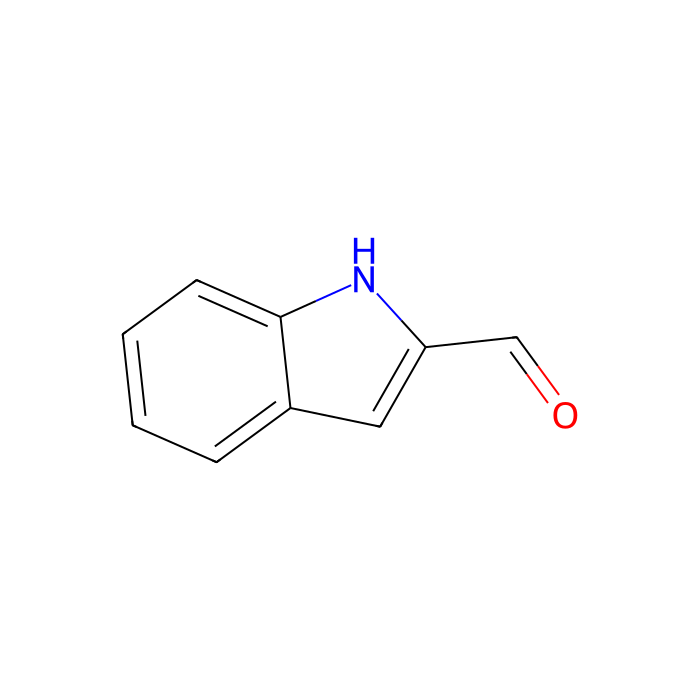
A heteroaromatic aldehyde featuring an indole core bearing a formyl group at the 2-position (1H‑indole‑2‑carbaldehyde). The aldehyde carbonyl (–CHO) is conjugated directly to the indole C2, and the ring contains the pyrrolic N–H typical of indoles.
Item-specific identifiers (as provided):
CAS: 19005-93-7
CID: 96389
InChIKey: 331633 (as listed in Product Data)
SMILES: Not specified for this item; refer to CoA/Spec Sheet.
Indole bicyclic system (benzene fused to pyrrole) with an N–H at position 1 (literature)
Electron-withdrawing aldehyde at C2; planar, conjugated framework (literature)
No stereogenic centers
2D structure in words: A fused benzannulated five-membered ring (pyrrolic) bearing an N–H, with a formyl substituent on the carbon adjacent to the nitrogen (C2); the benzene ring occupies positions C4–C7.
Notes: Literature identifiers (SMILES/InChIKey) can be verified in major databases; item-specific identifiers beyond those listed above are not specified for this SKU.
Synthetic Utility
Functional group set and reactivity (literature):
Electrophilic aldehyde at C2 enables: nucleophilic additions (RMgX/RLi), imine formation (amines), oxime/hydrazone formation, and olefinations (Wittig/HWE).
Indole N–H is mildly acidic; N-protection (Boc, Cbz, SEM) often improves chemoselectivity in strong-base chemistry.
Representative transformations:
C2 Diversification: Convert to alkenes (Wittig) or benzylic alcohols/amines (addition or reductive amination), then further elaborate by cross-coupling at other ring positions if prefunctionalized.
Oxidation state edits: Oxidize to indole‑2‑carboxylic acid (Pinnick) for amide coupling or reduce to 2‑methylindole (via oxime → Wolff–Kishner or catalytic hydrogenolysis pathways).
Cyclizations: Construct indole-fused bicyclics/spirocycles by intramolecular condensations using the aldehyde as a tethering handle.
Protecting-group strategies: Temporary conversion to imines/acetals to mask the aldehyde during steps incompatible with carbonyl reactivity.
Retrosynthetic value:
Serves as a convergent hub—late-stage introduction of the 2‑substituent from the aldehyde enables rapid SAR around the indole core without reassembling the ring system.
Practical considerations:
Conduct reactions under inert gas (argon/nitrogen) to minimize oxidation/polymerization of the aldehyde.
Dry solvents and bases; titrate strong nucleophiles to avoid competitive N‑deprotonation.
For isolations, derivatize transiently (e.g., to oximes) if the free aldehyde shows tailing or instability on silica.
Target Specificity
Not applicable. This product is a small-molecule chemical building block, not a biological targeting reagent (e.g., antibody, enzyme inhibitor with defined target claims). No antigen, epitope, or species reactivity information is associated with this SKU.
Domande frequenti
What is the purity of this product?
This product is supplied at ≥97% purity (chemical assay). Lot-specific values are stated on the Certificate of Analysis.
How should this product be stored?
Store at room temperature under argon. It is supplied under an argon blanket; reseal under inert gas after each use.
How is this product shipped?
This product ships under standard ambient conditions. No temperature-controlled packaging is required.
What are the CAS number, molecular formula and molecular weight?
The CAS Number is 19005-93-7, the molecular formula is C9H7NO, and the molecular weight is 145.16 g/mol. InChIKey SBNOTUDDIXOFSN-UHFFFAOYSA-N.
What documentation is provided?
Available product documentation, including Certificates of Analysis (COA), Safety Data Sheets (SDS), and specification sheets, is shown in the product document area. Document availability and access follow the current site policy.
Utilizziamo i cookie per garantire il corretto funzionamento del sito web e, ove consentito, per migliorare la tua esperienza. Puoi gestire le tue preferenze in qualsiasi momento nelle Impostazioni. Per saperne di più, consulta la nostra Cookie Policy.
Desidera che le inviamo un messaggio quando avremo sconti disponibili?
Ricordamelo più tardi
Grazie! Controlli la sua casella di posta per confermare.
Products are supplied to verified businesses, institutions, and qualified professionals for research and development use only. Not for use in humans, animals, diagnosis, or therapy.

 C1505081