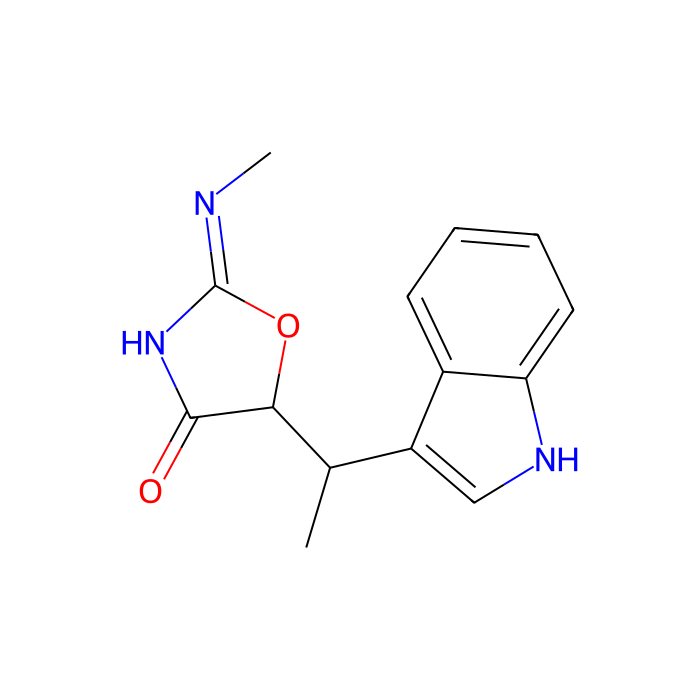
Indolmycin - Moligand™, ≥95% , CAS No.21200-24-8

CAS: 21200-24-8 Cat. No.: I329467 Formula: C14H15N3O2 Peso molecolare: 257.29
Disponibile su ordine
QUALITÀ & PUREZZA Moligand™ ? Moligand™ — Aladdin's line of ligands and bioactive small molecules. Use for receptor, pathway, and binding studies needing defined small-molecule tools. ≥95%
Synonyms
(5S)-5-[(1R)-1-(1H-indol-3-yl)ethyl]-2-methylimino-1,3-oxazolidin-4-one|Indolmycin|(5S)-5-[(1R)-1-(1H-indol-3-yl)ethyl]-2-(methylamino)-1,3-oxazol-4(5H)-one|4(5H)-Oxazolone, 5-(1-(1H-indol-3-yl)ethyl)-2-(methylamino)-, (S-(R*,S*))-|Indolemycin|(1R,5S)-(-)-5-(1-Indol-3-ylethyl)-2-(methylamino)-2-oxazolin-4-one|2-METHYLAMINO-5.ALPHA.-(.BETA.-INDOLYL)ETHYL-2-OXAZOLIN-4-ONE|2-Oxazolin-4-one, 5-(1-indol-3-ylethyl)-2-(methylamino)-, (1R,5S)-(-)-|(5S)-5-[(1R)-1-(1H-indol-3-yl)ethyl]-2-(methylamino)-1,3-oxazol-4-one|(5S)-5-[(1R)-1-(1H-indol-3-yl)ethyl]-2-(methylimino)-1,3-oxazolidin-4-one|tak-083|5-(1-Indol-3-ylethyl)-2-(methylamino)-2-oxazolin-4-one|(-)-indolmycin|(5S,6R)-(-)-indolmycin|Indomycin|PA-155A|4(5H)-oxazolone, 5-((1R)-1-(1H-indol-3-yl)ethyl)-2-(methylamino)-, (5S)-|Indolemycin; Indolmycin|INDOLMYCIN [MI]
Storage
Store at -20°C
Shipped In
Ice chest + Ice pads
★
Dimensione
Germania (EU)
USA*
Prezzo
Qtà
1mg
I329467-1mg
—
2 Disponibile
288,00€
Enter a quantity for the sizes you want to add.

Panoramica

Indolmycin is a naturally occurring antibiotic that acts against|Staphylococci|and|Helicobacter pylori.|The compound is a secondary metabolite of|Streptomyces griseus|with the ability to inhibit bacterial tryptophanyl-tRNA synthetase.

Specifiche

Sinonimi
(5S)-5-[(1R)-1-(1H-indol-3-yl)ethyl]-2-methylimino-1,3-oxazolidin-4-one | Indolmycin | (5S)-5-[(1R)-1-(1H-indol-3-yl)ethyl]-2-(methylamino)-1,3-oxazol-4(5H)-one | 4(5H)-Oxazolone, 5-(1-(1H-indol-3-yl)ethyl)-2-(methylamino)-, (S-(R*,S*))- | Indolemycin | (1R,5S)-(-)-5-(1-Indol-3-ylethyl)-2-(methylamino)-2-oxazolin-4-one | 2-METHYLAMINO-5.A Mostra altro
Specifiche e purezza
Moligand™, ≥95%
Condizioni di conservazione di stoccaggio
Store at -20°C
Spedito in
Ice chest + Ice pads
Questo prodotto richiede spedizione a catena fredda. I servizi di terra e altri servizi economici non sono disponibili.
Grado
Moligand™
Purezza
≥95%
Proprietà del prodotto
pKa
pKa: 0.96 (Predicted)
Nomi e identificatori
Pubchem Sid
Pubchem Sid Url
https://pubchem.ncbi.nlm.nih.gov/substance/504773296
SMILES
CC(C1C(=O)NC(=NC)O1)C2=CNC3=CC=CC=C32
IUPAC Name
(5S)-5-[(1R)-1-(1H-indol-3-yl)ethyl]-2-methylimino-1,3-oxazolidin-4-one
InChIKey
GNTVWGDQPXCYBV-PELKAZGASA-N
InChI
1S/C14H15N3O2/c1-8(12-13(18)17-14(15-2)19-12)10-7-16-11-6-4-3-5-9(10)11/h3-8,12,16H,1-2H3,(H,15,17,18)/t8-,12+/m1/s1
Isomeri SMILES
C[C@@H]([C@H]1C(=O)NC(=NC)O1)C2=CNC3=CC=CC=C32
Peso molecolare
257.29
Reaxys
620841
Reaxys-RN_link_address
https://www.reaxys.com/reaxys/secured/hopinto.do?context=S&query=IDE.XRN=620841&ln=

Dati avanzati

Taxonomic Classification

Taxonomy Tree

KingdomOrganic compounds
SuperclassOrganoheterocyclic compounds
ClasseIndoles and derivatives
SubclassIndoles
Intermediate Tree Nodes Not available
Direct Parent3-alkylindoles
Alternative Parents Substituted pyrroles  Benzenoids  Oxazolines  Heteroaromatic compounds  N-acylimines  Isoureas  Propargyl-type 1,3-dipolar organic compounds  Oxacyclic compounds  Carboxylic acids and derivatives  Carboximidamides  Azacyclic compounds  Organopnictogen compounds  Organic oxides  Hydrocarbon derivatives  Carbonyl compounds  
Molecular FrameworkAromatic heteropolycyclic compounds
Substituents 3-alkylindole - Substituted pyrrole - Benzenoid - Oxazoline - Pyrrole - Heteroaromatic compound - Isourea - N-acylimine - Carboxylic acid derivative - Carboximidamide - Oxacycle - Azacycle - Propargyl-type 1,3-dipolar organic compound - Organic 1,3-dipolar compound - Organic oxide - Organopnictogen compound - Organic oxygen compound - Hydrocarbon derivative - Carbonyl group - Organic nitrogen compound - Organonitrogen compound - Organooxygen compound - Aromatic heteropolycyclic compound
DescrizioneThis compound belongs to the class of organic compounds known as 3-alkylindoles. These are compounds containing an indole moiety that carries an alkyl chain at the 3-position.
External Descriptors 1,3-oxazoles - indoles - secondary amino compound
Struttura 3D
Modello di struttura chimica interattiva


Obiettivi associati (umani)
HeLa (62764 Activities)
Activity TypeRelationActivity valueUnitsAction TypeJournalPubMed IddoiAssay Aladdin ID
Obiettivi associati (non umani)
Helicobacter pylori (3113 Activities)
Activity TypeRelationActivity valueUnitsAction TypeJournalPubMed IddoiAssay Aladdin ID
Staphylococcus aureus (210822 Activities)
Activity TypeRelationActivity valueUnitsAction TypeJournalPubMed IddoiAssay Aladdin ID
Staphylococcus epidermidis (22802 Activities)
Activity TypeRelationActivity valueUnitsAction TypeJournalPubMed IddoiAssay Aladdin ID
Streptococcus pyogenes (16140 Activities)
Activity TypeRelationActivity valueUnitsAction TypeJournalPubMed IddoiAssay Aladdin ID
Enterococcus faecium (13803 Activities)
Activity TypeRelationActivity valueUnitsAction TypeJournalPubMed IddoiAssay Aladdin ID
Bacillus subtilis (32866 Activities)
Activity TypeRelationActivity valueUnitsAction TypeJournalPubMed IddoiAssay Aladdin ID
Streptomyces griseus (104 Activities)
Activity TypeRelationActivity valueUnitsAction TypeJournalPubMed IddoiAssay Aladdin ID
Enterococcus faecalis (29875 Activities)
Activity TypeRelationActivity valueUnitsAction TypeJournalPubMed IddoiAssay Aladdin ID
Streptomyces coelicolor (161 Activities)
Activity TypeRelationActivity valueUnitsAction TypeJournalPubMed IddoiAssay Aladdin ID
Influenza A virus (11224 Activities)
Activity TypeRelationActivity valueUnitsAction TypeJournalPubMed IddoiAssay Aladdin ID
Coxsackievirus B1 (166 Activities)
Activity TypeRelationActivity valueUnitsAction TypeJournalPubMed IddoiAssay Aladdin ID
Meccanismi d'azione
Certificati (CoA, COO, BSE/TSE e tabella di analisi)
C of A & Other Certificates(BSE/TSE, COO):
Analytical Chart:

Find and download the COA for your product by matching the lot number on the packaging.

1 results found

Lot NumberCertificate TypeDataOggetto
I2207812I2207812Certificate of AnalysisAug 04, 2022 I329467
Proprietà chimiche e fisiche
SolubilitàSoluble in ethanol, methanol, DMSO, DMF, and water (poor).
Indice di rifrazionen20D1.67 (Predicted)
Punto di ebollizione (°C)420.75° C at 760 mmHg (Predicted)
Punto di fusione (°C)186.82° C (Predicted)
Peso molecolare257.29
XLogP32.200
Hydrogen Bond Donor Count2
Hydrogen Bond Acceptor Count3
Rotatable Bond Count2
Exact Mass257.116 Da
Monoisotopic Mass257.116 Da
Topological Polar Surface Area66.500 Ų
Heavy Atom Count19
Formal Charge0
Complexity396.000
Isotope Atom Count0
Defined Atom Stereocenter Count2
Undefined Atom Stereocenter Count0
Defined Bond Stereocenter Count0
Undefined Bond Stereocenter Count0
The total count of all stereochemical bonds0
Covalently-Bonded Unit Count1
Sicurezza e pericoli (GHS)
Precauzioni

P264:Wash hands [and …] thoroughly after handling.

Reaxys
620841
Reaxys-RN_link_address
https://www.reaxys.com/reaxys/secured/hopinto.do?context=S&query=IDE.XRN=620841&ln=
Calcolatori di soluzioni
Recensioni

Recensioni dei clienti

Application Protocols

No vendor‑validated application protocols are provided in the Product Data for this item.

General guidance for small‑molecule probe use in biochemical assays:

  • Stock solution: Prepare 10–50 mM in DMSO. Aliquot and store at −20 °C. Avoid repeated freeze–thaw cycles.
  • Biochemical enzyme assay (example framework):
    • Prepare a dilution series (e.g., 10‑point 3‑fold) in assay buffer with constant DMSO percentage across wells.
    • Include vehicle controls and, if available, positive/negative control ligands.
    • Monitor enzymatic activity using an appropriate readout (e.g., coupled spectrophotometric assay, fluorescence, or radiometric method) and fit data to derive IC50 or kinetic parameters.
  • Thermal shift (DSF): Mix protein with a fluorescent dye and titrate compound to assess ΔTm shifts indicative of binding. Keep dye and DMSO levels constant across conditions.

These outlines are provided as general lab practices—not validated protocols for this specific product. Optimize conditions for your system and consult the CoA/SDS before use.

Biological Roles

General literature context (not item‑specific claims; for research/lab use only):

  • Indolmycin is an indole‑derived natural product historically studied as a selective molecular probe for protein translation pathways. In biochemical research, it has been used to interrogate aminoacyl‑tRNA synthetase biology, particularly tryptophanyl‑tRNA synthetase (TrpRS) in bacteria, by serving as a compact ligand that can modulate or report on enzyme activity in vitro.
  • Mechanistic interest: The indole moiety can mimic tryptophan’s aromatic side chain, while the attached heteroatom‑containing portion contributes to recognition within enzyme active sites, enabling studies of substrate mimicry, binding energetics, and structure‑activity relationships (SAR).
  • Systems studied: Bacterial translation components, comparative enzymology between prokaryotic and eukaryotic aminoacyl‑tRNA synthetases, and mutational analyses to identify resistance‑associated changes in binding sites. Researchers use purified enzymes or cell‑free systems to avoid confounding physiological variables.
  • Readouts and methods: Enzyme kinetics (e.g., ATP–PPi exchange, aminoacylation assays), differential scanning fluorimetry (thermal shift), isothermal titration calorimetry, and ligand displacement binding assays. Orthogonal approaches such as proteomics‑based pulldowns or CETSA in lysates can complement purified system data.

No clinical or therapeutic claims are made. All uses are restricted to controlled laboratory research applications.

Buffer Applications

This compound is a small‑molecule ligand rather than a buffering agent. It does not serve as an acid–base buffer in typical laboratory practice.

Practical notes for use in buffered assays (general guidance):

  • Prepare concentrated DMSO stock solutions and dilute into assay buffers (e.g., phosphate‑, HEPES‑, or Tris‑based systems) to desired final concentrations while keeping the final organic cosolvent fraction low (typically ≤1% v/v DMSO) to preserve enzyme or cell‑free system performance.
  • Common assay buffers: HEPES (pH 7.2–7.8), phosphate (pH 6.8–7.4), or Tris (pH 7.5–8.0), selected based on the biochemical target. Verify compound stability in the chosen buffer over the assay time window.
  • To mitigate precipitation upon dilution, add the organic stock slowly with vigorous mixing, and consider including 0.01–0.1% nonionic surfactant (e.g., Tween‑20) if compatible with the assay to reduce nonspecific adsorption.

Item‑specific buffer compatibility, exact pKa, and solubility in given buffers are not specified for this item; consult the CoA/Spec Sheet and perform small‑scale tests.

Green Alternatives

As a defined small‑molecule ligand (not a solvent or commodity reagent), Indolmycin is not typically the subject of “green replacement” selection in the way that common solvents (e.g., THF vs 2‑MeTHF) or reagents are. However, greener considerations can be applied to its handling and use in the laboratory:

Greener handling strategies (general):

  • Solvent choice for stock solutions:
    • Prefer water‑miscible, lower hazard options where feasible (e.g., aqueous buffer with minimal DMSO), while maintaining compound solubility and assay performance.
    • Minimize DMF/NMP use due to their higher health and environmental hazards compared to DMSO/ethanol.
  • Waste minimization:
    • Prepare small aliquots at concentrations aligned with near‑term experimental needs to reduce expired material and solvent waste.
    • Use microscale assay formats (96/384/1536‑well plates) to reduce per‑assay solvent and compound consumption.
  • Energy and storage:
    • Consolidate cold‑stored aliquots and use insulated secondary containers during handling to reduce freeze–thaw losses.

Illustrative comparison (general; not item‑specific):

  • DMSO vs DMF/NMP for stock solutions:
    • DMSO: Better EHS profile, high solvating power, widely compatible with biological assays.
    • DMF/NMP: Higher toxicity concerns; reserve for exceptional solubility constraints.

Note: No direct “green alternative” exists for the compound itself; implement green chemistry principles in solvent selection, scale, and waste management.

Pharmaceutical Uses

No pharmacopeial status or excipient role is provided for this item, and it is sold strictly for research use only.

General notes (non‑clinical, non‑therapeutic):

  • Indolmycin is studied in preclinical research contexts as a molecular probe of translation biochemistry. It is not supplied for therapeutic use, and no claims are made regarding safety or efficacy in humans or animals.
  • Formulation in research: For in vitro work, DMSO stocks are standard. If in vivo model research is contemplated within institutional approvals, users must develop their own carrier systems and assess stability, but such applications fall outside the scope of this catalog entry.

Item‑specific information:

  • Compliance/standards: Not specified for this item; refer to CoA/Spec Sheet.
  • Residual solvents, elemental impurities, bioburden/endotoxin: Not specified for this item; refer to CoA/Spec Sheet.

Reminder: This product is for laboratory research only and is not intended for diagnostic or clinical applications.

Physical Properties

Item-specific specifications are not provided in the Product Data.

  • Appearance: Not specified for this item; refer to CoA/Spec Sheet.
  • Melting point: Not specified for this item; refer to CoA/Spec Sheet.
  • Boiling point: Not applicable/not typically reported for this solid; refer to literature if needed.
  • Density: Not specified for this item; refer to CoA/Spec Sheet.
  • Refractive index: Not applicable for a solid.
  • pKa/logP: Not specified for this item; refer to literature.
  • UV-Vis characteristics: Not specified for this item; refer to CoA/Spec Sheet.
  • Solubility (practical guidance, general):
    • Frequently handled as a DMSO stock solution for life‑science research due to its heteroaromatic character; typical working concentrations range from 1–50 mM depending on assay requirements. Validate solubility for your specific batch.
    • Limited aqueous solubility is commonly expected for indole‑rich scaffolds; aqueous stocks may require co‑solvent (DMSO, ethanol) or pH adjustment. Confirm experimentally.

Literature/general expectations for indole‑containing small molecules (not item-specific):

  • Tend to be sparingly soluble in water, but soluble in polar aprotic solvents (DMSO, DMF) and moderately in alcohols. Light sensitivity may be observed for some indole derivatives; minimize exposure as a precaution.

Always verify any property critical to your application by consulting the lot-specific CoA or performing a small‑scale test.

Quality and Grades
  • Grade/Purity: Moligand™ (as stated in Product Data)

What Moligand™ implies (Aladdin catalog context, general):

  • The Moligand™ designation is used for small‑molecule ligands/chemotypes intended for molecular recognition, target engagement, and screening in life‑science research. Materials are suitable for in vitro discovery workflows (e.g., enzyme or binding assays) and exploratory SAR, not for human/animal use.
  • Typical emphasis includes high identity and purity appropriate for biochemical assays, with attention to residual solvent profile and assay‑interfering impurities. Exact acceptance criteria are batch‑specific.

Item‑specific details:

  • Purity value, residual solvents, water/peroxide content, metal limits, and UV cutoff: Not specified for this item; refer to CoA/Spec Sheet.
  • Stabilizers/inhibitors: Not specified for this item; refer to CoA/Spec Sheet.

Recommendations for assay use:

  • Verify purity by orthogonal methods when your application is purity‑sensitive (e.g., HPLC/UPLC, 1H NMR, HRMS).
  • For screening, prepare fresh DMSO stocks and minimize freeze–thaw cycles to maintain integrity.

Regulatory and use note:

  • For research use only. Not intended for diagnostic, therapeutic, or GMP manufacturing applications.
Reaction and Applications

This product is positioned as a finished small‑molecule ligand for life‑science research rather than as a general synthetic reagent. Consequently, it is not typically used as a stoichiometric reagent or catalyst in common organic transformations.

Research applications (general, literature‑based context for indol‑derived ligands):

  • Chemical biology and enzymology: Probe studies of aminoacyl‑tRNA synthetase pathways and tryptophan‑related metabolism in bacteria and model systems. Use in target engagement assays (e.g., biochemical inhibition kinetics, thermal shift assays, or ligand‑binding readouts). No medical or therapeutic claims are made.
  • Microbiology research tools: Employed in growth‑inhibition or mechanism‑of‑action studies under controlled laboratory conditions to interrogate protein synthesis machinery. Researchers should validate concentration ranges and exposure times empirically for each strain/model.

Practical handling tips:

  • Assay preparation: Make fresh DMSO stocks, protect from light, and pre‑warm buffers if needed to ensure complete dissolution prior to dosing.
  • Controls: Include vehicle controls (matching DMSO), and if applicable, inactive analogs/orthogonal probes to confirm on‑target effects.

If you intend to use this compound in synthesis (e.g., as a reference standard or derivatization starting point), consult primary literature on indole functionalization and amide/heterocycle stability to avoid conditions that degrade the core scaffold (strong oxidants, prolonged strong acid/base, or high temperatures).

Reaction Conditions

This product is not typically used as a reagent in synthetic transformations; therefore, no canonical “reaction conditions” apply.

For laboratory handling in research assays (general guidance):

  • Stock preparation: Dissolve in anhydrous DMSO to 10–50 mM; gently warm and sonicate if needed. Filter sterilize (0.22 µm) for sensitive biochemical applications.
  • Working solutions: Dilute into appropriate assay buffer with vigorous mixing to the desired final concentration. Keep final DMSO ≤0.5–1% v/v to minimize assay interference.
  • Temperature: Many biochemical assays are conducted at 20–25 °C (binding) or 30–37 °C (enzyme kinetics). Confirm compound stability over the assay time frame by LC or UV monitoring.
  • Light/moisture: Protect from excessive light and moisture exposure to minimize degradation of indole‑containing compounds.

If engaging in synthetic modification of the molecule (literature‑style considerations, not item‑specific):

  • Protect the indole NH when performing electrophilic substitutions.
  • Favor mild coupling reagents (e.g., HATU/HOAt, EDCI/HOBt) under neutral to slightly basic conditions for amide formation.
  • Avoid strong oxidants and extremes of pH that can degrade indole derivatives.

Always validate conditions empirically for your specific batch and application.

Safety and Handling

GHS/SDS data for this specific item are not provided in the Product Data and may vary by supplier/lot.

  • GHS classification, signal word, H‑statements, and pictograms: Not specified for this item; refer to the SDS.

General laboratory safety guidance (non‑specific; follow institutional SOPs):

  • PPE: Use a lab coat, safety glasses, and appropriate chemical‑resistant gloves. Avoid inhalation of dust/particles and contact with skin/eyes.
  • Engineering controls: Handle powders in a fume hood or ventilated enclosure to prevent airborne particulates.
  • Incompatibilities: Strong oxidizers and strong acids/bases may degrade indole‑containing scaffolds; avoid prolonged exposure. Do not heat above decomposition temperatures.
  • Hygroscopicity/photostability: Some indole derivatives can be light sensitive; store in the dark/amber container as a precaution. Keep tightly closed to avoid moisture ingress.
  • First aid (overview):
    • Skin/eye contact: Rinse with water for ≥15 minutes; remove contaminated clothing. Seek medical attention if irritation persists.
    • Inhalation: Move to fresh air; seek medical advice if symptoms occur.
    • Ingestion: Rinse mouth; do not induce vomiting; seek medical attention.
  • Spill and disposal: Avoid dust generation; sweep up carefully and place in a chemical waste container. Dispose in accordance with local regulations.

Always consult the product’s SDS for authoritative hazard information and emergency procedures.

Solvent Selection

Given the indole‑containing scaffold and typical small‑molecule behavior, the following guidance applies (general, non‑item‑specific):

  • Primary stock solvent: DMSO is commonly used due to excellent solvating power for heteroaromatic compounds and assay compatibility at low percentages (≤1–2% v/v in final wells).
  • Alternative solvents:
    • DMF or NMP for method development or synthesis support (less preferred for biological assays due to toxicity/volatility considerations).
    • Methanol or ethanol for intermediate polarity; can be co‑solvents for aqueous working solutions.
    • Aqueous buffers may require cosolvent (DMSO/EtOH) and gentle warming/sonication for complete dissolution.
  • Polarity/miscibility (general):
    • DMSO/DMF: Infinite miscibility with water; enable preparation of concentrated stocks and controlled dilution into buffered media.
    • Alcohols: Miscible with water, but lower solubilizing capacity for some indole derivatives compared to DMSO.

Practical tips:

  • Prepare a 10–50 mM DMSO master stock, filter through 0.22 µm if feasible, and store aliquots at −20 °C to minimize freeze–thaw.
  • During dilution into aqueous buffers, add stock slowly with mixing to prevent precipitation; keep final DMSO ≤0.5–1% for sensitive biochemical assays.
  • If precipitation occurs, increase temperature slightly (e.g., 25–37 °C), add small increments of co‑solvent, or reduce target concentration.
Storage and Reconstitution
  • Storage conditions (item‑specific): Store at −20 °C (per Product Data). Keep container tightly closed. Protect from moisture and, as a precaution, from light.
  • Shipping: Shipped in an ice chest with ice pads (per Product Data) to maintain low temperature during transit.
  • Reconstitution (general guidance for small molecules):
    • Preferred solvent: Anhydrous DMSO. Start at 10–50 mM.
    • Procedure: Allow vial to equilibrate to room temperature in a desiccated environment before opening to minimize condensation. Add measured solvent volume, gently vortex/sonicate until fully dissolved. If necessary, mildly warm (≤40 °C) briefly to aid dissolution.
    • Filtration: For sterile or particle‑free solutions, pass through a 0.22 µm PTFE or PVDF filter into sterile vials.
  • Aliquoting and stability:
    • Prepare single‑use aliquots to avoid repeated freeze–thaw. Store aliquots at −20 °C in amber vials or foil‑wrapped tubes.
    • Working solutions in aqueous buffers should be prepared fresh; verify stability over assay duration. Discard if precipitation, discoloration, or unexpected UV/LC profile changes are observed.
  • Compatibility: Avoid strong oxidizers and prolonged exposure to strong acids/bases that can degrade indole scaffolds.

For any lot‑specific stability data (e.g., retest date, purity on storage), consult the Certificate of Analysis.

Structure and Identity
  • Product name: Indolmycin (SKU: I329467)
  • CAS: 21200-24-8; PubChem CID: 135417159
  • InChIKey: Not specified for this item; refer to CoA/Spec Sheet.
  • SMILES: Not specified for this item; refer to CoA/Spec Sheet.
  • Molecular formula: Not specified for this item; refer to CoA/Spec Sheet.
  • Molecular weight: Not specified for this item; refer to CoA/Spec Sheet.

General structural features (literature):

  • Indolmycin is an indole-derived small molecule natural product. Its scaffold features an aromatic indole core (a bicyclic system comprising a benzene ring fused to a pyrrolic five‑membered ring bearing an NH) appended to a substituted side chain that confers polarity and recognition properties.
  • Functional groups typically associated with indolmycin analogs include: an indole NH (weakly acidic, H‑bond donor), amide/imidazolinone-like heterocycle or related carboxamide functionality (H‑bond donor/acceptor), and sp2‑rich aromatic surface area.
  • 2D description in words: a planar indole ring system with a pendant heteroatom‑containing side chain; one end is an indole C3 linkage, and the distal portion contains heteroatoms capable of hydrogen bonding.

Notes:

  • The exact isomerism, stereochemical descriptors, and definitive connection pattern are not specified in the product data here. Consult the Certificate of Analysis/SDS or a primary structure database for definitive identifiers for this specific lot.
Synthetic Utility

As supplied, Indolmycin is a target molecule/small‑molecule ligand, not a general synthetic intermediate. It is therefore not commonly employed as a reagent or building block in routine organic synthesis.

General synthetic context (literature perspective for indole natural products):

  • Retrosynthetic themes for indole‑based natural products often involve construction of the indole core (e.g., Fischer indolization, Bartoli, Larock annulation) followed by late‑stage installation of side‑chain heterocycles or amide functionalities under conditions that preserve the sensitive indole NH.
  • Functional group compatibility: Indole NH can be protected (e.g., Boc, SES) to endure electrophilic substitutions or oxidative steps. Amide or heterocycle fragments typically require mild coupling conditions to avoid decomposition.
  • Stability considerations: Avoid strong oxidants and prolonged strong acid/base, which may lead to indole oxidation/polymerization or ring opening of attached heterocycles.

If derivatization of Indolmycin is desired (e.g., probe tagging, biotinylation, or photoaffinity handle installation), route design should prioritize:

  • Selective modification sites distal to the indole NH to maintain binding competence.
  • Use of mild peptide‑style couplings and orthogonal protection strategies.

Because item‑specific reactive handles and exact functionality are not detailed in the Product Data, consult primary literature and perform small‑scale feasibility experiments before committing to larger modifications.

Target Specificity

Item‑specific target details (e.g., protein target, binding constants, selectivity profile) are not provided in the Product Data for SKU I329467.

  • Target, epitope, species reactivity, clone, isotype (if applicable): Not specified for this item; refer to CoA/Spec Sheet or primary references relevant to your application.

Note: While literature sources discuss molecular targets for indole‑derived probes, this section reports only product‑specific information. Users should confirm target engagement and specificity under their own experimental conditions.

Hai bisogno di aiuto per scegliere la qualità?

La nostra guida alla selezione delle qualità copre purezza, stato dello stabilizzatore e idoneità all'applicazione per tutte le varianti del nostro catalogo.

Visualizza la guida alle qualità Moligand™ →

Desidera che le inviamo un messaggio quando avremo sconti disponibili?

Ricordamelo più tardi

Grazie! Controlli la sua casella di posta per confermare.

Ops! Le notifiche sono disabilitate.