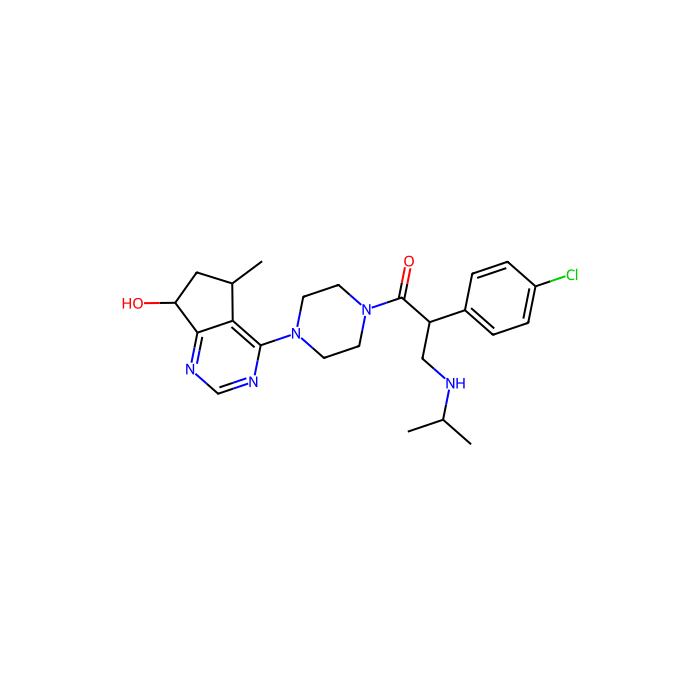
Determine the necessary mass, volume, or concentration for preparing a solution.
| Activity Type | Activity Value -log(M) | Mechanism of Action | Activity Reference | Publications (PubMed IDs) |
|---|

Moligand™, 10mM in DMSO Moligand™ per flussi di lavoro cromatografici e analitici sensibili che richiedono un'interferenza minima della linea di base.
Store at -80°C Spedizione Dry ice packs + Cold packs. Consultare il COA specifico del lotto per le specifiche esatte.
SDS, COA, scheda tecnica e scheda delle specifiche disponibili per il download. COA specifico del lotto accessibile tramite ricerca per numero di lotto.
Citato in 0 pubblicazioni peer-reviewed su cromatografia, sintesi organica e reazioni di accoppiamento incrociato.
Information
Ipatasertib (GDC-0068, RG7440) is a highly selective pan-Akt inhibitor targetingAkt1/2/3withIC50of 5 nM/18 nM/8 nM in cell-free assays, 620-fold selectivity over PKA. Phase 2.
In vitro
Testing against a broad panel of 230 kinases, GDC-0068 only inhibits 3 kinases by >70% at 1 μM concentration (PRKG1α, PRKG1β, and p70S6K, with IC50 of 98 nM, 69 nM, and 860 nM, respectively). GDC-0068 displays >100-fold selectivity for Akt over PKA with IC50 of 3.1 μM. In LNCaP, PC3 and BT474M1 cells, GDC-0068 treatment inhibits the phosphorylation of the Akt substrate, PRAS40 with IC50 of 157 nM, 197 nM, and 208 nM, respectively. Furthermore, GDC-0068 selectively inhibits cell cycle progression and viability of cancer cell lines driven by Akt signaling, including those with defects in the tumor suppressor PTEN, oncogenic mutations in PIK3CA, and amplification of HER2, with strongest effects in HER2+ and Luminal subtypes. [1-4]
In vivo
Oral administration of GDC-0068 in PC3 prostate tumor xenografts model induces down-regulation of p-PRAS40. In BT474-Tr xenografts, GDC-0068 treatment reduces pS6 and peIF4G levels, re-localizes FOXO3a to nucleus, and induces feedback upregulation of HER3 and pERK. Administration of GDC-0068 exhibits potent antitumor efficacy in multiple xenograft tumor models, including the PTEN-deficient prostate cancer models LNCaP and PC3, the PIK3CA H1047R mutant breast cancer model KPL-4, and MCF7-neo/HER2 tumor model. [1-4]
Cell Data
cell lines:
Concentrations:
Incubation Time:
Powder Purity:≥99%
Documento completo su pericoli, manipolazione, stoccaggio e conformità normativa.
<<<<<<< HEAD Scarica SDS → ======= Scarica SDS → >>>>>>> release248-p3Dati di qualità specifici del lotto. Inserisci il numero di lotto per recuperare il COA esatto.
Cerca COA →Riepilogo di riferimento rapido delle specifiche e applicazioni del prodotto.
Visualizza scheda tecnica →Attributi di qualità completi e criteri di accettazione per questa qualità.
Visualizza scheda delle specifiche →| Activity Type | Activity Value -log(M) | Mechanism of Action | Activity Reference | Publications (PubMed IDs) |
|---|
| Activity Type | Activity Value -log(M) | Mechanism of Action | Activity Reference | Publications (PubMed IDs) |
|---|
| Activity Type | Activity Value -log(M) | Mechanism of Action | Activity Reference | Publications (PubMed IDs) |
|---|
| Activity Type | Activity Value -log(M) | Mechanism of Action | Activity Reference | Publications (PubMed IDs) |
|---|
| Solubilità | Solubility (25°C) In vitro DMSO: 4 mg/mL (14.16 mM); |
|---|
General guidance (for planning only; not product specifications)
Pathway context (literature/general)
Mechanistic note (literature)
Research utility (general)
Off‑target and selectivity considerations (general)
Important caveats
No medical or clinical claims are made; this product is supplied strictly for research use only.
This compound is not a buffering agent and is not used to establish or maintain solution pH.
Practical note
If pH sensitivity is suspected (general)
While the compound itself is a fixed entity, greener choices can be made in handling and assay workflows.
Solvent considerations (general)
Process/assay design
Waste and energy
Comparison (general trends)
Note: These are workflow-level alternatives; the active chemical identity of Ipatasertib is unchanged.
No excipient or formulation role is specified for this catalog item; pharmacopeial status is not indicated.
Research/manufacturing context (general)
Regulatory note
Documentation
Item-specific physical properties (specification)
Thermal properties (literature/general)
Partitioning/solubility (literature/general guidance)
Spectroscopic identifiers (general)
Note: Where precise numeric values are required for method development or QC, rely on the item’s CoA/Spec Sheet or replicate trusted database entries; do not substitute literature ranges for product specifications.
Item-specific grade
What Moligand™ typically implies (general explanation; not a specification)
Practical considerations for assay use (general)
Stabilizers/additives
Trace impurities/elemental limits
This product is a bioactive small molecule used as a research tool rather than as a synthetic reagent.
Primary research application (literature/general)
Typical experimental contexts (general)
Practical tips (general guidance)
Note: No synthetic reaction applications (e.g., coupling, catalysis) are typical for this item; for synthetic reagents see our building‑block catalog.
Not typically applicable. Ipatasertib is used as a biochemical tool compound, not as a reagent or substrate in synthetic transformations.
For detailed synthetic reaction conditions, consult sections relevant to building blocks and reagents.
GHS classification and hazards (item-specific)
General laboratory precautions (best practice)
First aid (overview; defer to SDS)
Storage incompatibilities and stability (general)
Waste disposal
Authoritative safety information is provided on the SDS; always prioritize the SDS for decision‑making.
Solubility strategy (general for kinase inhibitors)
Aqueous formulation approaches (general)
Compatibility considerations
Comparison notes (general)
Item-specific storage and shipping
Stability notes (general)
Reconstitution (general guidance; not a specification)
In-use handling
Documentation
Brief profile for a research‑grade small‑molecule tool compound supplied under Aladdin’s Moligand™ line.
Item-specific identifiers (from Product Data)
Molecular formula and molecular weight
Structural features (general, literature)
2D structure description (general, literature)
This product is a finished bioactive small molecule (tool compound) and is not typically employed as a building block or reagent in synthetic organic chemistry.
If derivatization is required (general)
Recommendation
Note: Literature commonly describes Ipatasertib as a pan‑AKT (AKT1/2/3) inhibitor; however, per catalog policy, only product-provided target and validation data can be displayed here. Please consult primary literature or the SDS/CoA for assay-verified specificity data.
La nostra guida alla selezione delle qualità copre purezza, stato dello stabilizzatore e idoneità all'applicazione per tutte le varianti del nostro catalogo.
Visualizza la guida alle qualità Moligand™ →