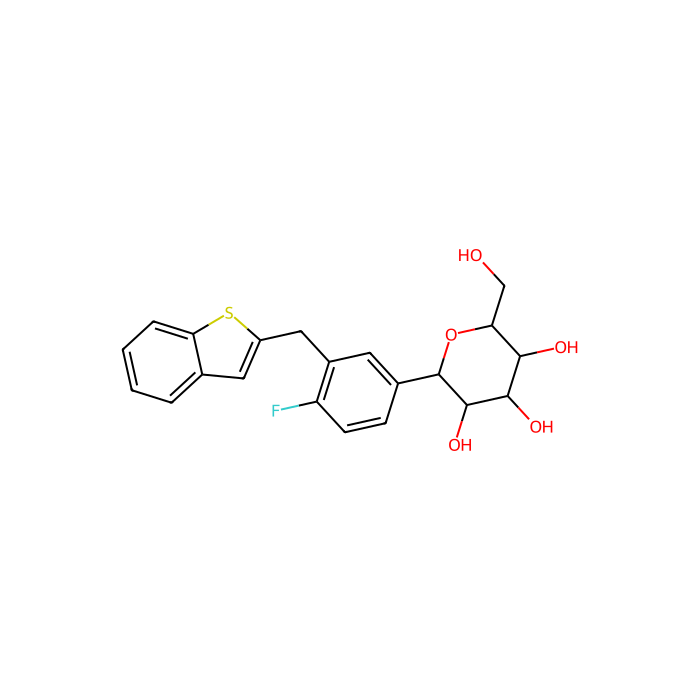
Ipragliflozin - Moligand™, ≥97% , Sodium/glucose cotransporter 2 inhibitor, CAS No.761423-87-4, Sodium/glucose cotransporter 2 inhibitor

CAS: 761423-87-4 Cat. No.: I177384 Formula: C21H21FO5S Peso molecolare: 404.45
Disponibile su ordine
QUALITÀ & PUREZZA Moligand™ ? Moligand™ — Aladdin's line of ligands and bioactive small molecules. Use for receptor, pathway, and binding studies needing defined small-molecule tools. ≥97%
Synonyms
(1S)-1,5-Anhydro-1-c-[3-[(1-benzothiophen-2-yl)methyl]-4-fluorophenyl]-D-glucitol | MS-26796 | (2S,3R,4R,5S,6R)-2-{3-[(1-benzothiophen-2-yl)methyl]-4-fluorophenyl}-6-(hydroxymethyl)oxane-3,4,5-triol | DB11698 | DTXSID701032738 | Ipragliflozin (INN) | sugl
Storage
Store at -20°C
Shipped In
Ice chest + Ice pads
★
Dimensione
Germania (EU)
USA*
Prezzo
Qtà
10mg
I177384-10mg
—
3 Disponibile

12,93€

19,87€
Salva 6,94 € (34.93%)
25mg
I177384-25mg
—
1 Disponibile

15,53€

23,34€
Salva 7,81 € (33.46%)
100mg
I177384-100mg
—
2 Disponibile

23,34€

35,49€
Salva 12,15 € (34.23%)
500mg
I177384-500mg
Su ordinazione · 8–12 settimane

52,85€

79,75€
Salva 26,90 € (33.73%)
1g
I177384-1g
Su ordinazione · 8–12 settimane

81,48€

122,26€
Salva 40,78 € (33.36%)
Enter a quantity for the sizes you want to add.
🧪
Perché questa qualità

Moligand™, ≥97% Moligand™ per flussi di lavoro cromatografici e analitici sensibili che richiedono un'interferenza minima della linea di base.

🌡

Stoccaggio e spedizione

Store at -20°C Spedizione Ice chest + Ice pads. Consultare il COA specifico del lotto per le specifiche esatte.

📋

Documenti di qualità

SDS, COA, scheda tecnica e scheda delle specifiche disponibili per il download. COA specifico del lotto accessibile tramite ricerca per numero di lotto.

📚

Prova documentale

Citato in 0 pubblicazioni peer-reviewed su cromatografia, sintesi organica e reazioni di accoppiamento incrociato.

Panoramica

Ipragliflozin (ASP1941) is a highly potent and selective SGLT2 inhibitor with IC50 of 2.8 nM; little and NO potency for SGLT1/3/4/5/6. IC50 value: 2.8 nM Target: SGLT2 in vitro: Ipragliflozin potently and selectively inhibited human, rat, and mouse SGLT2 at nanomolar ranges and exhibited stability against intestinal glucosidases. in vivo: Ipragliflozin showed good pharmacokinetic properties following oral dosing, and dose-dependently increased urinary glucose excretion, which lasted for over 12 h in normal mice. Oral administration of ipragliflozin increased urinary glucose excretion in a dose-dependent manner, an effect which was significant at doses of 0.3 mg/kg or higher and lasted over 12 h. Single administration of ipragliflozin dose-dependently increased urinary glucose excretion, reduced blood glucose and plasma insulin levels, and improved glucose intolerance .

Specifiche

Sinonimi
(1S)-1,5-Anhydro-1-c-[3-[(1-benzothiophen-2-yl)methyl]-4-fluorophenyl]-D-glucitol | MS-26796 | (2S,3R,4R,5S,6R)-2-{3-[(1-benzothiophen-2-yl)methyl]-4-fluorophenyl}-6-(hydroxymethyl)oxane-3,4,5-triol | DB11698 | DTXSID701032738 | Ipragliflozin (INN) | sugl
Specifiche e purezza
Moligand™, ≥97%
Meccanismi biochimici e fisiologici
Potent, selective sodium-glucose cotransporter 2 (SGLT2) inhibitor. Increases glucose excretion.
Condizioni di conservazione di stoccaggio
Store at -20°C
Spedito in
Ice chest + Ice pads
Questo prodotto richiede spedizione a catena fredda. I servizi di terra e altri servizi economici non sono disponibili.
Grado
Moligand™
Tipo di azione
INHIBITOR
Meccanismo d'azione
Sodium/glucose cotransporter 2 inhibitor
Nota
Wherever possible, you should prepare and use solutions on the same day. However, if you need to make up stock solutions in advance, we recommend that you store the solution as aliquots in tightly sealed vials at -20°C. Generally, these will be useable for up to one month. Before use, and prior to opening the vial we recommend that you allow your product to equilibrate to room temperature for at least 1 hour. Need more advice on solubility, usage and handling? Please visit our frequently asked questions (FAQ) page for more details.
Purezza
≥97%
Proprietà del prodotto
ALogP
2.5
Nomi e identificatori
Pubchem Sid
Pubchem Sid Url
https://pubchem.ncbi.nlm.nih.gov/substance/504765477
Sorrisi canonici
C1=CC=C2C(=C1)C=C(S2)CC3=C(C=CC(=C3)C4C(C(C(C(O4)CO)O)O)O)F
IUPAC Name
(2S,3R,4R,5S,6R)-2-[3-(1-benzothiophen-2-ylmethyl)-4-fluorophenyl]-6-(hydroxymethyl)oxane-3,4,5-triol
InChIKey
AHFWIQIYAXSLBA-RQXATKFSSA-N
INCHI
1S/C21H21FO5S/c22-15-6-5-12(21-20(26)19(25)18(24)16(10-23)27-21)7-13(15)9-14-8-11-3-1-2-4-17(11)28-14/h1-8,16,18-21,23-26H,9-10H2/t16-,18-,19+,20-,21+/m1/s1
Isomeri SMILES
C1=CC=C2C(=C1)C=C(S2)CC3=C(C=CC(=C3)[C@H]4[C@@H]([C@H]([C@@H]([C@H](O4)CO)O)O)O)F
Peso molecolare
404.45
Reaxy-Rn
26010161
Reaxys-RN_link_address
https://www.reaxys.com/reaxys/secured/hopinto.do?context=S&query=IDE.XRN=26010161&ln=

Documentazione

📋 Scheda di dati di sicurezza (SDS)

Documento completo su pericoli, manipolazione, stoccaggio e conformità normativa.

<<<<<<< HEAD Scarica SDS → ======= Scarica SDS → >>>>>>> release248-p3

✅ Certificato di analisi (COA)

Dati di qualità specifici del lotto. Inserisci il numero di lotto per recuperare il COA esatto.

Cerca COA →

📊 Scheda tecnica

Riepilogo di riferimento rapido delle specifiche e applicazioni del prodotto.

Visualizza scheda tecnica →

🔬 Scheda delle specifiche

Attributi di qualità completi e criteri di accettazione per questa qualità.

Visualizza scheda delle specifiche →

Dati avanzati

Taxonomic Classification

Taxonomy Tree

KingdomOrganic compounds
SuperclassOrganic oxygen compounds
ClasseOrganooxygen compounds
SubclassCarbohydrates and carbohydrate conjugates
Intermediate Tree Nodes Glycosyl compounds
Direct ParentPhenolic glycosides
Alternative Parents Hexoses  C-glycosyl compounds  1-benzothiophenes  2,3,5-trisubstituted thiophenes  Fluorobenzenes  Oxanes  Aryl fluorides  Heteroaromatic compounds  Secondary alcohols  Polyols  Oxacyclic compounds  Dialkyl ethers  Primary alcohols  Organofluorides  Hydrocarbon derivatives  
Molecular FrameworkAromatic heteropolycyclic compounds
Substituents Phenolic glycoside - Hexose monosaccharide - C-glycosyl compound - 1-benzothiophene - Benzothiophene - 2,3,5-trisubstituted thiophene - Halobenzene - Fluorobenzene - Aryl fluoride - Monosaccharide - Aryl halide - Benzenoid - Monocyclic benzene moiety - Oxane - Heteroaromatic compound - Thiophene - Secondary alcohol - Oxacycle - Organoheterocyclic compound - Polyol - Dialkyl ether - Ether - Primary alcohol - Hydrocarbon derivative - Alcohol - Organofluoride - Organohalogen compound - Aromatic heteropolycyclic compound
DescrizioneThis compound belongs to the class of organic compounds known as phenolic glycosides. These are organic compounds containing a phenolic structure attached to a glycosyl moiety. Some examples of phenolic structures include lignans, and flavonoids. Among the sugar units found in natural glycosides are D-glucose, L-Fructose, and L rhamnose.
External Descriptors Not available
Struttura 3D
Modello di struttura chimica interattiva


Obiettivi associati (umani)
SLC5A2 Tclin Sodium/glucose cotransporter 2 (8 Activities)
Activity TypeActivity Value -log(M)Mechanism of ActionActivity ReferencePublications (PubMed IDs)
SLC5A1 Tclin Sodium/glucose cotransporter 1 (3 Activities)
Activity TypeActivity Value -log(M)Mechanism of ActionActivity ReferencePublications (PubMed IDs)
F2 Tclin Thrombin (11687 Activities)
Activity TypeRelationActivity valueUnitsAction TypeJournalPubMed IddoiAssay Aladdin ID
ESR1 Tclin Estrogen receptor alpha (17718 Activities)
Activity TypeRelationActivity valueUnitsAction TypeJournalPubMed IddoiAssay Aladdin ID
PGR Tclin Progesterone receptor (8562 Activities)
Activity TypeRelationActivity valueUnitsAction TypeJournalPubMed IddoiAssay Aladdin ID
CHRM2 Tclin Muscarinic acetylcholine receptor M2 (10671 Activities)
Activity TypeRelationActivity valueUnitsAction TypeJournalPubMed IddoiAssay Aladdin ID
HTR1A Tclin Serotonin 1a (5-HT1a) receptor (14969 Activities)
Activity TypeRelationActivity valueUnitsAction TypeJournalPubMed IddoiAssay Aladdin ID
ADRA2A Tclin Alpha-2a adrenergic receptor (9450 Activities)
Activity TypeRelationActivity valueUnitsAction TypeJournalPubMed IddoiAssay Aladdin ID
AR Tclin Androgen Receptor (11781 Activities)
Activity TypeRelationActivity valueUnitsAction TypeJournalPubMed IddoiAssay Aladdin ID
CHRM1 Tclin Muscarinic acetylcholine receptor M1 (12690 Activities)
Activity TypeRelationActivity valueUnitsAction TypeJournalPubMed IddoiAssay Aladdin ID
GABRA1 Tclin GABA receptor alpha-1 subunit (399 Activities)
Activity TypeRelationActivity valueUnitsAction TypeJournalPubMed IddoiAssay Aladdin ID
MAOA Tclin Monoamine oxidase A (11911 Activities)
Activity TypeRelationActivity valueUnitsAction TypeJournalPubMed IddoiAssay Aladdin ID
DRD1 Tclin Dopamine D1 receptor (9720 Activities)
Activity TypeRelationActivity valueUnitsAction TypeJournalPubMed IddoiAssay Aladdin ID
ACHE Tclin Acetylcholinesterase (18204 Activities)
Activity TypeRelationActivity valueUnitsAction TypeJournalPubMed IddoiAssay Aladdin ID
PTGS1 Tclin Cyclooxygenase-1 (9233 Activities)
Activity TypeRelationActivity valueUnitsAction TypeJournalPubMed IddoiAssay Aladdin ID
SLC6A2 Tclin Norepinephrine transporter (10102 Activities)
Activity TypeRelationActivity valueUnitsAction TypeJournalPubMed IddoiAssay Aladdin ID
SLC6A4 Tclin Serotonin transporter (12625 Activities)
Activity TypeRelationActivity valueUnitsAction TypeJournalPubMed IddoiAssay Aladdin ID
ADRA1A Tclin Alpha-1a adrenergic receptor (8359 Activities)
Activity TypeRelationActivity valueUnitsAction TypeJournalPubMed IddoiAssay Aladdin ID
OPRM1 Tclin Mu opioid receptor (19785 Activities)
Activity TypeRelationActivity valueUnitsAction TypeJournalPubMed IddoiAssay Aladdin ID
DRD3 Tclin Dopamine D3 receptor (14368 Activities)
Activity TypeRelationActivity valueUnitsAction TypeJournalPubMed IddoiAssay Aladdin ID
SLC6A3 Tclin Dopamine transporter (10535 Activities)
Activity TypeRelationActivity valueUnitsAction TypeJournalPubMed IddoiAssay Aladdin ID
PDE3A Tclin Phosphodiesterase 3A (3309 Activities)
Activity TypeRelationActivity valueUnitsAction TypeJournalPubMed IddoiAssay Aladdin ID
HTR2B Tclin Serotonin 2b (5-HT2b) receptor (10323 Activities)
Activity TypeRelationActivity valueUnitsAction TypeJournalPubMed IddoiAssay Aladdin ID
TBXA2R Tclin Thromboxane A2 receptor (5717 Activities)
Activity TypeRelationActivity valueUnitsAction TypeJournalPubMed IddoiAssay Aladdin ID
PDE4A Tclin Phosphodiesterase 4A (1943 Activities)
Activity TypeRelationActivity valueUnitsAction TypeJournalPubMed IddoiAssay Aladdin ID
ADORA3 Tchem Adenosine A3 receptor (15931 Activities)
Activity TypeRelationActivity valueUnitsAction TypeJournalPubMed IddoiAssay Aladdin ID
HRH3 Tclin Histamine H3 receptor (10389 Activities)
Activity TypeRelationActivity valueUnitsAction TypeJournalPubMed IddoiAssay Aladdin ID
Homo sapiens (32628 Activities)
Activity TypeRelationActivity valueUnitsAction TypeJournalPubMed IddoiAssay Aladdin ID
Obiettivi associati (non umani)
Hdac6 Histone deacetylase 6 (222 Activities)
Activity TypeRelationActivity valueUnitsAction TypeJournalPubMed IddoiAssay Aladdin ID
Slc5a1 Sodium/glucose cotransporter 1 (11 Activities)
Activity TypeRelationActivity valueUnitsAction TypeJournalPubMed IddoiAssay Aladdin ID
Slc5a2 Sodium/glucose cotransporter 2 (17 Activities)
Activity TypeRelationActivity valueUnitsAction TypeJournalPubMed IddoiAssay Aladdin ID
Mus musculus (284745 Activities)
Activity TypeRelationActivity valueUnitsAction TypeJournalPubMed IddoiAssay Aladdin ID
Rattus norvegicus (775804 Activities)
Activity TypeRelationActivity valueUnitsAction TypeJournalPubMed IddoiAssay Aladdin ID
rep Replicase polyprotein 1ab (378 Activities)
Activity TypeRelationActivity valueUnitsAction TypeJournalPubMed IddoiAssay Aladdin ID
Meccanismi d'azione
Certificati (CoA, COO, BSE/TSE e tabella di analisi)
C of A & Other Certificates(BSE/TSE, COO):
Analytical Chart:

Find and download the COA for your product by matching the lot number on the packaging.

6 results found

Lot NumberCertificate TypeDataOggetto
H2022021H2022021Certificate of AnalysisMar 20, 2026 I177384
H2022020H2022020Certificate of AnalysisMar 20, 2026 I177384
H2022018H2022018Certificate of AnalysisMar 20, 2026 I177384
E2323032E2323032Certificate of AnalysisMar 11, 2026 I177384
I2418056I2418056Certificate of AnalysisSep 26, 2024 I177384
H2022019H2022019Certificate of AnalysisJun 09, 2023 I177384
Proprietà chimiche e fisiche
SolubilitàDMSO : ≥ 100 mg/mL (247.25 mM) H2O : < 0.1 mg/mL (insoluble)
Peso molecolare404.500 g/mol
XLogP32.500
Hydrogen Bond Donor Count4
Hydrogen Bond Acceptor Count7
Rotatable Bond Count4
Exact Mass404.109 Da
Monoisotopic Mass404.109 Da
Topological Polar Surface Area118.000 Ų
Heavy Atom Count28
Formal Charge0
Complexity525.000
Isotope Atom Count0
Defined Atom Stereocenter Count5
Undefined Atom Stereocenter Count0
Defined Bond Stereocenter Count0
Undefined Bond Stereocenter Count0
The total count of all stereochemical bonds0
Covalently-Bonded Unit Count1
Calcolatori di soluzioni
Recensioni

Recensioni dei clienti

Application Protocols

The Product Data do not provide tested applications or protocols for this item. The following general, non-validated guidance can help initiate method development; verify and optimize in your laboratory.

General small-molecule handling (research use only):

  • Stock solution: Weigh accurately and dissolve in anhydrous DMSO to prepare a 10–50 mM stock. Record concentration gravimetrically or by quantitative NMR if required.
  • Aliquoting: Dispense single-use aliquots (e.g., 10–50 µL) into low-bind microtubes or 96-well plates; store at –20 °C.
  • Thawing: Warm briefly to room temperature, vortex, quick-spin, and use immediately. Avoid repeated freeze–thaw cycles.
  • Assay addition: Add stock to assay buffer under vigorous mixing to a final DMSO content of ≤1–2% v/v. Inspect for precipitation; if observed, increase mixing time or co-solvent fraction within assay tolerance.
  • Documentation: Capture lot number, preparation date, solvent batch, and any observation of precipitation or color change in your ELN.

For analytical reference standard use, develop an RP-HPLC/LC–MS method with a water–ACN or water–MeOH gradient containing volatile modifiers (e.g., 0.1% formic acid or ammonium acetate) and validate linearity, precision, and stability-in-matrix as required.

Biological Roles

No item-specific biological role claims are provided in the Product Data. The following is general, literature-based context intended for research-planning only (not medical/clinical use).

  • Class: Small-molecule C-aryl glucoside ligand commonly employed to interrogate sodium–glucose cotransport biology in vitro.
  • Mechanistic context (literature): Binds to the SGLT family of membrane transporters with high selectivity for certain isoforms, enabling studies of glucose uptake modulation, transporter kinetics, and competitive binding paradigms.
  • Experimental systems: Utilized in cell-free membrane vesicles, proteoliposomes, and transporter-expressing cell lines for uptake inhibition and binding assays. Also used in biophysical assays (e.g., DSF) to probe transporter conformational stabilization.
  • Off-target profiling: Often included in panel screens (kinases, GPCRs, ion channels/transporters) to establish selectivity margins; such datasets inform structure–activity relationships for aryl–glucoside scaffolds (literature/general).

Important limitations:

  • Biological findings can be system-dependent (expression level, lipid composition, assay temperature, ionic strength). Replicate with proper positive/negative controls.
  • Avoid extrapolation to in vivo contexts; this product is for research use only.

Consult current literature and your institutional guidelines for designing ethically and scientifically robust experiments.

Buffer Applications

This compound is not a buffering agent and is not used to set or maintain pH. Accordingly, classic buffer recipes (phosphate, HEPES, Tris, etc.) do not apply.

Practical guidance (general):

  • Prepare a concentrated DMSO stock, then dilute into your pre-selected assay buffer (e.g., HEPES-, Tris-, or phosphate-based) keeping final DMSO ≤1–2% v/v.
  • If precipitation occurs upon dilution, increase dilution steps, add a small amount of co-solvent, or warm gently while mixing.
  • Avoid strong acids/bases that can degrade polyol/aryl-glucoside motifs; maintain neutral pH for stability unless your method requires otherwise.

For buffer selection and composition, refer to the needs of your biological assay rather than the properties of this ligand.

Green Alternatives

While the molecule itself is fixed, greener choices can be made around its handling, particularly in solvent selection and cleanup.

Greener solvent considerations (general):

  • Prefer DMSO over DMF/NMP for stock solutions where assay design allows; DMSO has a more favorable toxicity and regulatory profile and lower vapor pressure.
  • For chromatographic purification or analytical sample prep, consider:
    • Ethanol/water or acetonitrile/water for reversed-phase methods instead of halogenated solvents.
    • Supercritical CO2 (SFC) for chiral/separation method development when applicable.

Comparison (general; qualitative):

  • DMSO: High solvency, low volatility; waste stream manageable; common in bioassays.
  • DMF/NMP: Excellent solvency but reproductive toxicity concerns; minimize or replace where feasible.
  • ACN vs MeOH: ACN often provides sharper peaks at lower backpressure; MeOH is less toxic but can increase backpressure and change selectivity—optimize to balance safety and performance.

Operational improvements:

  • Microscale assays to minimize solvent and compound consumption.
  • Use closed-vial dilutions and pre-prepared solvent reservoirs to reduce evaporative losses.
  • Implement solvent recycling for HPLC where institutional infrastructure exists.

Note: These are general green-chemistry recommendations; adapt to the method requirements and regulatory environment of your laboratory.

Pharmaceutical Uses

No item-specific pharmaceutical or compendial claims are provided in the Product Data. This product is supplied strictly for research use only.

General research/CMC-related contexts (non-clinical):

  • Reference standard: Used as a chromatographic and mass spectrometric reference for method development, impurity profiling, and stability-indicating assays in research settings.
  • Formulation screening (in vitro): Solubility and preformulation studies (pH–solubility, co-solvents, and solid-state screening) to inform laboratory-scale delivery of the compound in model systems.
  • Control article: Benchmark compound for transporter-targeted assay qualification and inter-lab comparison studies.

Important notes:

  • Not manufactured to GMP standards unless explicitly stated on documentation; not for human or veterinary use.
  • No therapeutic, diagnostic, or clinical claims are made for this product.

For regulatory-grade materials or pharmacopeial reference standards, consult appropriate compendia or certified suppliers and verify lot-specific documentation.

Physical Properties

Item-specific physicochemical specifications are not provided in the Product Data and should be confirmed on the CoA/Spec Sheet for this lot.

  • Appearance: Not specified for this item; refer to CoA/Spec Sheet.
  • Molecular weight: Not specified for this item; refer to CoA/Spec Sheet.
  • Molecular formula: Not specified for this item; refer to CoA/Spec Sheet.
  • Melting point, boiling point, density, refractive index, UV cutoff: Not specified for this item; refer to CoA/Spec Sheet.

General/literature guidance (non-spec, for planning only):

  • Physical form: Typically a crystalline solid for many C-aryl glucosides.
  • Solubility profile: Poor aqueous solubility is common for aryl-glucoside transporter ligands; good solubility in polar aprotic organic solvents such as DMSO and DMF; limited solubility in MeOH/EtOH; practically insoluble in aliphatic hydrocarbons.
  • Ionization: Neutral polyol with no strongly ionizable centers in the physiological pH range; behaves as a non-electrolyte in buffer.
  • Partitioning: Lipophilic aromatic region combined with hydrophilic sugar often yields moderate-to-high logP/logD at neutral pH (literature, qualitative).

Practical tips (general):

  • Prepare concentrated DMSO stocks (e.g., 10–50 mM), then dilute into aqueous assay buffers with ≤1–2% final DMSO to maintain clarity.
  • Gentle warming (≤40 °C) and vortex/sonication can aid dissolution. Filter (0.22 µm PTFE) if particulate persists.

Always treat the above as general literature expectations rather than specifications for this item.

Quality and Grades
  • Supplied grade: Moligand™ (from Product Data).

What Moligand™ implies (general description):

  • Curated small-molecule/ligand quality suitable for discovery chemistry, screening, and chemical biology. Emphasis is on identity/purity compatible with in vitro assays, SAR exploration, and reference control work. Batch documentation typically includes identity confirmation and purity metrics appropriate for research. Refer to the item’s CoA for the exact analytical package.

Item-specific notes:

  • Purity: Not specified for this item; refer to CoA/Spec Sheet.
  • Stabilizers/additives: Not specified for this item; refer to CoA/Spec Sheet.
  • Residual solvents/heavy metals/UV absorbance: Not specified for this item; refer to CoA/Spec Sheet.

Guidance on use by grade:

  • Screening/assay development: Moligand™ materials are intended for research use where reproducible identity and purity support biochemical/biophysical measurements.
  • Medicinal chemistry: Suitable as a reference ligand or benchmark compound in transporter engagement studies (literature), formulation feasibility, and physicochemical profiling.

Documentation to request/consult:

  • CoA for batch-specific purity and analytical data.
  • SDS for safety classification and handling.
  • Spec Sheet for structural strings (SMILES/InChI) if required by LIMS/ELN.
Reaction and Applications

Manufacturer Applications: Not specified in the Product Data for this item beyond its inclusion in a small-molecule/compound library (Moligand™). The notes below expand on common research uses from the literature and general practice.

Research applications (literature/general):

  • Transporter biology: Widely used as a selective small-molecule ligand/probe for sodium–glucose cotransporter studies (SGLT family) in membrane transport assays, uptake measurements, and binding experiments.
  • Assay controls: Serves as a positive control/reference compound in biochemical inhibition assays, thermal-shift/DSF, and target engagement (e.g., CETSA in cell-free systems where applicable).
  • ADME/physchem profiling: Benchmark for solubility, permeability, and microsomal stability panels alongside structural analogs.
  • Analytical reference: Standard for LC–MS method development and quantitation in in vitro matrices.

Not typically used as a synthetic reagent. However, knowledge of its architecture informs:

  • C-aryl glycosidic bond formation strategies (e.g., intramolecular aglycone delivery, cross-coupling onto protected sugar scaffolds) for analogue synthesis.

Practical tips:

  • Prepare DMSO stocks at defined concentrations with accurate gravimetry; record water content of solvent when possible.
  • Verify identity/purity by LC–MS/HPLC before critical studies; confirm chromatographic behavior and absence of late-eluting impurities.
  • For membrane transporter assays, pre-equilibrate with the target-containing membranes/vesicles and control the final organic solvent percentage.
Reaction Conditions

Item-specific reaction condition data are not applicable, as this compound is a target molecule rather than a reagent.

General laboratory handling conditions (for solution preparation and assays):

  • Stock preparation: Dissolve in anhydrous DMSO to 10–50 mM. Gentle warming (≤40 °C) and sonication can aid dissolution.
  • Working concentrations: Commonly 1 nM–100 µM in biochemical assays depending on the system and endpoint (literature/general). Titrate to define IC50/affinity in your model.
  • Dilution: Add DMSO stock into vigorously stirred buffer to minimize local supersaturation; maintain final DMSO ≤1–2% v/v.
  • Stability checks: Verify by LC–MS or HPLC after assay incubation time (e.g., 30–120 min) to confirm chemical stability under assay conditions.

If pursuing chemical synthesis of analogs (general literature):

  • C-aryl glycosylation conditions often involve transition-metal catalysis (e.g., Ni/Pd-catalyzed cross-coupling of anomeric electrophiles) or radical-mediated anomeric coupling under photoredox; temperatures range from 0–100 °C depending on the method, with polar aprotic solvents (THF, DMF, DMSO) and bases such as K3PO4 or Cs2CO3. Consult primary literature for precise conditions.

Note: The above are general guidelines and not specifications for this product.

Safety and Handling

Authoritative safety information resides in the SDS. The Product Data do not list GHS details for this item; therefore consult the SDS before use.

  • GHS classification, signal word, H-statements, pictograms: Not specified for this item; refer to SDS.

General laboratory precautions for small organic solids (guidance only):

  • PPE: Lab coat, safety glasses, and appropriate chemically resistant gloves (e.g., nitrile). Use a fume hood to avoid dust or aerosol inhalation.
  • Avoid: Inhalation of dust, skin/eye contact, and ingestion. Wash thoroughly after handling.
  • Incompatibilities: Strong oxidizers and strong acids/bases may degrade polyhydroxylated aromatics; avoid moisture ingress when weighing to maintain material integrity.
  • Thermal stability: Avoid excessive heat; follow storage guidance.
  • First aid (overview; defer to SDS):
    • Inhalation: Move to fresh air; seek medical attention if symptoms occur.
    • Skin: Wash with soap and water; remove contaminated clothing.
    • Eyes: Rinse cautiously with water for several minutes; remove contact lenses if present and easy.
    • Ingestion: Rinse mouth; seek medical attention.

Spill/cleanup:

  • Avoid dust generation; collect mechanically or with damp disposable towels. Dispose of in accordance with institutional and local regulations.

Fire safety:

  • Many organic solids are combustible; use CO2, dry chemical, or foam extinguishers as appropriate.
Solvent Selection

This compound is a polyhydroxylated aryl glucoside; dissolution behavior typically reflects a balance of hydrophilic OH groups and a lipophilic aromatic core.

  • Primary stock solvent (general best practice):
    • DMSO: Most reliable for concentrated stocks (e.g., 10–50 mM). Offers excellent solvency for aryl–glucosides.
  • Secondary solvents:
    • DMF or NMP for method development (less preferred for bioassays due to toxicity/volatility concerns).
    • Alcohols (MeOH, EtOH): Moderate solubility; may require warming and sonication; risk of crystallization upon aqueous dilution.
    • Aqueous buffers: Typically low intrinsic solubility; use co-solvent strategy (0.5–2% DMSO, possibly with 0.1% nonionic surfactant such as Tween 80 for biophysical work if compatible).

Comparison (general):

  • DMSO vs MeOH: DMSO provides higher solubility and better stability for many C-aryl glucosides; MeOH is more volatile and may lead to precipitation on dilution.
  • DMSO vs DMF: Similar solvency; DMSO preferred for biological testing due to lower volatility/odor and acceptance in assays.

Practical tips:

  • Prepare a fresh anhydrous DMSO stock; avoid repeated exposure to high humidity to limit water uptake.
  • Filter sterilize stock solutions for cell-free biochemical assays if needed.
  • Validate final assay solvent composition to keep DMSO ≤1–2% v/v to minimize interference.
Storage and Reconstitution
  • Storage conditions (from Product Data): Store at -20°C.
  • Shipping (from Product Data): Shipped in ice chest + ice pads.

Item-specific additional storage notes:

  • Appearance: Not specified for this item; refer to CoA/Spec Sheet.
  • Stabilizers: Not specified for this item; refer to CoA/Spec Sheet.

General best practices for this compound class:

  • Keep container tightly closed in a dry, inert environment. Protect from light and ambient humidity to preserve solid-state integrity.
  • After opening, promptly prepare single-use DMSO stock aliquots (e.g., 10–50 mM) to minimize headspace and freeze–thaw stress.
  • Store DMSO stocks at –20 °C (or below) in tightly sealed, low-bind vials; purge headspace with inert gas if available.
  • Avoid repeated freeze–thaw cycles; thaw quickly at room temperature, mix thoroughly, and refreeze unused aliquots only once if necessary.
  • Inspect periodically for signs of degradation (discoloration, precipitation behavior changes). Confirm by HPLC/LC–MS as needed before critical experiments.

Disposal: Follow institutional and local regulations for disposal of organic chemicals and DMSO solutions.

Always defer to the product’s SDS and CoA/Spec Sheet for authoritative, lot-specific instructions.

Structure and Identity

Ipragliflozin is a small-molecule C-aryl glucoside commonly used as a selective transporter ligand in biochemical research (literature). The product is supplied as part of Aladdin’s Moligand™ collection.

  • Item-specific identifiers (from Product Data):

    • SKU: I177384
    • CAS: 761423-87-4
    • CID (PubChem): 10453870
    • InChIKey: Not specified for this item; refer to CoA/Spec Sheet.
    • SMILES: Not specified for this item; refer to CoA/Spec Sheet.
    • Molecular formula: Not specified for this item; refer to CoA/Spec Sheet.
    • Molecular weight: Not specified for this item; refer to CoA/Spec Sheet.
  • Structural features (general/literature description):

    • Core: D-glucitol (glucose-derived) scaffold with multiple hydroxyl groups.
    • Connectivity: C–C bond between the anomeric carbon (C1) of the sugar and an aryl system (C-aryl glucoside).
    • Aromatic domain: 4-fluorophenyl substituted with a benzo[b]thiophene-2-ylmethyl group (literature), providing a rigid, lipophilic pharmacophore.
    • Stereochemistry: Multiple defined stereocenters on the glucitol ring (literature). The aryl portion is achiral.
  • 2D structure in words (literature): A polyhydroxylated six-membered carbohydrate ring bearing at C1 a para-fluorophenyl group that is benzylically tethered to a benzothiophene ring; remaining sugar positions carry hydroxyl groups in fixed stereochemical orientations.

Note: Exact structural strings (SMILES/InChI) and batch-confirmed identity parameters should be verified on the item’s CoA/Spec Sheet and SDS.

Synthetic Utility

This molecule is generally not used as a reagent or building block. However, its architecture provides instructive value for synthetic and medicinal chemists.

Design and reactivity insights (general/literature):

  • C-Aryl glycoside bond formation: Highlights strategies for stereocontrolled C–C coupling at the anomeric position, including radical, metal-catalyzed, and intramolecular delivery approaches on protected sugar scaffolds.
  • Polyol manipulation: Requires selective protection/deprotection of multiple hydroxyls (e.g., benzyl, silyl, or acyl protecting groups) to control reactivity and solubility during synthesis.
  • Aryl diversification: Substituent effects (e.g., para-fluoro, benzothiophene) modulate lipophilicity, target binding, and metabolic stability; provides a platform for SAR through late-stage functionalization.
  • Chiral integrity: Maintenance of sugar stereocenters through hydrogenolysis, dehydration, and coupling steps is a key process parameter.

Method benchmarking:

  • Serves as a target for validating C-aryl glycosylation methods and for testing coupling conditions that tolerate polyfunctional substrates.

For routine laboratory synthesis, consult primary literature for stepwise routes, protecting group strategies, and catalyst/ligand choices compatible with carbohydrate frameworks.

Target Specificity

Only product-data-derived target information may be listed here. The Product Data for SKU I177384 do not specify target, antigen, isoform selectivity, species reactivity, or any binding constants.

  • Target/antigen: Not specified for this item; refer to CoA/Spec Sheet.
  • Selectivity/affinity data: Not specified for this item; refer to CoA/Spec Sheet.

For planning purposes, consult peer-reviewed literature for transporter selectivity profiles and validate in your own assay system.

Domande frequenti

What is the purity of this product?
This product is supplied at ≥97% purity (chemical assay). Lot-specific values are stated on the Certificate of Analysis.
What is Moligand??
Moligand? is one of Aladdin Scientific's premium product lines, formulated for high-purity applications across multiple workflows. Compared to standard grades in the same workflow, Moligand? products typically offer tighter specifications, more rigorous QC, and stronger lot-to-lot consistency.
How should this product be stored?
Store at ?20 °C. Freezer storage is required to maintain the specified shelf life.
How is this product shipped?
This product ships in an insulated container with ice pads. Unpack on arrival and transfer it to the storage condition stated above.
What are the CAS number, molecular formula and molecular weight?
The CAS Number is 761423-87-4, the molecular formula is C21H21FO5S, and the molecular weight is 404.45 g/mol. InChIKey AHFWIQIYAXSLBA-RQXATKFSSA-N.
What documentation is provided?
Available product documentation, including Certificates of Analysis (COA), Safety Data Sheets (SDS), and specification sheets, is shown in the product document area. Document availability and access follow the current site policy.

Desidera che le inviamo un messaggio quando avremo sconti disponibili?

Ricordamelo più tardi

Grazie! Controlli la sua casella di posta per confermare.

Ops! Le notifiche sono disabilitate.