≥99% per flussi di lavoro cromatografici e analitici sensibili che richiedono un'interferenza minima della linea di base.
🌡
Stoccaggio e spedizione
Store at 2-8°C,Desiccated Spedizione Wet ice. Consultare il COA specifico del lotto per le specifiche esatte.
📋
Documenti di qualità
SDS, COA, scheda tecnica e scheda delle specifiche disponibili per il download. COA specifico del lotto accessibile tramite ricerca per numero di lotto.
📚
Prova documentale
Citato in 0 pubblicazioni peer-reviewed su cromatografia, sintesi organica e reazioni di accoppiamento incrociato.
Panoramica
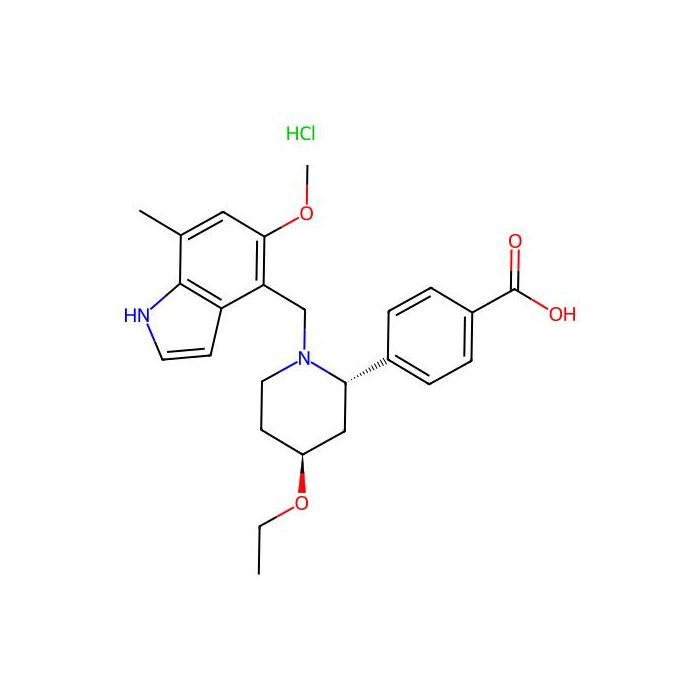
LNP023 hydrochloride is an orally bioavailable, highly potent and highly selective factor B inhibitor. LNP023 shows direct, reversible, and high-affinity binding to human factor B with a K D of 7.9 nM. LNP023 inhibits factor B with an IC 50 value of 10 nM
In Vitro
LNP023 demonstrates potent inhibition of alternative complement pathway (AP)-induced membrane attack complex (MAC) formation in 50% human serum (IC 50 value of 130 nM). ?\nLNP023 exhibits excellent selectivity over other proteases affording IC 50 values of >30 μM across a panel of 41 human proteases, including the AP protein factor D (>100 μM). MCE has not independently confirmed the accuracy of these methods. They are for reference only.
In Vivo
LNP023 (20-180 mg/kg; oral administration) prevents KRN (150 μL)-induced arthritis in mice and is effective upon prophylactic and therapeutic dosing in an experimental model of membranous nephropathy in rats. ?\nLNP023 exhibits moderate half-lives (T 1/2 ; Wistar Han rats 3.4 h, beagle dogs 5.5 h) and C max (Wistar Han rats 410 nM, beagle dogs 2200 nM) following oral administration (rat 30 and, dog 10 mg/kg). ?\nLNP023 exhibits terminal elimination half-lives (T 1/2 ; Wistar Han rats 7 h, beagle dogs 5.6 h) due to high plasma clearance (8, and 2 mL/min/kg respectively combined with large volumes of distribution (2.3, and 0.6 L/kg respectively) following intravenous administration (rat 1.0 and, dog 0.1 mg/kg). MCE has not independently confirmed the accuracy of these methods. They are for reference only. Animal Model: C57BL/6 mice with KRN-induced arthritisDosage: 20, 60, and 180 mg/kg Administration: Orally gavaged; twice a day (b.i.d.) for 14 days Result: Blocked KRN-induced arthritis.
Form:Solid
IC50& Target:KD: 7.9 nM (factor B),IC50: 10 nM (factor B)
LNP023 hydrochloride is an orally bioavailable, highly potent and highly selective factor B inhibitor. LNP023 shows direct, reversible, and high-affinity binding to human factor B with a K D of 7.9 nM. LNP023 inhibits factor B with an IC 50 value of 10 nM
Condizioni di conservazione di stoccaggio
Store at 2-8°C,Desiccated
Spedito in
Wet ice
Questo prodotto richiede spedizione a catena fredda. I servizi di terra e altri servizi economici non sono disponibili.
Certificati (CoA, COO, BSE/TSE e tabella di analisi)
C of A & Other Certificates(BSE/TSE, COO):
Analytical Chart:
Proprietà chimiche e fisiche
Solubilità
DMSO : 250 mg/mL (544.69 mM; Need ultrasonic) H2O : 50 mg/mL (108.94 mM; ultrasonic and warming and heat to 60°C)
Peso molecolare
459.000 g/mol
XLogP3
Hydrogen Bond Donor Count
3
Hydrogen Bond Acceptor Count
5
Rotatable Bond Count
7
Exact Mass
458.197 Da
Monoisotopic Mass
458.197 Da
Topological Polar Surface Area
74.800 Ų
Heavy Atom Count
32
Formal Charge
0
Complexity
594.000
Isotope Atom Count
0
Defined Atom Stereocenter Count
2
Undefined Atom Stereocenter Count
0
Defined Bond Stereocenter Count
0
Undefined Bond Stereocenter Count
0
The total count of all stereochemical bonds
0
Covalently-Bonded Unit Count
2
Calcolatori di soluzioni
Molarity Calculator
Determine the necessary mass, volume, or concentration for preparing a solution.
Dilution Calculator
Determine the dilution needed to prepare a stock solution.
Reconstitution Calculator
Recensioni
Recensioni dei clienti
Application Protocols
No tested application protocols or recommended dilutions are provided for this item. The following outlines general, non-item-specific practices for small-molecule tool compounds in biochemical and cellular assays:
Stock preparation: Dissolve in anhydrous DMSO to a convenient concentration (e.g., 10–50 mM). Vortex/sonicate as needed. Store aliquots at 2–8°C as specified; avoid repeated freeze–thaw.
Working solutions: Dilute into assay buffer or culture medium to achieve desired final concentration, keeping DMSO at minimal levels (commonly ≤0.5–1% v/v for sensitive cells).
Controls: Include vehicle control (matching DMSO %), positive control (if available), and negative control. Run concentration–response curves to determine potency under your specific conditions.
Plate handling: Use low-binding plastics to minimize adsorption. Pre-wet tips with solution to improve pipetting precision at low volumes.
Data quality: Randomize well positions to mitigate edge effects; include intra- and inter-plate replicates.
These steps are general guidance only. Validate all conditions for your application and consult the SDS/CoA for any item-specific instructions.
Biological Roles
No item-specific biological activity data are provided in the product data. The following is general, literature-based context for the target class associated with iptacopan, for research use only.
Pathway context (general): Iptacopan is known in the literature as a small-molecule modulator of the complement system, particularly the alternative pathway. Research commonly assesses effects on complement activation cascades, convertase formation, and cleavage events leading to downstream effectors.
Molecular interactions: Small molecules in this class are designed to bind complement proteins involved in the alternative pathway amplification loop, often engaging catalytic or allosteric sites to modulate activity (literature, general). Precise binding mode and residues should be confirmed from primary publications or structural databases.
Experimental readouts: Hemolysis assays, ELISAs for complement fragments, and mass-spectrometric quantification of pathway components are frequently used to quantify modulation (general methods).
Caution:
Do not infer therapeutic suitability from these notes. This material is supplied strictly for research use in biochemical and cellular studies. Item-specific potency, selectivity, and kinetics are not provided; consult primary literature and validate under your conditions.
Buffer Applications
This product is not a buffering agent and is not typically used to prepare buffer systems. For biological experiments involving this compound:
Prepare stocks in a suitable solvent (commonly DMSO) and dilute into assay buffers compatible with your biological system (e.g., phosphate- or HEPES-based buffers), maintaining low final organic solvent percentages (often ≤1–2% v/v) to minimize solvent effects (general guidance).
If aqueous dissolution is preferred, mildly acidic buffers can sometimes aid solubility for hydrochloride salts; confirm experimentally for this item.
No specific buffer recipes or pH ranges are specified for this item.
Green Alternatives
Green chemistry considerations are typically focused on solvents, reagents, and process routes. As a finished small-molecule hydrochloride salt used as a tool compound, substitution by a “greener alternative” is generally not applicable. Nevertheless, the following practices can reduce environmental impact during handling and use:
Solvent minimization: Prepare the highest practical stock concentration in DMSO or aqueous buffer to reduce overall solvent volumes in screening assays.
Solvent selection hierarchy (general): Prefer water or aqueous buffer when feasible; if organic stock is required, DMSO is often favored over DMF or NMP due to lower volatility and worker exposure, though all require proper handling and disposal.
Waste reduction: Consolidate dilute assay plates and solutions for appropriate disposal; consider micro-scale assays to reduce chemical use.
Energy efficiency: Store at 2–8°C as specified; avoid unnecessary ultra-cold storage to reduce energy consumption, provided stability data (CoA) support the recommended range.
Trade-offs:
Aqueous systems reduce organic solvent waste but may impact stability for certain salts; verify stability by LC over intended assay timeframes.
DMSO offers superior solubility but can complicate biodegradability and downstream waste treatment; minimize final assay % v/v where compatible with biology.
Pharmaceutical Uses
No pharmacopeial status, excipient role, or manufacturing specifications are provided for this item. This product is supplied strictly for laboratory research use and is not intended for human or veterinary applications.
Research and analytical contexts (general):
Reference standard: May be used as an in-house research reference material for method development in LC–MS quantitation, stability-indicating methods, or impurity profiling. Confirm purity, salt content, and reference value assignment via internal qualification.
Formulation R&D (preclinical research only): Solubility and stability screening in biorelevant media or simple vehicles to support in vitro assays (e.g., protein binding studies), with careful control of pH and ionic strength. Item-specific solubility/stability data are not provided and must be determined experimentally.
Compliance notes:
Not a USP/EP listed compendial article (status not specified). Do not use for GMP manufacturing unless appropriately qualified.
Labeling and documentation: Rely on CoA and SDS for batch-specific identity, purity, and handling instructions.
Physical Properties
Item-specific physicochemical properties are not provided in the product data. Where applicable, consult the CoA/Spec Sheet. The following notes are general considerations for small-molecule hydrochloride salts and are not specifications for this item.
Appearance: Not specified for this item; refer to CoA/Spec Sheet.
Molecular weight: Not specified for this item; refer to CoA/Spec Sheet.
Molecular formula: Not specified for this item; refer to CoA/Spec Sheet.
Melting point: Not specified for this item; refer to CoA/Spec Sheet.
Boiling point: Not applicable for nonvolatile salts; typically decompose before boiling (general, literature).
Density: Not specified for this item; refer to CoA/Spec Sheet.
Solubility: Hydrochloride salts often display improved solubility in polar solvents (e.g., water, methanol) and DMSO for stock solutions (general, literature); item-specific solubility is not specified.
LogP/logD: Not specified for this item; refer to CoA/Spec Sheet.
pKa: Not specified for this item; refer to CoA/Spec Sheet (HCl salt presence indicates at least one basic pKa in the neutral free base).
Refractive index: Not applicable to solids.
Handling implications (general):
Hygroscopicity can increase with salt forms; protect from moisture as directed by storage guidance.
Solid-state form (polymorph/hydrate) can influence solubility; verify by CoA if critical to your application.
Quality and Grades
Grade/Purity: Not specified for this item; refer to CoA/Spec Sheet.
Guidance on interpreting quality information (general):
When purity is reported, typical descriptors include “>95% (HPLC)” or “analytical standard grade.” For SAR and screening work, HPLC purity ≥95% is commonly acceptable; potency or IC50 determinations may require ≥98% with full identity characterization (1H NMR, HRMS).
Low water content and well-defined counterion stoichiometry are important for accurate dosing of hydrochloride salts. Confirm salt equivalency (free base %) on the CoA when preparing concentration-dependent assays.
If “salt form verified” is indicated on a spec sheet, it generally means counterion content was assessed (e.g., by argentometric titration, ion chromatography, or NMR integration).
Stabilizers: Not specified for this item. If stabilizers are present, understand potential interference in bioassays or analytical methods.
Recommendations:
Prior to use in quantitative studies, verify purity, identity (NMR/MS), and salt stoichiometry from the CoA.
For LC/LC–MS methods, confirm absence of inorganic chloride bleed by adequate sample dilution and column selection.
Reaction and Applications
This product is supplied as a finalized small-molecule research compound rather than a synthetic reagent. Consequently, it is not typically employed as a solvent or general-purpose reagent in transformations. Instead, its primary laboratory applications are in discovery research and method development.
Biochemical assays: Use as a reference tool compound to interrogate complement pathway biology (e.g., factor B-associated catalytic activity) in enzyme kinetics or binding assays. Validate activity with orthogonal readouts (fluorogenic substrates, SPR/BLI, ITC).
Cellular studies: Evaluate pathway modulation in cell-based systems expressing relevant complement components; establish concentration–response curves with appropriate solvent controls.
Selectivity profiling: Assess off-target effects across protease panels or pathway-adjacent proteins to support mechanistic conclusions.
Analytical development: Utilize as a system suitability or positive control in LC–MS bioanalytical methods (retention, ionization behavior, stability in matrices). Determine stability in DMSO and aqueous buffers by time-course LC.
Practical notes:
Prepare accurately weighed aliquots accounting for salt form (free base equivalent calculation) to ensure precise dosing.
Confirm identity/purity prior to biological testing; control for potential chloride-associated matrix effects in certain MS methods.
No specific named synthetic reactions are recommended for this item.
Reaction Conditions
Not typically applicable. This item is not used as a reagent or catalyst, and no item-specific reaction conditions are provided.
If derivatization or analytical method development is pursued (general guidance):
Stock solution preparation: DMSO stocks prepared at 10–50 mM are common for small molecules; verify solubility experimentally for this item. Filter if necessary.
Stability studies: Assess stability at room temperature vs. 2–8°C in intended matrices using LC–UV/MS. Time points might include 0, 2, 4, 8, 24, and 48 h (general practice).
Free base conversion (if required): Dissolve the HCl salt in minimal water, basify carefully (e.g., NaHCO3 or Na2CO3), extract into an organic solvent (EtOAc/MTBE), dry, and concentrate under reduced pressure. Validate identity and purity post-conversion. These steps are general and not specific to this item; undertake only with appropriate analytical controls.
Safety and Handling
Hazard classification details for this specific item are not provided in the product data. Always consult the item-specific SDS for authoritative safety information.
GHS classification: Not specified for this item; refer to SDS.
Signal word / pictograms / H-statements: Not specified for this item; refer to SDS.
General laboratory precautions for small-molecule hydrochloride salts:
PPE: Wear lab coat, safety glasses, and appropriate chemically resistant gloves (e.g., nitrile). Use in a fume hood to avoid inhalation of dust or aerosols.
Avoid contact with skin, eyes, and clothing. Prevent dust formation; handle powders gently.
Incompatibilities: Strong oxidizers and strong bases may be incompatible with amine-containing hydrochloride salts (general). Avoid moisture to prevent clumping or hydrolysis as applicable.
First aid (overview; defer to SDS): Inhalation—move to fresh air, seek medical attention if symptoms occur. Skin/eye contact—rinse with water for at least 15 minutes; remove contaminated clothing. Ingestion—rinse mouth; seek medical attention.
Spill response: Avoid dust, collect with minimal disturbance, and dispose according to institutional and local regulations.
Fire safety: Use CO2, dry chemical, or foam as suitable; combustion can produce corrosive HCl and nitrogen oxides (general for N/HCl salts).
Note: For research use only. Not for human or veterinary use.
Solvent Selection
Item-specific solubility data are not provided. The following considerations are general for small-molecule hydrochloride salts and should be validated empirically for this item.
Primary stock solvent (screening workflows): Anhydrous DMSO is commonly used to prepare concentrated stocks (e.g., 10–50 mM) for HTS/biochemical assays due to broad solubilizing power and compatibility with plate-based formats.
Aqueous handling: Hydrochloride salts frequently show improved water solubility vs. the corresponding free base. If needed, adjust pH slightly acidic (e.g., citrate/phosphate buffer pH 4.5–6.5) to maintain the protonated form (general guidance).
Alcohols: Methanol and ethanol can assist in co-solvent systems for dissolution before dilution into buffers.
Avoid: Highly nonpolar solvents (hexanes, heptane) are typically poor for salt forms.
Comparison (general):
DMSO: Maximal solubilizing ability; may require dilution to <1–2% v/v in assays to avoid solvent effects.
Water/buffer: Best biocompatibility; solubility depends on ionization state.
DMF: Alternative to DMSO for certain analytical methods; higher toxicity and hygroscopicity.
Practical tips:
Warm (25–37°C) and vortex/sonicate to aid dissolution; filter (0.22 µm) if needed.
Verify concentration by UV or quantitative NMR when critical; account for salt fraction if reporting as free base equivalent.
Storage and Reconstitution
Storage conditions (item-specific): Store at 2–8°C, desiccated (per product data). Protect from moisture. Avoid prolonged exposure to ambient humidity to prevent clumping or hydrolysis.
Shipping: Shipped on wet ice (per product data). Inspect immediately upon arrival; allow to equilibrate in a desiccator before opening to minimize moisture uptake.
Reconstitution (general guidance for small-molecule hydrochloride salts):
Choose solvent based on downstream use. DMSO is commonly used for concentrated stocks; aqueous buffers at mildly acidic pH may also be suitable. Item-specific solubility is not specified and should be verified empirically.
Procedure: Bring vial to room temperature in a desiccator. Weigh quickly. Add calculated volume of solvent to achieve target concentration. Vortex/sonicate to dissolve completely. If necessary, sterile-filter through 0.22 µm PTFE/PES.
Aliquoting: Divide into single-use aliquots to avoid repeated freeze–thaw and moisture exposure. Clearly label with concentration, solvent, date, and salt/free-base basis.
Stability: Not specified for this item; refer to CoA/Spec Sheet. If stability data are absent, prepare fresh working solutions on the day of use and store stock solutions at 2–8°C protected from light.
Note: For research use only.
Structure and Identity
Iptacopan hydrochloride is a small-molecule research compound supplied as the hydrochloride salt. Identity data provided with this item are limited; consult the CoA for definitive structural identifiers.
SKU: I647757
Product name: Iptacopan hydrochloride
CAS: 1646321-63-2 (literature identifier for iptacopan salt)
PubChem CID: 117823351 (literature)
InChIKey: 334267 (as provided; full InChIKey not specified for this item)
SMILES: Not specified for this item; refer to CoA/Spec Sheet.
Molecular formula: Not specified for this item; refer to CoA/Spec Sheet.
Molecular weight: Not specified for this item; refer to CoA/Spec Sheet.
Structural features (general, literature-based description of iptacopan):
Small-molecule inhibitor designed to engage complement pathway proteins; typically features multiple heteroatoms (e.g., N-containing motifs) enabling hydrogen-bonding and ionic interactions in the binding site.
Hydrochloride salt form implies at least one basic center protonated under physiological conditions, improving aqueous handling compared with the free base.
Two-dimensional structure (conceptual): polyfunctional, heteroatom-rich scaffold with at least one cationizable amine; presence of aromatic/heteroaromatic rings providing shape complementarity and π-stacking potential.
Notes:
Specific atom connectivities, stereochemistry, and exact functional groups are not specified for this item; consult supplier CoA/SDS or primary literature for definitive structural drawings.
Synthetic Utility
Iptacopan hydrochloride is a tool compound rather than a synthetic building block; it is not typically used as a reagent or intermediate in routine transformations.
General considerations for complex small-molecule salts:
Functional group compatibility: Hydrochloride salts of amine-containing molecules can participate in acid–base reactions; however, the intact scaffold is usually preserved during typical assay preparations. Use non-nucleophilic bases (e.g., DIPEA) only if converting to the free base for specific studies.
Derivatization: If isotopic labeling or biotinylation/fluorophore conjugation is desired for probe development, such work typically begins from earlier synthetic intermediates of the parent scaffold rather than from the final HCl salt; consult synthetic literature for route design.
Stability: Avoid strong oxidants or prolonged exposure to basic media that could induce degradation for heteroatom-rich frameworks (general guidance).
Conclusion: Treat this item as a final research-grade analyte/ligand. For retrosynthetic modifications or SAR expansion, reference published synthetic routes to precursor cores rather than manipulating the final salt.
Target Specificity
Item-specific biological target, epitope, or specificity data are not provided in the product data and should be confirmed from the CoA or primary literature.
Target/epitope: Not specified for this item; refer to CoA/Spec Sheet.
Species reactivity / selectivity: Not specified for this item; refer to CoA/Spec Sheet.
Assay-verified applications: Not specified for this item; refer to CoA/Spec Sheet.
Note: While iptacopan is discussed in the literature in the context of complement pathway research, any target specificity claims for this particular lot must be derived from supplier documentation or your own validation experiments.
Domande frequenti
What is the purity of this product?
This product is supplied at ≥99% purity (chemical assay). Lot-specific values are stated on the Certificate of Analysis.
How should this product be stored?
Store at 2–8 °C, desiccated. Keep the container tightly closed with desiccant — the material is moisture-sensitive.
How is this product shipped?
This product ships chilled on wet ice. Unpack on arrival and transfer it to the storage condition stated above.
What are the CAS number, molecular formula and molecular weight?
The CAS Number is 1646321-63-2, the molecular formula is C25H31ClN2O4, and the molecular weight is 458.98 g/mol. InChIKey SEZXOFFLNHXEJE-CQERKEQDSA-N.
What documentation is provided?
Available product documentation, including Certificates of Analysis (COA), Safety Data Sheets (SDS), and specification sheets, is shown in the product document area. Document availability and access follow the current site policy.
Utilizziamo i cookie per garantire il corretto funzionamento del sito web e, ove consentito, per migliorare la tua esperienza. Puoi gestire le tue preferenze in qualsiasi momento nelle Impostazioni. Per saperne di più, consulta la nostra Cookie Policy.
Desidera che le inviamo un messaggio quando avremo sconti disponibili?
Ricordamelo più tardi
Grazie! Controlli la sua casella di posta per confermare.
Products are supplied to verified businesses, institutions, and qualified professionals for research and development use only. Not for use in humans, animals, diagnosis, or therapy.