GRADE & PURITYMoligand™?Moligand™ — Aladdin's line of ligands and bioactive small molecules. Use for receptor, pathway, and binding studies needing defined small-molecule tools.10 mM in DMSO
Moligand™, 10 mM in DMSO Moligand™ for sensitive chromatographic and analytical workflows requiring minimal baseline interference.
🌡
Storage & shipping
Store at -80°C Ships Dry ice packs + Cold packs Check lot-specific COA for exact specifications.
📋
Quality documents
SDS, COA, datasheet, and spec sheet available for download. Lot-specific COA accessible via lot number lookup.
📚
Literature proof
Cited in 5 peer-reviewed publications across chromatography, organic synthesis, and cross-coupling reactions.
Panoramica
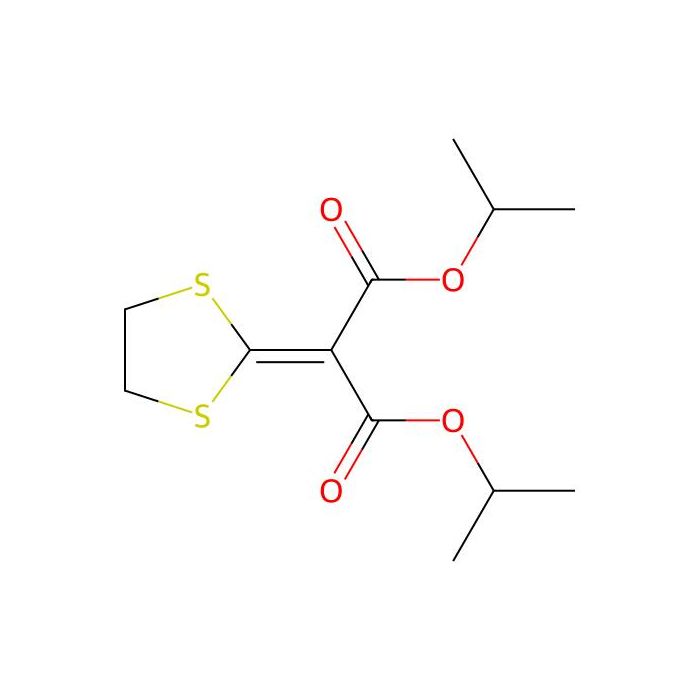
Isoprothiolane is a systemic fungicide . Isoprothiolane is a rice blast controlling agent against the fungal disease of rice planty Pyvioutavia oryzae Cav.
Specifications
Specifiche e purezza
Moligand™, 10 mM in DMSO
Condizioni di conservazione di stoccaggio
Store at -80°C
Spedito in
Dry ice packs + Cold packs
Questo prodotto richiede spedizione a catena fredda. I servizi di terra e altri servizi economici non sono disponibili.
1.Zhongmou Liu, Pan Zhang, Xiangyu Zhao. (2023) Combined treatment process of Fenton-like and peroxymonosulfate catalyzed by Fe(III)-reduced graphene oxide for efficient removal of isoprothiolane: Fe(III)/Fe(II) cycle and mechanism study. Journal of Environmental Chemical Engineering, [PMID:][10.1016/j.jece.2023.110656]
2.Lei Jiang, Lin Yuan, Shan Gao, Yingying Xiang, Fei Song, Wensi Ma, Jing Wan, Xiuling Ji, Yujiao Tu. (2023) Facile hydrothermal synthesis of N-doped fluorescent carbon dots for selective detection of insecticide parathion. Analytical Methods, 15 (19):(2376-2381). [PMID:37132329][10.1039/D3AY00124E]
3.Liwang Fei, Rahila Hafeez, Junliang Zhang, Shiquan Fu, Ying Xu, Lingyun Hao. (2025) Investigation of the mechanisms involved in the biocontrol activities of natural products from a marine soil bacterium against rice blast. PEST MANAGEMENT SCIENCE, [PMID:39895525][10.1002/ps.8684]
4.Xinyue Huang, Lei Jiang, Lin Yuan, Wensi Ma, Xintao Cui, Jiaxuan Liu, Xiuling Ji, YujiaoTu. (2025) Orange ratiometric fluorescent probe for sensitive detection of phoxim. SPECTROCHIMICA ACTA PART A-MOLECULAR AND BIOMOLECULAR SPECTROSCOPY, [PMID:40795714][10.1016/j.saa.2025.126785]
5.Liwang Fei, Jianbing Liang, Shiquan Fu, Ying Xu, Lingyun Hao. (2025) Green synthesis of silver nanoparticles using fermentation extracts from a mangrove soil bacterium: morphological characterization, and antifungal activities against rice blast fungus. PEST MANAGEMENT SCIENCE, [PMID:41204795][10.1002/ps.70358]
Calcolatori di soluzioni
Molarity Calculator
Determine the necessary mass, volume, or concentration for preparing a solution.
Dilution Calculator
Determine the dilution needed to prepare a stock solution.
Reconstitution Calculator
Recensioni
Recensioni dei clienti
Application Protocols
No vendor-tested bioassay protocols are provided for this small-molecule product. General research-use guidance:
Stock solution preparation: Dissolve in anhydrous DMSO to 10–100 mM; vortex and, if needed, sonicate gently. Filter (0.22 µm PTFE) for analytical applications.
Assay dosing: Dilute stocks into assay buffer or media to the desired final concentration, keeping DMSO ≤0.1–1% v/v depending on system tolerance.
Analytical standard prep: Prepare calibration levels in acetonitrile or methanol; include matched-matrix standards for residue or environmental analyses.
For any application requiring validated conditions (e.g., regulatory residue analysis), consult relevant standard methods and develop system-suitable SOPs. Always verify solubility and stability in the chosen matrix prior to extended studies.
Biological Roles
Research context (literature; not medical/clinical):
Agrochemical mode-of-action studies: Isoprothiolane is reported in the literature as a fungicidal agent used in rice cultivation. Mechanistic investigations have associated it with perturbation of fungal phospholipid biosynthesis, particularly pathways leading to phosphatidylcholine, and impacts on membrane integrity and development in phytopathogenic fungi (e.g., Magnaporthe spp.). Exact molecular targets may vary by organism and remain an area of study.
Metabolic and environmental fate: Biotransformation experiments indicate ester hydrolysis, oxidation of sulfur atoms, and ring cleavage as plausible metabolic routes in microbes and plants (literature). Resulting metabolites can be profiled by LC–HRMS for residue and pathway analysis.
Target selectivity considerations: As a hydrophobic organosulfur diester, passive membrane interactions and accumulation in lipid phases are expected; transport and bioavailability in model organisms are often governed by logP and formulation.
Use in the lab:
Serves as a reference compound for enzymology or metabolism studies investigating esterases, oxidases (e.g., S-oxidation), and detoxification pathways.
All statements reflect general literature and are intended strictly for research use; no clinical/therapeutic claims are made.
Buffer Applications
This compound is a hydrophobic organic small molecule and is not used as a buffering agent. For assay work, it is typically prepared as a concentrated stock in an organic cosolvent (e.g., DMSO) and then diluted into aqueous buffer systems suitable for the biological target under study. Select buffer systems (PBS, HEPES, MOPS) based on assay requirements, keeping final organic cosolvent content low (commonly ≤1–2% v/v) to maintain protein/cell compatibility.
Green Alternatives
Context: Isoprothiolane is a research target/analyte rather than a process solvent. Greening efforts therefore center on solvent choices, workup media, and analytical conditions rather than substituting the molecule itself.
Greener handling choices (literature/practice):
Dissolution/workup
Prefer ethyl acetate, methyl tert-butyl ether (MTBE), or 2-methyltetrahydrofuran (2-MeTHF) over chlorinated solvents when feasible.
Use heptane/ethyl acetate biphasic systems for extractions instead of DCM/water.
Chromatography
Replace acetonitrile with ethanol/water or methanol/water where resolution permits; consider supercritical CO2 for preparative separations.
Energy and waste
Avoid prolonged reflux; leverage microwaves or flow with precise temperature control.
Right-size reaction scales and purification to minimize solvent volumes.
Illustrative tradeoffs:
EtOAc vs DCM: EtOAc is less toxic and has a better EHS profile but may give slower extractions for hydrophobes; modest warming and phase mixing can compensate.
2-MeTHF vs THF: 2-MeTHF is bio-derived and less miscible with water (easier workups) but can contain peroxides; institute routine peroxide monitoring for ethers.
Note: No greener “substitute compound” is applicable—the substance is the analyte/ligand of interest. Focus improvements on solvent selection and process intensification.
Pharmaceutical Uses
Not a pharmaceutical excipient; this item is supplied for research use only. In a research/manufacturing context, isoprothiolane may be employed as:
A reference standard for analytical method validation (e.g., LC–MS residue analysis).
A challenge compound in formulation studies exploring delivery of hydrophobic organosulfur molecules (solubilization, microemulsions), purely for methodological development.
No pharmacopoeial monographs or excipient roles are asserted for this product. Do not use for human or veterinary applications.
Physical Properties
Item-specific values (specification-grade):
Appearance: Not specified for this item; refer to CoA/Spec Sheet.
Density, refractive index, water/peroxide/metal content, UV cutoff: Not specified for this item; refer to CoA/Spec Sheet.
Literature/general values and behavior (for reference only; not product specifications):
Physical state: typically an organic liquid or low-melting solid depending on purity and temperature; hydrophobic, non-ionic (literature).
Solubility profile: low solubility in water; good solubility in common organic solvents such as dichloromethane, chloroform, ethyl acetate, acetone, and aromatic hydrocarbons (literature). Limited solubility in highly polar protic solvents may occur due to ester functionality.
Volatility/boiling behavior: moderate volatility typical of mid-mass organosulfur esters; distillation may be complicated by partial thermal decomposition (literature).
Partitioning: expected high logP due to ester and thioacetal functionalities; strong affinity for nonpolar phases (literature).
Practical notes:
If precise physical constants (bp/mp, density, refractive index) are required for method development, chromatography, or environmental fate modeling, confirm with analytical data from the specific lot (CoA) or measure under your laboratory conditions.
Quality and Grades
Grade: Moligand™
Description: Moligand™ denotes inclusion in a curated small‑molecule/ligand library intended for discovery, screening, chemoproteomics, and SAR exploration. This designation emphasizes structural integrity, identity confirmation, and suitability for research workflows rather than process-scale manufacturing.
Typical expectations for Moligand™ items (general):
Verified identity by orthogonal methods (e.g., LC–MS, NMR) and catalog-level purity appropriate for screening. Exact test items, thresholds, and any stabilizers are lot-specific.
Packaging optimized for small-quantity handling (often inerted/low-moisture where appropriate).
Clear “For research use only” labeling.
Item-specific qualifications:
Purity, stabilizers, residual solvent limits, and elemental/UV specs: Not specified for this item; refer to CoA/Spec Sheet.
Practical guidance:
For HTS, fragment screening, or chemoproteomics, review the CoA to align purity and solvent compatibility with your assay. If ultra-low UV background or trace-metal control is critical (e.g., photochemistry, catalysis), confirm with the lot-specific specification or request additional QC documentation.
If you anticipate prolonged storage in solution (e.g., DMSO stocks), verify stability windows and any inhibitor/stabilizer use on the CoA to avoid drift during screening campaigns.
Reaction and Applications
Scope (research context; literature):
Reference standard and analytical control: Commonly used in agrochemical research to benchmark analytical methods (GC/LC) and to study environmental fate, metabolism, and residue chemistry.
Ligand/coordination studies: The 1,3-dithiolane motif can engage soft metal centers; although isoprothiolane is not a classical chelating ligand, it provides a sulfur-rich framework for exploratory binding studies (e.g., Hg(II), Ag(I), Au(I) affinity), typically weak without derivatization.
Reactivity platform: The conjugated malonate diester (if present as in literature structure) can participate in:
Nucleophilic conjugate additions (Michael-type) under basic or nucleophilic catalysis.
Transesterification or hydrolysis under acidic/basic conditions.
Reductive manipulations at the thioacetal (ring opening to dithiols under strong nucleophiles/reductants).
Analytical/assay applications:
Preparation of DMSO stocks for bioassays investigating membrane interactions or fungal pathway probes (literature), noting careful control of final organic cosolvent fraction.
Practical considerations:
Minimize exposure to strong bases/acids if preserving parent structure is essential.
For kinetic or mechanistic studies, verify compound stability in the chosen solvent and temperature regime by LC–MS before extended runs.
Note: The above reflects general literature use-cases for this chemical class; verify specific reactivity for the exact structure/lot via small-scale trials.
Reaction Conditions
General laboratory conditions for transformations applicable to this structural class (literature guidance; not product specifications):
Transesterification: Acid- or base-catalyzed (e.g., catalytic p-TsOH in the target alcohol under Dean–Stark, or sodium alkoxide in the corresponding alcohol) at 25–80°C. Monitor by GC/LC; neutralize and extract into EtOAc for workup.
Ester hydrolysis: Aqueous base (NaOH, K2CO3) in MeOH/H2O or THF/H2O at 20–50°C to give acids; acidification then extraction. Minimize strong base exposure to protect the dithiolane ring.
Conjugate addition (if an activated exocyclic alkene is present): Soft nucleophiles (thiols, malonates, amines) with base or organocatalysis in polar aprotic solvents (DMF, DMSO, MeCN) at 0–40°C. Typical reaction times 1–24 h; verify by LC–MS.
Sulfur oxidation: mCPBA or H2O2/AcOH at 0–25°C for controlled sulfoxide formation; excess oxidant or higher temperature can lead to sulfone or ring cleavage.
Analytical control:
LC–MS or GC–MS with splitless injection and non-polar columns (e.g., 5% phenyl) are commonly effective; UV detection near 210–230 nm benefits from the diester chromophore (literature).
Always confirm stability and compatibility for this exact compound/lot with a small-scale trial before scale-up.
Safety and Handling
Item-specific hazard classification:
Signal word, H-statements, GHS classes, pictograms: Not specified for this item; refer to the product SDS for authoritative information.
General safety considerations for organosulfur malonate esters (literature/good lab practice):
Hazards: May cause irritation to skin, eyes, and respiratory tract. Combustible organic liquid/solid; vapors or mists may form flammable mixtures with air when heated. Avoid inhalation and contact. Some organosulfur compounds can have strong odors; ensure adequate ventilation.
Incompatibilities: Strong oxidizers (risk of exothermic reaction/oxidation of sulfur), strong bases (can promote transesterification or decomposition), strong acids (hydrolysis). Avoid prolonged exposure to air/oxidants and elevated temperatures.
PPE: Lab coat, nitrile gloves (change regularly), splash goggles. Use in a chemical fume hood. For bulk handling, consider additional dermal and respiratory protection per risk assessment.
First aid (overview; defer to SDS):
Inhalation: Move to fresh air; seek medical attention if symptoms persist.
Skin: Wash with soap and water; remove contaminated clothing.
Eyes: Rinse cautiously with water for several minutes; remove contact lenses if present and easy; seek medical attention for persistent irritation.
Ingestion: Rinse mouth; do not induce vomiting unless directed by medical personnel.
Waste: Collect as halogen-free organic waste unless analytical verification suggests otherwise; dispose per institutional and local regulations.
Always consult the SDS for this specific product and follow institutional EHS procedures.
Solvent Selection
Applicability: Isoprothiolane is a hydrophobic organosulfur diester; solvent decisions primarily concern dissolution for synthesis, analytical method development, and bioassay stock preparation.
General guidance (literature):
Preferred solvents for dissolution: DMSO, DMF, acetone, acetonitrile, ethyl acetate, dichloromethane, chloroform, toluene. For biological assays, anhydrous DMSO is commonly used for high‑concentration stocks with subsequent dilution into aqueous media containing surfactants or cosolvents.
Limited solubility: Water and highly aqueous buffers without cosolvent.
Dielectric/polarity considerations: Despite ester functionality, the nonpolar surface area and thioacetal ring favor medium‑to‑low polarity organic solvents. For LC method development, reversed‑phase conditions with acetonitrile/water or methanol/water (with acid modifier) are typical.
Comparison notes:
DMSO vs DMF: DMSO offers broader biocompatibility for assay stocks; DMF may be preferred for certain coupling or transesterification setups but can complicate bioassays.
EtOAc vs DCM: Ethyl acetate is greener and often sufficient for workups; DCM provides faster evaporation and higher capacity for hydrophobes but with higher environmental/health costs.
Practical tips:
Warm gentle sonication can aid dissolution; avoid prolonged heating that may promote ester hydrolysis.
Filter solutions (PTFE syringe filter) before use in LC/assays to remove particulates.
Storage and Reconstitution
Storage conditions (item-specific): Store at -80°C.
Shipping (item-specific): Shipped on dry ice packs + cold packs to maintain low temperature.
Research use note: For research use only.
Handling and aliquoting (best practices):
Upon receipt, keep at -80°C. Allow vials to equilibrate to room temperature in a desiccated environment before opening to prevent condensation ingress. If frequent access is anticipated, prepare single-use aliquots under dry inert gas (N2/Ar) and refreeze promptly.
Solution stability: Not specified for this item; refer to CoA/Spec Sheet. As general guidance, DMSO stock solutions are often stored at ≤-20°C protected from light and moisture; minimize freeze–thaw cycles.
Light/moisture sensitivity: Organosulfur esters can undergo slow hydrolysis/oxidation; protect from moisture and strong light. Use amber vials where possible.
Disposal: Follow institutional guidelines for organic chemical waste. Do not discharge to drains. Retain original packaging/SDS for hazard communication.
Structure and Identity
Product: Isoprothiolane (SKU: I1499603)
CAS: 50512-35-1; PubChem CID: 39681
Molecular formula (item-specific): Not specified for this item; refer to CoA/Spec Sheet.
Molecular weight (item-specific): Not specified for this item; refer to CoA/Spec Sheet.
SMILES (item-specific): Not specified for this item; refer to CoA/Spec Sheet.
InChIKey (item-specific): Not specified for this item; refer to CoA/Spec Sheet.
General structural description (literature):
Isoprothiolane is an organosulfur compound featuring a five-membered 1,3-dithiolane ring appended to an activated malonate ester framework (commonly encountered as a diisopropyl malonate derivative). It is typically depicted as a dithiolane ring exocyclicly conjugated to a malonate (–CH=C(CO2R)2) motif.
Structural features (2D description, literature): a five-membered ring containing two adjacent sulfur atoms (positions 1 and 3), bearing an exocyclic C=C bond that is substituted by a malonate diester; the diester alkoxy groups are typically branched (isopropyl) substituents.
Notes:
The above structural features are provided as general literature description for the named compound; definitive identifiers and exact substituent details for this specific catalog item should be confirmed on the CoA/Spec Sheet.
Synthetic Utility
General reactivity opportunities (literature; structural class features):
Conjugated malonate diester handle (if present as in the literature structure):
Nucleophilic conjugate (Michael) additions to the exocyclic alkene, enabling diversification at the β‑position.
Hydrolysis to the corresponding malonic acid followed by decarboxylation or amide coupling, affording analogs for SAR.
Transesterification with alternative alcohols to tune lipophilicity and solubility.
1,3-Dithiolane ring (thioacetal-like):
Oxidation to sulfoxide/sulfone derivatives to probe electronic effects.
Reductive ring opening to reveal dithiol motifs for further ligation or metal-binding studies.
Stability under acidic conditions is typically higher than basic; basic conditions can induce ring-opening or exchange reactions.
Strategic use:
As a scaffold in agrochemical SAR, modifications at the ester groups and sulfur oxidation state can tune potency, permeability, and persistence.
In coordination chemistry method development, sulfur-rich motifs provide testbeds for soft-metal capture or sensing after appropriate derivatization.
Note: Because isoprothiolane is a defined active structure, most “utility” arises from derivative synthesis and analytical transformations rather than from using it as a generic reagent.
Target Specificity
Not applicable for this product category. Target specificity data (antigen/epitope, species reactivity, clone, isotype) apply to biological affinity reagents (e.g., antibodies), not to small organic molecules. For biochemical pathway interactions relevant to isoprothiolane, see the Biological Roles section (literature-based context).
We use cookies to ensure the website functions properly and, where permitted, to improve your experience. You can manage your preferences at any time in Settings. Learn more in our Cookie Policy.
Shall we send you a message when we have discounts available?
Remind me later
Thank you! Please check your email inbox to confirm.
Products are supplied to verified businesses, institutions, and qualified professionals for research and development use only. Not for use in humans, animals, diagnosis, or therapy.