Determine the necessary mass, volume, or concentration for preparing a solution.
| Activity Type | Relation | Activity value | Units | Action Type | Journal | PubMed Id | doi | Assay Aladdin ID |
|---|

Descrizione del prodotto:
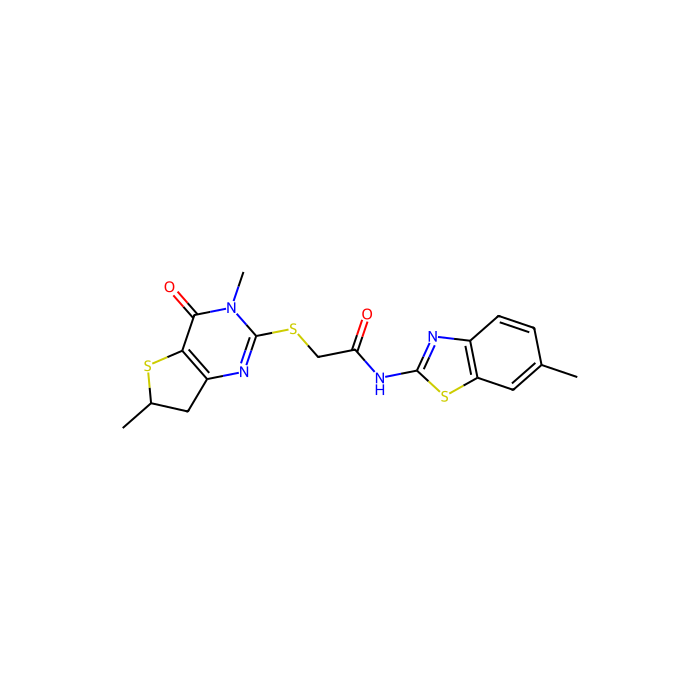
IWP-12 è un potente inibitore della porcospina (PORCN) e inibisce la segnalazione Wnt cellulare-autonoma con un IC50 di 15 nM.
Taxonomy Tree
| Kingdom | Organic compounds |
|---|---|
| Superclass | Organoheterocyclic compounds |
| Classe | Thienopyrimidines |
| Subclass | Not available |
| Intermediate Tree Nodes | Not available |
| Direct Parent | Thienopyrimidines |
| Alternative Parents | Benzothiazoles N-arylamides Pyrimidones Alkylarylthioethers Benzenoids Thiazoles Heteroaromatic compounds Secondary carboxylic acid amides Lactams Sulfenyl compounds Azacyclic compounds Organic oxides Hydrocarbon derivatives Carbonyl compounds |
| Molecular Framework | Aromatic heteropolycyclic compounds |
| Substituents | 1,3-benzothiazole - Thienopyrimidine - Aryl thioether - N-arylamide - Pyrimidone - Alkylarylthioether - Pyrimidine - Benzenoid - Azole - Thiazole - Heteroaromatic compound - Secondary carboxylic acid amide - Lactam - Carboxamide group - Thioether - Carboxylic acid derivative - Sulfenyl compound - Azacycle - Hydrocarbon derivative - Organic oxide - Organic oxygen compound - Organosulfur compound - Organooxygen compound - Organonitrogen compound - Carbonyl group - Organic nitrogen compound - Aromatic heteropolycyclic compound |
| Descrizione | This compound belongs to the class of organic compounds known as thienopyrimidines. These are heterocyclic compounds containing a thiophene ring fused to a pyrimidine ring. Thiophene is 5-membered ring consisting of four carbon atoms and one sulfur atom. Pyrimidine is a 6-membered ring consisting of four carbon atoms and two nitrogen centers at the 1- and 3- ring positions. |
| External Descriptors | Not available |
| Activity Type | Relation | Activity value | Units | Action Type | Journal | PubMed Id | doi | Assay Aladdin ID |
|---|
| Activity Type | Relation | Activity value | Units | Action Type | Journal | PubMed Id | doi | Assay Aladdin ID |
|---|
| Activity Type | Relation | Activity value | Units | Action Type | Journal | PubMed Id | doi | Assay Aladdin ID |
|---|
| Activity Type | Relation | Activity value | Units | Action Type | Journal | PubMed Id | doi | Assay Aladdin ID |
|---|
| Activity Type | Relation | Activity value | Units | Action Type | Journal | PubMed Id | doi | Assay Aladdin ID |
|---|
| Activity Type | Relation | Activity value | Units | Action Type | Journal | PubMed Id | doi | Assay Aladdin ID |
|---|
| Activity Type | Relation | Activity value | Units | Action Type | Journal | PubMed Id | doi | Assay Aladdin ID |
|---|
| Activity Type | Relation | Activity value | Units | Action Type | Journal | PubMed Id | doi | Assay Aladdin ID |
|---|
| Activity Type | Relation | Activity value | Units | Action Type | Journal | PubMed Id | doi | Assay Aladdin ID |
|---|
| Activity Type | Relation | Activity value | Units | Action Type | Journal | PubMed Id | doi | Assay Aladdin ID |
|---|
| Activity Type | Relation | Activity value | Units | Action Type | Journal | PubMed Id | doi | Assay Aladdin ID |
|---|
| Activity Type | Relation | Activity value | Units | Action Type | Journal | PubMed Id | doi | Assay Aladdin ID |
|---|
| Activity Type | Relation | Activity value | Units | Action Type | Journal | PubMed Id | doi | Assay Aladdin ID |
|---|
| Activity Type | Relation | Activity value | Units | Action Type | Journal | PubMed Id | doi | Assay Aladdin ID |
|---|
| Activity Type | Relation | Activity value | Units | Action Type | Journal | PubMed Id | doi | Assay Aladdin ID |
|---|
| Activity Type | Relation | Activity value | Units | Action Type | Journal | PubMed Id | doi | Assay Aladdin ID |
|---|
| Activity Type | Relation | Activity value | Units | Action Type | Journal | PubMed Id | doi | Assay Aladdin ID |
|---|
| Activity Type | Relation | Activity value | Units | Action Type | Journal | PubMed Id | doi | Assay Aladdin ID |
|---|
| Solubilità | Solvent:DMSO, Max Conc. mg/mL: 41.86, Max Conc. mM: 100 |
|---|---|
| Peso molecolare | 418.600 g/mol |
| XLogP3 | 3.700 |
| Hydrogen Bond Donor Count | 1 |
| Hydrogen Bond Acceptor Count | 7 |
| Rotatable Bond Count | 4 |
| Exact Mass | 418.059 Da |
| Monoisotopic Mass | 418.059 Da |
| Topological Polar Surface Area | 154.000 Ų |
| Heavy Atom Count | 27 |
| Formal Charge | 0 |
| Complexity | 711.000 |
| Isotope Atom Count | 0 |
| Defined Atom Stereocenter Count | 0 |
| Undefined Atom Stereocenter Count | 1 |
| Defined Bond Stereocenter Count | 0 |
| Undefined Bond Stereocenter Count | 0 |
| The total count of all stereochemical bonds | 0 |
| Covalently-Bonded Unit Count | 1 |
General cell-based assay workflow (literature/general; adapt to your system)
Biochemical assays
Note: No manufacturer-validated protocols were provided; treat the above as starting guidance only.
Context (literature/general; not a medical claim)
Experimental considerations
All roles described are for basic research use only. No clinical or diagnostic applications are implied.
Not typically applicable. IWP 12 is not a buffering reagent. For biological assays, it is commonly dissolved in DMSO and then diluted into existing buffers or cell culture media. Ensure the final vehicle percentage is compatible with your system and include matched vehicle controls.
This section typically addresses greener choices for solvents or bulk reagents. IWP 12 is a specialized bioactive small molecule used at micromolar concentrations in exploratory research; green-alternative considerations are generally not applicable.
Practical sustainability notes (general)
If your workflow involves solvent-intensive steps (e.g., purification or formulation development for this compound), consider greener solvents where feasible (e.g., ethanol or 2-MeTHF instead of chlorinated solvents) while ensuring compound stability and solubility.
No specific “green alternative” chemical substitutes apply to this item.
Not applicable to this catalog item. IWP 12 is supplied strictly for research use only (per Product Data). It is not formulated as a pharmaceutical ingredient, excipient, or for any clinical application. If formulation-like studies are conducted in a research context (e.g., improving solubility for in vitro dosing), document solvent systems, vehicle tolerability, and stability, but do not extrapolate to clinical use.
Item-specific (Product Data)
Literature/general (context, not specifications)
Practical notes
All numerical property values not listed above are not specified for this item and should be confirmed via the item’s CoA/SDS or primary literature (e.g., PubChem CID 3244448).
Item-specific (Product Data)
Interpreting grade (general guidance)
Stabilizers and formulation
Release documentation
Applicability to chemical synthesis: IWP 12 is a finished bioactive small molecule, not commonly employed as a reagent, catalyst, or solvent in organic synthesis. If used in synthetic studies, it is typically as an analytical standard or comparator, not as a reaction participant.
Research applications (literature/general, non-clinical)
Experimental considerations
Note: No manufacturer-specific application notes were provided. The above are general, literature-style uses; consult primary papers for IWP 12 before designing critical experiments.
Not typically applicable. IWP 12 is not used as a reagent or solvent in chemical reactions. For biological experiments, typical handling conditions are as follows (literature/general guidance):
All numerical “conditions” above are generic literature-style practices and not specifications for this item.
Item-specific (Product Data)
General laboratory precautions (literature/general guidance)
Waste & spill response
Always consult the product-specific SDS before use; the SDS supersedes any general guidance above.
Applicability: IWP 12 is a bioactive small molecule used primarily in biological assays rather than as a bulk reaction solvent.
Practical solvent choices for preparation (general guidance)
Polarity and miscibility (literature/general)
Tips to improve handling
Item-specific (Product Data)
General handling tips (literature/general)
Reconstitution
For lot-specific instructions (including any stabilizers or confirmed solubility), refer to the CoA/Spec Sheet.
Brief overview: IWP 12 is a small-molecule research tool widely used as a Wnt/Porcupine (PORCN) pathway inhibitor in cell biology studies.
Item-specific (Product Data)
Literature/general (for contextual understanding; verify against primary sources before critical use)
2D structure description
IWP 12 is a finalized bioactive small molecule rather than a general synthetic building block. As such, it is not routinely used as a substrate, reagent, or ligand in organic synthesis.
Potential niche uses (general)
If derivatization is contemplated for probe development
No generalized named reactions or retrosynthetic patterns are provided here because the precise structure and functional handles are not specified in the Product Data.
This section (antigen/epitope/clone/isotype) applies to antibodies and related affinity reagents and is not applicable to a small-molecule inhibitor. For IWP 12, literature commonly describes functional inhibition of the enzyme PORCN (Porcupine), thereby modulating Wnt ligand secretion, but no antibody-style specificity parameters apply here.