≥98% per flussi di lavoro cromatografici e analitici sensibili che richiedono un'interferenza minima della linea di base.
🌡
Stoccaggio e spedizione
Store at -20°C Spedizione Ice chest + Ice pads. Consultare il COA specifico del lotto per le specifiche esatte.
📋
Documenti di qualità
SDS, COA, scheda tecnica e scheda delle specifiche disponibili per il download. COA specifico del lotto accessibile tramite ricerca per numero di lotto.
📚
Prova documentale
Citato in 0 pubblicazioni peer-reviewed su cromatografia, sintesi organica e reazioni di accoppiamento incrociato.
Panoramica
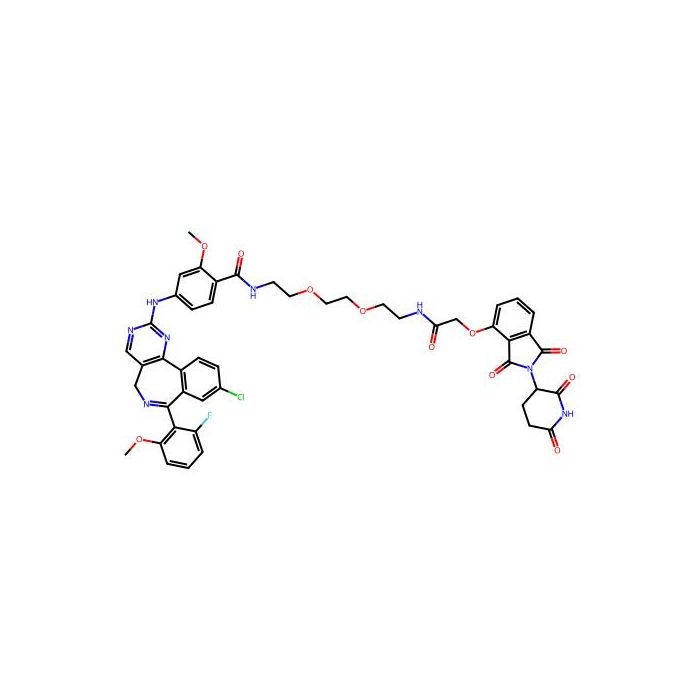
JB170 is a potent and highly specific PROTAC -mediated AURORA-A ( Aurora Kinase ) degrader ( DC 50 =28 nM) by linking Alisertib, to the Cereblon -binding molecule Thalidomide. JB170 preferentially binds AURORA-A ( EC 50 =193 nM) over AURORA-B (EC 50 =1.4 µM). JB170-mediated S-phase arrest is caused specifically by AURORA-A depletion. JB170 has excellent ability to inhibit non-catalytic function of AURORA-A kinase
In Vitro
JB170 (1 μM; 24-72 hours; MV4-11 cells) mediates Aurora-A depletion inhibiting cancer cell survival. ?\nJB170 (0.01-10 μM; 6 hours; MV4-11 cells) reduces AURORA-A levels. ?\nJB170 (0.5 μM; 12 hours; MV4-11 cells) delays/arrests S-phase progression. ?\nJB170 (0.5 μM; 0-72 hours; MV4-11 cells) induces apoptosis is exclusively caused by targeting AURORA-A. ?\nJB170 (0.1 μM; 0-9 hours; IMR5 cells) shows rapid AURORA-A depletion. JB170 (0~1 μM; 6 hours; MV4-11 cells) strongly attenuates in mutants with respect to AURORA-A. JB170 (0.1 μM; 18 hours; MV4-11 cells) does not activate AURORA-A. JB170 (0~1 μM; 24 hours; IMR5 cells) largely abrogates AURORA-A T217D depletion. JB170 (1 μM; 4 days; IMR5 cells) mediates Aurora-A depletion inhibiting cancer cell survival. JB170 (IMR5 cells) reduces AURORA-A levels by lowering AURORA-A mRNA levels. MCE has not independently confirmed the accuracy of these methods. They are for reference only. Cell Viability AssayCell Line: MV4-11 cells Concentration: 1 µM Incubation Time: 24-72 hours Result: After 72 hours, the number of viable cells was 32% of control levels. Western Blot AnalysisCell Line: MV4-11 cells Concentration: 0.01~10 μM Incubation Time: 6 hours Result: Substantial degradation was observed at 100 nM and 1 µM. Apoptosis AnalysisCell Line: MV4-11 cells Concentration: 0.5 µM Incubation Time: 0~72 hours Result: Apoptosis was exclusively caused by targeting AURORA-A. Cell Cycle AnalysisCell Line: MV4-11 cells Concentration: 0.5 µM Incubation Time: 12 hours Result: Delayed or arrested S-phase progression.
Form:Solid
IC50& Target:Aurora A 28 nM (DC 50 ) Aurora A 99 nM (Kd) Aurora A 193 nM (EC 50 ) Cereblon
Specifiche
Specifiche e purezza
≥98%
Meccanismi biochimici e fisiologici
JB170 is a potent and highly specific PROTAC -mediated AURORA-A ( Aurora Kinase ) degrader ( DC 50 =28 nM) by linking Alisertib, to the Cereblon -binding molecule Thalidomide. JB170 preferentially binds AURORA-A ( EC 50 =193 nM) over AURORA-B (EC 50 =1.4
Condizioni di conservazione di stoccaggio
Store at -20°C
Spedito in
Ice chest + Ice pads
Questo prodotto richiede spedizione a catena fredda. I servizi di terra e altri servizi economici non sono disponibili.
Tipo di azione
INHIBITOR
Purezza
≥98%
Nomi e identificatori
Peso molecolare
963.36
Documentazione
📋 Scheda di dati di sicurezza (SDS)
Documento completo su pericoli, manipolazione, stoccaggio e conformità normativa.
Certificati (CoA, COO, BSE/TSE e tabella di analisi)
C of A & Other Certificates(BSE/TSE, COO):
Analytical Chart:
Proprietà chimiche e fisiche
Solubilità
DMSO : 100 mg/mL (103.80 mM; Need ultrasonic)
Calcolatori di soluzioni
Molarity Calculator
Determine the necessary mass, volume, or concentration for preparing a solution.
Dilution Calculator
Determine the dilution needed to prepare a stock solution.
Reconstitution Calculator
Recensioni
Recensioni dei clienti
Application Protocols
No validated application protocols are provided for JB170 in the Product Data.
Item-specific facts:
Tested applications and recommended conditions: Not specified for this item; refer to internal assay notes or CoA where available.
General protocol framework for screening compounds (to be adapted to your assay):
Stock preparation: Dissolve JB170 in anhydrous DMSO at 10–50 mM; aliquot and store at −20 °C.
Working solutions: Prepare serial dilutions in DMSO (e.g., 3-fold or 10-fold) and back-dilute into assay buffer to desired final concentrations with consistent vehicle controls.
Controls: Include positive control inhibitor/ligand, negative control, and vehicle (DMSO-only). Add detergent if aggregation is suspected.
Readout validation: Confirm linearity of signal vs. time and substrate; check inner-filter effects or autofluorescence if using optical assays.
Data quality: Aim for Z′-factor ≥0.5 in HTS; run at least triplicates for IC50/EC50 determinations. Fit dose–response with appropriate models and report Hill slope.
Documentation:
Record batch/lot number, solution age, and storage history alongside results to ensure reproducibility.
Biological Roles
No biological function is assigned to JB170 in the Product Data. Any roles discussed here are general considerations for screening-library members and are not claims about this specific item.
Item-specific facts:
Biological target, pathway, and MoA: Not specified for this item; refer to CoA/Spec Sheet or associated screening documentation if available.
General context (for small-molecule library compounds):
Screening compounds may interact with enzymes, receptors, transporters, ion channels, or nucleic acids. Such interactions are typically discovered empirically via HTS or focused assays.
Compounds can serve as starting points for chemical probes after rigorous validation: establishing potency, selectivity, reversibility, and on-target engagement (e.g., CETSA, nanoBRET, chemoproteomics).
Polypharmacology is common; orthogonal assays and counterscreens are essential to exclude assay artifacts (fluorescence quenching, redox cycling, aggregation) and off-target effects.
Practical recommendations:
Once a phenotype or activity is observed for JB170, pursue dose–response curves, time-dependence, and washout experiments to differentiate reversible vs. irreversible effects.
Confirm chemical stability under assay conditions (buffer composition, pH, light, temperature). Analyze pre/post-assay by LC–MS to exclude degradation.
Compliance note:
For research use only. No medical, diagnostic, or clinical application is implied or supported.
Buffer Applications
Buffer use is indirect for JB170: as a small-molecule library member, it is typically dosed into biological buffers from an organic stock solution. No dedicated buffering role is expected.
Item-specific facts:
None provided related to buffering capacity or pKa.
Practical lab guidance (general):
Stock preparation: Prepare 10–50 mM JB170 in DMSO; dilute into assay buffers immediately before use to minimize precipitation.
Common assay buffers: PBS, HEPES, Tris, or Bis-Tris systems selected for target biology; ensure final DMSO ≤0.1–1% v/v depending on assay tolerance.
pH considerations: Without pKa data, avoid extreme pH. Start at physiological pH (7.2–7.5) for cell-based assays or target-appropriate ranges for enzymology. Monitor turbidity upon dilution.
Solubilization aids: Consider 0.01–0.05% nonionic detergent (Tween-20, Pluronic F-68) or 5–10% PEG-400 if compatible with readout; validate controls.
Tips:
Pre-wet pipette tips with DMSO stock to improve accuracy at low volumes.
Add stock last to well to reduce localized supersaturation and precipitation; mix thoroughly with plate shakers.
Not applicable:
JB170 is not a buffer component and no buffering recipes are provided for this item.
Green Alternatives
Considering solvent and operational choices for JB170 in alignment with green chemistry principles (general guidance; not item-specific specifications).
Typical context:
Screening compounds are most often handled as DMSO stocks; greener options and practices can reduce environmental burden and operator exposure.
Greener options (literature/general):
Replace DMF/NMP with Cyrene or PolarClean for some dissolution and reaction contexts (if compatible with assays).
Favor ethanol or isopropanol over methanol or chlorinated solvents for precipitation/recovery where feasible.
Use water-based assay buffers with minimal DMSO (≤0.1–0.5% v/v) when assay tolerance permits.
Comparison (general, not specific to JB170):
DMSO: High solvency, water-miscible; good for stocks, but can affect cells at >0.5–1%.
Ethanol: Renewable source potential; lower toxicity vs. MeOH; flammable.
2-MeTHF/CPME: Greener ethers for extractions (if needed); immiscible with water; flammable; not typical for assay stocks.
Operational greening:
Right-size aliquots to minimize waste and avoid repeated freeze–thaw.
Implement microplate-based mini-screens to reduce solvent volumes.
Consolidate solvent waste streams and adopt closed-container handling to reduce emissions.
Caveat:
Validate any solvent substitution for biological compatibility and compound stability before full deployment.
Pharmaceutical Uses
JB170 is provided strictly for research use. No excipient status, pharmacopeial monograph, or formulation role is provided in the Product Data.
Item-specific facts:
For research use only; not for human or veterinary use.
Regulatory/compendial status: Not specified for this item; refer to CoA/Spec Sheet.
General R&D context (non-clinical, not item-specific):
Early discovery: Compounds from screening libraries can be evaluated in preclinical assays to explore structure–activity relationships (SAR), ADME properties, and developability signals (solubility, stability).
Preformulation screening: If JB170 emerges as a lead, standard preformulation studies may include salt form exploration, solid-state characterization, and enabling formulations for in vivo studies—only after appropriate approvals and safety evaluations.
Compliance reminders:
Do not use in diagnostics, therapeutics, or as a drug substance/excipient in humans or animals.
For any GLP/GMP needs, a distinct supply chain and documentation would be required; contact Aladdin Scientific for feasibility.
Documentation:
Maintain batch traceability and analytical data with all experimental records to support reproducibility and IP filings.
Physical Properties
Physical property profile for JB170 as supplied.
Item-specific facts (from Product Data):
Appearance: Not specified for this item; refer to CoA/Spec Sheet.
Grade/Purity: Not specified for this item; refer to CoA/Spec Sheet.
Molecular Weight: Not specified for this item; refer to CoA/Spec Sheet.
Basic constants (literature/general for small-molecule library compounds; NOT item-specific):
Melting/boiling point: Not specified for this item. Library compounds are commonly solids with melting points spanning ~80–250 °C (literature, typical range), but exact MP/BP must be confirmed on the CoA.
LogP/cLogP: Not specified for this item. Screening collections often cover cLogP ~1–5 (literature, typical), but this is not a specification here.
pKa: Not specified for this item; ionization state must be determined from structure.
Solubility: Not specified for this item. As a practical starting point for screening compounds, 10–50 mM stock in anhydrous DMSO is typically achievable for many scaffolds (general practice); verify experimentally for JB170.
Refractive index, density, UV-Vis cutoff: Not specified for this item; refer to CoA/Spec Sheet.
Practical guidance (general):
Perform a small solubility screen (DMSO, DMF, MeOH, EtOH, 1:1 DMSO:water) and document precipitation limits at target assay concentrations.
If hygroscopicity or polymorphism is a concern, request solid-state data (XRPD/DSC/TGA) when available.
Quality and Grades
Quality framework and what to expect for JB170.
Item-specific facts (from Product Data):
Grade/Purity: Not specified for this item; refer to CoA/Spec Sheet.
What “screening compound” quality typically entails (general guidance, not a specification):
Identity confirmation via 1H NMR and LC–MS; optional 13C NMR and HRMS.
Purity typically assessed by HPLC/UPLC (UV at multiple wavelengths) with reporting ≥95% for screening-ready materials in many libraries; confirm actual value on the CoA.
Residual solvents and water content may be reported by GC and Karl Fischer, respectively; exact limits are not specified for this item.
Stabilizers/additives:
None are listed in the Product Data. If present, they will be disclosed on the CoA; absence here should not be interpreted as guaranteed additive-free.
Practical recommendations:
Request the latest batch-specific CoA/SDS for JB170 prior to critical studies. If UV applications (e.g., photoassays) are planned, inquire about UV-Vis profile and potential photolability.
If you require specialized grades (e.g., salt form, deuterated analog, analytical reference standard), contact Aladdin Scientific for availability or custom synthesis.
Documentation and traceability:
Retain batch/lot numbers and analytical reports with your laboratory records for reproducibility and regulatory audits.
Reaction and Applications
Applications focus on screening and discovery rather than specific named organic reactions, since the structure of JB170 is not provided.
Item-specific facts (from Product Data):
Manufacturer Applications: Not specified.
Research applications (general for library members):
Primary use: High-throughput screening (HTS), fragment or lead discovery, target deconvolution campaigns, phenotypic assays, and chemical biology probes (post-validation).
Secondary use: Reference compound in SAR matrices, orthogonal assay validation, counterscreens for selectivity and chemotype liability assessment.
Practical assay tips:
Prepare concentrated DMSO stocks (e.g., 10 mM), aliquot to avoid freeze–thaw, and confirm stability by LC–MS after 1–2 weeks at storage conditions.
Assess compound aggregation with detergent controls (0.01–0.05% Tween-20 or Triton X-100), dynamic light scattering (DLS), or AMP/ALDH counterscreens when applicable.
Evaluate pan-assay interference (PAINS) risks using cheminformatics tools once structure is available; follow with redox and fluorescence interference controls as needed.
Beyond screening:
If JB170 is advanced as a hit, route to analogue synthesis and ADME profiling (microsomal stability, permeability, solubility, plasma protein binding). Without structural data, tailor assays empirically based on observed MoA signals.
Note:
Without the explicit scaffold, do not assume reactivity or functional handles for derivatization; obtain structural disclosure or spectral data before planning synthetic elaboration.
Reaction Conditions
No specific synthetic reaction conditions can be prescribed for JB170 without a disclosed structure. The following are general handling and solution-preparation conditions relevant to its use as a screening compound.
Item-specific facts:
None provided regarding chemical reactivity or processing.
General solution handling (for bioassays/screening):
Stock solutions: 10–50 mM in anhydrous DMSO; vortex and, if necessary, gently warm (≤37 °C) to assist dissolution. Avoid prolonged heating.
Filtration: Use 0.22 μm PTFE filters for particulate removal if precipitation occurs; confirm no significant adsorption losses.
Dilution: Add DMSO stock to aqueous buffer last, with mixing; maintain final DMSO typically ≤0.1–1% v/v.
Light sensitivity: Unknown; protect from light during long incubations as a precaution (foil-wrap vials/plates).
Stability checks: Reassess by LC–MS/HPLC after storage and after assay incubation (e.g., 1–24 h at room temperature/37 °C) to confirm integrity.
Plate-based operations:
Echo/acoustic or pin-tool transfer is recommended for low-volume dispensing; validate accuracy with dye controls and weighbacks where feasible.
Avoid edge effects by equilibrating plates to room temperature and using humidified incubators for longer assays.
If conducting chemical reactions (general):
Start with small-scale trials and inert atmosphere until stability is known; choose solvent and temperature based on functional groups once structural data are available.
Safety and Handling
Safety overview for laboratory use of JB170.
Item-specific facts (from Product Data):
Hazard Information (Signal Word, H-Statements, GHS Classification, Pictograms): Not specified for this item; refer to the SDS.
Research Use: For research use only.
GHS/SDS guidance (authoritative source):
Always consult the product-specific Safety Data Sheet (SDS) for definitive hazard, toxicological, and regulatory data prior to use. In absence of provided GHS details, handle as a potentially harmful organic compound.
General laboratory precautions (general knowledge):
PPE: Use lab coat, safety glasses, and appropriate chemical-resistant gloves (e.g., nitrile). Avoid inhalation, ingestion, and skin/eye contact. Work in a certified chemical fume hood when handling powders or volatile solvents.
Incompatibilities: Unknown for this specific item; avoid strong oxidizers/reductants and reactive acids/bases until compatibility is known. Keep away from ignition sources if dissolved in flammable solvents.
First Aid (overview): In case of skin/eye contact, rinse with water for ≥15 minutes; remove contaminated clothing. If inhaled, move to fresh air. If ingested, seek medical attention. Follow SDS instructions.
Spill/accidental release: Contain solids with damp disposable towels or inert absorbent; for solutions, use suitable absorbents. Dispose via licensed chemical waste per local regulations.
Special risks:
Unknown sensitization or mutagenicity; minimize exposure and avoid aerosolization. If DMSO solutions are used, remember DMSO enhances dermal absorption—prevent skin contact.
Solvent Selection
Guidance for dissolving and using JB170 in research workflows when structure/solubility are not disclosed.
Item-specific facts (from Product Data):
No solvent recommendations are provided for this item.
Practical starting points (general knowledge for small molecules):
Primary stock solvent: Anhydrous DMSO (prepare 10–50 mM stocks where solubility permits). Filter through 0.22 μm if needed.
Alternative solvents for stubborn solubility: DMF, NMP, ethanol, methanol, isopropanol. For aqueous use, dilute DMSO stocks into buffer to ≤0.1–1% v/v DMSO, checking for precipitation.
Aqueous co-solvent strategies: 1:1 DMSO:water pre-mix, or add 10–20% PEG-400 to improve apparent solubility (assay compatibility dependent).
Miscibility/polarity context (general values, not item-specific):
DMSO is polar aprotic (ε ~47, literature), miscible with water and organics; DMF/NMP are also polar aprotic and water-miscible; EtOH/MeOH are polar protic, water-miscible; IPA less polar, sometimes reduces precipitation.
When to choose which solvent:
Cell-based assays: Prefer DMSO stocks with careful final DMSO ≤0.1–0.5% if sensitive lines are used.
Enzymology/biophysics: Validate solvent effect on activity/readout; run matched vehicle controls.
Purification/recovery: If re-crystallization or drying is needed, choose volatile alcohols or MeCN mixtures for ease of removal.
Tip:
Conduct a 6–8 point solubility mini-screen at room temperature and 37 °C and document clarity after 1–24 hours.
Storage and Reconstitution
Storage and preparation guidance for JB170 as a research-use small molecule.
General storage practices (not item-specific specifications):
Keep container tightly closed under dry, inert headspace if possible. Consider desiccation to mitigate moisture uptake. Protect from light as a precaution until photostability is known.
Minimize freeze–thaw by preparing single-use aliquots. Thaw at room temperature before opening to reduce condensation.
Reconstitution (general guidance):
For screening: Dissolve in anhydrous DMSO to 10–50 mM, vortex, and, if needed, warm gently (≤37 °C). Verify clarity; if particulates persist, brief sonication may assist. Record final concentration by weight-in/volume-out or quantitative NMR if precision is required.
For aqueous assays: Dilute DMSO stock into buffer just before use. Inspect for precipitation; if observed, lower final concentration, raise temperature to 25–37 °C, or add acceptable co-solvent/detergent.
Stability checks:
Periodically verify purity by HPLC/LC–MS after storage at −20 °C. Document any color change or precipitation in the solid.
Disposal:
Dispose of unused material and solutions as organic chemical waste per institutional and local regulations.
Structure and Identity
Concise overview of identity and structural information for JB170.
Item-specific facts (from Product Data):
SKU: J647029
Product Name: JB170
CAS: 2705844-82-0
Category: Small molecules and compound libraries (小分子和化合物库)
Molecular formula: Not specified for this item; refer to CoA/Spec Sheet.
Molecular weight: Not specified for this item; refer to CoA/Spec Sheet.
SMILES: Not specified for this item; refer to CoA/Spec Sheet.
InChIKey: Not specified for this item; refer to CoA/Spec Sheet.
Structural features:
Not specified for this item; refer to CoA/Spec Sheet. Without a structure, ring systems, functional groups, or stereochemistry cannot be detailed.
2D structure description (general guidance):
As a screening-library member, JB170 is expected to be an organic small molecule with discrete functional groups amenable to medicinal chemistry follow-up; however, the exact scaffold and substituent pattern are not provided here. Please consult the Certificate of Analysis (CoA) or structure disclosure, when available, for precise functional-group annotations and depiction.
Cross-identifiers (literature/computed):
No public CID, SMILES, or InChIKey were provided in the Product Data. If you require these, contact Aladdin Scientific support for the latest structure release or NDA-compliant disclosure.
Synthetic Utility
Synthetic applications cannot be detailed without a disclosed structure for JB170. The notes below are general to library compounds and are not claims about specific functional groups present in this item.
Item-specific facts:
Functional groups and reactivity: Not specified for this item; refer to CoA/Spec Sheet or structure disclosure.
General considerations for library members:
If structural information becomes available, identify derivatization vectors (e.g., aryl halides for cross-coupling, amines for acylation/urea formation, acids for amide coupling) to generate SAR.
Protecting-group strategies and chemoselectivity should be planned based on heteroatom content and redox-sensitive motifs.
Late-stage diversification: C–H activation, photoredox, or Minisci-type functionalization may enable rapid analogue generation when appropriate handles are absent.
Practical steps post-hit identification:
Confirm identity and purity of JB170 (orthogonal analytics), then procure or synthesize close analogues to validate SAR trends.
Establish a robust synthetic route enabling gram-scale preparation for in-depth studies, including crystallographic or solid-state investigations if needed.
Caution:
Without the explicit scaffold, avoid assuming reactivity or stability under specific conditions (acid/base, oxidants, light). Validate experimentally.
Target Specificity
Target information for JB170 is not provided.
Item-specific facts (from Product Data):
Biological target(s), selectivity profile, and mode of action: Not specified for this item; refer to CoA/Spec Sheet or screening reports.
General guidance (for screening compounds):
Determine apparent target engagement using orthogonal biochemical/biophysical methods (e.g., SPR, ITC, DSF, CETSA, NanoBRET) after a phenotypic or biochemical hit is observed.
Build a selectivity matrix across close homologs or off-target panels to assess specificity vs. promiscuity.
Employ chemoproteomics or photoaffinity/ABPP approaches where appropriate to map binding partners.
Caution:
Do not assume target specificity based on name alone. All specificity claims must be generated experimentally and independently verified.
Domande frequenti
What is the purity of this product?
This product is supplied at ≥98% purity (chemical assay). Lot-specific values are stated on the Certificate of Analysis.
How should this product be stored?
Store at ?20 °C. Freezer storage is required to maintain the specified shelf life.
How is this product shipped?
This product ships in an insulated container with ice pads. Unpack on arrival and transfer it to the storage condition stated above.
What are the CAS number, molecular formula and molecular weight?
The CAS Number is 2705844-82-0, the molecular formula is C48H44ClFN8O11, and the molecular weight is 963.36 g/mol.
What documentation is provided?
Available product documentation, including Certificates of Analysis (COA), Safety Data Sheets (SDS), and specification sheets, is shown in the product document area. Document availability and access follow the current site policy.
Utilizziamo i cookie per garantire il corretto funzionamento del sito web e, ove consentito, per migliorare la tua esperienza. Puoi gestire le tue preferenze in qualsiasi momento nelle Impostazioni. Per saperne di più, consulta la nostra Cookie Policy.
Desidera che le inviamo un messaggio quando avremo sconti disponibili?
Ricordamelo più tardi
Grazie! Controlli la sua casella di posta per confermare.
Products are supplied to verified businesses, institutions, and qualified professionals for research and development use only. Not for use in humans, animals, diagnosis, or therapy.