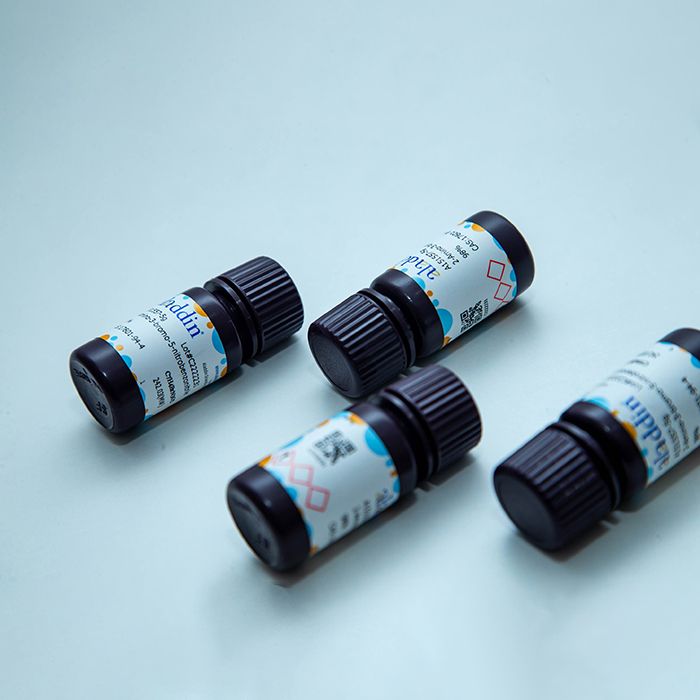
JBJ-09-063 TFA is a mutant-selective allosteric EGFR inhibitor with IC 50 s of 0.147 nM, 0.063 nM, 0.083 nM and 0.396 nM for EGFR L858R, EGFR L858R/T790M, EGFR L858R/T790M/C797S and EGFRLT/L747S. JBJ-09-063 TFA effectively reduces EGFR , Akt and ERK1/2 ph
In Vitro:JBJ-09-063 is remarkably effective at inhibiting cell growth and leads to a significant increase in apoptosis, even though H3255GR cells are resistant to gefitinib as a single agent, as they contain an EGFR T790M mutation. JBJ-09-063 is effective in
In Vivo:JBJ-09-063 (3mg/kg i.v., 20mg/kg p.o.) exhibits favorable pharmacokinetics properties and is sufficiently stable to deliver good efficacy upon oral dosing. MCE has not independently confirmed the accuracy of these methods. They are for reference on
Biological Activity:JBJ-09-063 TFA is a mutant-selective allosteric EGFR inhibitor with IC 50 s of 0.147 nM, 0.063 nM, 0.083 nM and 0.396 nM for EGFR L858R, EGFR L858R/T790M, EGFR L858R/T790M/C797S and EGFRLT/L747S. JBJ-09-063 TFA effectively reduces EGFR , Akt and ERK1/2 ph
Specifiche
Specifiche e purezza
≥99%
Condizioni di conservazione di stoccaggio
Store at 2-8°C,Desiccated
Spedito in
Wet ice
Questo prodotto richiede spedizione a catena fredda. I servizi di terra e altri servizi economici non sono disponibili.
Tipo di azione
INHIBITOR
Purezza
≥99%
Nomi e identificatori
Peso molecolare
670.67
Dati avanzati
Certificati (CoA, COO, BSE/TSE e tabella di analisi)
C of A & Other Certificates(BSE/TSE, COO):
Analytical Chart:
Proprietà chimiche e fisiche
Solubilità
DMSO : ≥ 100 mg/mL (149.10 mM)
Calcolatori di soluzioni
Molarity Calculator
Determine the necessary mass, volume, or concentration for preparing a solution.
Dilution Calculator
Determine the dilution needed to prepare a stock solution.
Reconstitution Calculator
Recensioni
Recensioni dei clienti
Application Protocols
Item-specific tested applications, recommended dilutions, and positive controls: Not specified for this item; refer to CoA/Spec Sheet.
General handling protocol for small-molecule TFA salts (not item-specific)
Stock preparation: Bring vial to room temperature in a desiccator. Open quickly, weigh accurately, and dissolve in dry DMSO or appropriate solvent to make a 10–50 mM stock. Vortex until fully dissolved; gentle warming (≤40 °C) can help if needed.
Working solutions: Dilute stock into pre‑equilibrated assay buffer with vigorous mixing to the desired final concentration, keeping DMSO ≤1% v/v when possible. Check for precipitation visually or by light scattering.
Controls: Include vehicle controls and, where known, positive/negative reference compounds. Confirm final pH and osmolality for cell‑based assays.
Documentation: Record lot number and any post‑receipt manipulations (salt exchange, neutralization) in ELN/LIMS, attaching analytical confirmation.
Biological Roles
Item-specific biological targets/pathways: Not specified for this item; refer to CoA/Spec Sheet.
General context (not item-specific)
As a small‑molecule library member in TFA salt form, this compound is intended for research into biochemical pathways, target engagement studies, and phenotypic screening. The salt form facilitates handling and dosing accuracy but does not define biological activity.
Any biological role or mechanism of action must be established empirically. Researchers should determine binding targets, selectivity, and functional effects using validated assays (e.g., enzyme kinetics, thermal shift, CETSA, target occupancy by MS‑based proteomics) under controlled pH and ionic strength to account for the TFA counter‑ion.
For cell‑based work, confirm cytotoxicity profiles and off‑target effects across relevant cell lines, and evaluate serum protein binding where applicable. Avoid over‑interpreting preliminary signals until dose–response and orthogonal assays are completed.
Important note
No clinical or diagnostic use is implied. This product is for research use only, as noted by the manufacturer.
Buffer Applications
This product is not a buffering reagent. However, practical buffer considerations apply when dosing TFA salts into biological or analytical systems.
Practical guidance (general; not item-specific)
pH impact: The TFA counter‑ion can slightly acidify solutions. Use buffers with sufficient capacity (e.g., HEPES, MOPS, TRIS) near your target pH and verify final pH after compound addition.
Stock dilution: Prepare concentrated stocks in DMSO or water, then dilute into buffer with vigorous mixing to avoid localized precipitation.
LC–MS sample prep: For mass spectrometry, avoid additional TFA in mobile phases; use formic acid or ammonium formate/acetate to maintain signal intensity.
Salt exchange: If TFA interferes with biological readouts, exchange for a more assay‑compatible counter‑ion (e.g., acetate) prior to dosing and document the conversion.
Green Alternatives
While this product’s identity details are not specified, practical greener choices can be made in handling and formulation of TFA salt small molecules.
Greener solvent choices (general; not item-specific)
Prefer water or aqueous buffers where solubility allows.
Use ethanol or isopropanol instead of methanol when feasible.
Minimize DMSO volumes (≤1% in assays) and avoid chlorinated solvents when not required.
Counter‑ion considerations
TFA can suppress MS signals and contributes to fluorinated waste. For greener analytics and bioassays, consider exchanging TFA for acetate, bicarbonate, or formate.
Comparison snapshot (general)
Water/buffer: Highest EHS profile; may need pH control to maintain solubility.
Ethanol: Renewable feedstock options; good solvency for many organics; flammable.
Isopropanol: Less toxic than methanol; slower evaporation.
Acetonitrile: Effective but petro‑based; manage waste properly.
Operational practices
Scale solutions to immediate need to reduce waste.
Use microscale high‑throughput solubility screens to select the least hazardous solvent that meets performance targets.
Consolidate fluorinated waste streams separately for compliant disposal.
Pharmaceutical Uses
Item-specific pharmacopeial status and excipient roles: Not specified for this item; refer to CoA/Spec Sheet.
General context (not item-specific)
In preformulation research, small molecules are frequently evaluated in multiple salt forms to optimize solubility, stability, and processability. TFA salts are convenient for discovery‑stage synthesis and purification but are less common in late‑stage development due to regulatory and analytical considerations (e.g., residual TFA limits and MS method compatibility).
For formulation screening, assess alternative salts (e.g., HCl, mesylate, citrate, maleate) where appropriate, and quantify residual counter‑ions by validated methods (ion chromatography, 19F NMR for TFA) if relevant to your workflow.
Compliance note
This product is for research use only and is not intended for human or veterinary use, API manufacture, or clinical applications.
Physical Properties
Item-specific measured properties (BP, MP, density, solubility, logP, pKa, refractive index): Not specified for this item; refer to CoA/Spec Sheet.
General/literature characteristics of organic TFA salts (for planning only; not specifications)
Physical state: Frequently crystalline solids or amorphous powders; many are hygroscopic due to ionic character.
Solubility: Often highly soluble in polar protic/aprotic media (water, methanol, ethanol, acetonitrile, DMSO); less soluble in nonpolar solvents (hexanes, toluene). Actual solubility is structure‑dependent.
Counter‑ion acidity: Trifluoroacetic acid (conjugate acid of TFA−) has pKa ≈ 0.3 (literature), which can affect solution pH upon dissolution in water or aqueous buffers.
Hygroscopicity: Ionic salts may absorb moisture; desiccated storage is preferred to maintain mass accuracy and prevent hydrolysis of moisture‑sensitive cations.
Practical notes (general)
If aqueous solubility is limited for the salt, dissolve first in a small volume of DMSO or methanol, then dilute into water or buffer with rapid mixing.
If free‑base properties are required (e.g., for organic extractions), basify an aqueous solution (e.g., with NaHCO3/Na2CO3) and extract into an organic solvent, validating recovery by analytical methods.
Quality and Grades
Item-specific grade/purity: Not specified for this item; refer to CoA/Spec Sheet.
Interpreting typical grades (general guidance)
Screening library/small‑molecule research grade: Intended for discovery biology/chemistry, HTS, and SAR; purity commonly assessed by HPLC/LC–MS and NMR. Specifications and analytical methods should be confirmed on the CoA for this SKU.
Salt form confirmation: Identity and counter‑ion stoichiometry are typically verified by LC–MS (mass increment), 19F NMR, or ion chromatography; residual TFA content may be reported in %mol or equivalents.
Water and residual solvent: Moisture and volatiles influence weigh accuracy and assay concentration; Karl Fischer and residual solvent profiles, when provided, help with exact dosing. For this item, values are not specified; refer to CoA/Spec Sheet.
Stabilizer/antioxidant
Not specified for this item; refer to CoA/Spec Sheet.
Practical quality notes (general)
If exact counter‑ion content affects your assay (pH‑sensitive targets), consider converting to the free base or performing buffer exchange, and verify by analytical methods prior to critical experiments.
Reaction and Applications
Item-specific applications: Not specified for this item; refer to CoA/Spec Sheet.
General laboratory applications for small‑molecule TFA salts (not item-specific)
Chemical biology and screening: Supplied as TFA salts for improved stability and handling in HTS, phenotypic screens, and target validation studies.
Physicochemical profiling: Suitable for logD, solubility, microsomal stability, and permeability assays once the salt form and pH conditions are standardized.
Synthetic handling: The TFA salt can be converted to the free base for downstream transformations (e.g., acylation, alkylation) where the amine needs to be unprotonated.
Practical tips
Salt-to-base conversion: Dissolve in minimal water/MeOH, add saturated NaHCO3 to pH ~9–10 (literature guidance), extract with an immiscible organic solvent, dry, and concentrate under mild conditions.
Counter‑ion exchange: Use ion‑exchange resins (OH− form) or preparative HPLC with volatile buffers to replace TFA with acetate/formate for bioassays or MS compatibility.
Analytical confirmation: After any conversion, verify identity and purity by LC–MS, 1H/13C NMR, and, if relevant, 19F NMR to confirm TFA removal.
Reaction Conditions
Item-specific reaction conditions: Not specified for this item; refer to CoA/Spec Sheet.
General procedures involving TFA salts (not item-specific; literature practices)
Liberation of free base: Dissolve the TFA salt in water or MeOH/H2O, add aqueous NaHCO3 or Na2CO3 to pH ~9–10, extract with an organic solvent (EtOAc, MTBE, DCM), dry (Na2SO4), and concentrate under reduced pressure at ≤40 °C.
Ion exchange: Pass an aqueous or alcoholic solution through a pre‑equilibrated anion‑exchange resin (OH− or acetate form) to replace TFA− with a more compatible counter‑ion; monitor by 19F NMR or LC–MS.
Salt formation (if needed): React the free base with a stoichiometric amount of the desired acid in an appropriate solvent (EtOH/IPA/EtOAc) and induce crystallization by antisolvent addition or cooling.
Analytical controls
Confirm pH and assay concentration after neutralization or exchange.
Verify removal/reduction of TFA by 19F NMR (disappearance of CF3COO− signal) and/or ion chromatography.
Assess purity by LC–MS/HPLC and NMR before use in sensitive assays.
Safety and Handling
Item-specific hazard classification
GHS classification, signal word, H‑statements, pictograms: Not specified for this item; refer to the product SDS.
General safety guidance for TFA salts and small‑molecule screening compounds (not item-specific)
PPE: Use lab coat, safety glasses, and suitable gloves (e.g., nitrile). Weigh and handle in a fume hood to avoid inhalation of particulates/aerosols.
Avoid contact with strong bases and oxidizers. If converting to the free base, control CO2 evolution when using bicarbonate/carbonate.
Acidic residues: Solutions may be slightly acidic due to TFA; neutralize spills with appropriate carbonate/bicarbonate absorbents.
First aid (overview; defer to SDS): In case of skin/eye contact, rinse with water for at least 15 minutes and seek medical attention. If inhaled, move to fresh air. If swallowed, rinse mouth and obtain medical advice.
Waste: Dispose according to institutional chemical waste procedures; salts containing perfluoroacetate anions should not be discharged to drain.
Storage incompatibilities (general)
Store away from moisture and strong bases. Keep container tightly closed in a desiccator to prevent deliquescence and potential hydrolysis of sensitive functionalities.
Solvent Selection
Item-specific solubility/miscibility: Not specified for this item; refer to CoA/Spec Sheet.
General solvent strategy for TFA salts (not item-specific)
Primary solvents: DMSO, water, methanol, and ethanol are typical first choices due to polarity and hydrogen‑bonding capabilities.
Secondary solvents: Acetonitrile and isopropanol can be effective; mixtures (e.g., DMSO/H2O, MeOH/H2O) often enhance solubility and handling.
Nonpolar solvents: Usually poor for ionic salts; the free‑base form may be required for dissolution in ethers, chlorinated solvents, or hydrocarbons.
Practical selection tips
For bioassay stocks: Prepare concentrated DMSO stocks (e.g., 10–50 mM) and dilute into assay buffer to ≤1% DMSO final, verifying absence of precipitation.
For pH‑sensitive systems: Pre‑neutralize residual TFA by titration or buffer with adequate capacity (e.g., HEPES, TRIS), then confirm pH after dosing.
For analytical sample prep: Water/ACN with 0.1% formic acid or ammonium formate (LC–MS) often yields robust ionization; avoid adding extra TFA in LC–MS workflows due to ion suppression.
Mini comparison (general)
DMSO: Highest solvating power; potential biological interference at >1–2%.
Water: Green and compatible; constrained by intrinsic solubility and pH.
MeOH/EtOH: Good compromise; lower viscosity than DMSO; flammable.
Storage and Reconstitution
Item-specific storage and shipping (from Product Data)
Storage: Store at 2–8 °C, desiccated.
Shipped: On wet ice.
General stability/handling (not item-specific)
Keep tightly sealed in original container within a desiccator to minimize moisture uptake and mass drift.
Allow vial to equilibrate to room temperature in a desiccator before opening to prevent condensation.
Reconstitution guidance (general)
Solvent choice: Use dry DMSO, water, or alcohols based on solubility and intended application. Start with a small volume to achieve a concentrated stock (e.g., 10–50 mM), then dilute as needed.
Filtration: If particulate matter is observed, pass solutions through a 0.22 µm PTFE or PES syringe filter.
Aliquoting: Prepare single‑use aliquots to avoid repeated freeze–thaw; store aliquots at 2–8 °C for short term or at −20 °C for extended periods if compatible with the compound (confirm on CoA/SDS).
Shelf life and specifications: Not specified for this item; refer to CoA/Spec Sheet.
Research use note
For research use only. No medicinal or diagnostic use is intended.
Structure and Identity
A small‑molecule research reagent supplied as the TFA (trifluoroacetate) form.
Item-specific (from Product Data)
SKU: J659137
Product name: JBJ-09-063 TFA
Category: Small molecules and compound library (小分子和化合物库)
Structural identifiers (SMILES, InChIKey, CAS, MF, MW): Not specified for this item; refer to CoA/Spec Sheet.
General/literature context (applies to typical TFA salts; not item-specific)
TFA salts commonly indicate a protonated basic functionality (e.g., amine) paired with trifluoroacetate as counter‑ion.
The trifluoroacetate anion is strongly electron-withdrawing and acidic (conjugate acid pKa ~0.3, literature), stabilizing cationic centers and often improving solid-state stability and crystallinity.
2D structural description (general for TFA salts)
A cationic organic core (unknown for this item) paired with the anionic CF3COO− counter‑ion. The TFA fragment features a carbonyl group adjacent to a CF3 substituent; resonance delocalization across the carboxylate oxygen atoms.
Synthetic Utility
Item-specific functional groups/reactivity: Not specified for this item; refer to CoA/Spec Sheet.
General synthetic utility of TFA salts (not item-specific)
Handling: TFA salts of amines are often crystalline and easier to weigh/purify than free bases; they can be deprotected/neutralized in situ to liberate the nucleophilic amine.
Transformations: After converting to the free base, typical reactions include acylation, sulfonylation, reductive amination, alkylation, and cross‑coupling on suitably functionalized scaffolds.
Purification: Ion‑pairing with TFA can assist in chromatographic separations. Removal/exchange of TFA post‑purification is often accomplished with mild base or ion‑exchange resins.
Retrosynthetic value
Salt form does not alter core connectivity but improves handling during late‑stage diversification, parallel synthesis, and library production. When planning synthesis, include a step for counter‑ion exchange if downstream analytics are TFA‑sensitive.
Target Specificity
Item-specific biological target(s), selectivity profile, and potency: Not specified for this item; refer to CoA/Spec Sheet.
Note
No target specificity information is provided in the Product Data. Researchers should determine target engagement and selectivity experimentally using validated biochemical or biophysical assays.
Domande frequenti
What is the purity of this product?
This product is supplied at ≥99% purity (chemical assay). Lot-specific values are stated on the Certificate of Analysis.
How should this product be stored?
Store at 2–8 °C, desiccated. Keep the container tightly closed with desiccant — the material is moisture-sensitive.
How is this product shipped?
This product ships chilled on wet ice. Unpack on arrival and transfer it to the storage condition stated above.
What are the CAS number, molecular formula and molecular weight?
The CAS Number is J659137, the molecular formula is C33H30F4N4O5S, and the molecular weight is 670.67 g/mol.
What documentation is provided?
Available product documentation, including Certificates of Analysis (COA), Safety Data Sheets (SDS), and specification sheets, is shown in the product document area. Document availability and access follow the current site policy.
Utilizziamo i cookie per garantire il corretto funzionamento del sito web e, ove consentito, per migliorare la tua esperienza. Puoi gestire le tue preferenze in qualsiasi momento nelle Impostazioni. Per saperne di più, consulta la nostra Cookie Policy.
Desidera che le inviamo un messaggio quando avremo sconti disponibili?
Ricordamelo più tardi
Grazie! Controlli la sua casella di posta per confermare.
Products are supplied to verified businesses, institutions, and qualified professionals for research and development use only. Not for use in humans, animals, diagnosis, or therapy.