Determine the necessary mass, volume, or concentration for preparing a solution.
| Activity Type | Relation | Activity value | Units | Action Type | Journal | PubMed Id | doi | Assay Aladdin ID |
|---|

≥95% per flussi di lavoro cromatografici e analitici sensibili che richiedono un'interferenza minima della linea di base.
Protected from light,Store at -20°C,Argon charged,Desiccated Spedizione Ice chest + Ice pads. Consultare il COA specifico del lotto per le specifiche esatte.
SDS, COA, scheda tecnica e scheda delle specifiche disponibili per il download. COA specifico del lotto accessibile tramite ricerca per numero di lotto.
Citato in 17 pubblicazioni peer-reviewed su cromatografia, sintesi organica e reazioni di accoppiamento incrociato.
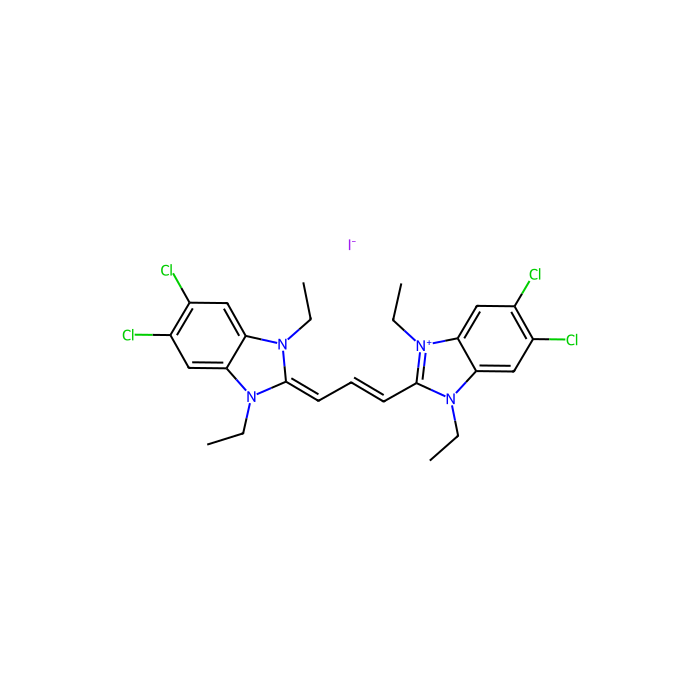
JC-1 is a fluorescent lipophilic carbocyanine dye, which can be used to measure mitochondrial membrane potential.
A dual-emission potential-sensitive probe that can be used to measure mitochondrial membrane potential. JC-1 is a green-fluorescent (λex 520 nm) monomer at low membrane potential. At higher potentials, JC-1 forms red-fluorescent (λem 596 nm ) "J-aggregates," which exhibit broad excitation and very narrow emission spectra. The ratio of red to green fluorescence of JC-1 is dependent only on membrane potential, and not influenced by mitochondrial size, shape, or density.
The decrease of mitochondrial membrane potential is a landmark event in the early stage of apoptosis. The decrease of cell membrane potential can be easily detected by the transition of JC-1 from red fluorescence to green fluorescence, and the transition from red fluorescence to green fluorescence of JC-1 can also be used as an early detection indicator of apoptosis.
The maximum excitation wavelength of JC-1 monomer is 514nm and the maximum emission wavelength is 529nm; the maximum excitation wavelength of JC-1 polymer is 585nm and the maximum emission wavelength is 590nm. For actual observation, use the conventional settings for observing red fluorescence and green fluorescence.
The commonly used concentration range of JC-1 for detecting the mitochondrial membrane potential of cells is 1-20μg/mL, and the suitable concentration of JC-1 for many cells is 10μg/mL.
Precautions
If the amount of JC-1 used at a time is small, each tube needs to be appropriately divided to avoid repeated freeze-thaw.
For your safety and health, please wear lab coats and disposable gloves.
Documento completo su pericoli, manipolazione, stoccaggio e conformità normativa.
<<<<<<< HEAD Scarica SDS → ======= Scarica SDS → >>>>>>> release248-p3Dati di qualità specifici del lotto. Inserisci il numero di lotto per recuperare il COA esatto.
Cerca COA →Riepilogo di riferimento rapido delle specifiche e applicazioni del prodotto.
Visualizza scheda tecnica →Attributi di qualità completi e criteri di accettazione per questa qualità.
Visualizza scheda delle specifiche →Taxonomy Tree
| Kingdom | Organic compounds |
|---|---|
| Superclass | Organoheterocyclic compounds |
| Classe | Benzimidazoles |
| Subclass | Not available |
| Intermediate Tree Nodes | Not available |
| Direct Parent | Benzimidazoles |
| Alternative Parents | N-substituted imidazoles Benzenoids Aryl chlorides Heteroaromatic compounds Ketene acetals Azacyclic compounds Organopnictogen compounds Organonitrogen compounds Organochlorides Organic iodide salts Hydrocarbon derivatives |
| Molecular Framework | Aromatic heteropolycyclic compounds |
| Substituents | Benzimidazole - Aryl chloride - Aryl halide - Benzenoid - N-substituted imidazole - Azole - Heteroaromatic compound - Imidazole - Ketene acetal or derivatives - Azacycle - Organic nitrogen compound - Organohalogen compound - Organochloride - Organonitrogen compound - Organic salt - Organic iodide salt - Hydrocarbon derivative - Organopnictogen compound - Aromatic heteropolycyclic compound |
| Descrizione | This compound belongs to the class of organic compounds known as benzimidazoles. These are organic compounds containing a benzene ring fused to an imidazole ring (five member ring containing a nitrogen atom, 4 carbon atoms, and two double bonds). |
| External Descriptors | cyanine dye - organic iodide salt |
| Activity Type | Relation | Activity value | Units | Action Type | Journal | PubMed Id | doi | Assay Aladdin ID |
|---|
Find and download the COA for your product by matching the lot number on the packaging.
| Lot Number | Certificate Type | Data | Oggetto |
|---|---|---|---|
 D2617443 | Certificate of Analysis | Apr 08, 2026 | J125134 |
| D2617444 | Certificate of Analysis | Apr 08, 2026 | J125134 |
| D2617448 | Certificate of Analysis | Apr 08, 2026 | J125134 |
| G2509024 | Certificate of Analysis | Jul 22, 2025 | J125134 |
| L2103724 | Certificate of Analysis | Jun 09, 2025 | J125134 |
| D2507073 | Certificate of Analysis | Apr 19, 2025 | J125134 |
| K2405029 | Certificate of Analysis | Nov 12, 2024 | J125134 |
| K2224596 | Certificate of Analysis | Sep 13, 2024 | J125134 |
| K2224597 | Certificate of Analysis | Sep 13, 2024 | J125134 |
| K2224598 | Certificate of Analysis | Sep 13, 2024 | J125134 |
| L2312076 | Certificate of Analysis | Dec 20, 2023 | J125134 |
| L2103714 | Certificate of Analysis | Sep 19, 2023 | J125134 |
| G1917104 | Certificate of Analysis | Mar 14, 2023 | J125134 |
| Solubilità | DMSO |
|---|---|
| Sensibilità | light sensitive;Moisture sensitive;air sensitive |
| Peso molecolare | 652.200 g/mol |
| XLogP3 | |
| Hydrogen Bond Donor Count | 0 |
| Hydrogen Bond Acceptor Count | 3 |
| Rotatable Bond Count | 6 |
| Exact Mass | 652.001 Da |
| Monoisotopic Mass | 650.003 Da |
| Topological Polar Surface Area | 15.300 Ų |
| Heavy Atom Count | 34 |
| Formal Charge | 0 |
| Complexity | 625.000 |
| Isotope Atom Count | 0 |
| Defined Atom Stereocenter Count | 0 |
| Undefined Atom Stereocenter Count | 0 |
| Defined Bond Stereocenter Count | 1 |
| Undefined Bond Stereocenter Count | 0 |
| The total count of all stereochemical bonds | 1 |
| Covalently-Bonded Unit Count | 2 |
The following are literature-based, general protocols for research use. Optimize per cell type, instrument, and plate format.
A. Live-cell microscopy (culture cells):
B. Flow cytometry:
C. Plate-reader assay (96-well):
Notes:
Scope: JC-1 itself does not have endogenous biological roles; it is an exogenous fluorescent probe used to interrogate a fundamental bioenergetic parameter (ΔΨm) in cells (research use only).
Mechanistic basis (literature/general):
Experimental considerations:
Use domains:
JC-1 is not a buffering agent. However, buffer choice affects staining performance (literature/practice):
Typical working solution prep (literature example):
Note: For fixed-cell imaging, JC-1 is generally not suitable as ΔΨm collapses upon fixation; measure in live cells whenever possible.
Context: JC-1 is a chlorinated carbocyanine iodide salt. From a green chemistry perspective, considerations include halogen content, DMSO/DMF usage for solubilization, and potential persistence of fluorescent dyes in waste streams.
Potential alternatives (literature/general; selection depends on assay needs):
Comparison highlights:
Greener practice tips:
This product is a research-use-only fluorescent probe and is not intended for pharmaceutical formulation, diagnostic, or therapeutic applications.
Formulation context (general information):
Regulatory note:
Item-specific specifications:
Literature/general properties (for JC-1 iodide; for reference only):
Notes:
Item-specific status:
Guidance on grades for fluorescent probes (general):
What is specific for this item:
This product is a fluorescent indicator dye rather than a synthetic reagent. Applications are in analytical cell biology and bioimaging (research use only).
Key research applications (literature/general):
Practical tips:
Data analysis:
Not applicable in the conventional synthetic sense: JC-1 is used as a staining reagent, not as a reactant. The following provides assay-condition guidance (literature/practice) rather than chemical reaction conditions.
Typical assay conditions for ΔΨm measurements:
Expected outcomes: cells with intact ΔΨm show higher red/green ratio; depolarized cells shift to green-dominant signal. Always calibrate instrument settings using positive/negative controls.
Authoritative safety data: Always consult the product SDS for definitive information.
Item-specific hazard fields:
General laboratory safety guidance (literature/practice):
Storage per Product Data:
Relevance: JC-1 is supplied as a solid dye for preparation of stock solutions. It is not used as a reaction solvent; this section addresses dissolution for assay stock preparation.
Solubility and solvent choices (literature/general):
Selection notes:
Comparison (literature):
Item-specific storage (from Product Data):
Reconstitution (general literature guidance):
Working solutions:
Additional notes:
Brief overview: JC-1 is a lipophilic cationic carbocyanine dye widely used as a mitochondrial membrane potential (ΔΨm) indicator in cells (research use only).
Structural features (general description):
JC-1 is a specialized fluorescent dye probe and is not typically used as a synthetic building block or reagent.
General chemistry note (literature):
Recommendation:
This section is typically applicable to antibodies or affinity reagents with defined antigen targets. JC-1 is a small-molecule fluorescent probe and does not have an antigen/epitope specificity.
Contextual note (general): JC-1 accumulates in energized mitochondria due to membrane potential rather than binding a specific biomolecular target. No clone, isotype, or species reactivity applies.