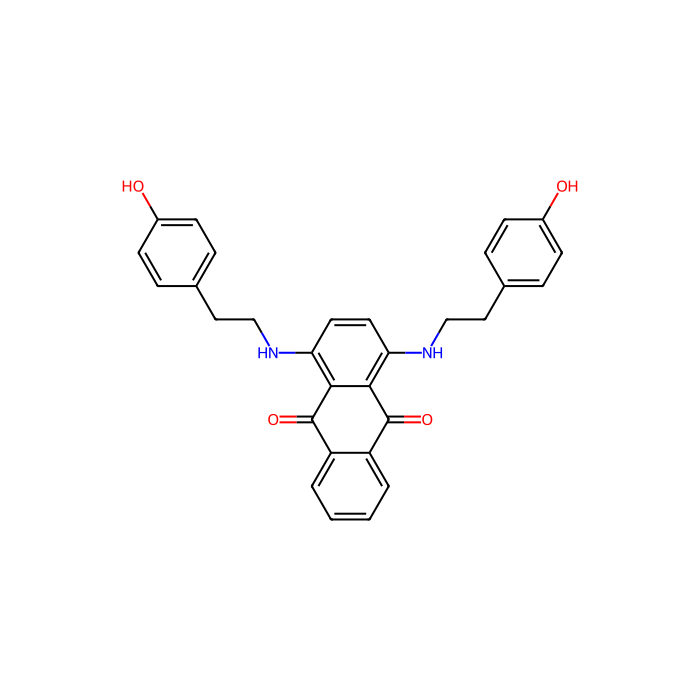
This compound belongs to the class of organic compounds known as anthraquinones. These are organic compounds containing either anthracene-9,10-quinone, 1,4-anthraquinone, or 1,2-anthraquinone.
External Descriptors
Not available
1. Djoumbou Feunang Y, Eisner R, Knox C, Chepelev L, Hastings J, Owen G, Fahy E, Steinbeck C, Subramanian S, Bolton E, Greiner R, and Wishart DS. ClassyFire: Automated Chemical Classification With A Comprehensive, Computable Taxonomy. Journal of Cheminformatics, 2016, 8:61.
Certificati (CoA, COO, BSE/TSE e tabella di analisi)
C of A & Other Certificates(BSE/TSE, COO):
Analytical Chart:
Proprietà chimiche e fisiche
Solubilità
Soluble in DMSO (≥10 mg/mL), and water (<2 mg/mL).
Indice di rifrazione
n20D1.73
Punto di ebollizione (°C)
~780.2° C at 760 mmHg (Predicted)
Punto di fusione (°C)
~301.99° C (Predicted)
Peso molecolare
478.500 g/mol
XLogP3
7.100
Hydrogen Bond Donor Count
4
Hydrogen Bond Acceptor Count
6
Rotatable Bond Count
8
Exact Mass
478.189 Da
Monoisotopic Mass
478.189 Da
Topological Polar Surface Area
98.700 Ų
Heavy Atom Count
36
Formal Charge
0
Complexity
681.000
Isotope Atom Count
0
Defined Atom Stereocenter Count
0
Undefined Atom Stereocenter Count
0
Defined Bond Stereocenter Count
0
Undefined Bond Stereocenter Count
0
The total count of all stereochemical bonds
0
Covalently-Bonded Unit Count
1
Calcolatori di soluzioni
Molarity Calculator
Determine the necessary mass, volume, or concentration for preparing a solution.
Dilution Calculator
Determine the dilution needed to prepare a stock solution.
Reconstitution Calculator
Recensioni
Recensioni dei clienti
Application Protocols
There are no vendor-validated application protocols for this item in the Product Data. The following are general best practices for handling small-molecule screening compounds.
Stock solution preparation
Equilibrate vial to room temperature in a desiccator before opening to prevent condensation.
Prepare an initial 10–50 mM stock in anhydrous DMSO. Vortex and, if necessary, sonicate briefly to dissolve. Record exact concentration and lot.
Sterile filtration (0.22 µm PTFE) is optional for cell-free assays; avoid aqueous filtration unless solubility is confirmed.
Assay use
Dilute stocks into assay buffer keeping DMSO ≤1–2% v/v. Include vehicle controls.
Verify solubility and absence of precipitation visually and by absorbance/light scattering if possible.
Storage of working solutions
Aliquot stocks to single-use vials or plate wells to minimize freeze–thaw. Label with concentration, solvent, and date.
Replace with item-specific protocols if supplied in the future.
Biological Roles
No biological function, pathway involvement, or target specificity is provided for this catalog entry. As a general member of a small-molecule compound library, it should be treated as an experimental research chemical with unknown biological activity.
General considerations (non–item-specific)
Use only for in vitro or ex vivo research. Establish appropriate concentration ranges, vehicle controls (e.g., ≤1–2% DMSO), and exposure times to avoid nonspecific effects.
If exploring biochemical/biophysical interactions, determine purity, confirm identity, and characterize solubility/aggregation behavior (e.g., DLS, absorbance at 400–800 nm) to avoid false positives from colloidal aggregation.
For cell-based assays, evaluate cytotoxicity windows independently (e.g., resazurin/ATP assays) before mechanistic studies.
Documentation
Record exact batch/lot, storage history, and stock concentration to correlate with assay outcomes.
No medical or clinical claims are associated with this product. It is provided strictly for research use only.
Buffer Applications
This product is a small organic molecule from a screening library and is not a buffering reagent. Therefore, dedicated buffer recipes or pH ranges do not apply.
Practical notes
If preparing aqueous working solutions for assays, use established biological buffers (e.g., PBS, HEPES, Tris) appropriate to your system, and dilute DMSO stocks to ≤1–2% v/v to minimize solvent effects.
Confirm compound stability in the chosen buffer (pH, ionic strength, light sensitivity) once the structure and pKa are known from the CoA.
For buffer formulation guidance, refer to standard buffer components rather than this compound.
Green Alternatives
In the absence of structure-specific information, greener practice focuses on solvent choice, waste minimization, and energy-efficient handling for small-molecule stocks.
Greener solvent considerations (general)
Prefer ethanol or isopropanol over methanol when feasible (lower toxicity), recognizing solubility limitations.
Where DMSO is required, minimize volumes and ensure efficient plate mapping to reduce waste.
For work-ups and chromatography, consider ethyl acetate, 2-MeTHF, or cyclopentyl methyl ether (CPME) instead of chlorinated solvents when compatible with the compound.
Comparison (general guidance)
DCM vs EtOAc: EtOAc offers lower toxicity and better environmental profile; may require longer elution times or altered gradients.
THF vs 2-MeTHF: 2-MeTHF (bio-based, higher BP) reduces peroxide risk relative to diethyl ether and offers greener metrics; check solubility.
Operational green tips
Consolidate analyses (LC–MS, HPLC) to limit repeated injections.
Store at −20°C as directed to extend shelf life, reducing repeat synthesis/purchase and associated footprint.
Use micro-scale reaction conditions for any derivatization or analytical degradation studies.
Note: Once the structure is known, apply solvent selection guides (e.g., GSK/ACS green solvent guides) more precisely to the compound’s polarity and stability.
Pharmaceutical Uses
No pharmacopeial status, excipient role, or formulation designation is provided for this item. It is supplied for research use only and is not intended for human or veterinary applications.
General research-related uses (non-therapeutic)
Analytical reference in method development (e.g., retention time marker, extraction recovery studies) where a generic, non-endogenous small molecule is acceptable.
Early discovery workflows such as HTS, fragment/add-on libraries, or orthogonal assay validation—subject to confirmation of identity and purity from the CoA.
Compliance
Not GMP-certified. Not accompanied by DMF/CEP. If you require regulated-use materials, contact Aladdin Scientific for suitable alternatives or custom sourcing.
Always refrain from making therapeutic or clinical claims with this material.
Physical Properties
Item-specific physico-chemical data are not provided in the Product Data. Use this section as a checklist and consult the CoA/SDS for definitive values.
Item-specific values (specifications for this catalog item)
Appearance: Not specified for this item; refer to CoA/Spec Sheet.
Purity/Grade: Not specified for this item; refer to CoA/Spec Sheet.
Molecular Weight: Not specified for this item; refer to CoA/Spec Sheet.
Melting point (mp): Not specified for this item; refer to CoA/Spec Sheet.
Boiling point (bp): Not specified for this item; refer to CoA/Spec Sheet.
Density: Not specified for this item; refer to CoA/Spec Sheet.
Refractive index: Not specified for this item; refer to CoA/Spec Sheet.
Water content, residual solvents, metals, UV cutoff: Not specified for this item; refer to CoA/Spec Sheet.
General/literature guidance (applicability depends on structure)
Solubility screening strategy: For unknown or diverse small molecules, initial stock solutions are commonly prepared at 10–50 mM in dry DMSO or DMF, with secondary solubility checks in MeOH or EtOH if aqueous work is planned.
Aqueous handling: Many drug-like small molecules have limited water solubility; co-solvent systems (DMSO ≤1–2% v/v in assay) and pH adjustment may be needed. Avoid assuming ionization behavior without pKa data.
LogP/logD, pKa, and polar surface area (literature/computed) are crucial for predicting solubility and permeability; compute from the definitive SMILES once obtained from the CoA.
Always defer to the SDS and CoA for authoritative, item-specific physical data.
Quality and Grades
Item-specific quality designation and purity are not provided in the Product Data.
Grade/Purity (catalog specification): Not specified for this item; refer to CoA/Spec Sheet.
Guidance on interpreting grades (general)
Screening library compounds are often provided at “research grade,” suitable for in vitro assays, method development, and hit validation. They are not certified for clinical or GMP use.
If labeled as “analytical standard” or “reference standard,” expect tighter assay identity/purity documentation (HPLC/UPLC chromatogram, NMR, MS). If labeled “screening compound,” typical documentation includes LC–MS purity and identity only.
Stabilizers/Salts: If the compound is provided as a particular salt form or with stabilizers, this will impact formula weight and solubility; confirm on the CoA. For this item: Not specified for this item; refer to CoA/Spec Sheet.
Recommended quality checks (user)
Verify identity by LC–MS (accurate mass/fragmentation) and, if needed, 1H NMR.
Confirm purity by HPLC/UPLC (UV and/or ELSD). If UV-active, monitor multiple wavelengths.
Document water content (Karl Fischer) if hygroscopic behavior is suspected.
Research Use Note
For research use only. Not for human or veterinary use.
Reaction and Applications
This listing corresponds to a small-molecule entry in a screening/compound library (Category: 小分子和化合物库). No synthetic or functional annotations are provided in the Product Data. Accordingly, the following are general, non–item-specific research applications.
Discovery and screening use-cases (general)
Assay development and method validation: Use as a representative small molecule to optimize LC–MS sample prep, recovery, and matrix effects.
High-throughput screening (HTS) logistics: Maintain DMSO stocks, track plate maps, and control for DMSO carryover in biochemical/biophysical assays.
Without a disclosed structure, no reliable guidance can be given on functional-group reactivity, protection/deprotection strategies, or named-reaction compatibility. Obtain the SMILES/InChI to assess potential derivatizations (amide coupling, cross-coupling, nucleophilic substitutions, etc.).
Practical tips
Aliquot upon receipt (−20°C storage per Product Data) to avoid repeated freeze–thaw.
Record exact lot, net mass, and concentration when preparing stocks for traceability in SAR or assay reproducibility studies.
Note: Replace this section with structure-driven application notes once the CoA reveals functional groups and stability profile.
Reaction Conditions
No item-specific reaction conditions are applicable because the functional groups, reactivity, and stability of this compound are not disclosed.
General planning notes (if derivatization is pursued after structure confirmation)
Solvent: Choose based on polarity and stability (e.g., DCM/EtOAc for neutral reactions; MeCN/DMF/DMSO for polar substitutions or couplings).
Temperature: Begin at ambient; escalate cautiously once thermal stability is known (DSC/TGA or stability scouting recommended).
Catalysis: Select catalysts specific to identified transformations (e.g., Pd for cross-coupling, EDCI/HATU for amidation) only after confirming compatible functional groups.
Atmosphere: Use inert gas (N2/Ar) for air- or moisture-sensitive motifs.
Times/yields: Literature precedent will depend entirely on the confirmed scaffold; avoid assumptions without structural data.
Defer to structure-specific literature once the CoA provides the exact identity.
Safety and Handling
Safety information specific to this item is limited in the Product Data. Exercise standard laboratory prudence for research-only small molecules.
Item-specific hazard data
GHS Classification: Not specified for this item; refer to SDS.
Signal Word / H-Statements / Pictograms: Not specified for this item; refer to SDS.
General handling guidance (not item-specific; follow institutional SOPs)
PPE: Use lab coat, safety glasses, and appropriate gloves (e.g., nitrile). Handle powders/solids in a fume hood to avoid inhalation of dust or aerosols.
Incompatibilities: Unknown for this structure; segregate from strong oxidizers and acids/bases until specific reactivity is confirmed from SDS.
First aid (overview): Skin/eye contact—rinse with water for ≥15 min; inhalation—move to fresh air; ingestion—seek medical attention. Refer to SDS for detailed instructions.
Spill response: Avoid dust generation, ventilate area, collect with inert absorbent, dispose per local regulations.
Fire safety: Many organic compounds are combustible. Use CO2, dry chemical, or foam; cool containers with water spray. Check SDS for decomposition hazards.
Waste: Dispose as organic chemical waste; do not discharge to drains.
Storage and shipping (from Product Data)
Storage: Store at −20°C.
Shipping: Ice chest + ice pads. Minimize freeze–thaw cycles by aliquoting upon first use.
Always consult the item’s SDS for definitive hazard classifications and emergency measures.
Solvent Selection
Because the structure and polarity are not disclosed in the Product Data, select solvents using a tiered screening strategy suitable for diverse small molecules.
Practical approach
Primary stock solvent: DMSO (anhydrous) at 10–50 mM is commonly effective for drug-like molecules. Filter-sterilize if needed for cell-free assays.
Secondary options: DMF, methanol, ethanol, and acetonitrile for HPLC compatibility. For nonpolar entities, consider dichloromethane or ethyl acetate for processing; switch back to DMSO/MeOH for assay stocks.
Aqueous use: Prepare working solutions by diluting DMSO stocks into buffers, keeping DMSO ≤1–2% v/v to minimize assay interference.
General solvent properties (literature, for planning)
If precipitation occurs upon dilution, add a small amount of co-solvent, warm gently, or adjust pH if the compound has ionizable groups (verify pKa once structure is confirmed).
For LC methods, match diluent strength to initial mobile phase to prevent peak distortion.
Note: Replace generic guidance with item-specific recommendations once the SMILES/formula from the CoA is available.
Storage and Reconstitution
Item-specific conditions (from Product Data)
Storage: Store at −20°C.
Shipping: Ice chest + ice pads.
General best practices (applicable to small-molecule solids or concentrated solutions)
Upon receipt, allow the sealed container to reach room temperature before opening to avoid condensation. Work in a low-humidity environment.
If supplied as a solid: Prepare aliquots as 10–50 mM stocks in anhydrous DMSO (or another suitable solvent once the structure is verified). Record exact concentration and solvent.
If supplied in solution: Confirm solvent and concentration on the label/CoA. Store tightly sealed, protected from moisture and light as appropriate.
Aliquot to minimize freeze–thaw cycles; repeated cycling can accelerate degradation.
Short-term storage: 2–8°C for days to a week may be acceptable for many DMSO stocks; long-term store at −20°C as specified. Avoid frost-free freezers that cycle temperatures.
Stability/expiry: Not specified for this item; refer to CoA/Spec Sheet. Perform periodic LC–MS/HPLC checks if used over extended periods.
Reconstitution notes
If dissolution is sluggish, warm gently (≤37°C) and vortex/sonicate briefly. Do not heat above solvent BP. Confirm complete dissolution before use.
For definitive stability and storage limits, consult the item’s CoA/SDS.
Structure and Identity
Concise identity summary for this small-molecule screening compound entry.
SKU: B335782
Product Name: JFD00244 (screening library code)
CAS: 96969-83-4 (from Product Data)
PubChem CID: 2817242 (from Product Data)
InChIKey: 369466 (as provided; note this appears non-standard length — verify against CoA/SDS)
SMILES: Not specified for this item; refer to CoA/Spec Sheet.
Molecular Formula: Not specified for this item; refer to CoA/Spec Sheet.
Molecular Weight: Not specified for this item; refer to CoA/Spec Sheet.
Structural features
Detailed 2D/3D structure, functional groups, ring systems, and stereochemistry: Not specified for this item; refer to CoA/Spec Sheet.
Notes
JFD-series identifiers are often internal codes for discovery compounds in screening sets. Without a disclosed structure, users should retrieve exact identifiers (IUPAC name, SMILES, InChI) from the accompanying CoA/SDS for informatics registration, ELN records, and inventory systems.
If importing into cheminformatics software, map the CAS and CID to confirm the canonical structure and any known tautomers/salts (if applicable).
Synthetic Utility
The Product Data do not disclose structure or functional groups, so specific synthetic roles cannot be assigned.
General guidance (conditionally applicable once structure is known)
If the compound contains common handles (e.g., aryl halide, boronate, amine, carboxylate), it may be suitable for cross-couplings, amide formations, or SNAr. Verify by consulting the SMILES/InChI on the CoA.
For analog generation (SAR), plan convergent routes enabling late-stage diversification at the most modifiable position(s). Employ protecting-group strategies only if demanded by functionality.
Assess chemical stability under acid/base, redox, and photolytic conditions before scale-up or derivatization.
Analytical recommendations
Track reaction progress by LC–MS to detect isomers/impurities.
Use orthogonal purification (normal-phase, reverse-phase, or crystallization) depending on polarity revealed by the structure.
Until the definitive structure is available, treat synthetic utility as unknown.
Target Specificity
Target information (protein, pathway, or organism specificity) is not provided in the Product Data and cannot be inferred without the disclosed structure.
Antigen/epitope, clone, isotype, species reactivity: Not applicable; this is not an antibody or biologic.
If using as a putative chemical probe, independently determine target engagement via appropriate biophysical or biochemical assays (e.g., thermal shift, SPR, ITC), and validate with orthogonal methods.
Domande frequenti
What is the purity of this product?
This product is supplied at ≥98% purity (chemical assay). Lot-specific values are stated on the Certificate of Analysis.
How should this product be stored?
Store at ?20 °C. Freezer storage is required to maintain the specified shelf life.
How is this product shipped?
This product ships in an insulated container with ice pads. Unpack on arrival and transfer it to the storage condition stated above.
What are the CAS number, molecular formula and molecular weight?
The CAS Number is 96969-83-4, the molecular formula is C30H26N2O4, and the molecular weight is 478.54 g/mol. InChIKey UUJHFIBEJJLZBF-UHFFFAOYSA-N.
What documentation is provided?
Available product documentation, including Certificates of Analysis (COA), Safety Data Sheets (SDS), and specification sheets, is shown in the product document area. Document availability and access follow the current site policy.
Utilizziamo i cookie per garantire il corretto funzionamento del sito web e, ove consentito, per migliorare la tua esperienza. Puoi gestire le tue preferenze in qualsiasi momento nelle Impostazioni. Per saperne di più, consulta la nostra Cookie Policy.
Desidera che le inviamo un messaggio quando avremo sconti disponibili?
Ricordamelo più tardi
Grazie! Controlli la sua casella di posta per confermare.
Products are supplied to verified businesses, institutions, and qualified professionals for research and development use only. Not for use in humans, animals, diagnosis, or therapy.