QUALITÀ & PUREZZAMoligand™?Moligand™ — Aladdin's line of ligands and bioactive small molecules. Use for receptor, pathway, and binding studies needing defined small-molecule tools.≥98%(HPLC)
Potent and selective monoacylglycerol lipase (MAGL) inhibitor (IC50= 0.4 nM). Exhibits >13,000 and ~630-fold selectivity for MAGL over FAAH and ABHD6, respectively. Increases brain levels of 2-arachidonoylglycerol (2-AG) levels in micein vivo. Promotes analgesia in pain models.
Condizioni di conservazione di stoccaggio
Store at -20°C
Spedito in
Ice chest + Ice pads
Questo prodotto richiede spedizione a catena fredda. I servizi di terra e altri servizi economici non sono disponibili.
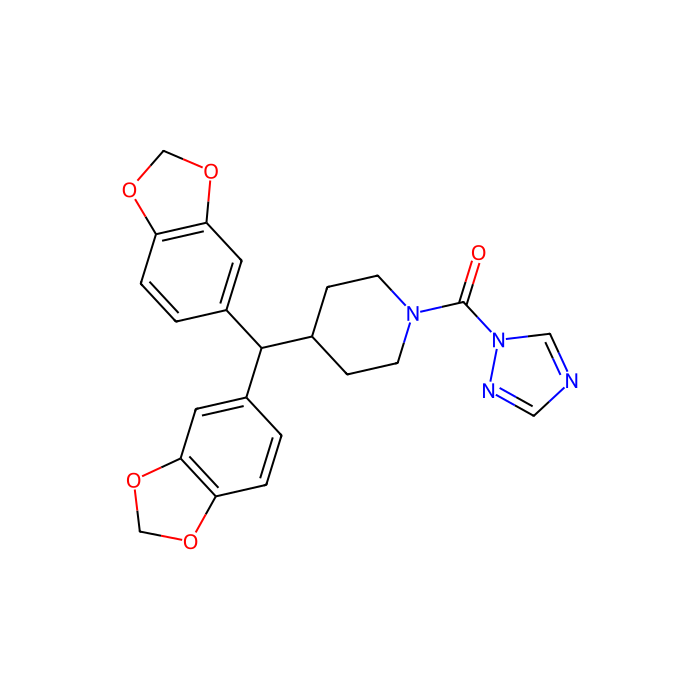
This compound belongs to the class of organic compounds known as benzodioxoles. These are organic compounds containing a benzene ring fused to either isomers of dioxole. Dioxole is a five-membered unsaturated ring of two oxygen atoms and three carbon atoms.
External Descriptors
Not available
1. Djoumbou Feunang Y, Eisner R, Knox C, Chepelev L, Hastings J, Owen G, Fahy E, Steinbeck C, Subramanian S, Bolton E, Greiner R, and Wishart DS. ClassyFire: Automated Chemical Classification With A Comprehensive, Computable Taxonomy. Journal of Cheminformatics, 2016, 8:61.
Determine the necessary mass, volume, or concentration for preparing a solution.
Dilution Calculator
Determine the dilution needed to prepare a stock solution.
Reconstitution Calculator
Recensioni
Recensioni dei clienti
Application Protocols
No vendor-validated protocols are provided for this item. The following are general, non-item-specific templates suitable for small-molecule ligands:
DMSO stock preparation:
Bring vial to room temperature in a desiccator to avoid condensation. Add anhydrous DMSO to make a 10–50 mM stock. Vortex until fully dissolved. If needed, brief sonication (≤5 min). Record exact concentration.
Biochemical assay (IC50) template:
Prepare a 10-point 3-fold serial dilution in assay buffer with constant DMSO (e.g., 0.5% v/v). Include no-compound and vehicle controls. Run in triplicate. Fit dose–response with a 4PL model and report Hill slope.
Thermal shift (DSF) template:
Mix protein (1–5 µM), SYPRO/DSF dye, and ligand (final 1–100 µM) in HEPES buffer (pH 7.5) with ≤1% DMSO. Ramp 25→95 °C at 1 °C/min. ΔTm indicates stabilization/destabilization.
SPR binding screen:
Immobilize target (amine coupling). Inject ligand in a multi-concentration series (e.g., 5–500 µM) with matched DMSO in running buffer. Reference-subtract and perform DMSO calibration.
Item-specific conditions, positive controls, and validated dilutions: Not specified for this item; refer to CoA/Spec Sheet.
Biological Roles
Item-specific biological roles or targets for JJKK 048 are not disclosed.
General context for research ligands (not item-specific):
Functional role: Discovery ligands are used to interrogate protein function by binding to active or allosteric sites, modulating activity, or serving as tracers in displacement assays. They may help map pathways by perturbing specific nodes in enzymatic cascades or signaling complexes.
Biochemical impact: Depending on structure and ionization state, ligands can interact via H-bonding, hydrophobic contacts, metal coordination, or covalent reversible/irreversible mechanisms. Without structural details here, assume non-covalent binding until demonstrated otherwise.
Selectivity profiling: Off-target assessment across kinases, GPCRs, proteases, or other enzyme families is commonly performed to establish a selectivity fingerprint and guide SAR.
ADME-relevant properties (exploratory): Cell-based engagement requires permeability and stability; stability in assay media and resistance to redox/photolysis should be confirmed experimentally.
Important limitations:
No therapeutic or clinical claims apply; material is for research use only (as stated by the manufacturer).
Target identity, binding mode, potency, and selectivity of JJKK 048 are Not specified for this item; consult CoA/Spec Sheet or supplier under appropriate disclosure.
Buffer Applications
This product is not a buffering reagent. No item-specific buffer system recommendations are provided.
Practical handling for ligands in buffers (general, not item-specific):
Prepare a high-concentration DMSO stock (e.g., 10–50 mM), then dilute into assay buffer (HEPES, Tris, or PBS) to desired test concentrations.
Keep final DMSO concentration low (≤0.5–1% v/v) to maintain protein stability and avoid solvent effects on activity.
Include 0.01–0.05% non-ionic detergent (e.g., Tween-20) to minimize colloidal aggregation artifacts in biochemical assays when appropriate.
Filter or centrifuge solutions to remove particulates before biophysical measurements (e.g., DSF, SPR).
Adjust pH to the biologically relevant range (often pH 7.2–7.5 for mammalian proteins). In the absence of a known pKa, test solubility and stability across pH 6.5–8.0.
Item-specific buffer compatibility, pKa, isoelectric points, or salt effects: Not specified for this item; refer to CoA/Spec Sheet.
Green Alternatives
Because JJKK 048 is positioned as a research ligand rather than a bulk process solvent or reagent, “green alternatives” pertain mainly to solvent choices during handling and any optional derivatization. No item-specific solvent requirements are disclosed.
General guidance (not item-specific):
Stock and assay solvents:
Prefer DMSO for stock solutions when feasible; DMSO is relatively benign, has low volatility, and broad solubilizing capacity. Keep final assay DMSO ≤0.5–1% v/v when possible.
For extractions or crystallizations, consider ethanol or isopropanol over chlorinated solvents when compatible with compound stability.
Replace DMF/NMP with Cyrene, propylene carbonate, or green esters where reaction scope permits; or use water/ethanol with phase-transfer catalysis for certain couplings.
Substitute THF with 2-MeTHF or CPME in air/moisture-tolerant reactions.
Greener solvents may reduce solubility or alter reaction kinetics; verify performance with small pilots.
Item-specific environmental attributes (stabilizers, inhibitor-free status, residuals): Not specified for this item; refer to CoA/Spec Sheet.
Pharmaceutical Uses
No pharmacopeial status or excipient/formulation role is provided for JJKK 048. The product is designated For research use only and is not intended for human or veterinary use.
General context for discovery ligands (not item-specific):
Early discovery: Such compounds can serve as tool molecules or preliminary hits in screening cascades, informing structure–activity relationships (SAR) and guiding medicinal chemistry optimization.
Formulation for research assays: DMSO stocks and simple aqueous dilutions suffice for most in vitro testing. Lyophilized format, if used, is typically reconstituted in anhydrous solvent; item-specific instructions are required for definitive guidance.
Manufacturing/CMC relevance: None indicated. No GMP grade or pharmacopeial monograph is referenced in the product data.
Item-specific information requested by regulated users (if applicable):
Residual solvents, heavy metals, elemental impurities (ICH Q3D), and long-term stability are Not specified for this item; refer to CoA/Spec Sheet.
Conclusion: Treat JJKK 048 strictly as a research reagent. Any development beyond discovery research would require additional qualification, analytical characterization, and regulatory evaluation.
Appearance: Not specified for this item; refer to CoA/Spec Sheet.
Molecular Weight: Not specified for this item; refer to CoA/Spec Sheet.
Molecular Formula: Not specified for this item; refer to CoA/Spec Sheet.
Melting/Boiling Point: Not specified for this item; refer to CoA/Spec Sheet.
Density/Refractive Index: Not specified for this item; refer to CoA/Spec Sheet.
LogP/pKa: Not specified for this item; refer to CoA/Spec Sheet.
Solubility (item-specific): Not specified for this item; refer to CoA/Spec Sheet.
General guidance (literature/practice-based; not item-specific):
Many discovery ligands are handled as concentrated DMSO stocks (e.g., 10–50 mM) due to broad solubilizing power and assay compatibility up to 0.1–1% v/v DMSO.
Where aqueous use is required, co-solvent systems (DMSO or DMF 1–5% v/v) and pH adjustment near the compound’s ionization state can improve solubility. Without a disclosed pKa, pilot solubility screens at pH 6–8 are advisable.
If the compound is a salt, hygroscopicity is possible; minimize exposure to ambient humidity.
Important: Do not treat the above as specifications. For authoritative values, consult the item’s CoA/Spec Sheet and SDS.
Quality and Grades
Grade/Purity (item-specific): Moligand™ (as provided). Specific assay purity, residual solvents, metal content, water, and stabilizers are Not specified for this item; refer to CoA/Spec Sheet.
About Moligand™ grade (general description; not item-specific):
Moligand™ denotes materials intended for ligand discovery, biochemical screening, or target engagement research. Typical quality expectations include:
Identity confirmation by orthogonal methods (e.g., HRMS, 1H NMR, LC–MS), and purity suitable for screening and follow-up assays.
Low levels of non-volatile residues to minimize assay interference; UV transparency sufficient for spectroscopic assays (when applicable). Exact thresholds vary by item.
Practical implications:
Researchers can prepare concentrated DMSO stocks and perform dose–response studies without extensive re-purification in early discovery. For biophysical assays (ITC/SPR/DSF), additional polishing (e.g., prep-HPLC) may be considered if signal artifacts are observed.
Documentation and verification:
For this specific SKU (J286608), detailed specifications (HPLC area % purity, water/metal limits, residual solvents, stabilizers) are Not specified for this item; refer to CoA/Spec Sheet.
CoA typically lists batch-level analytical results; request prior to critical experiments or regulatory submissions.
Reaction and Applications
Context: JJKK 048 is offered as a Moligand™-grade research ligand; the primary use is biochemical/biophysical evaluation rather than synthetic transformations. No item-specific application notes were provided.
General research applications for discovery ligands (not item-specific):
Biophysical binding assays: Surface Plasmon Resonance (SPR), Isothermal Titration Calorimetry (ITC), Microscale Thermophoresis (MST), thermal shift/DSF. Prepare clean solutions and match buffer/solvent to protein stability.
Biochemical inhibition/activation assays: Enzyme kinetics (IC50/Ki determination), with careful control of DMSO percentage and inclusion of detergent (e.g., 0.01–0.05% Tween-20) to mitigate aggregation artifacts.
Cellular target engagement: CETSA/TPP or NanoBRET tracer displacement when suitable cell-permeability is present; confirm by control experiments to exclude assay interference.
Affinity capture/chemoproteomics (if chemistry allows): Derivatization to append linkers or photo-crosslinkers for pull-down and MS identification of binding proteins.
Practical tips (general):
Validate compound integrity by LC–MS before critical assays; freeze–thaw can degrade some ligands.
Run detergent and redox controls; pan-assay interference (PAINS) motifs, if present, can confound readouts.
Use orthogonal assays to confirm mechanism (e.g., competitive vs non-competitive kinetics, thermal shift corroboration with SPR/ITC).
Item-specific manufacturer applications: Not specified for this item; refer to CoA/Spec Sheet.
Reaction Conditions
No synthetic or reaction-use conditions are specified for JJKK 048. The material is positioned as a research ligand; standard organic synthesis conditions would only apply if users derivatize the scaffold.
General guidance for handling in assay preparation (not item-specific):
Stock solution: Dissolve at 10–50 mM in anhydrous DMSO. Vortex and, if needed, sonicate briefly to aid dissolution. Confirm by LC–MS.
Working solutions: Dilute into assay buffer to desired concentrations, maintaining final DMSO ≤0.5–1% v/v. Pre-clear by centrifugation (≥10,000 g, 5 min) to remove particulates.
Light/oxygen sensitivity: If suspected, prepare and store solutions under low light and inert gas (argon/nitrogen). Use amber vials.
If derivatization is contemplated (general, not item-specific):
Choose solvent based on functional group compatibility (e.g., 2-MeTHF/EtOAc/MeCN for coupling; EtOH/water for bioconjugation in buffered media).
Typical temperatures: 0–80 °C depending on transformation; monitor stability.
Item-specific reactivity, catalysts, yields, or purification profiles: Not specified for this item; refer to CoA/Spec Sheet.
Safety and Handling
Item-specific safety data:
GHS Classification: Not specified for this item; refer to SDS.
Signal Word / H-Statements / Pictograms: Not specified for this item; refer to SDS.
General laboratory safety (applicable to small-molecule ligands; not item-specific):
Personal protective equipment: lab coat, safety glasses, and appropriate chemically resistant gloves (e.g., disposable nitrile). Work in a fume hood when handling powders or volatile solvents.
DMSO/DMF solutions can enhance dermal absorption of solutes; avoid skin contact.
Prevent inhalation of dust/aerosols. Use closed tubes and wipe down work areas after handling.
Incompatibilities are unknown for this item; until defined, segregate from strong oxidizers, acids/bases, and reactive metals. Avoid light/moisture if instability is suspected.
First aid (general): In case of contact, rinse with water for 15 minutes and remove contaminated clothing. If inhaled, move to fresh air. Seek medical attention as needed. Provide SDS to responders.
Disposal: Collect unused material and contaminated disposables as organic chemical waste per institutional and regulatory guidance.
Always consult the item-specific SDS for authoritative hazard, exposure limits, and emergency measures.
Solvent Selection
Item-specific solvent data are not disclosed. The following decision guidance is general (not item-specific) and reflects common practice for small-molecule ligands:
Primary stock preparation:
DMSO: First-line solvent for screening stocks (10–50 mM). Broad solubility and good compatibility with enzymatic and binding assays at 0.1–1% v/v.
DMF: Alternative when DMSO solubility is insufficient; verify assay compatibility.
Aqueous working solutions:
Prepare serial dilutions into assay buffer, keeping final organic co-solvent ≤0.5–1% v/v when possible.
Consider pH adjustment relative to the compound’s pKa (unknown here); test pH 6.5–8.0 for most protein assays.
Volatile options for synthetic manipulation (if derivatization is planned):
Acetonitrile, ethanol, or isopropanol may be useful for crystallization or intermediate workup steps; confirm compound stability.
Small comparison (general):
DMSO vs DMF: DMSO is more biocompatible; DMF can solubilize stubborn aromatics but may perturb proteins at lower percentages.
Aqueous buffers (HEPES/Tris/PBS) with ≤1% DMSO often balance protein stability and solubility.
Notes for this item:
Specific solubility, pKa, and logP are Not specified for this item; refer to CoA/Spec Sheet.
Always conduct a mini-solubility test (turbidity/LC–MS check) under your assay conditions.
Appearance: Not specified for this item; refer to CoA/Spec Sheet.
General best practices (not item-specific):
Upon receipt: Inspect the container for integrity. Allow to warm in a desiccator before opening to avoid moisture condensation on cold solids.
Aliquoting: If the material will be used intermittently, prepare single-use aliquots (solid or solution) to minimize freeze–thaw cycles.
Reconstitution:
Preferred: Anhydrous DMSO to prepare a 10–50 mM stock; confirm complete dissolution visually and by LC–MS if critical.
Alternative: DMF or mixed solvent systems if DMSO solubility is limited. For aqueous use, dilute stock into buffer, keeping final organic solvent ≤0.5–1% v/v.
Stability:
Unknown for this specific item; protect from light and moisture by default. Store solutions at −20 °C in amber vials; avoid repeated freeze–thaw.
Documentation: Record lot number, preparation date, solvent, and concentration on each aliquot.
Any stabilizers, counterions, water content, or specific shelf-life: Not specified for this item; refer to CoA/Spec Sheet.
Structure and Identity
Brief overview: JJKK 048 (SKU J286608) is supplied as a Moligand™-grade research ligand. Detailed structural identity is not disclosed in the product data.
Item-specific (from Product Data):
Product Name: JJKK 048
CAS: 1515855-97-6
PubChem CID: 76313567
InChIKey: 47505 (as provided)
SMILES: Not specified for this item; refer to CoA/Spec Sheet.
Molecular Formula: Not specified for this item; refer to CoA/Spec Sheet.
Molecular Weight: Not specified for this item; refer to CoA/Spec Sheet.
Structural features:
Not specified for this item; refer to CoA/Spec Sheet.
2D structure description (general note):
Not available for this item. In absence of a disclosed structure, JJKK 048 should be treated as a small-molecule ligand/probe candidate under the Moligand™ designation. Any ring systems, stereochemical centers, functional groups, or ionizable moieties are not provided in the current listing.
Identification best practices:
Use the CAS and internal SKU for ordering and record-keeping.
For structure-relevant assay design (e.g., choosing solvent, pH, or immobilization chemistry), request the item-specific specification sheet or CoA where available under appropriate confidentiality arrangements.
Synthetic Utility
Item-specific functional groups, protecting groups, and reactivity are not disclosed; therefore, no specific synthetic disconnections can be recommended for JJKK 048.
General considerations for ligands used in chemical biology (not item-specific):
Derivatization for probes: If the scaffold tolerates modification, install linkers (PEG, aliphatic, or azido/alkynyl handles) distal to the binding pharmacophore to create affinity resins, imaging probes, or biotinylated conjugates.
Photoaffinity/click chemistry: Addition of diazirine/benzophenone plus an alkyne/azide enables photo-crosslinking and CuAAC tagging for chemoproteomic studies.
Immobilization: Amino/carboxyl/thiol/amine-reactive handles can couple to NHS-ester, maleimide, or click-compatible surfaces for SPR or BLI experiments.
Stability: Evaluate sensitivity to oxidation, hydrolysis, and light before scale-up modification; protect labile motifs during synthesis and purification.
Caveats:
Without known structure, assumptions about nucleophilicity/electrophilicity, acidity/basicity, or metal-binding cannot be made for this item.
If synthetic modification is planned, request additional structural/analytical information (under CDA if required) to preserve binding competence while enabling functionalization.
Target Specificity
Target protein/class: Not specified for this item; refer to CoA/Spec Sheet.
Binding mode, KD/IC50, or selectivity: Not specified for this item; refer to CoA/Spec Sheet.
Species cross-reactivity: Not applicable/Not specified.
Notes:
As a Moligand™ research ligand, JJKK 048 may be used in target engagement or screening assays. However, no item-specific target or potency information is provided in the current listing.
For rigorous study design, obtain any available target annotation and binding/functional data (under appropriate disclosure) or generate de novo using orthogonal assays (SPR/ITC/biochemical enzymology/cellular readouts).
Domande frequenti
What is the purity of this product, and how is it determined?
This product is supplied at ≥98% purity, determined by HPLC. Lot-specific values are stated on the Certificate of Analysis.
What is Moligand??
Moligand? is one of Aladdin Scientific's premium product lines, formulated for high-purity applications across multiple workflows. Compared to standard grades in the same workflow, Moligand? products typically offer tighter specifications, more rigorous QC, and stronger lot-to-lot consistency.
How should this product be stored?
Store at ?20 °C. Freezer storage is required to maintain the specified shelf life.
How is this product shipped?
This product ships in an insulated container with ice pads. Unpack on arrival and transfer it to the storage condition stated above.
What are the CAS number, molecular formula and molecular weight?
The CAS Number is 1515855-97-6, the molecular formula is C??H??N?O?, and the molecular weight is 434.44 g/mol. InChIKey CLSNATLUIXZPMV-UHFFFAOYSA-N.
What documentation is provided?
Available product documentation, including Certificates of Analysis (COA), Safety Data Sheets (SDS), and specification sheets, is shown in the product document area. Document availability and access follow the current site policy.
Hai bisogno di aiuto per scegliere la qualità?
La nostra guida alla selezione delle qualità copre purezza, stato dello stabilizzatore e idoneità all'applicazione per tutte le varianti del nostro catalogo.
Utilizziamo i cookie per garantire il corretto funzionamento del sito web e, ove consentito, per migliorare la tua esperienza. Puoi gestire le tue preferenze in qualsiasi momento nelle Impostazioni. Per saperne di più, consulta la nostra Cookie Policy.
Desidera che le inviamo un messaggio quando avremo sconti disponibili?
Ricordamelo più tardi
Grazie! Controlli la sua casella di posta per confermare.
Products are supplied to verified businesses, institutions, and qualified professionals for research and development use only. Not for use in humans, animals, diagnosis, or therapy.