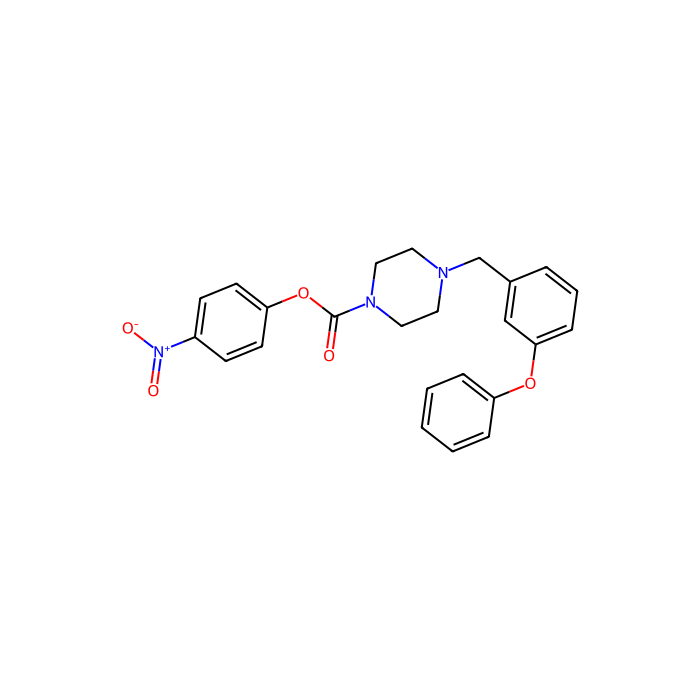
Determine the necessary mass, volume, or concentration for preparing a solution.
| Activity Type | Activity Value -log(M) | Mechanism of Action | Activity Reference | Publications (PubMed IDs) |
|---|

JZL195 has been used:
as a selective inhibitor of endocannabinoid (eCB) clearance enzymes to induce in vivo long-term depression at CA3-CA1 synapses and at prelimbic (PrL)-nucleus accumbens (NAc)synapses, to study the neuroprotective action of eCB to inhibit the action of hydrolytic enzymes that limit eCB activity, to study the effect of 2-linoleoylglycerol (2-LG) on the human CB1 receptor activity as a dual fatty acid amide hydrolase (FAAH)/monoacylglycerol lipase (MAGL) inhibitor to study its dose-related antipruritic effect on the serotonin (5-HT)-induced scratching modelTaxonomy Tree
| Kingdom | Organic compounds |
|---|---|
| Superclass | Benzenoids |
| Classe | Benzene and substituted derivatives |
| Subclass | Diphenylethers |
| Intermediate Tree Nodes | Not available |
| Direct Parent | Diphenylethers |
| Alternative Parents | Diarylethers Nitrobenzenes Piperazine carboxylic acids Benzylamines Nitroaromatic compounds Phenol ethers Phenoxy compounds Phenylmethylamines N-alkylpiperazines Aralkylamines Carbamate esters Trialkylamines Propargyl-type 1,3-dipolar organic compounds Azacyclic compounds Organic oxoazanium compounds Organic oxides Hydrocarbon derivatives Organic salts Carbonyl compounds Organic cations |
| Molecular Framework | Aromatic heteromonocyclic compounds |
| Substituents | Diphenylether - Diaryl ether - Nitrobenzene - Piperazine-1-carboxylic acid - Benzylamine - Phenoxy compound - Nitroaromatic compound - Phenol ether - Phenylmethylamine - Aralkylamine - N-alkylpiperazine - 1,4-diazinane - Piperazine - Carbamic acid ester - C-nitro compound - Organic nitro compound - Tertiary amine - Tertiary aliphatic amine - Allyl-type 1,3-dipolar organic compound - Propargyl-type 1,3-dipolar organic compound - Organic 1,3-dipolar compound - Organoheterocyclic compound - Ether - Azacycle - Organic oxoazanium - Carbonyl group - Organic nitrogen compound - Organonitrogen compound - Organooxygen compound - Hydrocarbon derivative - Amine - Organic oxide - Organic oxygen compound - Organic salt - Organic cation - Aromatic heteromonocyclic compound |
| Descrizione | This compound belongs to the class of organic compounds known as diphenylethers. These are aromatic compounds containing two benzene rings linked to each other through an ether group. |
| External Descriptors | Not available |
| Activity Type | Activity Value -log(M) | Mechanism of Action | Activity Reference | Publications (PubMed IDs) |
|---|
| Activity Type | Activity Value -log(M) | Mechanism of Action | Activity Reference | Publications (PubMed IDs) |
|---|
| Activity Type | Activity Value -log(M) | Mechanism of Action | Activity Reference | Publications (PubMed IDs) |
|---|
| Activity Type | Relation | Activity value | Units | Action Type | Journal | PubMed Id | doi | Assay Aladdin ID |
|---|
| Activity Type | Relation | Activity value | Units | Action Type | Journal | PubMed Id | doi | Assay Aladdin ID |
|---|
| Activity Type | Relation | Activity value | Units | Action Type | Journal | PubMed Id | doi | Assay Aladdin ID |
|---|
| Activity Type | Relation | Activity value | Units | Action Type | Journal | PubMed Id | doi | Assay Aladdin ID |
|---|
| Activity Type | Relation | Activity value | Units | Action Type | Journal | PubMed Id | doi | Assay Aladdin ID |
|---|
| Activity Type | Relation | Activity value | Units | Action Type | Journal | PubMed Id | doi | Assay Aladdin ID |
|---|
| Activity Type | Relation | Activity value | Units | Action Type | Journal | PubMed Id | doi | Assay Aladdin ID |
|---|
| Activity Type | Relation | Activity value | Units | Action Type | Journal | PubMed Id | doi | Assay Aladdin ID |
|---|
| Activity Type | Relation | Activity value | Units | Action Type | Journal | PubMed Id | doi | Assay Aladdin ID |
|---|
| Activity Type | Relation | Activity value | Units | Action Type | Journal | PubMed Id | doi | Assay Aladdin ID |
|---|
Find and download the COA for your product by matching the lot number on the packaging.
| Lot Number | Certificate Type | Data | Oggetto |
|---|---|---|---|
 A2205242 | Certificate of Analysis | Jul 03, 2026 | J276066 |
| A2205250 | Certificate of Analysis | Jul 03, 2026 | J276066 |
| A2205255 | Certificate of Analysis | Jul 03, 2026 | J276066 |
| A2205484 | Certificate of Analysis | Jul 03, 2026 | J276066 |
| A2205241 | Certificate of Analysis | Oct 13, 2025 | J276066 |
| Solubilità | Soluble in DMSO to 100 mM |
|---|---|
| Peso molecolare | 433.500 g/mol |
| XLogP3 | 4.300 |
| Hydrogen Bond Donor Count | 0 |
| Hydrogen Bond Acceptor Count | 6 |
| Rotatable Bond Count | 6 |
| Exact Mass | 433.164 Da |
| Monoisotopic Mass | 433.164 Da |
| Topological Polar Surface Area | 87.800 Ų |
| Heavy Atom Count | 32 |
| Formal Charge | 0 |
| Complexity | 605.000 |
| Isotope Atom Count | 0 |
| Defined Atom Stereocenter Count | 0 |
| Undefined Atom Stereocenter Count | 0 |
| Defined Bond Stereocenter Count | 0 |
| Undefined Bond Stereocenter Count | 0 |
| The total count of all stereochemical bonds | 0 |
| Covalently-Bonded Unit Count | 1 |
No tested applications, protocols, or recommended dilutions are provided in the product data for this item.
General guidance for small-molecule tool compounds (to be adapted and validated by the user):
Important: The above points are generic good practices. Develop and validate item-specific protocols empirically. Refer to the product’s CoA/SDS for any constraints or cautions unique to your lot.
No target specificity or mechanism is provided in the product data for this item.
Literature-level context (for orientation only; verify with primary sources before use):
Best practices when probing biological roles (general):
Important: The above discussion is general and literature-based. This product record does not specify any biological target, potency, or selectivity; no claims are made for therapeutic or clinical use. All use is for research only.
This item is a bioactive small molecule, not a buffering reagent. Conventional buffer preparation guidance (pH ranges, recipes, ionic strength) does not apply.
Practical notes for using small molecules in buffers (general good practice):
For buffer composition or pH stability specific to JZL195, consult empirical testing and the product’s CoA/SDS. No item-specific buffer data are provided.
Green chemistry considerations are typically framed for solvents and bulk reagents. For specialized bioactive small molecules like JZL195, substitution with a “green alternative” is generally not applicable because the molecular structure defines the biological activity.
Nevertheless, you can incorporate greener practices around its use:
Comparison table (practice-level, not a compound replacement):
Conclusion: There is no direct “green substitute” for JZL195’s bioactivity. Focus sustainability efforts on solvents, scale, waste, and energy around its experimental use.
This product is supplied strictly for research use and is not intended for human or veterinary applications. No pharmacopeial status, excipient role, or manufacturing use is provided in the product data.
Contextual notes (general, non-clinical):
Compliance reminder:
Conclusion: There are no pharmaceutical or clinical uses associated with this catalog item. Any formulation discussions should remain within the scope of laboratory research and method development only.
Item-specific physical data are not provided in the product data. Do not infer specifications from literature. For lot-specific values, consult the CoA/Spec Sheet.
General, literature-level handling guidance for hydrophobic bioactive small molecules (not item-specific):
Important: Treat any literature property values you may find for JZL195 as informational only unless they are explicitly listed on the CoA for this catalog item. Always defer to the provided CoA/SDS for authoritative specifications.
What Moligand™ generally denotes (catalog context; not an item-specific guarantee):
How to use quality information effectively:
Notes on comparisons to other grades:
Conclusion: Rely on the lot-specific CoA for exact purity, identification methods, and any stabilizer information.
This product is a bioactive research compound rather than a general-purpose synthetic reagent. No manufacturer application notes were provided for this listing.
General, literature-level research uses of JZL195 (context only; verify against primary sources):
Practical tips (non-item-specific):
Important: The above are general research practices. No compound-specific claims (targets, IC50s, or selectivity) are made here beyond literature context due to lack of item-specific data.
Not applicable. JZL195 is supplied as a bioactive research compound rather than a reagent for promoting or mediating chemical reactions. No catalytic or stoichiometric reaction conditions are associated with this product in the provided data.
General handling for solution preparation (good practice, not item-specific):
If you intend to use JZL195 in a chemical reaction context (e.g., as a substrate or derivatization partner), such conditions must be established empirically and are outside the scope of this product listing.
Safety information specific to this item is not provided in the product data. Always consult the SDS supplied with the product for definitive hazard classifications and response measures.
General laboratory safety guidance for bioactive small molecules (good practice):
Note: This product is for research use only; not for human or veterinary use.
Item-specific solubility data are not provided. The following guidance reflects common practice for hydrophobic bioactive small molecules and should be validated empirically for JZL195.
Comparison (general guidance):
Always confirm solubility and stability with a small-scale pilot before committing precious samples.
Good practice for reconstitution and handling (general):
Specifications not provided for this item:
Research use only: Not for human or veterinary use.
Brief description: JZL195 is a cataloged bioactive small molecule supplied in the Moligand™ line for research use.
Structural features (general, literature-level description without item-specific assertion):
Notes:
JZL195 is offered as a bioactive probe compound rather than a general synthetic building block. Consequently, “synthetic utility” in classical organic methodology (e.g., as a reagent, catalyst, or monomer) is limited or non-applicable.
General considerations (if incorporating into chemical biology workflows):
Not applicable:
Recommendation: Treat JZL195 as a finished tool compound. If chemical modification is desired, consult primary literature for tolerance of substitutions and perform stepwise SAR validation.
No target information is provided in the product data for this item.
Guidance (general, for planning experiments):
All use is for research only; no clinical or diagnostic claims are made.
La nostra guida alla selezione delle qualità copre purezza, stato dello stabilizzatore e idoneità all'applicazione per tutte le varianti del nostro catalogo.
Visualizza la guida alle qualità Moligand™ →