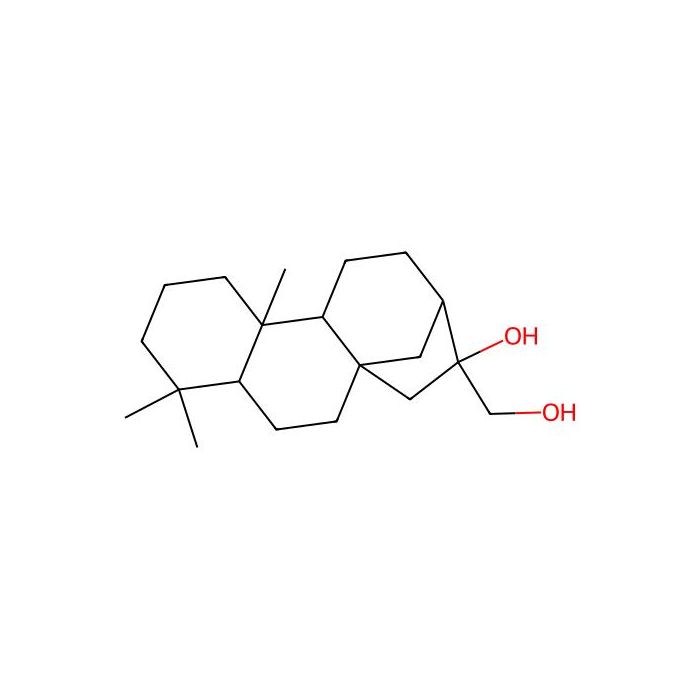
Kauran-16,17-diol (ent-Kauran-16β,17-diol), a natural diterpene, posseses anti-tumor and inducing-apoptosis activity, with a IC 50 of 17 μM on inhibiting NO production in LPS-stimulated RAW 264.7 macrophages.
In Vitro
Kauran-16,17-diol (ent-Kauran-16β,17-diol) down-regulates Bcl-2 by disruption of the Ap-2α/Rb transcription activating complex and induces E2F1 up-regulation in MCF-7 cells. MCE has not independently confirmed the accuracy of these methods. They are for reference only.
Kauran-16,17-diol (ent-Kauran-16β,17-diol), a natural diterpene, posseses anti-tumor and inducing-apoptosis activity, with a IC 50 of 17 μM on inhibiting NO production in LPS-stimulated RAW 264.7 macrophages.
Condizioni di conservazione di stoccaggio
Protected from light,Store at -80°C
Spedito in
Dry ice packs + Cold packs
Questo prodotto richiede spedizione a catena fredda. I servizi di terra e altri servizi economici non sono disponibili.
This compound belongs to the class of organic compounds known as kaurane diterpenoids. These are diterpene alkaloids with a structure that is based on the kaurane skeleton. Kaurane is a tetracyclic compound that arises by cyclisation of a pimarane precursor followed by rearrangement. It possesses a [3,2,1]-bicyclic ring system with C15-C16 bridge connected to C13, forming the five-membered ring D.
External Descriptors
Not available
1. Djoumbou Feunang Y, Eisner R, Knox C, Chepelev L, Hastings J, Owen G, Fahy E, Steinbeck C, Subramanian S, Bolton E, Greiner R, and Wishart DS. ClassyFire: Automated Chemical Classification With A Comprehensive, Computable Taxonomy. Journal of Cheminformatics, 2016, 8:61.
Certificati (CoA, COO, BSE/TSE e tabella di analisi)
C of A & Other Certificates(BSE/TSE, COO):
Analytical Chart:
Calcolatori di soluzioni
Molarity Calculator
Determine the necessary mass, volume, or concentration for preparing a solution.
Dilution Calculator
Determine the dilution needed to prepare a stock solution.
Reconstitution Calculator
Recensioni
Recensioni dei clienti
Application Protocols
No application protocols (e.g., WB, IHC, IF, FC) are applicable to this small-molecule product.
General handling protocol (research use)
Equilibrate sealed vial to room temperature before opening to prevent moisture condensation.
Weigh the required amount rapidly; reseal immediately.
Prepare a fresh stock solution in dry DMSO (e.g., 10–50 mM). Vortex and, if needed, sonicate briefly to aid dissolution. Filter through a 0.22 µm PTFE syringe filter for particulate removal.
For biological assays, dilute the DMSO stock into prewarmed media/buffer with vigorous mixing; keep final DMSO ≤1–2% v/v unless your assay validates higher.
Document final concentrations, solvent fractions, and any observed precipitation or turbidity.
Biological Roles
General context (literature; not item-specific)
Kaurane (and ent-kaurane) diterpenes are widespread plant secondary metabolites. The kaurane skeleton is biosynthetically related to gibberellin pathways, with ent-kaurene serving as a precursor in terpenoid biosynthesis.
Diterpenoid diols like Kauran-16,17-diol provide functional handles that can be further oxidized, glycosylated, or esterified in planta, diversifying chemical defense and signaling repertoires.
The rigid, hydrophobic scaffold influences membrane interactions and protein binding in biochemical studies; hydroxylation at vicinal positions modulates polarity and potential hydrogen-bonding capacity.
Research relevance
Serves as a reference compound in natural product chemistry for dereplication and profiling of kaurane-type constituents in botanical extracts by LC–MS/MS and NMR.
Used to explore structure–activity relationships by systematic masking or inversion of the C16/C17 diol, enabling correlation between polarity, conformation, and target engagement in biochemical assays.
Important notes
No claims are made regarding physiological or therapeutic effects. For any biological testing, ensure appropriate controls (vehicle, inactive analogs) and verify compound integrity (freshly prepared stocks, light protection) to avoid artifacts due to aggregation or degradation.
Buffer Applications
Kauran-16,17-diol is a hydrophobic small molecule and is not a buffering agent.
Applicability
Not typically used to prepare pH buffer systems or electrophoresis buffers. For aqueous work, it is introduced as a solute in an organic co-solvent (e.g., DMSO) and then diluted into buffered media.
Practical note
When adding to aqueous buffers, predissolve in DMSO or ethanol, add slowly with vigorous mixing, and keep final co-solvent content low (commonly ≤1–2% v/v) to minimize precipitation and maintain buffer performance.
Green Alternatives
Although Kauran-16,17-diol is a target molecule rather than a process solvent, greener choices can be made for its handling and derivatization.
Greener solvent substitutions (general guidance)
Replace dichloromethane with 2-methyltetrahydrofuran (2-MeTHF) or cyclopentyl methyl ether (CPME) for protection (silylation, acetonide) and esterification steps, monitoring rates and selectivity.
Use ethyl acetate or propylene carbonate where feasible for extractions and workups instead of chlorinated solvents.
Favor ethanol or isopropanol over methanol for recrystallizations when solubility permits.
Greener reagents/routes
Enzymatic acylation (lipases in solvent-free or 2-MeTHF media) can deliver regioselective monoacylates with reduced waste and milder conditions.
Employ catalytic, hypervalent iodine oxidations (e.g., BIAB/TEMPO) or electrochemical oxidations in place of stoichiometric chromium reagents.
Solubility limitations of bulky diterpenes may necessitate a co-solvent or higher temperatures in greener media; ensure adequate mixing and consider phase-transfer catalysis.
Reaction rates in ethers like 2-MeTHF/CPME may be slower than in CH2Cl2; mild heating or increased catalyst loading may compensate.
Quick comparison (general)
CH2Cl2 vs 2-MeTHF: similar polarity; 2-MeTHF is biorenewable and less volatile, but may afford slightly diminished solubility for highly hydrophobic substrates—empirically optimize.
Pharmaceutical Uses
This product is provided strictly for research use only.
Formulation/excipient status
No pharmacopeial excipient status is indicated. Not specified for this item; refer to CoA/Spec Sheet.
Research/manufacturing context (general)
May be employed as a reference standard in analytical method development for natural product-containing materials (e.g., botanical raw materials) using HPLC/UPLC–UV or LC–MS.
Semi-synthetic derivatization of diterpenoid diols can generate libraries for preclinical screening; any formulation-related work should remain within non-clinical R&D environments.
Compliance reminder
Not for human or animal therapeutic use. No clinical claims are made. For any GLP/GMP-related work, qualify material per your internal quality system and the lot-specific CoA.
Physical Properties
Item-specific specifications
Appearance: Not specified for this item; refer to CoA/Spec Sheet.
Grade/Purity: Not specified for this item; refer to CoA/Spec Sheet.
Melting point (MP): Not specified for this item; refer to CoA/Spec Sheet.
Boiling point (BP): Not specified for this item; refer to CoA/Spec Sheet.
Density: Not specified for this item; refer to CoA/Spec Sheet.
Refractive index: Not specified for this item; refer to CoA/Spec Sheet.
Water/Peroxide/Metal limits, UV cutoff: Not specified for this item; refer to CoA/Spec Sheet.
Literature/general expectations for kaurane-type diols (informational only; confirm with item CoA)
Physical state: typically crystalline solid or resinous solid at ambient temperature due to the bulky tetracyclic hydrocarbon framework and low volatility.
Solubility profile: sparingly soluble in water; soluble in organic media such as DMSO, DMF, acetone, ethyl acetate, dichloromethane, methanol/ethanol (literature). True solubility depends on stereochemistry and microcrystallinity; measure experimentally for your system.
Partitioning: high hydrophobicity expected (logP >> 2, literature trend for tetracyclic terpenoids bearing only two hydroxyls). Actual logP should be determined experimentally or computed for the exact isomer.
Thermal behavior: polycyclic diterpenes often exhibit decomposition before distillation; purification typically by recrystallization or chromatography rather than distillation.
Practical handling notes (general)
Prepare concentrated stocks in anhydrous DMSO or ethanol for screening/assays; dilute into working media immediately before use to avoid precipitation. Filter through a 0.22 µm PTFE syringe filter if particulates persist.
Quality and Grades
Item-specific quality information
Grade/Purity: Not specified for this item; refer to CoA/Spec Sheet.
Stabilizers/Inhibitors: Not specified for this item; refer to CoA/Spec Sheet.
How to interpret grades (general guidance)
Research grade (typical for small-molecule libraries) indicates material suitable for laboratory R&D, screening, and synthesis. If HPLC or analytical grade is stated on the CoA, it generally implies stringent controls on organic/metallic impurities and low UV-absorbing background—verify the chromatographic purity and residual solvent profile on the CoA.
Natural product analogs/diterpenoids often have stereochemical considerations. If “isomeric purity” or “diastereomeric ratio” is listed on the CoA, it denotes control over the specific kaurane stereochemistry—this can critically affect biological readouts and synthetic behavior.
Recommended quality checks upon receipt (practical tips)
Record lot-specific CoA data (purity method, residual solvents, water content if reported). Recheck purity by independent HPLC/UPLC (multiple wavelengths) or qNMR for critical applications.
Confirm identity via HRMS and 1H/13C NMR; look for diagnostic diol resonances and kaurane methyl singlets/doublets. If stereochemistry is crucial, consider NOESY/ROESY or chiroptical methods (ECD/ORD) and, if feasible, single-crystal X-ray.
Assess stability under your intended conditions (stock solvent, temperature, light). Perform short-term stability indicating assays (e.g., HPLC at 0, 24, 72 h).
Reaction and Applications
As a vicinal diol on a rigid kaurane skeleton, Kauran-16,17-diol is a versatile intermediate for derivatization, SAR studies, and semi-synthesis of terpenoid analogs.
Selective protection: formation of cyclic acetals/ketals (acetonides) using 2,2-dimethoxypropane and catalytic acid (e.g., p-TsOH) to temporally mask both OH groups; or orthogonal silyl protections (TBS/TBDPS) for stepwise manipulation.
Esterification/carbamylation: DCC/DMAP or EDCI/DMAP couplings to make mono- or diesters/carbamates; enzymatic (lipase-catalyzed) acylations can deliver regioselectivity on the rigid scaffold.
Oxidation: TEMPO/bleach or Dess–Martin periodinane to convert secondary alcohol(s) to ketone(s); careful control can afford mono-oxidized derivatives for probing stereoelectronic effects.
Substitution/cyclization: Mitsunobu conditions (DEAD/DIAD, PPh3) may invert configuration at an OH-bearing center to give cyclic ethers if neighboring nucleophiles are present.
Periodate chemistry: vicinal diols can undergo cleavage with NaIO4/RuO4 in certain contexts; on a sterically congested skeleton, reactivity may be attenuated—evaluate experimentally.
Applications in research
Natural product analog generation: introduction of polar handles (sulfates, phosphates, glycosides) to modulate solubility and target engagement in chemical biology studies.
Chiral probe/scaffold: the rigid tetracycle provides defined 3D presentation for fragment elaboration or as a chiral auxiliary surrogate in exploratory synthesis.
Reference standard: serves as an analytical standard for kaurane diterpenoid profiling in botanicals (HPLC/LC–MS method development).
Reaction Conditions
General literature guidance for manipulating vicinal secondary diols on bulky terpenoid frameworks; optimize for your substrate and lab setup.
Protection
Acetonide: 2,2-dimethoxypropane (5–10 equiv), catalytic p-TsOH (1–5 mol%), CH2Cl2 or 2-MeTHF, 0–25 °C, 1–6 h. Quench with NaHCO3 and wash. Typical isolated yields: 70–90% (literature).
Silyl ethers: TBS-Cl (2.2 equiv), imidazole (3 equiv), DMF or CH2Cl2, 0–25 °C, 2–16 h. For more robust protection use TBDPS-Cl with catalytic DMAP. Yields: 75–95% (literature).
Oxidation
Dess–Martin periodinane (1.3–2.0 equiv per OH), CH2Cl2, 0–25 °C, 0.5–3 h. Monitor by TLC/HPLC; avoid excess to limit overoxidation. Typical yields: 60–85% (mono-/di-oxidation depending on stoichiometry).
TEMPO/NaOCl: TEMPO (2–5 mol%), NaOCl (1.5–2.0 equiv), pH ~9 (NaHCO3), biphasic CH2Cl2/H2O, 0–10 °C. Good selectivity for secondary alcohols on terpenoids (literature).
Esterification/carbamate
DCC (1.2–1.5 equiv), DMAP (0.1 equiv), carboxylic acid (1.5–2 equiv), CH2Cl2 or 2-MeTHF, 0–25 °C, 2–16 h. Filter dicyclohexylurea; 70–95% typical yields.
CDI-mediated carbonate/carbamate: CDI (1.5–2 equiv), DMF/THF, 0–25 °C, 1–6 h, then nucleophile addition.
Mitsunobu inversion
DIAD (1.2 equiv), PPh3 (1.2 equiv), ROH/RCO2H nucleophile, THF/CH2Cl2, 0–25 °C, 2–6 h. Expect steric sensitivity; optimize equivalents and temperature.
Purification/analysis
Normal-phase silica (hexanes/EtOAc 9:1 → 3:7) or RP-C18 (MeCN/H2O with 0.1% formic acid if needed). Monitor by 1H NMR (diagnostic oxymethine shifts) and LC–MS.
All conditions above are literature-style guidance, not specifications for this catalog item.
Safety and Handling
Item-specific hazard classification
GHS Classification: Not specified for this item; refer to CoA/Spec Sheet and SDS.
Signal word / H-statements / Pictograms: Not specified for this item; refer to SDS.
General safety guidance for hydrophobic diterpenoid diols (informational; defer to SDS)
Expected hazards: low volatility solid; may cause skin/eye irritation on contact and irritation if inhaled as dust. Avoid aerosolization and dust formation.
Personal protective equipment (PPE): lab coat, nitrile gloves, safety glasses/goggles. Consider double-gloving for extended handling or solvent wet work.
Engineering controls: handle powders in a fume hood; use local exhaust ventilation during weighing and dissolution. Employ dust-minimizing techniques (antistatic spatulas, grounded balances).
Incompatibilities: strong oxidizing agents (risk of exothermic reactions/oxidation of alcohols); strong acids may cause dehydration; strong bases can promote elimination/epimerization at activated centers.
First-aid overview: skin—wash with soap/water; eyes—rinse with water for several minutes and seek evaluation; inhalation—move to fresh air; ingestion—rinse mouth and seek medical advice. Follow institutional SOPs.
Spill/cleanup: avoid dust; dampen with compatible solvent (e.g., ethanol) and absorb with inert material. Dispose according to local regulations.
Fire response: treat as combustible organic solid. Use CO2, dry chemical, or foam. Combustion may produce CO/CO2 and irritant fumes.
Storage (item-specific; see also Storage tab)
Store protected from light at −80 °C per Product Data. Keep tightly closed, dry, and segregated from oxidants. Allow vials to equilibrate to room temperature before opening to reduce moisture condensation.
Solvent Selection
Kauran-16,17-diol is a highly hydrophobic, polycyclic diol. Solvent choice impacts dissolution, reaction outcomes, and assay performance.
Polar aprotic: DMSO, DMF—excellent solvents for stock solutions and many transformations; ensure anhydrous grades for moisture-sensitive steps.
Polar protic: methanol, ethanol, isopropanol—moderate solubility; useful for recrystallization or formulation co-solvents.
Moderately polar aprotic: acetone, ethyl acetate—good for workup and chromatography.
Nonpolar: toluene, hexanes—limited solubility; useful in protection reactions and crystallizations when combined with a polar co-solvent.
Practical selection scenarios
Screening stocks: 10–50 mM in anhydrous DMSO; dilute into assay buffer with vigorous mixing and surfactant (e.g., 0.01–0.05% Tween-20) if precipitation is observed (general practice; verify compatibility).
Protection/derivatization chemistry: CH2Cl2 or toluene for silylation or acetonide formation (acid-catalyzed); DMF for carbamate/urethane formation.
Purification: normal-phase silica gel using hexanes/EtOAc gradients; reverse-phase C18 with aqueous acetonitrile or methanol if needed for polar derivatives.
Comparison notes (general)
Choose DMSO over ethanol for highest solubilizing power in microplate assays, at the cost of potential biological interference.
For greener processing, consider 2-MeTHF or CPME as alternatives to CH2Cl2 in protection or esterification steps, balanced against solubility limits for bulky diterpenes.
Storage and Reconstitution
Item-specific storage and shipping
Storage conditions: Protected from light; store at −80 °C (per Product Data). Keep tightly capped in a dry, inert atmosphere if possible.
Shipping: Dry ice packs + cold packs (per Product Data) to maintain low temperature and minimize thermal excursions.
Stability considerations (general)
Polycyclic diols are typically stable solids when dry and cold. Avoid repeated freeze–thaw; moisture and light can promote slow oxidation or dehydration over time.
If long-term storage is needed after opening, consider backfilling with inert gas and using desiccant. Record opening date and lot.
Recommended solvents: anhydrous DMSO for highest solubility; ethanol or methanol as alternatives. Start at 10–50 mM stocks. Warm gently (25–40 °C) and vortex/sonicate to assist dissolution.
Aliquot stocks into amber vials or light-protective tubes; store aliquots at −80 °C. Avoid more than 2–3 freeze–thaw cycles.
Working solutions in aqueous media should be prepared immediately before use. If precipitation occurs, reduce concentration, increase co-solvent slightly, or use surfactant compatible with your assay.
Specifications not provided
Appearance, purity/grade, and exact solubility: Not specified for this item; refer to CoA/Spec Sheet.
Research use note
For research use only. Not for human or animal therapeutic or diagnostic use.
Structure and Identity
Kauran-16,17-diol is a diterpenoid diol on the kaurane (kauran) hydrocarbon skeleton, bearing two alcohol functions at C16 and C17.
Item-specific (from Product Data)
SKU: K650245
Product name: Kauran-16,17-diol
CAS: 16836-31-0
PubChem CID: 13816757
InChIKey: 196370 (as provided)
SMILES: Not specified for this item; refer to CoA/Spec Sheet.
Molecular formula: Not specified for this item; refer to CoA/Spec Sheet.
Molecular weight: Not specified for this item; refer to CoA/Spec Sheet.
Literature/General structural information (not item-specific)
Core scaffold: kaurane/kaurane-type tetracyclic diterpene framework (perhydrophenanthrene fused to cyclopentane), typically with multiple bridgehead centers and a rigid, hydrophobic carbon framework.
Functional groups: vicinal secondary diol at the C16/C17 positions (two alcohols on adjacent carbons), enabling diol-specific reactivity (acetonide formation, selective protection, oxidation/esterification).
Stereochemistry: kaurane diterpenes are polycyclic and stereochemically rich; Kauran-16,17-diol generally exists as a defined stereochemical isomer dictated by the kaurane backbone. Absolute configuration and diastereomeric purity should be confirmed from the CoA.
Approximate empirical formula often reported for kaurane diols: C20H34O2 (literature), corresponding to a nominal formula mass ~306.5 g/mol (literature). Verify the exact values for this catalog item on the CoA before use.
2D structure (descriptive)
Four fused alicyclic rings forming a compact, hydrophobic cage; two adjacent hydroxyl substituents located on the side-chain-bearing ring junction carbons (16 and 17), typically oriented in well-defined axial/equatorial dispositions depending on the kaurane stereochemistry.
Synthetic Utility
Kauran-16,17-diol is a functionally rich building block on a rigid kaurane scaffold.
Functional group leverage
Vicinal secondary diol enables orthogonal protection (acetonide vs silyl), selective oxidation to ketones, regioselective acylation, and intramolecular cyclizations. The two hydroxyls also permit installation of diverse linkers (carbonates, carbamates, sulfates, phosphates).
The tetracyclic hydrocarbon core provides conformationally locked vectors for appendage—useful for SAR and mapping 3D pharmacophores.
Named/typical transformations (literature)
Acetonide formation (2,2-dimethoxypropane, catalytic p-TsOH, CH2Cl2 or 2-MeTHF, rt–reflux) to protect both OH groups simultaneously.
Selective silylation (TBS-Cl or TBDPS-Cl, imidazole, DMF/CH2Cl2, 0–25 °C) followed by differential manipulation of the unprotected OH.
Oxidation (Dess–Martin periodinane or TEMPO/NaOCl, CH2Cl2/EtOAc, 0–25 °C) to corresponding ketone(s), enabling subsequent aldol, Wittig, or reductive steps.
Mitsunobu reactions (DIAD/DEAD, PPh3) to invert configuration and form cyclic ethers where geometry allows.
Formation of cyclic carbonates (triphosgene or CDI) across the diol for protecting or tuning polarity.
Retrosynthetic value
Serves as an advanced intermediate toward oxidized kauranoids and as a platform for late-stage diversification (LSF), exploiting the differential reactivity of the two secondary alcohols under steric control.
Target Specificity
Not applicable. This product is a small-molecule diterpenoid, not an antibody, enzyme, or targeted biological reagent.
No antigen/epitope, clone, isotype, or species reactivity data are associated with this item.
Utilizziamo i cookie per garantire il corretto funzionamento del sito web e, ove consentito, per migliorare la tua esperienza. Puoi gestire le tue preferenze in qualsiasi momento nelle Impostazioni. Per saperne di più, consulta la nostra Cookie Policy.
Desidera che le inviamo un messaggio quando avremo sconti disponibili?
Ricordamelo più tardi
Grazie! Controlli la sua casella di posta per confermare.
Products are supplied to verified businesses, institutions, and qualified professionals for research and development use only. Not for use in humans, animals, diagnosis, or therapy.