GRADE & PURITYMoligand™?Moligand™ — Aladdin's line of ligands and bioactive small molecules. Use for receptor, pathway, and binding studies needing defined small-molecule tools.10 mM in DMSO
Moligand™, 10 mM in DMSO Moligand™ for sensitive chromatographic and analytical workflows requiring minimal baseline interference.
🌡
Storage & shipping
Store at -80°C Ships Dry ice packs + Cold packs Check lot-specific COA for exact specifications.
📋
Quality documents
SDS, COA, datasheet, and spec sheet available for download. Lot-specific COA accessible via lot number lookup.
📚
Literature proof
Cited in 0 peer-reviewed publications across chromatography, organic synthesis, and cross-coupling reactions.
Panoramica
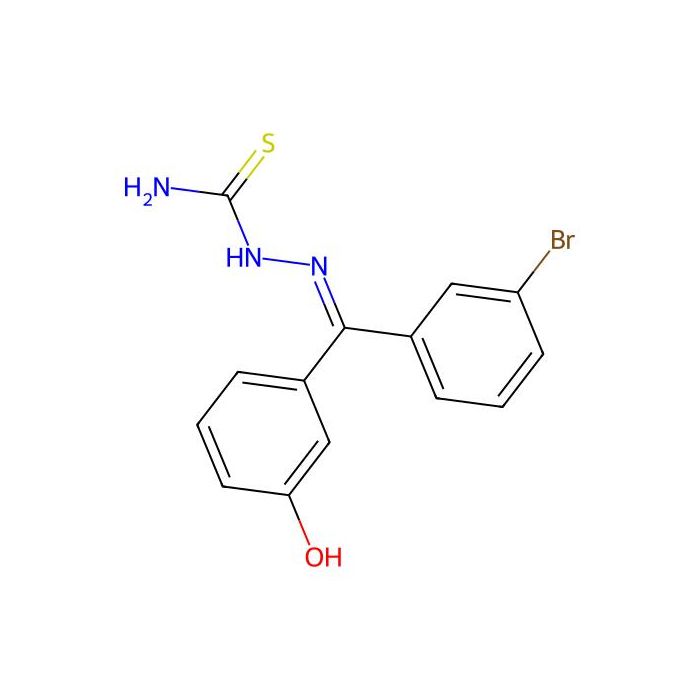
KGP94 is a selective inhibitor of cathepsin L with an IC 50 of 189 nM. KGP94 inhibits migration and invasion of metastatic carcinoma and shows low cytotoxicity (GI 50 =26.9 µM) against various human cell lines.
Specifications
Specifiche e purezza
Moligand™, 10 mM in DMSO
Condizioni di conservazione di stoccaggio
Store at -80°C
Spedito in
Dry ice packs + Cold packs
Questo prodotto richiede spedizione a catena fredda. I servizi di terra e altri servizi economici non sono disponibili.
Grado
Moligand™
Tipo di azione
INHIBITOR
Nomi e identificatori
Isomeri SMILES
C1=CC(=CC(=C1)O)/C(=N\NC(=S)N)/C2=CC(=CC=C2)Br
PubChem CID
52944285
Documentazione
📋 Safety Data Sheet (SDS)
Comprehensive hazard, handling, storage, and regulatory compliance document.
Certificati (CoA, COO, BSE/TSE e tabella di analisi)
C of A & Other Certificates(BSE/TSE, COO):
Analytical Chart:
Calcolatori di soluzioni
Molarity Calculator
Determine the necessary mass, volume, or concentration for preparing a solution.
Dilution Calculator
Determine the dilution needed to prepare a stock solution.
Reconstitution Calculator
Recensioni
Recensioni dei clienti
Application Protocols
Tested applications and recommended conditions are not specified for this item. No validated protocols, concentrations, or assay formats are provided in the Product Data.
Please refer to your internal SOPs for handling small-molecule screening compounds and develop assay-specific conditions (e.g., concentration ranges, incubation times, readouts) appropriate to your biological system. Document lot numbers, stock preparation details, and vehicle controls in your experimental records.
Biological Roles
Item-specific biological targets, pathways, or modes of action are not specified in this listing.
General context for Moligand library members:
These compounds are used as chemical probes or screening hits/leads to interrogate biological macromolecules (enzymes, receptors, transporters) and cellular pathways.
Data generated with such molecules can inform structure–activity relationships (SAR), selectivity profiles, and mechanism-of-action hypotheses when integrated with orthogonal biochemical and biophysical assays.
When a literature target is known (via CAS/CID lookup), users should confirm the identity and activity with their in-house standards under the specific assay conditions employed.
Good practices:
Validate compound integrity (purity, identity) before biological testing.
Control for assay interference (fluorescence quenching/emission overlap, redox cycling, aggregation), as false positives can arise from chemotype-dependent artifacts.
Document vehicle controls (DMSO %) and include concentration–response curves with appropriate statistics (e.g., 4-parameter logistic fits) to derive potency metrics.
Note: No medical or clinical claims are made. This product is supplied strictly for research use only, consistent with the Product Data.
Buffer Applications
This product is a small-molecule ligand candidate and does not function as a buffer component. However, appropriate buffer selection is often critical for its use in assays.
General guidance for assay buffers (not item-specific):
Biochemical assays: HEPES (pH 7.2–7.6) or Tris (pH 7.5–8.0) with 100–150 mM NaCl are common. Include 0.01–0.05% nonionic detergent (e.g., Tween-20) to mitigate colloidal aggregation where appropriate.
Enzyme assays: Buffer, salt, cofactor, and divalent cation composition should match enzyme requirements. Maintain consistent DMSO percentage across wells.
Cell-based assays: Use appropriate culture medium; dissolve compound in DMSO and add to achieve the desired final concentration while keeping DMSO typically ≤0.1–0.5% v/v to preserve cell health.
Filtration (0.22 μm) or centrifugation of working solutions can remove particulates before sensitive readouts.
Item-specific pKa/solubility to tailor buffer pH is not available in this listing; perform a small pH–solubility screen if solubility limitations are observed.
Green Alternatives
Because this item is a discovery compound rather than a process solvent or reagent, green chemistry considerations focus primarily on solvent choices and handling during screening and analytics.
Prefer water-rich assay buffers with minimal DMSO content (≤0.1–0.5% v/v when compatible) to reduce VOC load and improve lab safety.
Where a co-solvent is required, consider ethanol or 2-propanol over DMF when assay performance allows; they are generally lower in toxicity and easier to handle.
For chromatographic analyses, consider MeOH over MeCN when method performance allows, balancing detector response, backpressure, and separation selectivity.
Illustrative comparison (general, not item-specific):
DMSO: High solvency; moderate environmental impact; broadly accepted in bioassays.
Ethanol/IPA: Lower toxicity and environmental burden; may offer reduced solubility for very lipophilic structures.
DMF/DMAC/NMP: Powerful solvents but with higher health/environmental concerns—reserve for limited use when absolutely necessary.
Operational practices:
Use small-volume aliquots to minimize waste and avoid repeated freeze–thaw.
Consolidate analytical runs and employ micro-scale assay formats (384/1536-well) to reduce solvent consumption.
Implement appropriate waste segregation and solvent recycling where supported by facility SOPs.
Pharmaceutical Uses
No excipient role, pharmacopeial status, or formulation use is specified for this item. It is supplied for research use only and is not intended for human or veterinary use, diagnostic procedures, or as a drug substance/excipient.
General note for discovery compounds:
If downstream preformulation studies are contemplated, determine solid-state form (amorphous vs crystalline; polymorph), hygroscopicity, and thermal stability. Such information is not provided here and should be developed experimentally.
Any consideration of dosage form development must follow appropriate regulatory and safety pathways and is outside the scope of this research reagent listing.
Physical Properties
Item-specific physico-chemical specifications are not provided in this listing.
Provided in Product Data:
Appearance: Not specified for this item; refer to CoA/Spec Sheet.
Molecular Weight: Not specified for this item; refer to CoA/Spec Sheet.
Typical properties for small-molecule library members (general/literature guidance; not specifications for this item):
Aggregation behavior, aqueous solubility, and logP/logD can vary widely by chemotype. Many discovery compounds are formulated as DMSO stock solutions (e.g., 10–50 mM) due to limited water solubility.
Potential ionizable groups (if present) will determine pKa and pH-dependent solubility; consult cheminformatics predictions or experimental titration for this specific compound.
Melting point, boiling point, density, refractive index, and UV/Vis profile should be obtained from the CoA or direct measurement when preparing analytical methods (HPLC/LC–MS/UPLC-PDA).
Do not treat any value as a product specification unless it appears on the item’s CoA/Spec Sheet. For method development (LC–MS/HPLC), a scouting gradient (e.g., water/MeCN + 0.1% formic acid or NH4OAc) is recommended to empirically determine retention and detection characteristics.
Quality and Grades
From Product Data:
Grade/Purity: Moligand™
About Moligand™ grade (general description):
Moligand designates compounds curated for ligand discovery, target screening, and SAR exploration. Emphasis is on structural identity and fitness for screening workflows rather than chromatographic solvent grades or preparative excipient standards.
Typical deliverables include quality documentation (e.g., LC–MS/HRMS and/or NMR) verifying chemical identity and reported purity suitable for biological assay screening. Exact purity thresholds, residual solvent limits, water/peroxide/metal content, and UV cutoffs are item-dependent and must be confirmed on the CoA/Spec Sheet.
What is specific to this item:
This listing does not provide numerical purity or stabilizer details. Accordingly:
Purity (%): Not specified for this item; refer to CoA/Spec Sheet.
Residual solvents, water content, metal limits, and UV properties: Not specified for this item; refer to CoA/Spec Sheet.
Practical notes for users:
For screening campaigns, document the lot-specific purity and identity methods from the CoA in your ELN.
If required by your QC system, perform orthogonal verification (e.g., independent HPLC and ^1H NMR) after receipt, especially before dose–response or in vivo enabling studies.
Reaction and Applications
This product is positioned as a Moligand small-molecule for discovery and screening rather than as a synthetic reagent. Consequently, classic synthetic reaction roles (e.g., coupling reagent, catalyst, base) are not applicable.
Research application contexts (general guidance for ligand-discovery compounds):
Biochemical binding assays: Use to probe target engagement by fluorescence polarization, thermal shift (DSF), surface plasmon resonance (SPR), MST, or enzyme inhibition assays.
Cellular target validation: After orthogonal identity confirmation, evaluate phenotypic effects with careful control of DMSO percentage and compound carryover. Pair with target engagement markers (e.g., CETSA or NanoBRET) where applicable.
SAR development: Combine activity data with analog series to refine pharmacophoric hypotheses and guide hit-to-lead decisions.
Orthogonal analytics: LC–MS for stability and uptake studies; confirm integrity in assay buffer over experimental timelines.
Practical considerations:
Ensure accurate concentration by preparing volumetrically using calibrated pipettes and verifying stock concentration when feasible (qNMR or UV with known ε after structure confirmation).
Assess compound stability in assay media (pH, temperature, light) to rule out time-dependent artifacts.
Include counter-screens to detect redox cyclers, aggregators, or assay-interfering fluorescence/absorbance (e.g., use detergent, dynamic light scattering, or PAINS filters as appropriate).
Reaction Conditions
Not applicable in the conventional sense: this product is a screening compound rather than a reagent used to promote chemical reactions.
General laboratory handling conditions (not item-specific):
For preparing assay stocks, dissolve accurately weighed material in anhydrous DMSO using volumetrically calibrated pipettes. Gentle warming (e.g., 25–37°C) and vortexing/sonication may assist dissolution; avoid prolonged heating.
Upon dilution into aqueous buffers, add the DMSO stock slowly with mixing to minimize precipitation. Verify solution clarity before use.
For analytical quantitation, common conditions include reversed-phase LC (C18) with a water/MeCN or water/MeOH gradient containing 0.1% formic acid or volatile buffer (e.g., 5–10 mM ammonium acetate) and MS detection. Optimize empirically as properties are scaffold-dependent.
No temperature, catalyst, or yield guidance is provided for chemical synthesis of this item in this listing.
Safety and Handling
Safety information specific to this item is not provided in the current listing.
From Product Data:
GHS Classification: Not specified for this item; refer to SDS.
Signal Word / H-Statements / Pictograms: Not specified for this item; refer to SDS.
Storage Conditions: Store at −80°C.
Shipping: Dry ice packs + cold packs.
General laboratory safety guidance for small-molecule research compounds (not item-specific):
Use in a chemical fume hood with appropriate PPE: lab coat, safety glasses, and suitable gloves (e.g., nitrile). Avoid inhalation, ingestion, and skin/eye contact.
Many discovery compounds are handled as DMSO solutions; prevent contact and avoid aerosol formation. If lyophilized powder is supplied, minimize dust generation.
Incompatibilities are structure-dependent; as a precaution, avoid strong oxidizers and strong acids/bases until compatibility is known.
First aid (general): On skin/eye contact, rinse with water for ≥15 minutes. If inhaled, move to fresh air. If ingested, rinse mouth; seek medical attention for all exposures.
Waste: Dispose according to institutional chemical waste SOPs. Treat solutions and contaminated materials as hazardous chemical waste.
Always consult the official SDS for authoritative hazard classification, exposure controls, and response measures before use.
Solvent Selection
Item-specific solubility is not supplied here; consult the CoA or perform a small-scale solubility screen.
General guidance for small-molecule screening compounds:
Primary stock solvent: Dimethyl sulfoxide (DMSO) is commonly used due to broad solubilizing power and assay compatibility at low final percentages (typically ≤0.5–1% v/v).
Secondary co-solvents: DMF, ethanol, or isopropanol may help dissolve lipophilic scaffolds; mix into aqueous buffers post-dilution while monitoring for precipitation.
Aqueous buffers: Use assay-relevant buffers (e.g., HEPES, PBS, Tris). Adjust pH near the compound’s ionization state (if known) to enhance solubility; filter sterilize if needed.
pH and salt effects: Weak bases often dissolve better in mildly acidic media; weak acids in mildly basic media. Beware of salt-induced precipitation in high-ionic-strength buffers.
Comparison (general considerations):
DMSO vs DMF: DMSO is more biocompatible for cell-free/cellular assays; DMF can be more aggressive and hygroscopic.
Alcohols (EtOH/IPA): Easier evaporation but lower solubilization breadth; watch cytotoxicity in cellular assays.
Practical tips:
Prepare concentrated stocks (e.g., 10–50 mM in DMSO) and store aliquots at ≤−20 to −80°C to limit freeze–thaw cycles.
On dilution into aqueous media, add organic stock slowly with mixing and include a small amount of co-solvent if microprecipitation is observed.
Confirm clarity by visual inspection and, when critical, by nephelometry or light scattering.
Storage and Reconstitution
From Product Data:
Storage Conditions: Store at −80°C.
Shipped In: Dry ice packs + Cold packs.
General best practices for small-molecule library compounds (not item-specific):
If supplied as a solid: equilibrate to room temperature in a desiccator before opening to minimize moisture condensation. Weigh quickly and reseal under dry conditions.
Prepare concentrated DMSO stocks (e.g., 10–50 mM) and dispense into single-use aliquots (low-binding tubes or 96/384-well plates) to avoid repeated freeze–thaw cycles.
Store aliquots at −80°C (as specified). Protect from light if the structure contains photo-labile motifs (unknown here; adopt light protection as a precaution).
Avoid prolonged exposure of DMSO solutions to ambient moisture; DMSO is hygroscopic and water uptake can impact solubility and assay results.
Before use, thaw on ice or at room temperature, briefly vortex, and visually confirm homogeneity. If precipitation is observed after aqueous dilution, re-optimize solvent composition or gently warm to aid dissolution.
Specifications not provided in this listing:
Stabilizers, exact solvent system (if supplied in solution), and shelf-life/retest date: Not specified for this item; refer to CoA/Spec Sheet.
Structure and Identity
Brief overview: KGP94 (SKU: K1495158) is supplied as a Moligand small-molecule library member for research screening and ligand-discovery workflows.
Item-specific identifiers (from Product Data):
Product Name: KGP94
CAS: 1131456-28-4
PubChem CID: 52944285
Category: Small molecules and compound libraries (Moligand)
Structure descriptors:
Molecular Formula: Not specified for this item; refer to CoA/Spec Sheet.
Molecular Weight: Not specified for this item; refer to CoA/Spec Sheet.
SMILES: Not specified for this item; refer to CoA/Spec Sheet.
InChIKey: Not specified for this item; refer to CoA/Spec Sheet.
Structural features (general guidance):
Functional groups, ring systems, and stereochemistry are not provided in the Product Data. Consult the certificate of analysis (CoA) and the reference database entry (e.g., PubChem CID 52944285) for the definitive 2D/3D structure.
2D structure description:
Not specified in this listing. For unambiguous identity, reference the CAS and CID above along with primary literature or database structure records.
Synthetic Utility
This product is offered as a finished small-molecule research ligand and is not positioned as a synthetic building block or reagent. Consequently, its use in general organic synthesis (e.g., as a coupling partner or intermediate) is not typical.
General guidance if derivatization is contemplated for probe development (not item-specific):
After confirming structure (via CoA and independent analytics), identify non-pharmacophoric positions for tagging/linker installation (e.g., biotin/fluorophore handles) guided by SAR.
Consider bioorthogonal chemistry (CuAAC, SPAAC, SuFEx) for probe conjugation where functional handles are available or can be introduced synthetically.
Evaluate the impact of modifications on solubility, permeability, and target engagement using orthogonal assays.
Note: No reaction conditions or reactivity claims can be made without the compound’s defined functional groups. Refer to the literature associated with the CAS/CID for any reported synthetic transformations of this specific scaffold.
Target Specificity
Target, selectivity profile, and mechanism-of-action data are not specified in the Product Data for this item.
Guidance for users:
If a putative target is known from literature corresponding to the CAS or PubChem CID, verify activity and selectivity under your assay conditions, including orthogonal target engagement methods.
Include counter-screens against related protein families to assess off-target effects and assay interference.
All claims of specificity should be supported by your own experimental data or authoritative literature and documented alongside the item’s lot-specific CoA.
Need help choosing the grade?
Our grade selection guide covers purity, stabilizer status, and application suitability for all variants in our catalog.
We use cookies to ensure the website functions properly and, where permitted, to improve your experience. You can manage your preferences at any time in Settings. Learn more in our Cookie Policy.
Shall we send you a message when we have discounts available?
Remind me later
Thank you! Please check your email inbox to confirm.
Products are supplied to verified businesses, institutions, and qualified professionals for research and development use only. Not for use in humans, animals, diagnosis, or therapy.