This compound belongs to the class of organic compounds known as hydroxy fatty acids. These are fatty acids in which the chain bears a hydroxyl group.
External Descriptors
Hydroxy fatty acids
1. Djoumbou Feunang Y, Eisner R, Knox C, Chepelev L, Hastings J, Owen G, Fahy E, Steinbeck C, Subramanian S, Bolton E, Greiner R, and Wishart DS. ClassyFire: Automated Chemical Classification With A Comprehensive, Computable Taxonomy. Journal of Cheminformatics, 2016, 8:61.
Determine the necessary mass, volume, or concentration for preparing a solution.
Dilution Calculator
Determine the dilution needed to prepare a stock solution.
Reconstitution Calculator
Recensioni
Recensioni dei clienti
Application Protocols
Not applicable as a kit/assay or antibody. There are no WB/IHC/IF/FC protocols specific to this product.
General usage notes (research context):
Preparation of stock solutions: Dissolve in water, aqueous buffer (pH ≥ 3), or DMSO to desired concentration (e.g., 0.1–1.0 M). Filter‑sterilize (0.22 μm) for cell‑free biochemical assays as needed.
Calibration standards: For LC‑MS metabolomics, prepare serial dilutions in water:acetonitrile (1:1) with 0.1% formic acid; store aliquots at ≤−20 °C to minimize degradation of reference solutions.
Derivatization for GC: Convert to volatile derivatives (e.g., methyl ester with MeOH/HCl, followed by silylation of the OH) for GC‑MS analysis of α‑hydroxy acids.
Biological Roles
General biology/biochemistry (literature; non‑clinical):
Metabolic context: L‑Leucic acid (HICA) is an α‑hydroxy acid related to the branched‑chain amino acid (BCAA) L‑leucine. It can arise via redox interconversion with α‑ketoisocaproate (KIC) and participates in microbial and eukaryotic intermediary metabolism.
Enzymatic relevance: α‑Hydroxy/α‑keto acid pairs interconvert via dehydrogenases; HICA can serve as a substrate or product in such redox cycles depending on organism and enzyme complement.
Transport/ionization: With a carboxyl pKa ~3.5–3.9 (literature), HICA exists predominantly as a carboxylate at physiological pH and is transported by monocarboxylate transport systems in many cells (general principle for α‑hydroxy acids).
Metal complexation: The α‑hydroxycarboxylate motif chelates divalent/trivalent cations, influencing bioavailability and transport (e.g., Ca2+, Mg2+ binding).
Analytical standard: Commonly used as a reference standard for LC‑MS/GC‑MS profiling of BCAA‑related metabolites in biofluids and cell extracts.
Notes:
No medical or therapeutic claims are made. Use is restricted to research and laboratory investigations of metabolic pathways, transport, and enzymology involving α‑hydroxy/α‑keto acid chemistry.
Buffer Applications
Applicability: L‑Leucic acid is not a conventional Good’s buffer and is rarely used as a primary buffering component in biological assays. However, as a weak monocarboxylic acid, it can contribute to pH control in the acidic range.
General guidance (literature/practice):
Effective buffering range: approximately pH 2.5–4.5 (centered near its carboxyl pKa ~3.5–3.9).
Preparation: Dissolve the calculated amount in water to desired ionic strength; adjust pH downward with strong acid (HCl) or upward with NaOH to the target value. Consider ionic strength contributions from the conjugate base (sodium/potassium salts).
Compatibility: Suitable as an acidic component in mixed‑buffer systems when specific analyte interactions with α‑hydroxy acids are desired (e.g., metal chelation control). Avoid for enzyme systems sensitive to carboxylate chelation or α‑hydroxy acid binding.
Practicalities: Limited volatility and manageable odor profile make it convenient; however, established buffers (acetate, citrate) are generally preferred for reproducibility and documented enzyme compatibility.
For routine buffering needs, select a standard buffer (acetate, citrate, MES) and reserve L‑leucic acid for specialized cases where its chemical motif is advantageous.
Green Alternatives
Sustainable handling of L‑leucic acid focuses on solvent and reagent choices, as the substrate itself is a bio‑derived metabolite.
Strategies (general, literature):
Prefer water/ethanol: Many operations (dissolution, crystallization, some esterifications) can be conducted in aqueous ethanol or neat ethanol, reducing reliance on high‑hazard solvents.
Aqueous coupling: Water‑tolerant carbodiimide couplings (EDC/sulfo‑NHS) in water or water/EtOH mixtures reduce solvent burden versus DMF/NMP.
Catalysis: Use organocatalysts or TEMPO/bleach for selective oxidations instead of chromium(VI) reagents.
Energy: Perform at ambient temperature where feasible; α‑hydroxy acids dissolve readily at room temperature, limiting heating needs.
Illustrative comparison (general; not product specs):
| Operation | Conventional choice | Greener option | Trade‑offs |
|---|---|---|---|
| Amide coupling | DMF or NMP with HATU | Water/EtOH with EDC/sulfo‑NHS | Reaction rates may be slower; pH control required |
| Esterification | Toluene reflux with Dean–Stark | Neat MeOH/EtOH under catalytic acid | Product workup simpler; avoid azeotropes |
| Oxidation to α‑keto acid | DMP or Swern | TEMPO/NaOCl (pH‑buffered) | Selectivity/pH monitoring critical |
Waste minimization: Neutralize and dilute aqueous carboxylate solutions for proper disposal per institutional and regulatory guidance; recover ethanol where possible.
Pharmaceutical Uses
No therapeutic or clinical claims are made. This product is for research use only.
General formulation/manufacturing context (literature/practice):
Excipient potential: As a small organic acid with an α‑hydroxy group, L‑leucic acid can, in principle, form salts or esters with actives to modulate solubility or stability; however, it is not a compendial standard buffer and is not widely cited as a common excipient.
Prodrug/derivative chemistry: The α‑hydroxycarboxylate motif enables ester prodrug strategies (research context), providing tunable lipophilicity and potential for enzymatic cleavage. Any such use requires full development toxicology and is outside the scope of this listing.
Analytical reference: More routinely, L‑leucic acid serves as a reference standard for metabolomics and stability studies concerning branched‑chain amino acid pathways.
Regulatory status: No pharmacopeial grade or monograph is implied by this listing. If a pharmacopoeial grade is required, consult the CoA/Spec Sheet or contact Aladdin Scientific for available grades and documentation.
For formulation experiments, verify compatibility with excipients, pH adjusters, and containers/closures, and assess stability in the intended vehicle.
Physical Properties
Item-specific specifications (this lot):
Not specified for this item; refer to CoA/Spec Sheet.
Literature/typical values for L‑leucic acid (for reference only; not product specifications):
Molecular weight: ~132.16 g/mol
Molecular formula: C6H12O3
Physical state: typically a white to off‑white crystalline solid (literature)
Melting point: reports around 140–145 °C for the L‑/DL‑forms (literature; varies with enantiopurity and hydration)
Boiling point: not commonly reported; decomposition likely before boiling under ambient pressure (literature expectation for α‑hydroxy acids)
Density: not widely tabulated (literature)
pKa (carboxyl): approximately 3.5–3.9 (literature, aqueous, 25 °C); secondary alcohol pKa not practically relevant in water
LogP (octanol/water): expected low (acidic, hydrogen‑bonding; literature estimations near 0 to −0.5 for deprotonated form; unionized form modestly hydrophilic)
Solubility: readily soluble in water (especially as the carboxylate at neutral/basic pH); soluble in polar protic solvents (MeOH, EtOH) and polar aprotic solvents (DMSO, DMF); sparingly soluble in nonpolar solvents (literature)
Optical rotation: depends on concentration/solvent; consult CoA for item‑specific value.
Note: Provide exact values from the CoA/Spec Sheet for formal reporting; the above are literature references only.
Quality and Grades
Item-specific grade/purity: Not specified for this item; refer to CoA/Spec Sheet.
General guidance on quality considerations for L‑leucic acid:
Assay/purity: For synthetic or biochemical work, typical benchmarks include ≥98% (HPLC or titration). Verify by CoA. Enantiomeric excess (ee) is critical for chiral applications; confirm by chiral HPLC or optical rotation.
Residual solvents and water: α‑hydroxy acids can be hygroscopic or form hydrates; Karl Fischer water and residual solvent data may be listed on the CoA. For moisture‑sensitive couplings, pre‑dry under vacuum at ambient temperature.
Heavy metals/inorganics: If downstream use is catalysis‑sensitive or bio‑assay related, check metals/ash specs on the CoA.
Stabilizers: Typically none required for solid α‑hydroxy acids; if any stabilizer is present, it will be declared on the CoA/specification. None are specified for this item.
Analytical identity: Proton/carbon NMR (D2O or DMSO‑d6), IR (broad OH ~3200–3500 cm−1; C=O ~1710–1730 cm−1), MS (M−H− at m/z 131), and optical rotation for the L‑isomer are common.
Recommendation: Select the grade that matches your application (synthesis vs. biochemical studies) and rely on the batch CoA for assay, ee, water, and chromatographic purity.
Reaction and Applications
Applications (general, literature):
Chiral building block: The (S)‑configured α‑hydroxy center allows synthesis of enantioenriched esters/amides; retention or inversion can be managed via protection and activation strategies.
Esterification: Converts to methyl/ethyl esters under Fischer conditions (alcohol + acid catalyst). These esters are useful intermediates for further transformations (e.g., Mitsunobu to invert the α‑OH stereocenter).
Amide formation: Direct coupling with amines using EDC/HOBt, DIC/DMAP, or HATU/DIPEA in DMF or DCM/DMF yields N‑acyl derivatives; protecting the α‑OH (e.g., TBDMS, TBDPS, acetyl) can improve selectivity and suppress side reactions (mixed anhydrides, O‑acylation).
Oxidation: Selective oxidation of the α‑OH to the corresponding α‑keto acid (ketoisocaproic acid) using TEMPO/bleach or Dess–Martin periodinane; careful control prevents over‑oxidation/decarboxylation.
Reduction/derivatization: Conversion to diols via reduction of the carboxyl to alcohol (e.g., LiAlH4 → diol) or to lactols/lactones under dehydrative conditions (less favored due to chain length/geometry).
Chelation/organometallics: α‑Hydroxycarboxylates can form complexes with Mg2+, Ca2+, Fe3+, Al3+; useful for phase transfer or as ligation handles in coordination chemistry.
Biochemical research: Employed as a leucine‑pathway metabolite standard and as a probe for α‑hydroxy acid metabolism and transport studies (no clinical claims).
Practical tips:
Drying: For water‑sensitive couplings, pre‑dry under vacuum at ambient temperature; avoid elevated temperatures that may cause dehydration.
Protecting groups: Silyl ethers (TBDMS) or acylation (acetate, benzoate) of the α‑OH improve chemoselectivity in peptide‑like couplings.
Stereochemistry: Mitsunobu reactions on the α‑OH effect inversion; SN1/SN2 pathways are minimized by neighboring carboxyl; prefer Mitsunobu or activation as sulfonate esters if needed.
Reaction Conditions
General conditions from literature (guidance only; adjust per substrate and scale):
Fischer esterification (to methyl/ethyl ester):
Solvent: neat MeOH or EtOH (or refluxing toluene with Dean–Stark if higher alcohols used)
Catalyst: conc. H2SO4 or p‑TsOH (0.5–5 mol%)
Temperature/time: reflux, 2–16 h depending on alcohol and water removal
Notes: Use molecular sieves or azeotropic removal for higher conversions; avoid overheating to prevent dehydration.
Amide coupling (to amides/peptides):
Solvent: DMF or DCM/DMF (anhydrous)
Reagents: EDC·HCl (1.1–1.5 equiv) + HOBt/HOAt or HATU (1.05–1.2 equiv); base DIPEA (2–3 equiv)
Temperature/time: 0–25 °C, 1–12 h
Notes: Protect the α‑OH if O‑acylation competes; monitor by TLC/HPLC; maintain pH 7–8 in aqueous EDC protocols.
Oxidation to α‑keto acid (KIC):
TEMPO/NaOCl system in biphasic water/CH2Cl2 or water/EtOAc; pH ~8–9 (NaHCO3/Na2CO3 buffer)
Temperature/time: 0–5 °C to control over‑oxidation; 0.5–3 h
Alternative: Dess–Martin periodinane in CH2Cl2, 0–25 °C, 0.5–2 h
Notes: Work quickly; α‑keto acids can decarboxylate under harsh conditions.
These conditions are representative and may require optimization for scale, purity targets, and enantiopurity retention.
Safety and Handling
Item-specific hazard information provided:
Signal word: Not specified for this item; refer to SDS.
H‑statements: Not specified for this item; refer to SDS.
GHS classification/pictograms: Not specified for this item; refer to SDS.
General laboratory safety guidance for α‑hydroxy carboxylic acids (literature/practice):
Expected hazards: may cause eye/skin irritation; low volatility reduces inhalation risk. Avoid ingestion and prolonged contact.
PPE: lab coat, safety glasses/goggles, appropriate chemical‑resistant gloves (e.g., nitrile). Handle powders in a fume hood or with local exhaust to minimize dust.
First aid overview: rinse eyes/skin with water for ≥15 min if contacted; remove contaminated clothing; if inhaled, move to fresh air; if ingested, rinse mouth—seek medical attention per SDS.
Incompatibilities: strong oxidizers (can over‑oxidize the alcohol); strong bases/acids (can cause exothermic neutralization; may induce esterification/dehydration under harsh acidic conditions); acylating/strong dehydrating agents.
Reactivity notes: contains both an alcohol and a carboxylic acid; can form esters with alcohols under acidic catalysis; may chelate certain metals via α‑hydroxycarboxylate motif.
Handling tips: keep container tightly closed; avoid moisture ingress during precision weighing to maintain accurate concentration; use clean, dry spatulas.
Always consult the product SDS for authoritative hazard classification, exposure limits, and emergency measures.
Solvent Selection
L‑Leucic acid is a polar, protic, Brønsted‑acidic molecule (α‑hydroxycarboxylic acid). Solvent choice depends on intended operation (dissolution, coupling, esterification, or analysis).
General guidance (literature/practice; not item‑specific specifications):
Solid stability: Store tightly closed in a cool, dry place away from strong oxidizers and acids/bases. Protect from prolonged humidity to prevent clumping or hydrate formation.
Reconstitution:
Aqueous: Dissolve in deionized water or buffer. Adjust pH with NaOH to form the carboxylate if higher solubility is required. Typical working stocks: 0.1–1.0 M.
Organic: Readily dissolves in DMSO, DMF, MeOH, EtOH for synthetic operations.
Sterile solutions: Prepare with sterile water/buffer and filter through 0.22 μm membranes for cell‑free assays. Avoid repeated freeze–thaw of solutions; aliquot and store at −20 to −80 °C as appropriate for your application.
Shelf life: Not specified for this item; refer to CoA/Spec Sheet.
Always consult the CoA and SDS for lot‑specific stability, assay, and safety information before use.
Structure and Identity
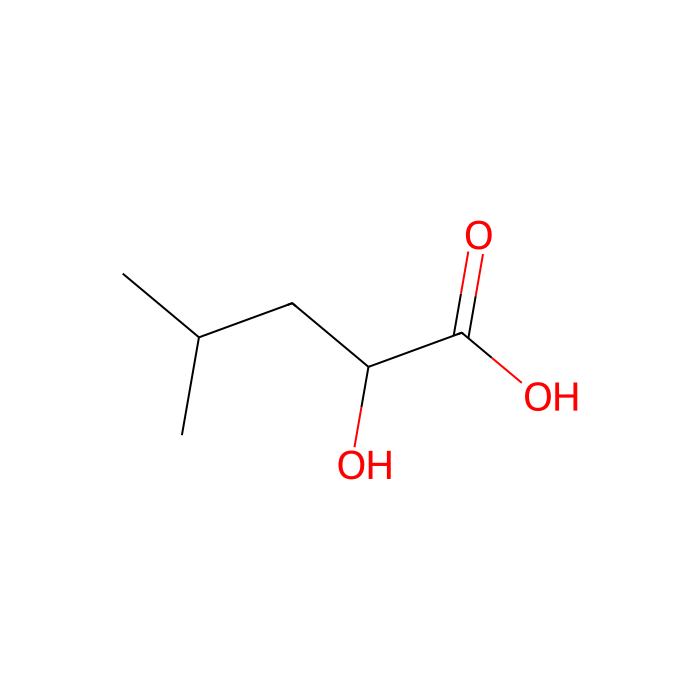
L‑Leucic acid is the L‑enantiomer of α‑hydroxyisocaproic acid, an α‑hydroxy carboxylic acid structurally related to the amino acid L‑leucine.
Item-specific (from Product Data)
SKU: S161033
CAS: 13748-90-8
InChIKey: 210401 (as provided)
Storage: Room temperature; shipped under normal conditions
Category: Life Science (研究用)
Literature/Computed identifiers (for reference; not item specifications)
Common names: L‑Leucic acid; (S)‑2‑hydroxy‑4‑methylpentanoic acid; (S)‑HICA
Molecular formula: C6H12O3 (literature)
Molecular weight: ~132.16 g/mol (literature)
Chiral configuration: L/(S) at C2 (the α‑carbon bearing OH)
SMILES (literature): CC(C)CC(O)C(=O)O with defined stereochemistry at C2: CC@HCC(C)C(=O)O (representations vary)
Structural features (general description)
Functional groups: one α‑hydroxyl (secondary alcohol at C2), one carboxylic acid.
Carbon skeleton: branched C6 chain (isocaproic backbone) with a 4‑methyl substituent.
2D description: a pentanoic acid backbone bearing a methyl branch at C4 and a hydroxyl substituent at C2; the α‑carbon is stereogenic (L‑configuration).
Synthetic Utility
Functional group leverage (general, literature):
α‑Hydroxy acid duality: Combines a nucleophilic secondary alcohol with a carboxylic acid, enabling orthogonal protection and sequential transformations.
Chiral center: L‑configuration at C2 provides an opportunity to transmit stereochemical information or to access the opposite configuration via inversion (e.g., Mitsunobu).
Representative transformations:
Protection strategies: Silylation of the alcohol (TBDMS‑Cl, imidazole) or acylation (Ac2O/DMAP) to suppress O‑acylation during amide couplings; carboxyl protection as methyl/benzyl esters (MeI/K2CO3; BnOH/EDC; BnBr, then hydrogenolysis) to enable selective alcohol chemistry.
Amide couplings: EDC/HOBt or HATU/DIPEA in DMF/DCM affords N‑acyl amino alcohols; downstream cyclizations can produce oxazoline/oxazolidinone motifs when further elaborated.
Oxidation: TEMPO/NaOCl, Dess–Martin, or Swern to the α‑keto acid (KIC), enabling decarboxylative couplings or further aldol‑type chemistry.
Substitution at C2: Activation of the OH as a mesylate/tosylate followed by displacement is generally challenged by neighboring group participation; Mitsunobu substitution (ROH + DEAD/Ph3P with a nucleophile) is preferred for inversion at C2.
Metal complex chemistry: Formation of α‑hydroxycarboxylate complexes with main‑group/transition metals for catalytic or materials studies.
Retrosynthetic value: Serves as a chiral pool precursor to leucine‑derived frameworks, branched aliphatic fragments, and as a handle to access α‑keto acid chemistry without racemization when conditions are controlled.
Target Specificity
Not applicable. This product is a small‑molecule α‑hydroxy acid, not an antibody, oligonucleotide, or targeted biological reagent. No antigen, epitope, clone, isotype, or species specificity applies.
We use cookies to ensure the website functions properly and, where permitted, to improve your experience. You can manage your preferences at any time in Settings. Learn more in our Cookie Policy.
Shall we send you a message when we have discounts available?
Remind me later
Thank you! Please check your email inbox to confirm.
Products are supplied to verified businesses, institutions, and qualified professionals for research and development use only. Not for use in humans, animals, diagnosis, or therapy.

 L2209192